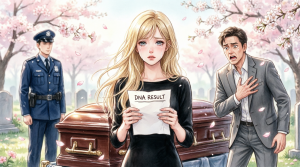
The will reading ended not with dramatic exits or courtroom shouting but with paperwork. Signatures. Statements. Formal acknowledgment of findings. Martin, always a man who understood that emotional devastation does not excuse incomplete documentation, moved through it with efficient kindness. I signed where he indicated. Eleanor signed as witness. Vivian refused at first, then complied when Martin informed her refusal would alter nothing.
When it was over, Alyssa remained seated long after everyone else stood.
I gathered my folder.
As I passed her, she looked up.
“Did he really love me?” she asked.
Such a small question for a woman whose life had just split open.
I answered honestly.
“Yes,” I said. “Enough to stay longer than he should have.”
She flinched as though the truth had touched a bruise.
That afternoon I returned to the house one last time before legal arrangements required formal inventory. Vivian was in the living room surrounded by open boxes and the remains of a life she had assumed would continue unquestioned. Silver framed photographs had been taken down from the mantel. Drawers stood open. The room looked less like a grand house and more like a stage after a play has closed.
She rose when I entered.
For one mad instant, I thought she might apologize.
Instead she said, “You always did enjoy being the victim.”
I laughed then, quietly, because some lines are too absurd for anger.
“You hid a child’s letters from her father.”
“He was mine by then.”
The words slipped out before she could stop them.
We both heard them.
There it was, the whole rotten core in a single sentence.
I took one step closer. “No. He was grieving. You confused access with possession.”
Her face hardened. “I gave him structure. I gave him a family again.”
“You gave him an illusion he was too damaged to challenge until it was almost too late.”
Vivian’s mouth trembled. “You think you understand what happened here? You were a child. You knew nothing. Your mother died and left a wreck behind. I held everything together.”
“You held everything in your fist,” I said. “There’s a difference.”
For a second I saw genuine desperation in her. Not remorse. Something smaller and uglier. Fear of irrelevance.
“I did what I had to do,” she snapped. “Do you think the world is kind to women with daughters and no security? Do you think your father would have chosen me if he knew? Do you think I could risk that? I protected what was mine.”
I stared at her.
My whole life, I had imagined her malice as something elegant and deliberate. But in that moment I saw the ordinary desperation underneath. Selfishness. Panic. The primitive terror of losing status and shelter and the image of being wanted. She had built her life the way trapped people sometimes do: not by creating goodness but by barricading herself behind other people’s pain.
It did not make her innocent.
If anything, it made her worse.
“You had thirty years to choose decency,” I said. “And every time, you chose yourself.”
She opened her mouth again, perhaps to plead, perhaps to manipulate, but I held up a hand.
“I am not pursuing criminal action over the household accounts because my father clearly chose not to. You should thank whatever remained human in him for that. Beyond that, you have forty-eight hours to remove your belongings from this property.”
She looked at me as if expecting I would soften.
I did not.
Something in her seemed to collapse then. Not dramatically. Just enough that she looked older, smaller, almost colorless.
She sat back down without another word.
Alyssa came to find me the next day in the kitchen.
Rosa was outside speaking with movers. The house echoed with disruption. Cabinet doors opened and shut. Footsteps crossed overhead. Somewhere in the front hall, a man was wrapping a grandfather clock in protective felt while discussing traffic on the interstate.
Alyssa stood by the counter holding a mug she was not drinking from.
She looked exhausted. Not theatrically grieving or artfully disheveled. Truly exhausted. Her eyes were swollen. Her hair was tied back without care. For the first time in her life, she looked like someone who had no idea how to arrange herself into acceptability.
“This is your fault,” she said.
I was surprised enough to almost smile. “There she is.”
She flinched. “Don’t.”
“Then don’t open with nonsense.”
Her grip tightened around the mug. “If you had stayed away—”
“If I had stayed away,” I cut in, “you would have inherited everything on a lie.”
At that, her composure shattered.
The mug hit the counter hard enough to splash coffee onto her hand. She didn’t seem to notice.
“I had a life,” she said, voice rising. “Do you understand that? I had a life that made sense. I knew who I was. I knew where I belonged. I knew why things were the way they were.”
Her chest was rising too fast. I thought for a moment she might hyperventilate.
“And now?” I asked.
“Now I don’t know anything.” Tears spilled over. She wiped them angrily away. “I don’t know who my father is. I don’t know if she even knows. I don’t know if every memory I have is poisoned. I don’t know whether he looked at me and saw a lie every single day.”
I said nothing.
She leaned both hands on the counter and stared at the floor.
“I spent my whole life thinking I was special,” she whispered. “Thinking I was the chosen one. The real daughter. And now I find out I was just…” She searched for the word and could not find one adequate to the wreckage. “I was just the secret.”
The silence that followed was unlike the silences we had known as children. Not a standoff. Not contempt. Something rawer.
Then she said, without looking at me, “Did you know before the study?”
“No.”
She nodded once.
“Did he… did he hate me after he found out?”
The ache that question stirred in me was unwelcome.
“No,” I said. “I think he hated himself. Those are not the same thing.”
She covered her mouth with one hand.
For a while she cried quietly, and I let her. Not because I had become generous overnight, but because there are griefs no argument can improve.
When she finally looked up, she seemed embarrassed by her own humanity.
“I don’t know what happens to me now,” she said.
“Legally? You have thirty days.”
“I mean after that.”
I leaned against the opposite counter and studied my sister. The girl who had once hidden my shoes before school. The teenager who rolled her eyes when I got into college and said, “Well, pity admissions help someone.” The woman who had smiled while asking for a DNA test.
And yet also this. A person undone by the same liar who had shaped my life.
“I can’t answer that,” I said. “But for what it’s worth, I know what it feels like to have your sense of self built by someone else’s cruelty. That part, I understand.”
She stared at me as if I had spoken in a language she had never heard before.
“I don’t deserve your understanding,” she said.
“No,” I replied. “Probably not.”
The truth of that landed between us without softness.
“But deserved things,” I added, “are not the only things people get.”
She looked down again.
That evening, two of my aunts cornered me in the formal sitting room and suggested that the family might like to “move forward together.” The sudden shift in tone would have been funny if it had not been so transparent. These were women who had whispered at the funeral and looked through me at Christmas for years. Now, with Vivian disgraced and Alyssa disinherited, they seemed newly open to the possibility that I was, after all, blood.
“I’m not interested,” I said.
One of them blinked rapidly. “Candace, darling, there’s no need to be harsh. We were all misled.”
“You were all comfortable.”
That ended the conversation.
My grandmother asked me to meet her for lunch the next day at a small café downtown. It was the sort of place with bentwood chairs and old mirrors and pastry cases that made ambition look quaint. We sat by the window. She ordered tea. I ordered coffee and barely touched it.
For a while we talked around the edges of practical things. The weather. My work. Her apartment. Then she opened her handbag and took out a small velvet box.
“I’ve carried this longer than is reasonable,” she said.
Inside was a wedding ring.
Simple gold. Small diamond. Elegant in the unshowy way older jewelry often is. I knew instantly whose it had been even before Eleanor said her name.
“Your mother wanted you to have it when you were grown,” she said.
My breath caught.
“She gave it to me after the diagnosis. She said, ‘If Candace ever wonders whether I wanted her, tell her I wanted her before I knew what fear was.’” Eleanor’s voice trembled only slightly. “I have waited thirty years to give this to you.”
I slid the ring onto my finger.
It fit.
I don’t know why that undid me more than everything else. Perhaps because pain distorts time, and suddenly I was holding proof that somewhere beneath all the noise and lies and omissions, there had once been a straightforward love waiting patiently for me to grow into it.
Eleanor reached across the table and covered my hand with hers.
“You are not beginning from nothing,” she said. “Remember that.”
After I sold the house, I repeated that sentence to myself often.
The legal work took months. Estates of that size rarely resolve with speed, even without scandal. There were appraisals and audits and inventory meetings. Martin moved through it all with the competence of a man who had long ago accepted that grief and paperwork must often share a desk.
During one of those meetings, when he was explaining the structure of the trusts and the private holdings my father had arranged, I asked the question that had been growing in me since the will reading.
“Is there any way to give Alyssa something?”
Martin looked at me over his glasses.
He did not answer immediately. Instead, he opened a separate file and drew out a handwritten note.
“Your father anticipated that you might ask,” he said.
He handed it to me.
Candace,
You will want to share because you have more compassion than I earned. But do not mistake rescue for repair. Alyssa has been handed illusions her entire life. Let truth be the first thing she must build from.
I read it twice.
There are times when mercy is the right instinct and times when it is merely another form of postponement. My father, who had postponed too much for too long, understood that by the end.
I folded the note and put it back in the file.
“All right,” I said.
Martin nodded, as if he had expected that answer.
The house sold to a medical family from Columbus with three children and a golden retriever and no idea how many unhappy meals had been eaten under those chandeliers. I signed the papers without ceremony. I did not walk through the rooms one final time. I did not pause in my old bedroom because it no longer existed. I did not stand in the driveway and look back.
Some places deserve grief. Others deserve closure.
The coastal cottage was different.
Martin had told me about it a week after the will reading, almost as an afterthought.
“Your father purchased a property under one of my holding companies several years ago,” he said. “He intended to transfer it to you personally after his health improved enough for… certain conversations. That did not happen. It passes now as part of the estate.”
I nearly refused to see it. By then, every new revelation about my father felt less like a gift and more like a test I had not studied for. How much hidden love can a woman absorb before it starts to feel like another kind of loss?
Then one weekend in late autumn I flew west and drove north along a stretch of coast where the air tasted of salt and cedar and weather. The cottage sat above a rocky shoreline with a wide porch facing the Pacific. The paint was pale gray. The windows were generous. The rooms were simple. No one had decorated it to impress anyone else.
The first time I stepped inside, I felt something I had not expected.
Peace.
Not joy. Not immediate belonging. Those are louder feelings. This was quieter. A loosening. As if the rooms had been waiting without demanding anything from me.
On the mantle in the living room was a small framed photograph I had never seen before. My father, years younger, holding me as a baby in our Ohio backyard. He was laughing at something off-camera. I was gripping his tie with the ruthless confidence of infants everywhere. There was no Vivian in that photograph. No performance. No shadow.
Just us.
I picked up the frame and sat down on the couch with it in my hands until sunset bled orange across the water.
I moved into the cottage in stages.
At first it was only weekends. Then weeks split between Chicago and the coast. Then, after the foundation was established and my firm agreed to a more flexible arrangement, it became home in every meaningful sense. I kept my work. I kept my office. I kept the life I had built with my own intelligence and exhaustion and refusal to disappear. But I stopped treating peace as something I had to earn after productivity.
I hung my mother’s ring on a small ceramic dish by the sink when I cooked. I framed the photo of my father with me as a baby and placed it on my nightstand. I invited Eleanor to visit, and she sat on the porch wrapped in a blanket one April evening and cried quietly at the sound of the ocean because my mother had always wanted to live near water and never got the chance.
“I think he bought this for the daughter he hoped he might one day know properly,” she said, looking out at the waves.
“Too late?”
She considered that. “For some things. Not all.”
I kept my professional name for a while out of habit. Candace Moore. It fit the architecture of the life I had built in exile. Moore was my mother’s maiden name, the one I took after college because I could not bear to carry Harper into rooms where I wanted to be taken seriously on my own terms.
But after a year of probate and revelation and the slow rebuilding of my private history, I changed my company biography.
Candace Harper Moore.
Both names. Both truths.
It felt less like compromise and more like integration. I was my mother’s daughter. I was my father’s daughter. The fact that both statements could live in the same line without canceling one another healed something I had not known was still split.
The foundation came next.
People assume grief makes you generous automatically. It doesn’t. Grief can make you mean, self-protective, exhausted, reckless, sentimental, numb, extravagant, suspicious, or any combination thereof. But once the legal smoke cleared and the money stopped feeling like a moral argument and started feeling like a responsibility, I knew I did not want to simply preserve it.
My father had failed me in ways no institution could undo. Yet his final acts had still altered the shape of my future. I wanted to do something with that contradiction.
So I founded the William Harper Foundation for Children of Fractured Homes.
The name surprised people. More than one advisor suggested I use my own instead.
“Your father’s reputation is complicated,” one consultant said carefully during the planning phase.
“That’s the point,” I answered.
The foundation would fund scholarships, therapy access, legal aid, and mentorship programs for young people who grew up feeling like outsiders in their own families. Children of custody wars. Children cut out by remarriage. Children scapegoated, doubted, erased, or weaponized by adults too damaged or selfish to protect them properly. We accepted applications from all over the country, and part of the process required a personal essay not about achievements but about belonging.
The first year, I read every essay myself.
Some came from teenagers sleeping on sofas after being pushed out by new stepfamilies. Some from college students supporting themselves because the parent who promised tuition had chosen a new spouse’s children instead. Some from quiet, high-performing girls who had built perfect report cards around the hope that someone at home might finally see them.
Their stories devastated me.
They also made me feel less alone than success ever had.
On the foundation homepage, beneath the mission statement, I placed one line from my father’s unfinished letter:
You never needed to prove you deserved to be loved.
It was both true and cruel, because of course I had needed to prove it to myself after years of being taught otherwise. But perhaps that was the work of adulthood in any damaged family—learning the difference between what should have been freely given and what must now be rebuilt internally.
Rosa called once a month.
Sometimes with small domestic updates. Sometimes with news that mattered more than she realized. She had left the old house before the sale and moved in with her sister nearby, but she remained, in some quiet way, a witness to the old world.
“Your stepmother is in Florida now,” she told me during one call. “With a cousin who does not seem happy about it.”
I could picture Vivian there, in someone else’s guest room, surrounded by furniture not chosen by her, stripped of the social circuitry she had once managed so expertly. It did not give me pleasure exactly. Justice is rarely as intoxicating in practice as revenge fantasies promise. Mostly it gave me perspective.
Rosa continued, “Alyssa moved to Oregon.”
That surprised me. “Oregon?”
“A small town, I think. She works for a nonprofit. Not glamorous. But maybe good for her soul.”
I stood on the porch while she spoke, the Pacific wind pushing at my hair. “Have you talked to her?”
“Once. She sounded… quieter.”
That word stayed with me.
Quieter.
Months later, a letter arrived in Oregon postmarked in careful unfamiliar handwriting. I knew it was Alyssa’s before I opened it.
I am not writing to ask for anything, it began.
I just wanted you to know I am trying.
The letter was not eloquent. That made it more believable. She wrote about therapy. About working entry-level at a nonprofit where no one cared about last names. About using Grace, her middle name, because Harper no longer felt earned and Alyssa no longer felt uncomplicated. She wrote that she was learning how much of her personality had been built as performance under our mother’s—she used mother, not Mom, which I noticed—approval. She wrote that she did not expect forgiveness, only wanted me to know that what I had said in the kitchen mattered more than she understood at the time.
I folded the letter carefully and put it in a drawer.
I did not answer.
Not because I wanted punishment. Not because I enjoyed withholding. But because some silences are no longer weapons. Some are simply honest. I did not yet know what I wanted from her, if anything. I had spent too many years responding quickly to other people’s emotional demands. I would not do that now, even for the possibility of reconciliation.
Time passed.
The foundation grew.

