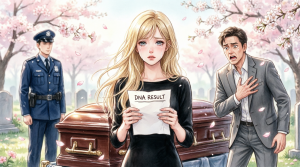
When your mother died, I was broken. Vivian appeared, and I was too weak to see what she truly was. By the time I understood, too much had already been set in motion. I told myself I was protecting you by keeping peace in the house. In truth, I was protecting my own cowardice.
I had to stop reading for a moment. The room was too quiet. My heartbeat too loud.
Twelve years ago, I discovered that Alyssa is not my biological daughter. Vivian had deceived me from the beginning. I should have ended everything immediately, but then she told me that if I exposed the truth, Alyssa’s life would be destroyed and the scandal would consume you as well. I delayed. Then I had the stroke.
I saw again, as if through a fogged pane of glass, my father after the stroke. His right side weakened. His speech thick and frustratingly slow. Vivian answering questions for him before he could finish. Vivian telling visitors he needed rest. Vivian controlling the room with one hand on his shoulder and concern painted across her face like makeup.
In the letter, his handwriting grew shakier.
For a long time I could not speak enough to explain. She controlled my home, my access, my correspondence. I found your camp letters years after they were written. I read them and hated myself. By then you were gone, and every attempt I made to reach you felt too small for the damage I had allowed. I feared your anger, but more than that I feared I had no right to ask for your forgiveness.
He wrote that he had followed my career with pride. That he had arranged the money Martin sent anonymously because he could not bear to help me only in his imagination. That he had purchased the coastal cottage years earlier because I once mentioned in an interview that the ocean made me feel honest. That the will was his final attempt to return me to myself.
At the end, the lines broke and slanted.
You spent your life believing you had to prove you belonged. But you were always my daughter. The only thing I hope you will one day prove is to yourself—that you deserve to be loved, even by those of us who failed you.
The sentence ended mid-thought.
There was no signature.
He had died before finishing it.
I was still holding the paper against my mouth when I heard footsteps in the hall.
I stood too quickly. The chair scraped the floor.
Alyssa appeared in the doorway.
For one suspended second, neither of us moved. Her gaze traveled past me to the walls, the photographs, the clippings, the evidence of a father whose private devotion had never once been offered in public. Whatever she had expected to find me doing in that room, it had not been this.
“What is all this?” she whispered.
I did not answer.
Her eyes dropped to the papers in my hands. I watched understanding arrive in fragments—first confusion, then alarm, then something raw and childlike beneath the polish she had worn all her life.
“Candace,” she said again, and this time my name sounded less like an accusation and more like an appeal.
I stepped around her.
She did not try to stop me.
For the next three days I said almost nothing.
Not to Vivian, who studied me with the brittle calculation of a chess player realizing the board had changed. Not to Alyssa, who avoided my eyes at breakfast and flinched whenever our paths crossed in the hall. Not to the relatives, who filled the house with low-voiced speculation and professional condolences while pretending not to notice the tension curdling under the surface.
I kept the documents with me at all times. The old DNA report. The hospital records. The divorce decree. My father’s letter. The unopened camp envelopes, now slit and read and stacked with almost religious care in the bottom drawer of the guest-room desk.
On Thursday evening, my grandmother knocked softly on my door.
I had not spoken more than a few words to Eleanor Harper Moore in years. Not because I did not want to, but because access to her had thinned after my mother died and vanished completely once Vivian decided my mother’s side of the family was inconvenient. As a child, I remembered Eleanor as warmth and tweed coats and the smell of roses and tea. She was the one who told me stories about my mother’s laugh, my mother’s stubbornness, my mother’s habit of singing while cooking. Then she was simply gone, absorbed into the list of things no one in the house mentioned.
Now she stood in the hallway looking smaller than memory but steadier than anyone else under that roof.
“May I come in?”
I nodded.
She sat in the chair by the window while I remained on the bed, my father’s letter folded in my hands. For a minute she simply looked at me with a tenderness so direct it hurt.
“You look like her when you’re angry,” she said.
“My mother?”
“Yes.” She smiled faintly. “Everyone always said you didn’t look like your father, as though a child can only belong by repeating one face. But when you were little and you crossed your arms when someone lied to you, you were all Lydia.”
I laughed once, not because anything was funny but because the truth of that hit some buried place inside me.
“She loved him very much,” Eleanor said. “Your father. More than was wise perhaps. But then, most great loves are unwise in one direction or another.”
I looked down at the letter. “Did he love her?”
“With everything he had at the time. The trouble was that after she died, what he had left was mostly guilt.”
The room was quiet except for wind brushing the windows.
“I found out things,” I said carefully.
“I know.”
I looked up sharply.
Eleanor’s face did not change. “Martin spoke to me after the funeral. He did not share details. He only said that your father had tried, in the end, to put truth where lies had lived too long.”
I swallowed. “Why didn’t anyone tell me anything?”
“Because the people who should have protected you were either too selfish or too weak.” She did not soften the words. “And because families are astonishingly efficient at preserving whatever story lets the most comfortable people continue sleeping.”
I thought of Vivian in black silk delivering a eulogy that erased me. Of my father, silent in the family portrait room. Of Alyssa laughing as a child because she had been taught I was funny only as an insult.
Eleanor leaned forward slightly. “Whatever happens tomorrow, remember this. You were never the wrong child. You were simply the inconvenient truth in a house built on someone else’s deception.”
That sentence settled into me like a key turning.
Friday morning came cold and clear, the sky bright enough to feel almost insulting. Martin’s office in Chicago overlooked the city from a floor so high the traffic below looked organized rather than desperate. The conference room was all leather and glass and controlled light. It smelled faintly of coffee and paper and the legal version of inevitability.
Vivian arrived first, dressed in widow’s black, every detail immaculate. If you had seen her without context, you would have thought she was preserving dignity under strain. But I knew what the set of her shoulders meant. Combat.
Alyssa came in behind her and took the chair at Vivian’s right, but there was a small measurable gap between them, as if some invisible hand had shifted her an inch away from the mother who had shaped her.
Eleanor sat in the back corner.
I chose the chair opposite Vivian and placed my folder in front of me.
Martin cleared his throat.
“Mr. Harper’s will contains an amended clause added two years ago,” he said. His voice was calm, but not casual. “It states that his estate is to be distributed solely to his biological children, and that all claimants must consent to DNA verification using preserved paternal samples held by this office. Refusal constitutes forfeiture.”
Vivian’s face tightened almost imperceptibly.
I watched her realize, in real time, that my father had anticipated treachery. That the man she had once controlled through illness and domestic performance had found a way to reach beyond her anyway.
Martin lifted the envelope.
No one breathed.
He opened it with a letter opener and unfolded the papers inside.
“Candace Harper,” he read, “confirmed 99.99 percent biological match to William Harper.”
My chest loosened, though not with triumph. More with release. A room I had lived in all my life had suddenly opened a window.
Martin looked down again.
“Alyssa Harper,” he continued. “No biological relationship to William Harper detected. Zero shared markers consistent with paternity.”
For one second the room was soundless.
Then Alyssa was on her feet so fast her chair hit the floor.
“That’s impossible.”
The words came out in a raw, high voice that no longer belonged to the polished woman she had been trying to perform.
“There has to be a mistake,” she said. “Run it again. Use another lab. Mom, tell them this is wrong.”
She turned to Vivian.
That was when it happened. The look that would remain with me longer than any argument. My sister, who had spent an entire life inside certainty, looking at her mother and discovering that certainty had no face.
Vivian did not stand immediately. She did not rush to comfort her. She just sat there, white and rigid and caught.
Alyssa’s eyes widened.
“You knew,” she whispered.
Vivian found her voice at last, sharp with defensive intelligence. “This is obviously compromised. Martin has always favored Candace. Everyone here knows that.”
“Explain this, then,” I said.
My own voice surprised me. It was steady. Controlled. Cold enough to cut.
I slid the twelve-year-old DNA report across the table.
Martin picked it up first, scanned it once, and handed it to Eleanor, who read with a grim sort of sadness that suggested none of this shocked her as much as it should have. Then Martin passed over the medical file from the transplant evaluation.
“My father knew twelve years ago,” I said. “He found out during donor testing. He confirmed it privately.”
Alyssa looked from me to the papers to Vivian.
“I don’t understand,” she said.
That sentence held more terror than any scream.
Vivian straightened, as if posture alone could rebuild authority. “Your father accepted you as his daughter regardless. Biology is not the only thing that makes a family.”
The hypocrisy of hearing that from the woman who had weaponized biology against me for decades was almost enough to make me laugh.
I didn’t.
Martin spoke before I could.
“Mrs. Harper—”
“Ms. Shaw,” he corrected himself. “Given the divorce finalized five years ago, you have no standing to challenge the terms as spouse. As for Ms. Alyssa Harper’s claim, the clause is explicit. Biological relation is the sole condition.”
Alyssa turned toward him so sharply I thought she might be sick. “Divorce?”
I almost pitied Vivian then. Almost. But pity is difficult when standing across from the architect of your loneliness.
“Yes,” Martin said. “Your father filed after discovering significant financial misconduct and paternity deception. He chose not to publicize it.”
Alyssa made a small broken sound.
Vivian reached toward her. “Sweetheart—”
“Don’t.” Alyssa recoiled. “Don’t call me that right now.”
She looked around the room as if searching for some other adult to correct the script.
No one did.
“I spent my whole life,” she said slowly, “listening to you tell me she might not even be his. You made me think—”
Her voice cracked. She swallowed and tried again.
“You made me think I was the real daughter.”
No one interrupted.
“The whole time,” she whispered, “it was me.”
There are moments when a person’s arrogance falls away so completely that what remains is not justice but naked humanity. I saw my sister then not as the girl who had mocked me or the woman who demanded a DNA test to protect her inheritance, but as another child raised inside Vivian’s manipulations. A child given a throne built over a pit.
That recognition did not erase what she had done. It did not soften memory or excuse cruelty. But it entered the room anyway, unwelcome and undeniable.
Martin opened a final document. “Your father left a statement to be read if these results produced dispute.”
He read aloud.
William wrote about meeting Vivian in the aftermath of my mother’s death, when grief had hollowed him into a man eager to be rescued by appearances. He wrote about learning the truth twelve years earlier and delaying exposure out of weakness, fear, and misplaced desire to protect Alyssa from scandal. He wrote about the stroke, the years of relative imprisonment inside his own house, and his horror at discovering the letters Vivian had hidden from him.
When Martin read the sentence about those letters, my hands clenched so hard around the edge of the chair that my fingers hurt.
I found Candace’s letters long after she sent them. I cannot describe the shame of holding a child’s unanswered longing in your hands and knowing your silence was not chosen by her, but inflicted by the woman I brought into our home.
By the time Martin finished, Vivian was no longer holding her composure so much as gripping the shreds of it. Alyssa had collapsed back into her chair and was staring at the table as if it were the only solid thing left in the world.
“I don’t know who I am anymore,” she said.
It was not addressed to anyone. Or perhaps to all of us.
No one answered.

