Chapter 1: “Daddy, Mommy Is Calling Me”
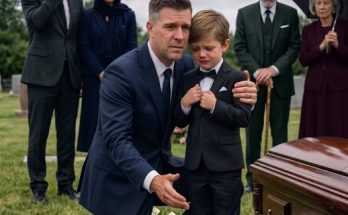
The rain began falling just as I was about to say goodbye to my wife. It was a thin, cold rain that darkened the cemetery grass and gathered on the shoulders of black coats. The mourners had already started leaving, carrying umbrellas toward the parking lot, their voices fading beneath the sound of water dripping from the maple trees. I stood beside Laura’s grave with my seven-year-old son, Ethan, holding his hand. My wife had been gone for three days. Three days since I had found her lying motionless in our bed.
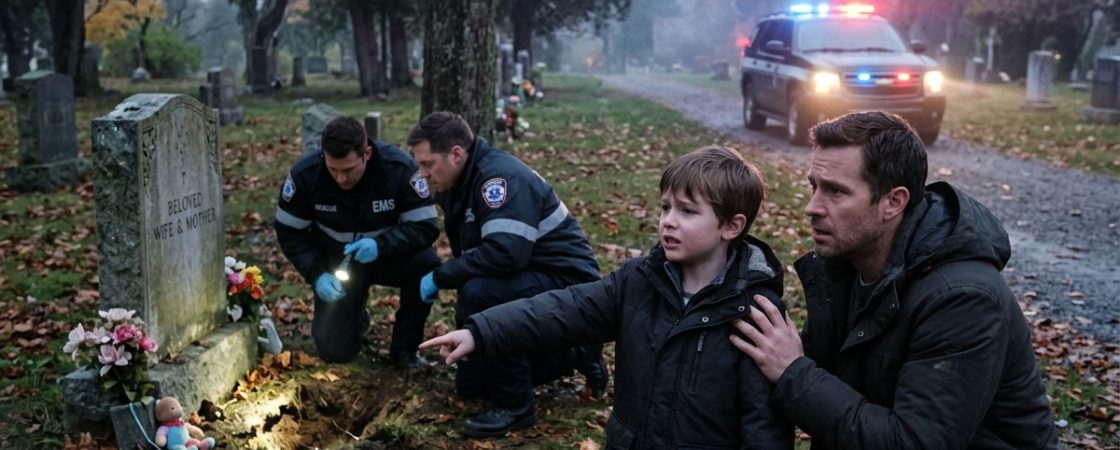
Three days since the paramedics had arrived at our house in Maplewood, Ohio, and worked desperately to save her. Three days since a doctor had told me that, despite their efforts, Laura had died. I still remembered the moment I heard those words. The hallway had smelled of the lavender detergent Laura used on our sheets. Her slippers were beside the bed. A half-finished glass of water sat on the nightstand. Everything looked ordinary. Everything except my wife.
Now, after the funeral, I was trying to understand how I was supposed to return to that house without her. Ethan had barely spoken during the service. He had stood beside me in his little navy suit, his fingers curled around mine, while relatives and friends described his mother as kind, generous, and full of life. When the minister invited everyone to offer a final goodbye, Ethan had placed a folded drawing beside the flowers. It showed three stick figures beneath a yellow sun. Me. Him.
And Laura, wearing a pink dress.
Above their heads, in uneven letters, he had written:
OUR FAMILY FOREVER.
I had almost broken down when I saw it.
Now, as the last few mourners began walking away, Ethan tugged at my jacket.
“Daddy?”
I looked down.
“What’s wrong, buddy?”
His eyes were red, but his expression was strangely serious.
“We need to check on Mommy.”
I crouched beside him.
“What do you mean?”
“I heard her calling my name.”
For a moment, I couldn’t speak.
The cemetery seemed to grow quieter around us.
“Where did you hear her, Ethan?”
He pointed toward the fresh earth.
“From there.”
A relative standing nearby stopped walking.
I gently placed both hands on Ethan’s shoulders.
“Sweetheart, I know you miss Mommy. I miss her too. Sometimes, when we’re sad, we can almost hear the voice of someone we love.”
He shook his head so hard that tears spilled down his cheeks.
“No, Daddy. I wasn’t imagining it.”
His little hands tightened around my jacket.
“She said, ‘Ethan, I’m here.’ I heard her. Please, Daddy. We can’t leave her.”
Something in his voice unsettled me.
Children often experience grief in ways adults don’t understand. I knew that. I had spent the last three days watching Ethan move between silence, confusion, and sudden tears.
But this was different.
He wasn’t asking to see his mother one last time.
He was insisting that she was calling him.
And there was a detail I couldn’t ignore.
Earlier that morning, at the funeral home, I had touched Laura’s hand.
It had seemed warmer than I expected.
I had mentioned it quietly to the funeral director, who explained that the temperature of prepared remains could vary depending on the environment and the procedures involved. His answer had sounded reasonable at the time.
I had accepted it because I needed to accept something.
But now Ethan was looking at me as though he knew something I didn’t.
I stood and turned toward the funeral director, who was gathering his papers near the cemetery entrance.
“Could I speak with you for a moment?”
He approached us.
“Of course, Mr. Walker.”
“My son believes he heard his mother calling him. He says it came from the grave.”
The funeral director’s expression softened.
“I’m very sorry. Children can have powerful experiences when they’re grieving.”
“I understand that. But I need to ask you something.”
I hesitated.
Then I forced myself to say the words.
“Is there any possibility that Laura’s death was misunderstood?”
His face grew serious.
“Her death was formally pronounced by a physician. The required procedures were completed.”
“Then I need someone qualified to review the situation. I don’t want to make assumptions, but I can’t ignore what my son is telling me.”
The funeral director glanced at Ethan.
The boy was staring at the ground, tears running down his face.
“Mommy said my name,” he whispered.
That was when I made my decision.
I called emergency services and explained the situation as clearly as I could. I told the dispatcher that my wife had been pronounced dead, that the funeral had just ended, and that I was concerned about an unusual circumstance involving my child’s account and a memory that had troubled me.
I did not ask anyone to disturb the grave without authorization.
I asked for guidance from the appropriate professionals.
The dispatcher took the information seriously and explained that any further assessment would need to be handled by authorized personnel.
Laura’s brother, Daniel, came to stand beside me.
“If something needs checking, Michael, let’s make sure it’s checked properly,” he said.
I nodded.
The rain grew heavier.
Relatives gathered beneath umbrellas while cemetery personnel contacted the appropriate authorities. The funeral director made several calls, and the family was asked to wait while the next steps were arranged.
Ethan held my hand with both of his.
“Are they going to find Mommy?”
I swallowed.
“I don’t know, buddy. But we’re going to let the professionals check everything carefully.”
He looked up at me.
“Promise you won’t leave?”
I squeezed his fingers.
“I promise.”
I had made many promises to my son since Laura died.
That I would take care of him.
That he would always be loved.
That we would get through the days ahead together.
This was the first promise I had made that I wasn’t certain how to keep.
But I knew I couldn’t dismiss his fear simply because it frightened me.
So we waited.
And as the rain fell over the cemetery, I began to realize that the hardest part of losing Laura might not be learning how to live without her.
It might be discovering that there were things about her final hours that I still didn’t understand.
Chapter 2: The Discovery Behind the Closed Door
Nearly two hours passed before anyone gave us an update.
By then, the rain had soaked through the cuffs of my trousers, and Ethan had fallen asleep against my shoulder. His small face was pale with exhaustion. Every few minutes, he stirred and whispered something I couldn’t quite understand.
Laura’s mother, Margaret, sat beside us in the waiting room with a tissue pressed to her mouth.
She had barely spoken since we arrived.
Daniel paced near the window.
The funeral director had gone to speak with the officials overseeing the assessment. No one had told us exactly what they were doing, only that the situation required careful handling and that the family needed to remain in the designated waiting area.
I looked at the clock.
3:26 p.m.
An hour earlier, I had been standing beside my wife’s grave, trying to convince my son that he was hearing something that couldn’t possibly be true.
Now I was waiting for a team of professionals to tell me whether there was anything left to investigate.
I looked down at Ethan.
His eyelashes rested against his cheeks. One of his hands was still curled around my index finger.
I remembered the night he was born.
Laura had been exhausted, her hair damp against her forehead, but she had insisted on holding him herself before the nurses took him for his first examination.
“He’s so tiny,” she had whispered.
I had laughed nervously.
“He’s seven pounds. That’s not tiny.”
She had given me the look she reserved for moments when I said something ridiculous.
“Michael, he’s our entire world.”
Then she had kissed Ethan’s forehead.
I had taken a photograph of them together.
For seven years, that picture had sat on our bedside table.
Now I wondered whether I would ever be able to look at it without feeling that the ground had disappeared beneath my feet.
The door opened.
A woman in medical scrubs stepped into the waiting room. She was in her forties, with dark hair pulled into a bun and an identification badge clipped to her collar.
“Mr. Walker?”
I stood immediately.
“I’m Michael.”
“My name is Dr. Helen Carter. I’m coordinating the medical assessment.”
I glanced toward the room behind her.
“Have you found something?”
She paused.
“We have identified an unexpected finding that requires further evaluation. I don’t want to give you incomplete information, and we need to continue the assessment before drawing conclusions.”
My throat tightened.
“Is my wife alive?”
Dr. Carter held my gaze.
“I cannot answer that question yet. We are taking the situation very seriously.”
Margaret began crying quietly.
Daniel stopped pacing.
I felt Ethan move against my shoulder.
He opened his eyes.
“Did they find Mommy?”
I looked at the doctor.
She glanced at him, then back at me.
“We’re still checking, sweetheart.”
Ethan sat upright.
“I told Daddy she called me.”
Dr. Carter’s expression softened.
“I understand that you heard something very important, Ethan. The medical team is checking everything carefully.”
He nodded as though that was all he had needed to hear.
Then the doctor asked me to accompany her to a private consultation room.
I left Ethan with Margaret and followed her down the corridor.
The room was small, with two chairs, a desk, and a box of tissues.
Dr. Carter waited until I sat down.
“Mr. Walker, I need to explain what we know and what we don’t know.”
“Please.”
“The initial medical assessment documented your wife’s death. We are reviewing the circumstances, the available records, and the information reported today. During the further examination, a finding was observed that could not be dismissed without additional testing.”
“What finding?”
She took a breath.
“There was an indication of possible biological activity that required immediate verification.”
For a moment, the words meant nothing to me.
Then I understood what she was suggesting.
“No.”
She didn’t interrupt.
“No,” I repeated. “Are you telling me that Laura might still be alive?”
“I am telling you that we have an unexpected finding that requires urgent assessment. We cannot responsibly confirm anything until the evaluation is complete.”
I stood so quickly that the chair scraped the floor.
“Then why are we sitting here talking?”
“We have medical personnel assessing her now. I wanted to explain the situation before you heard fragments of it from someone else.”
I pressed both hands against the desk.
For three days, I had told myself that Laura was gone.
I had watched people close the casket.
I had listened to the minister speak.
I had placed my hand on the polished wood and whispered goodbye.
I had held my son while he cried.
And now a doctor was telling me that something about the situation required a new assessment.
My mind refused to accept it.
“What could cause this?”
“There are several possibilities, and we need to verify the observations before discussing causes. The circumstances of the original assessment will also be reviewed.”
“Was the first doctor wrong?”
“I can’t determine that from the information available at this moment.”
“Then tell me what to do.”
“Stay with your family. Let the medical team complete its work. If emergency treatment is required, it will be provided.”
I sat down again.
My hands were shaking.
Dr. Carter waited a moment before asking whether I had any additional information about Laura’s medical history.
I told her what I knew.
Laura had been thirty-six years old. She had no known serious heart condition. She had complained of fatigue in the weeks before her death, but she had attributed it to stress and poor sleep.
She had gone to bed on a Sunday night after helping Ethan finish a school project.
The next morning, I found her unresponsive.
I called emergency services and followed the dispatcher’s instructions while waiting for the ambulance.
The paramedics worked on her.
They tried to revive her.
Eventually, a physician confirmed her death.
I had believed that was the end of the story.
Dr. Carter wrote down every detail.
Then she asked whether Laura had taken any medications or experienced any unusual symptoms.
I described the headaches she had mentioned, the occasional dizziness, and the fact that she had been unusually tired.
The doctor made another note.
“Thank you. That information may be important.”
“Doctor?”
“Yes?”
“If there’s any chance she can be saved, please don’t stop.”
Her expression changed.
“We will provide whatever treatment is medically indicated.”
I nodded.
Then I walked back into the waiting room.
Ethan was standing beside the door.
He looked at me.
“Daddy?”
I knelt in front of him.
“They’re still checking, buddy.”
“Is Mommy coming home?”
I wanted to tell him yes.
I wanted to promise him that his mother would walk through the front door, remove her shoes, and complain about the wet footprints we had left in the hallway.
I wanted to hear her laugh at something silly on television.
I wanted to watch her brush Ethan’s hair away from his forehead and tell him that he was growing too quickly.
But I couldn’t give my son a promise that no one had yet earned the right to make.
“I don’t know,” I whispered. “But we’re going to wait for the doctors to tell us the truth.”
He looked at me for a long moment.
Then he nodded.
“Okay, Daddy.”
He slipped his hand into mine.
And we waited again.