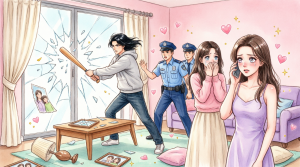
My Parents Cut Me Off 5 Years Ago, Then Demanded To Sell My House To Pay My Sister’s 150K Debt. When I Refused, They Broke In With Baseball Bats And Destroyed The Living Room, Causing $40K Of Damage To Take Revenge On Me, Only To Discover It Wasn’t My House Anymore. When The Police Arrived They Desperately Called Me For Help…
Part 1
Three months ago, I watched my parents swing baseball bats through a stranger’s living room on a grainy police body-cam video, and for a split second I thought, This is it. This is the thing that finally ruins me. The final humiliation. The family disaster that will have my name attached to it forever.
Then the officer paused the footage, leaned toward the microphone clipped to his chest, and said something I didn’t expect.
“Ma’am, your parents didn’t destroy your home. They destroyed the wrong home.”
I didn’t laugh. I didn’t cry. I just stared at the freeze-frame of my mother’s face—red, furious, determined—while she stood in a doorway like she belonged there, like she had every right to be inside whatever house she chose. My father was beside her, shoulders hunched with purpose, gripping the bat the way he used to grip my bicycle seat when I was eight and learning to ride. Only now he wasn’t steadying me. He was swinging.
If you’d asked me five years ago whether my parents were capable of breaking into a house with baseball bats, I would’ve told you no. Absolutely not. My dad complained about his lower back when he folded laundry. My mom got anxious if a restaurant had live music. They were the kind of people who didn’t even jaywalk.
But five years ago, I still believed in the version of my family that existed on the surface. The weekly dinners. The jokes. The familiar routine that made it easy to ignore how conditional their love was, how carefully it was rationed out based on what you could provide.
Five years ago, I was twenty-eight and living in a studio apartment that was basically a closet with plumbing. The shower was so close to the toilet that if you bent down to pick up shampoo, you could accidentally flush with your elbow. The kitchen was a single stretch of counter that ended right at the bed. I used to joke that I could cook pasta while still lying under my blanket, and it was only half a joke.

I lived that way on purpose.
Every morning, I’d wake up and look at the whiteboard I’d hung above my desk, where I’d written one number in thick black marker: 120,000.
That number wasn’t greed. It wasn’t a luxury. It was a door.
Freedom had a price tag, and I was paying it in slow, miserable installments. I ate canned beans because they were cheap. I took the bus because I didn’t want a car payment. I bought thrift store sweaters and pretended it was a quirky aesthetic choice. I worked late nights as a software developer until the code blurred and my eyes burned, then took freelance gigs on weekends while my friends went to brunch and posted pictures of mimosas like happiness was something you could order off a menu.
I didn’t resent them. Not really. I wanted what they had: ease. I just wanted it more than I wanted temporary comfort.
My dream wasn’t complicated. I wanted a house. A real house. One with walls that didn’t vibrate when the neighbor’s bass hit. One with a door I could close, a space that was mine.
In October of that year, I found it.

A three-bedroom craftsman with hardwood floors and a front porch that looked like it belonged in a movie. The kitchen caught the morning sun like liquid gold, turning dust motes into little sparks. There was a backyard big enough for a garden, even though I didn’t know the first thing about gardening. I stood in the living room during the showing and felt something settle in my chest, like a long-held breath finally releasing.
That’s when the trouble started—because good news in my family didn’t belong to you. It belonged to everyone.
Every Saturday, I drove to my parents’ house for our weekly tradition. My mom, Susan, made her famous meatloaf and acted like it was a gift to the world. My dad, Wade, complained about his back and the neighbor’s dog and how “kids these days” didn’t know how to do anything with their hands. But he secretly loved having both his daughters at the table. You could see it in the way he kept glancing up like he wanted to memorize the scene.
My older sister, Clara, always arrived ten minutes late with a story that made her the hero and the victim at the same time. Clara was three years older than me and had the kind of confidence that made people assume competence. She spoke in declarations. She laughed like she was on stage. She could turn any conversation into a performance where the spotlight found her automatically.
She also married Michael.
Michael was the kind of man who always had a plan that didn’t involve real work. The kind who called himself an “entrepreneur” because he didn’t want to say he didn’t have a stable job. He talked about investments and “opportunities” and “scaling” like those words were spells you could cast to make money appear.
Clara had tried to start businesses before. Two of them had failed so spectacularly they’d left craters in the family finances. My parents had refinanced their home to help her. Twice. They never said it out loud, but it rewired the family hierarchy. Clara became the fragile genius who needed saving. I became the practical one who could be leaned on without consequence.
That October Saturday, the moment I stepped into my parents’ house, I felt something off. There was a nervous energy in the air, like the house was holding its breath. Clara and Michael were whispering in the corner like conspirators. My mom kept looking at me with a strange expression—part excitement, part calculation. My dad couldn’t quite meet my eyes, which was unusual because he was normally the first one to ask about my work.

I should’ve listened to my instincts. I should’ve turned around and walked right back out.
But I was floating on my own happiness, and I wanted to share it. I had pictures of the house on my phone. I had rehearsed the moment in my head: my mom squealing, my dad nodding with pride, Clara teasing me but still smiling.
We sat down at the dining room table, and my mother clasped her hands like she was about to say grace even though we hadn’t done that in years.
“Clara has wonderful news,” she announced.
Clara didn’t just share news. She performed it.
She stood up and handed out papers—actual printed charts and graphs like she was pitching to venture capitalists instead of her family over meatloaf. She had a presentation: projected revenue streams, market analysis, “growth strategy.” Michael nodded at all the right places like a supportive accessory.
“I’ve learned from my mistakes,” Clara said, eyes shining with that dangerous mix of desperation and delusion I’d seen before. “This time, I’ve got everything figured out. I just need capital for initial development and marketing.”
The word capital landed heavy on my tongue, like metal.
“The projections show we could double our investment within two years,” Michael added.
Then the room shifted.
My parents and my sister and my brother-in-law all turned and looked at me with the same expression—expectant, focused, like they’d been waiting for me to arrive so they could open a locked door.
“Why are you all looking at me like that?” I asked, though part of me already knew.
Clara’s voice turned syrupy, sweet the way it was when she wanted something.
“Well,” she said, “Mom mentioned you’ve been saving for a house. She said you have about… a hundred and twenty thousand saved up.”
My stomach dropped so hard it felt like missing a stair in the dark.
They had discussed my savings. They had measured my life in numbers and decided what portion belonged to them.
And in that moment, before anyone even asked, I understood something that would take me years to fully accept:
In my family, love wasn’t unconditional. It was a bill that came due whenever Clara wanted something.
Part 2
“I’m not investing my house money in your business,” I said, and the words came out sharper than I meant them to—like a reflex, like my body was protecting itself before my heart could talk me into generosity.
For a second, no one moved. The only sound was the ceiling fan ticking as it rotated above us, slow and steady, like time didn’t care what was about to happen.
Clara’s face crumpled as if I’d slapped her.
“But if you help me now,” she said, voice trembling, “in two years I’ll give you back two-forty. You could buy an even better house.”
I stared at her. Then, embarrassingly, I laughed.
Not because it was funny. Because the absurdity of it short-circuited something in my brain. Clara had already failed twice. Twice my parents had cleaned up the wreckage while she moved on to the next idea like consequences were for other people. Now she was asking me to gamble my entire future on printed graphs and optimism.
“Clara,” I said, trying to keep my voice steady, “you’ve already failed at business twice. Maybe it’s time to stop with the schemes and get a regular job like the rest of us.”
The explosion was immediate.
Clara’s chair scraped back hard enough to squeal on the wood floor. She burst into tears—loud, dramatic, full-body sobs—and ran from the room like we were teenagers again and I’d stolen her favorite sweater.
Michael glared at me like I’d kicked a puppy.
“You’re heartless,” he snapped, and followed her.
I waited for my parents to say something reasonable. Something parental. Something like, Lara’s allowed to say no.
Instead my mother turned toward me with a look so cold it made my skin prickle.
“How could you be so cruel to your sister?” she demanded.
Cruel. Like I’d done something violent by protecting my own savings.
My dad’s jaw flexed. He always got that muscle twitch when he was trying to hold in anger.
“Clara is more talented than you’ll ever be,” my mother continued. “You’re just jealous of her success.”
I stared at her, stunned.
“Success?” I said, the word coming out incredulous. “What success? The bankruptcies? The creditors calling your house? Dad’s panic attacks? Mom, you refinanced your home. Twice.”
My dad slammed his hand on the table.
“Enough,” he said.
Then, in a voice that felt rehearsed, like he’d practiced it in the mirror, he delivered the killing blow.
“You give Clara that money,” he said, “or you’re no longer part of this family.”
It was so clean, so absolute, that for a second I didn’t believe I’d heard him correctly.
“You’re… you’re kicking me out?” I asked, and hated how small my voice sounded.
“You heard your father,” my mother said, eyes shining with righteous fury. “Family helps family.”
I looked between them, these strangers wearing my parents’ faces, and I felt something in me crack—not loud, not dramatic, but deep. Like a tree splitting at the core.
“I’m not giving her my money,” I said quietly.
My dad pushed his chair back. “Then get out of our house,” he said. “And don’t come back.”
So I did.
I walked out into the crisp October air with my cheeks burning, climbed into my car, and drove back to my studio apartment in silence. The streetlights blurred as I went. At home, I sat on my bed—the same bed that was also my couch and my dining chair—and stared at the whiteboard that said 120,000.
The number looked different now.
It didn’t look like a door. It looked like a target.
The next day, I changed my phone number. I blocked their emails. I told mutual friends I didn’t want messages passed back and forth. If my parents wanted to erase me over money, I would make it official.
The weeks after were strange. Grief came in waves, but so did relief. There were no more Saturdays spent bracing for Clara’s moods. No more subtle comments about how I should “help out more.” No more pressure disguised as love.
I threw myself into work. When you cut off the people who raised you, the quiet is deafening. I filled it with code, deadlines, and long runs at night with my earbuds blasting angry music.
One year later, I bought the craftsman.
The hardwood floors were even more beautiful than I remembered. The morning sunlight still poured into the kitchen like a blessing. I set up my home office in the spare bedroom and bought a secondhand desk that wobbled slightly but felt like a throne compared to the cramped corner I used to work in.
The first night I slept there, the house was so quiet I could hear the refrigerator hum. I lay in bed and waited for the panic, the loneliness, the regret.
Instead I felt peace.
For five years, I lived without them. Five peaceful, drama-free years. I got promoted twice. I learned how to make real meals. I hosted friends for game nights. I planted herbs in the backyard and killed half of them but kept trying anyway.
Through mutual friends, I heard Clara’s business had actually succeeded this time. She and Michael bought a big house. They traveled constantly and posted pictures of fancy dinners and beaches like their lives were a commercial. I felt an odd combination of genuine happiness for her and a hollow ache for myself—not because I missed the money, but because I missed the idea of having a family that could celebrate each other without turning it into a transaction.
Then I met Julian.
It wasn’t dramatic. No sparks in a rainstorm. We met through a professional networking group—one of those events where everyone pretends they don’t hate small talk. Julian was in another state, but he was steady in a way my family never had been. Kind. Patient. The kind of person who listened like your words mattered.
We made long distance work. He visited me, I visited him, and somewhere between airport pickups and late-night calls, I started imagining a future that didn’t involve bracing for the next family explosion.
By the time my mother emailed me after five years of silence, I was actually considering selling my house to move closer to Julian and start over somewhere new.
The email subject line was short, urgent, manipulative in its simplicity:
We need to see you. It’s life and death.
And despite everything I told myself—despite the boundaries, despite the silence—I felt my stomach clench with old instinct.
Because no matter how toxic someone is, the word dying still reaches into you.
I replied with one sentence.
I’ll come by Saturday.
Part 3
On Saturday morning, I sat in my car outside my parents’ house for ten minutes, hands gripping the steering wheel so hard my knuckles went pale. The neighborhood looked smaller than I remembered, like the houses had shrunk while I’d grown up. The paint on the siding was duller. The lawn was patchier. Even the air felt heavier.
Then I noticed the driveway.
Two cars sat there like trophies: Clara’s brand-new Porsche and Michael’s pristine Mercedes, both polished to a shine that screamed money. The sight hit me like a slap. If this was truly life and death, they had an interesting way of prioritizing.
I forced myself out of the car and walked up the steps. My mother opened the door before I knocked, like she’d been watching through the curtains.
She looked older. Not just older in the normal way—tired older. New lines around her eyes. Her hair thinner. Her smile hesitant.
“Lara,” she said, voice shaky. “Thank you for coming.”
Behind her, the living room was staged like an intervention. My father sat in his usual chair, face grim. Clara sat on the couch beside Michael, eyes red and puffy like she’d been crying for hours. Michael’s arm was around her shoulder, protective and theatrical.
They all looked at me like I was the missing piece they’d been waiting to snap back into place.
“What’s going on?” I asked, staying standing. I didn’t want to get comfortable. Comfort in this house used to be a trap.
My mother’s eyes filled immediately.
“It’s about Clara,” she said. “She’s in serious trouble.”
Clara stared at her hands. My father cleared his throat.
“Her business went under three months ago,” he said. “The bank took the house. She owes money to… people.”
I felt a flicker of vindication that I hated. I didn’t want Clara to fail. I just wanted my family to stop treating my responsibility like it was to clean up after her.
“I’m sorry,” I said carefully. “That’s awful. But what does it have to do with me?”
Clara finally looked up. Her voice was barely a whisper.
“One hundred and fifty thousand,” she said.
I blinked. “You owe one hundred and fifty thousand dollars?”
Michael answered for her, of course.
“Private investors,” he said. “They’re not the kind of people who accept ‘I’ll pay you later.’”
Clara started crying again, quieter now, more desperate than dramatic.
“They’ve been calling,” she said. “Making threats. They know where we’re staying. They know our routines.”
My mother stepped forward as if she could physically push guilt into my body.
“We’re scared,” she said. “Really scared, Lara.”
I did feel bad. I’m not made of stone. Fear is contagious, and this room was thick with it.
“That’s terrible,” I said. “But I still don’t understand why I’m here.”
My mother inhaled, then dropped the bomb like it was a reasonable request.
“We know you bought a house,” she said. “A nice one. We think you should sell it and help Clara pay off these debts.”
For a moment, I couldn’t speak. The audacity stole the air from my lungs.
“Are you out of your mind?” I finally said.
“You’re young,” my mother pressed on, talking over me like my words were background noise. “You can earn another house. Clara and Michael could be seriously hurt if they don’t pay this money back.”
I looked around the room at all of them, and it was like seeing the family dynamic laid bare on an operating table.
“So let me get this straight,” I said slowly, voice getting colder with each word. “You kicked me out of the family five years ago because I wouldn’t give Clara money. Now that business has failed, and you want me to sell my house to bail her out.”
“Family helps family,” my father said, as if he hadn’t disowned me.
“Family?” I laughed, but there was no humor in it. “You told me I wasn’t family anymore. Remember? You cut me off completely.”
Clara’s tears spilled faster. “I know we messed up,” she said. “But this is different. These people aren’t going to just take us to court. They’re going to hurt us.”
“Then maybe you should have thought about that before you borrowed money,” I said.
Michael’s face reddened. “You have no idea what kind of pressure we’re under.”
“You’re right,” I said. “I don’t. But I noticed the Porsche and the Mercedes in the driveway. Maybe start by selling those.”
“We need those cars for work,” Clara snapped, suddenly sharp.
“You need them more than you need to be safe?” I asked.
My mother stepped closer, voice rising. “This house you bought—if you sold it, you could pay off Clara’s debt and still have money left for a nice apartment.”
A nice apartment.
The phrase hit an old nerve, like they were trying to shove me back into the cramped life I’d clawed my way out of.
“Mom,” I said, trembling with anger now, “I worked my ass off for that house. I saved for years. I lived like a monk. I didn’t have vacations. I didn’t go out. I didn’t buy nice things. I earned that place. I’m not selling it because Clara made reckless choices.”
“She’s your sister,” my father said, voice hard.
“She’s a grown woman,” I replied. “She made her own choices.”
Clara shot up from the couch. “You’re supposed to help me,” she cried. “You’re supposed to care what happens to me.”
“Where was that loyalty five years ago?” I asked. “When all of you told me to get lost?”
My mother’s face twisted. “That was different.”
“How?” I demanded. “How was it different? I didn’t want to give away my future then, and I don’t want to give away my future now.”
Silence fell, heavy and judgmental.
I could feel their eyes on me, like I was the villain in their story.
“I’m not doing this,” I said, voice steady now. “Clara got herself into this mess. She can get herself out. If you want to help her so badly, sell your house and give her the money.”
My mother gasped like I’d cursed at her.
“This is the only house we have,” she said. “We’re old. We can’t start over like you can.”
I held her gaze.
“Then you understand exactly how I feel about my house,” I said.
I walked out.
Behind me, Clara called, “You’re making a huge mistake! These people don’t mess around!”
I turned back at the door.
“Neither do I,” I said.
I drove home feeling lighter and sick at the same time. Part of me wanted to vomit from the stress. Another part felt like I’d just pushed a boulder off my chest.
When I got home, I stood in my kitchen—the kitchen that caught morning light like gold—and stared at the place I’d built.
I knew, with a clarity that scared me, that they weren’t done.
Part 4
A week later, I heard a car door slam outside while I was making coffee. I looked out the window and nearly dropped the mug.
My parents were walking up my driveway like they owned the place.
For a moment, I couldn’t move. It felt like a nightmare where your body refuses to run.
I opened the door before they could knock, more out of anger than hospitality.
“What are you doing here?” I demanded. “How did you even get my address?”
My mother looked proud, like she’d solved a puzzle.
“Clara hired a private investigator,” she said.
“A private investigator?” I repeated, disbelief turning my voice sharp. “Are you serious right now?”
My father’s eyes were scanning my house, taking it in the way a shopper looks at a price tag. He whistled low.
“This is a nice place,” he said.
“Get off my property,” I snapped.
But my mother pushed past me and walked into my living room anyway, touching the back of my couch, examining a framed photo on the mantel like she was at an open house.
My father followed.
Shock froze me for half a second, then anger unfroze me.
“Don’t make yourselves comfortable,” I said. “You’re not staying.”
My mother was already walking from room to room, calculating.
“If you sold this house,” she said, “you could easily pay off Clara’s debt and still have plenty left over for a smaller place.”
My father spread his arms wide as if the space itself offended him.
“It’s just you living here,” he said. “You don’t need all this room.”
“What I need is none of your business,” I replied.
My mother’s eyes filled with tears on cue, like she could summon them with a switch.
“Clara is really scared,” she said. “They called yesterday. They said if they don’t get their money by the end of the month, something bad is going to happen.”
“Then maybe Clara should go to the police,” I said.
My father snorted. “The police can’t help with this. These aren’t the kind of people who care about restraining orders.”
I could feel my pulse in my throat.
“That is still not my problem,” I said. “You both need to leave. Now.”
My mother folded her arms like a stubborn child.
“We’re not leaving until you agree to help your sister.”
“Then I’m calling the police,” I said.
I pulled out my phone and started dialing before I could talk myself out of it. My father grabbed my arm.
“Don’t be ridiculous,” he hissed.
“Let go of me,” I said, yanking free. My voice shook, but my hand didn’t.
I stared them down. “If you don’t leave right now, I’m calling them. I’m serious.”
For a moment, I thought they might call my bluff. My mother’s jaw tightened. My father’s eyes narrowed. Then something flickered—maybe the realization that this could get real, that consequences existed outside family guilt.
My mother started sobbing louder.
“Fine,” she said, “but this isn’t over. If something happens to Clara, it’s on your head.”
“And if something happens to my financial security because I bail her out,” I said, “that’s on my head. At least this way, only the person who made the mess deals with the consequences.”
My father pointed at me, trembling with anger.
“You’re going to regret this,” he said. “Family is supposed to stick together.”
“You didn’t think that five years ago,” I replied.
They left, and I locked the door behind them with hands that wouldn’t stop shaking.
I stood in my living room, heart hammering, and realized something that made my skin go cold:
They weren’t just manipulative. They were escalating.
Julian called that night and listened while I vented. His voice was steady, calm, a hand on my back through the phone line.
“You did the right thing,” he said. “They can’t show up after five years and demand you fix their problems.”
“I know,” I said, though my voice sounded thin. “But I don’t trust them. I don’t think they’re going to stop.”
There was a pause, then Julian said carefully, “What do you want to do?”
I looked around my house—the house I loved, the house that had been my proof I could build something on my own—and felt a twist of grief.
“I’ve been talking to a realtor,” I admitted. “About selling eventually to move closer to you. I wasn’t ready yet. But now…”
“Now it might be safer to take away their leverage,” Julian finished gently.
The next morning, I called the realtor.
“Hey, it’s Lara,” I said, voice tight. “Remember we talked about putting my house on the market? I need to sell it as fast as possible.”
She sounded surprised. “Fast as possible?”
“I’ll take a discount,” I said. “Whatever it takes.”
She hesitated, then said, “I actually have a buyer who’s been looking in your area. If you’re serious about a quick sale, he’ll be interested.”
Three days later, she called with an offer. It was lower than I’d hoped, but fair considering the speed. I accepted immediately.
When I told Julian, he was quiet for a moment.
“Why the rush?” he asked, though his tone wasn’t accusing—just concerned.
I explained everything. The private investigator. The uninvited visit. The refusal to leave.
“I don’t want to live waiting for them to show up again,” I said. “I’d rather have the money somewhere safe, somewhere they can’t stare at and turn into a weapon.”
Julian exhaled softly. “That’s smart,” he said. “And… it means you can come stay with me sooner than we planned.”
A small spark of relief flickered in my chest.
“You’re okay with that?” I asked. “Me staying at your place while we figure out something permanent?”
“Are you kidding?” he said, and I could hear his smile. “I’ve been hoping you’d move here. This just speeds up our timeline.”
The closing happened fast. Paperwork signed. Keys handed over. My house—my hard-won dream—became someone else’s.
Julian drove out to help me pack. We loaded boxes into a moving truck, and I tried not to look too long at the empty rooms. The walls felt like they were watching me leave.
When the last box was loaded, I stood in the driveway and looked back at the porch, the windows, the garden bed I’d built with my own hands.
I felt grief, but underneath it was something stronger.
Relief.
My family couldn’t use my house as emotional blackmail anymore.
Julian put his arm around me. “You okay?” he asked.
I swallowed, then nodded.
“Yeah,” I said. “I’m good. Let’s go.”
We drove off, and with every mile, I felt the weight lift. Whatever happened with Clara and her debt, it wasn’t going to involve me.
For the first time in weeks, I let myself believe I was free.
Part 5
Living with Julian felt like stepping into a quieter universe. His apartment was warm and calm, filled with things chosen for comfort instead of show. A worn-in couch that had actually been sat on. Books that had cracked spines from being read. A kitchen that smelled faintly of coffee and rosemary because he cooked real meals like it was normal.
I worked remotely, so the transition was mostly emotional. I kept bracing for the next crisis, the next call, the next demand. But the days passed in steady rhythm. Morning meetings. Evening walks. Weekend house browsing for our future.
Sometimes, in the middle of an ordinary moment—like Julian handing me a mug of tea or laughing at a stupid commercial—I’d feel a wave of grief for the family I didn’t have. Not the family I lost, exactly, but the family I’d wished for.
Julian never rushed me through it. He didn’t tell me to forgive. He didn’t insist family was everything. He just let me talk, and when I fell silent, he stayed.
A month after I moved, my phone rang on a Tuesday morning. The caller ID showed a number I didn’t recognize, but it had my old hometown area code.
I almost let it go to voicemail. Then something in my gut tightened, and I answered.
“Hello?”
“Is this Lara Smith?” a man asked.
“Yes. Who’s calling?”
“This is Officer Hughes with the Lincoln Police Department,” he said. “I’m calling about an incident involving your parents, Wade and Susan Smith.”
My blood went cold.
“What kind of incident?” I managed.
“They were arrested last night for breaking and entering and destruction of property,” he said. “The homeowner wants to press charges.”
For a second, my brain refused to process the words.
“Breaking and entering where?” I asked.
There was a pause, like he was checking his notes.
“The address they broke into is listed as your former residence,” he said. “Is 847 Maple Street a house you used to own?”
My stomach dropped.
“I sold that house,” I said. “A month ago.”
Another pause, heavier this time.
“Then they didn’t know,” Officer Hughes said quietly. “That would explain… a few things.”
“What were they doing there?” I asked, voice rising.
“That’s what we’re trying to figure out,” he said. “They caused significant damage to the interior of the home. Destroyed furniture, broke windows, spray-painted obscenities on the walls. The new owner came home to find them in his living room, smashing a coffee table with a baseball bat.”
I sank onto Julian’s couch, legs suddenly useless.
“You’re serious,” I whispered.
“Very,” Officer Hughes said. “The damage is estimated at around forty thousand dollars. Your parents claimed they believed it was still your house and that you’d wronged them.”
I closed my eyes. My heart was pounding so hard it made my ears ring.
“They said they were getting back at you,” he continued. “For abandoning your family.”
A laugh bubbled up—thin, shocked, not funny at all. “They abandoned me,” I said, but my voice sounded distant even to myself. Like the words belonged to someone else.
Officer Hughes asked for context, and I gave it. The five-year cutoff. Clara’s debts. The demands to sell my home. The private investigator. The uninvited visit. I told him everything, each sentence feeling like I was laying out evidence not just for the police, but for myself. Proof I hadn’t imagined the madness.
When I finished, he exhaled slowly.
“So they didn’t know you’d sold the house,” he said.
“No,” I said. “They probably went there to vandalize my property. Instead they destroyed some innocent person’s home.”
“That’s exactly what it looks like,” he agreed. “And I have to say—your parents are lucky they weren’t shot. The homeowner is a legal gun owner. He came in, heard the noise, and called 911 from his car. If he’d walked in—”
I opened my eyes, suddenly nauseous.
My parents could have been killed. Over a vendetta. Over money. Over Clara.
After I hung up, I sat frozen until Julian came out of his office and saw my face.
“What happened?” he asked immediately, crossing the room.
I told him, and as I spoke, his expression shifted from confusion to shock to a kind of quiet fury.
“That’s insane,” he said. “They could have gotten themselves killed. Or killed someone else.”
“I know,” I whispered. My hands were shaking. “They thought it was my house.”
Julian sat beside me and took my hand like he could anchor me to the couch.
“What do you need?” he asked.
I stared at the wall, seeing my mother’s proud face when she said private investigator, hearing my father’s voice saying you’re no longer part of this family.
“I need this to be real,” I said softly. “I need there to be consequences that don’t magically disappear because they’re my parents.”
And for the first time, I said something out loud that I’d never dared to say before, even in my own head.
“I don’t think they love me,” I said. “Not in the way parents are supposed to.”
Julian didn’t argue. He didn’t say, I’m sure they do, deep down. He just squeezed my hand tighter.
“I’m sorry,” he said. “You didn’t deserve any of that.”
Over the next few weeks, I got updates. The legal system moved slowly, but reality didn’t. My parents were facing serious charges. Their lawyer negotiated a plea deal to avoid jail time, but it came with restitution—full restitution—for the homeowner.
Forty thousand in damage, plus legal fees, plus court costs. It climbed close to sixty thousand total.
A friend from back home, Caitlyn, called me with the rest of the story like she was delivering gossip, except her voice kept catching, like even she couldn’t believe it.
“Lara,” she said, “they had to sell their house.”
I sat down at my kitchen table—Julian’s table, technically—and felt something sharp twist in my chest.
“They said it was the only house they had,” I murmured.
“I know,” Caitlyn said. “That’s the irony. They couldn’t afford the restitution any other way. So they sold it. And here’s the kicker—after they paid everything for the court and the homeowner, they gave the remaining money to Clara.”
My throat tightened.
“They did what they demanded you do,” Caitlyn said quietly. “But with their own house.”
I should’ve felt satisfied. Vindicated. But what I felt was a hollow ache, like watching a building collapse in slow motion. Even when consequences finally arrived, my parents still chose Clara.
“And it gets worse,” Caitlyn added, voice dropping. “Clara’s creditor problems? They weren’t what she said.”
“What do you mean?”
“Turns out the ‘dangerous people’ were basically just an investment firm,” Caitlyn said. “They were threatening to sue. Like, normal legal stuff. No broken kneecaps, no scary hitmen. Clara exaggerated everything to scare your parents. She made it sound like her life was on the line.”
I closed my eyes, anger rising hot and clean.
“So she lied,” I said.
“Yeah,” Caitlyn whispered. “And now your parents are renting a small apartment with Clara and Michael. All four of them in a two-bedroom. From what I hear it’s… bad. Lots of fighting.”
When I hung up, Julian found me staring out the window.
“You okay?” he asked.
I turned toward him, and to my own surprise, I smiled—small, tired, but real.
“I think I am,” I said. “I think… I’m finally done hoping they’ll become different people.”
Part 6
After the arrest, my family tried to reach me through mutual friends like I was a customer service line they could call when they needed to fix something. At first it was vague: Your mom wants you to know she misses you. Your dad is really upset. Clara’s having a hard time.
Then it became direct: They want to apologize. They want to explain. They want to see you.
Every time someone brought it up, I said no.
Caitlyn called again a few weeks later.
“Your mom asked me to tell you she’s sorry,” she said. “She said they realize they handled everything wrong. That they made terrible mistakes.”
“It’s too late for sorry,” I replied.
I didn’t say it with drama. I said it like stating a fact. Like telling someone the store is closed.
“They spent five years not caring whether I was alive or dead,” I continued. “Then they demanded I bankrupt myself for Clara. Then they committed actual crimes because I wouldn’t do what they wanted.”
Caitlyn sighed. “But they’re your family.”
I stared at the ceiling, feeling the old tug of guilt, the old conditioning, like a hook in my ribs.
“No,” I said firmly. “They’re related to me. Family doesn’t abandon you and then show up demanding money. Family doesn’t hire private investigators to stalk you. Family doesn’t break into houses with baseball bats because they don’t get their way.”
Julian was sitting across from me, listening. When I hung up, he reached for my hand.
“I’m proud of you,” he said.
The words made my eyes sting. Proud was not something my parents said to me unless it served a narrative.
In the months that followed, my life kept moving forward in a way that almost felt rude, like the universe hadn’t gotten the memo that my family was imploding.
Work was going well. I got a big promotion—one of those moments I would’ve once driven to my parents’ house to celebrate, craving their approval like oxygen. Instead, Julian took me out for dinner, toasted me with a cheap but bubbly bottle of champagne, and told me I’d earned it.
We started seriously house hunting in his area. Not because I needed a place to prove myself anymore, but because we wanted a shared future. A home that belonged to us, not to my family’s leverage.
One evening, after a long day of touring houses, we sat on Julian’s couch scrolling through listings. We were both tired and a little punchy, arguing playfully about whether a breakfast nook was necessary.
Julian nudged me with his shoulder. “This one has a backyard big enough for a garden,” he said, eyes bright. “You’d like that.”
I snorted. “Half my herbs died last time.”
“That’s because you loved them too aggressively,” he said, and I laughed—an easy laugh, unguarded.
Then his expression shifted slightly, thoughtful.
“You know,” he said, “when you moved in, you kept apologizing. For your family. For the drama. Like you were responsible.”
I looked down at my hands. “I felt responsible,” I admitted.
“And now?” he asked.
I thought about my parents selling their house. About Clara’s lies. About the body-cam footage frozen on my mother’s furious face.
“I still feel sad,” I said. “But I don’t feel responsible anymore.”
Julian’s smile was soft. “Good,” he said.
A week later, we found a house that felt right.
It wasn’t a craftsman like my old one, but it had its own charm—white siding, big windows, a sturdy oak tree out front that looked like it had been standing watch for decades. The kitchen was bright. The floors creaked in a way that felt lived-in, not broken. The backyard was a blank canvas.
We walked through it twice, then stood in the empty living room and looked at each other.
“I can see us here,” Julian said quietly.
I could too. And the realization hit me with a strange grief: this was the kind of moment people called their parents about. This was the kind of moment mothers cried happy tears.
Instead, I had Julian. I had friends. I had peace.
And it was enough.
That night, we sat at the table with paperwork spread out, making an offer. My phone buzzed with an unknown number from my hometown.
For a second, my chest tightened. I thought, What now?
I let it go to voicemail.
The voicemail was from my mother.
Her voice sounded small, fragile, the way it did when she wanted sympathy.
“Lara,” she said, “please. We need to talk. We made mistakes. Your father and I… we just wanted to keep the family together. Clara is struggling. We’re struggling. We didn’t mean for any of this to happen.”
I listened to the message twice, waiting for something that sounded like real accountability. Waiting for the part where she said, We were wrong to disown you. We were wrong to treat you like a bank. We were wrong to invade your home.
Instead I heard the same old theme: we didn’t mean for consequences to happen.
Julian watched my face as I deleted the voicemail.
“You don’t have to respond,” he said.
“I know,” I replied.
He hesitated, then asked gently, “Do you want to?”
I thought about it. About what response would actually do. Would it heal anything? Or would it reopen the door they’d spent years trying to kick down?
“I want closure,” I admitted. “But I don’t think they can give me that.”
Julian reached across the table and squeezed my hand.
“Then give it to yourself,” he said.
So I did, in the only way I knew how.
I wrote my mother an email—not a conversation, not an invitation, just a boundary in words.
I told her I was glad they were safe. I told her I hoped they found stability. I told her I would not be in contact, now or in the future, and I asked her to stop trying to reach me through friends.
Then I blocked her address.
When I hit send, my hands shook, but my breathing felt deeper. Like I’d cut the last string tying me to a weight I’d carried for years.
Two days later, Julian and I got the call: our offer was accepted.
We hugged in the kitchen, laughing, and for a moment I forgot entirely about my parents, my sister, the debt, the bats, the broken windows.
I remembered what it felt like to build something with someone who wasn’t trying to take from me.
Part 7
Moving into our new house felt different than moving into my craftsman had. That first house had been my victory over scarcity, my proof that I could escape. This house was something softer: a beginning, not a defiant ending.
We painted the spare room into a shared office space. We argued over where to put the couch. We bought a ridiculous amount of plants because Julian believed we could “redeem your herb record,” and I told him that was optimistic bordering on delusional, which made him laugh.
And slowly, without me noticing exactly when, my nervous system unclenched.
I stopped flinching at unknown numbers. I stopped scanning every room for emotional landmines. I stopped expecting love to come with an invoice.
One afternoon, while unpacking the last box of kitchen stuff, I found something that made me sit down on the floor.
A photo album.
It was one I’d thrown in a box years ago and forgotten about. I flipped it open and saw old snapshots: me and Clara in Halloween costumes, Clara with her arm around my shoulders, both of us grinning. My dad holding me on his shoulders at a fair. My mom smiling behind a birthday cake.
For a moment, grief hit me so hard it stole my breath.
Julian found me sitting there and lowered himself beside me without a word.
“They look happy,” he said quietly, looking at the pictures.
“They were,” I whispered. “Sometimes.”
He didn’t correct me. He didn’t say, But they still loved you. He just let the sadness exist without trying to talk me out of it.
That night, I dreamed about my childhood home. In the dream, the front door was wide open, and the house was full of strangers walking in and out like it was a public building. I tried to close the door, but it wouldn’t move. Every time I pushed, more people appeared.
When I woke up, my heart was racing.
Julian rolled toward me, half asleep. “Bad dream?” he murmured.
“Yeah,” I said, staring at the ceiling. “Same one, different faces.”
He reached for my hand in the dark. “You’re here,” he said. “You’re safe.”
The next morning, I went for a run and thought about something I hadn’t fully allowed myself to consider:
What if my parents breaking into the wrong house wasn’t just a crime?
What if it was the final, undeniable proof that cutting them off was necessary?
For years, I’d wrestled with doubt. Even after they disowned me, a part of me wondered if I’d been too harsh. Even after they demanded I sell my home, a part of me felt guilty for not rescuing Clara.
But baseball bats don’t happen by accident. Private investigators don’t happen by accident. Breaking windows and spray-painting walls doesn’t happen because you “just love your family so much.”
That kind of behavior comes from entitlement. From a belief that other people exist to serve you.
My family had always believed that about me. They just hadn’t been forced to face the ugliness of it until the law got involved.
A few weeks later, Caitlyn texted me something she’d heard through the grapevine: Clara and Michael were fighting constantly in the cramped apartment with my parents. Michael blamed Clara for exaggerating the danger. Clara blamed Michael for “not providing enough.” My parents were exhausted, bitter, still convinced that if I’d just “helped,” none of this would’ve happened.
Reading it, I felt something unexpected.
Nothing.
No satisfaction. No urge to jump in. No desperate itch to fix it.
Just distance.
Julian noticed me staring at my phone and asked what was wrong.
“Nothing,” I said, and meant it. “Just… updates from the old world.”
He nodded like he understood exactly what that meant.
That weekend, Julian suggested we throw a housewarming dinner. Not a big party—just a few close friends. He said, “Let’s fill this place with good memories on purpose.”
So we did.
We cooked too much food. People brought wine and dumb board games. Someone spilled salsa on our new rug and panicked, and Julian laughed and said, “Congratulations, it’s officially ours now.”
I watched our friends in the kitchen, heard the easy chatter, and felt something settle into place.
This is what family can be, I thought.
Not DNA. Not obligation. Not guilt.
Choice.
Later that night, after everyone left, Julian and I stood in the quiet living room with empty plates stacked on the counter and the scent of garlic still in the air.
He wrapped his arms around me from behind and rested his chin on my shoulder.
“You seem lighter,” he said.
“I am,” I admitted. “I didn’t realize how much space their drama took up in my head. It’s like… the silence isn’t scary anymore.”
Julian kissed my cheek. “Good,” he said.
I turned in his arms to face him. “Can I tell you something without you worrying?” I asked.
He raised an eyebrow. “That depends entirely on what it is.”
I smiled faintly. “Sometimes I think about my parents breaking into that house,” I said. “And I realize… they thought they were destroying me. But really, they destroyed the last excuse I had to keep hoping.”
Julian’s expression softened.
“That sounds like a painful gift,” he said.
“It was,” I agreed. “But it’s still a gift.”
He studied me for a moment, like he was making a decision. Then he took a slow breath and said, “Speaking of gifts…”
I didn’t know what he meant until he stepped back, reached into his pocket, and my heart did something strange—like it recognized a moment before my mind did.
Julian got down on one knee.
My hands flew to my mouth instinctively. The room tilted slightly, like the air had changed density.
He opened a small box and revealed a ring that caught the light from the lamp, delicate but steady, like it belonged on a hand that built things.
“Lara,” he said, voice quiet but certain, “will you marry me?”
Tears sprang into my eyes so fast it felt like my body had been waiting to release them for years.
He continued before I could speak.
“We can build our life together,” he said. “Not the life your family tried to write for you. The real one. The one you deserve.”
I nodded, crying, laughing, shaking all at once.
“Yes,” I whispered. “Absolutely yes.”
He stood up and slid the ring onto my finger. When his hands touched mine, it felt like a promise that didn’t come with conditions.
I leaned into him, forehead against his chest, and let myself believe something I hadn’t believed in a long time:
That the future could be safe.
Part 8
We planned the wedding slowly, deliberately, like we were building it brick by brick instead of rushing to prove something to anyone. Julian’s parents were kind in a way that made me suspicious at first. The first time his mom hugged me, I stiffened instinctively, waiting for the moment she’d pull back and ask for something.
Instead she just said, “We’re so happy you’re here.”
No strings. No ledger.
It made me cry in their guest bathroom like a weirdo, but Julian just held me later and said, “You’re allowed to feel it.”
As the wedding date got closer, the occasional message from my old life still found a way to leak through. A distant cousin sent a Facebook message: Your mom is devastated you won’t talk to her. Another friend asked, gently, if I’d consider letting my parents attend the wedding “just to keep the peace.”
I stopped trying to explain. People who hadn’t lived it always wanted a simpler ending. They wanted the family reunion montage. They wanted forgiveness as a shortcut to comfort.
But peace you have to keep is not peace. It’s a hostage situation with nicer language.
One evening, about two months before the wedding, a letter arrived in our mailbox with my mother’s handwriting.
My stomach flipped.
Julian held it up like it was a suspicious package. “Do you want me to open it?” he asked.
I stared at the envelope. A part of me wanted to burn it. Another part wanted to rip it open and search for the impossible: proof that my mother had finally understood.
“Let’s open it,” I said, surprising myself.
Julian slid a finger under the flap carefully, then handed me the pages.
My mother’s writing slanted slightly, the letters pressed hard into the paper like she’d been gripping the pen too tightly.
Lara,
I don’t know if you’ll read this, but I have to try. Your father and I have had a lot of time to think. Losing the house, living the way we do now, it’s been hard. Harder than we ever imagined. We made choices we regret. We thought we were protecting Clara. We thought we were doing what family does. We see now that we hurt you. We were wrong to cut you off. We were wrong to demand your money. We were wrong to go to your house.
I know you may never forgive us. But I want you to know I am sorry. I miss my daughter. I miss the life we had. If you ever want to talk, we are here. If not, I understand.
Love, Mom.
I read it twice.
There were words in it I hadn’t heard from her in years: we were wrong.
But even as my chest tightened, I noticed what wasn’t there.
No mention of the private investigator. No mention of the bats. No mention of the innocent homeowner whose house they’d wrecked. No acknowledgment that they’d only faced consequences because the law forced them to. No recognition of the years of silence like I was disposable.
And the line that lodged under my ribs like a thorn:
I miss the life we had.
Not: I miss you, Lara, as you are.
I set the letter down slowly.
Julian watched my face. “How do you feel?” he asked.
I expected rage. Or grief. Or guilt.
Instead I felt… clarity.
“I think she’s sorry,” I said quietly. “But I don’t think she’s changed.”
Julian nodded. “Those can be different things,” he said.
I picked up the letter again, folded it neatly, and placed it back in the envelope.
“I don’t want revenge,” I said. “I don’t even want them to suffer. I just… don’t want them close enough to hurt me again.”
Julian reached for my hand. “Then they won’t be,” he said.
A week later, we met with a lawyer and set up something I’d avoided because it felt too extreme: a formal no-contact notice. Not a dramatic restraining order—there was no active harassment anymore—but a clear legal boundary, a documented line in the sand.
It wasn’t about punishment. It was about protecting the life I’d built.
The day we mailed the notice, I went into the backyard and sat under the oak tree. The leaves were starting to turn, the air smelling like fall. I stared at the garden beds Julian and I had built together, now filled with stubborn little green shoots that had miraculously survived my care.
I thought about my parents’ house, sold under pressure. About Clara, still chasing shortcuts. About my younger self in a studio apartment eating beans and dreaming of hardwood floors.
I had wanted freedom so badly I’d sacrificed comfort for years.
And I’d gotten it.
Just not in the way I expected.
When the wedding day came, the backyard was strung with lights. Friends filled the chairs. Julian looked impossibly happy, like the world had finally lined up with his heart.
As I walked down the aisle, I didn’t feel the usual movie-moment sadness about who wasn’t there. I’d grieved that already.
What I felt was something steadier:
Belonging.
Julian took my hands and whispered, “You’re here,” like he said in the dark after my nightmares. “You’re safe.”
We said our vows under the oak tree, and when Julian kissed me, my friends cheered so loudly the neighbors clapped from their porch.
Later that night, after the music softened and the last guest left, Julian and I stood barefoot in the grass, holding leftover cake on plates, laughing like teenagers.
“I’m married to you,” I said, like it was unbelievable.
Julian grinned. “You sure are,” he said. “Stuck with me now.”
I leaned into him, and the old fear—the fear that love was conditional, that it could be revoked—didn’t rise.
Because love like this didn’t demand I sell pieces of myself to earn it.
It just asked me to show up.
Part 9
Two years after the wedding, our son learned to walk.
It happened in the living room on a Tuesday afternoon while Julian was on a work call and I was kneeling on the rug with a toy dinosaur in my hand, making ridiculous roaring noises.
“Noah,” I coaxed, holding my arms out. “Come on, buddy. You can do it.”
Noah wobbled upright, chubby legs trembling, then took three determined steps toward me and collapsed into my arms with a delighted squeal.
I laughed so hard I cried. Julian rushed in from the office, half-panicked.
“What happened?” he demanded, then saw Noah grinning and me sobbing on the rug.
“He walked,” I choked out.
Julian dropped to his knees and pulled both of us into a hug, laughing into Noah’s hair.
In that moment, I thought about my parents—not in longing, not in anger, but like a distant weather system you remember exists somewhere.
Because having a child does something strange: it makes you understand, with brutal clarity, what you deserved when you were small.
Noah didn’t have to earn my love. He didn’t have to provide anything. He didn’t have to sacrifice his future to keep the family stable.
He was loved because he existed.
That was it.
Sometimes, when things were quiet, I wondered what my parents were doing now. Caitlyn still occasionally relayed news, though less often. Clara and Michael had separated, apparently, after one too many fights in the cramped apartment. Michael moved in with a friend. Clara bounced between “fresh starts,” always promising the next plan was the one.
My parents stayed in their small rental. My dad picked up part-time work at a hardware store, the kind of job he used to sneer at when he thought he deserved better. My mom worked evenings at a grocery store deli, slicing meats and telling customers to have a nice day with a politeness she never offered me when she was furious.
Caitlyn told me my mother sometimes asked about me quietly now, like she’d learned that pushing got her nowhere. She asked about my career. About whether I was happy. She asked if I had kids, but she never asked for my address.
Maybe the no-contact notice had scared her. Maybe time had softened her pride. Maybe she was simply tired.
One afternoon, when Noah was napping, I found myself standing in the hallway staring at the closet where we kept old boxes. I pulled one down, sat on the floor, and opened it.
Inside was the photo album from my childhood, the one that still made my chest ache when I flipped through it.
I turned pages slowly. My sister and I in matching pajamas. My parents smiling at a picnic. Me holding a science fair ribbon, beaming.
There had been love in those moments. I wasn’t imagining it.
But love, I realized, isn’t just what happens in the good snapshots. Love is what happens when things get hard. When someone disappoints you. When you don’t get what you want.
That’s where my family failed me.
They didn’t just hurt my feelings. They tried to take my future. When I refused, they tried to punish me. When punishment didn’t work, they tried crime. When crime backfired, they called it regret.
A softer knock sounded at the doorframe. Julian leaned against it, watching me.
“You okay?” he asked.
I held up the album slightly. “Just thinking,” I said.
He stepped in and sat beside me, shoulder against mine.
“About them?” he guessed.
“Yeah,” I admitted. “And about us. About how… different it can be.”
Julian glanced at the pictures. “You know,” he said gently, “you’re allowed to keep the good memories without inviting the bad behavior back in.”
I leaned my head against his shoulder. “I’m learning that,” I said.
That evening, after Noah went to bed, I wrote one more email.
Not to reopen contact. Not to negotiate. Not to ask for anything.
I wrote it to close a door I no longer needed to keep staring at.
Mom and Dad,
I received your letter. I’m glad you are safe and I hope you find stability and peace. I need you to understand that I am not reopening contact. I’m building a life that is healthy and calm, and that means keeping firm boundaries. I wish you well from a distance. Please respect this and do not attempt to contact me again.
Lara
I sent it, then blocked every remaining channel I could think of.
When I finished, I expected to feel guilty.
Instead I felt the same thing I’d felt the day I walked out of my parents’ house five years ago, only cleaner now:
Release.
Later, Julian and I stood in the backyard under the oak tree. The garden beds were full and thriving now. The string lights we’d used at the wedding still hung along the fence, glowing softly in the dark.
Julian slipped his hand into mine. “You did good,” he said.
I looked at the house—our house—warm light in the windows, Noah asleep inside, the future steady and ordinary in the best way.
“I did,” I said.
In the distance, a dog barked. Somewhere down the street, a neighbor laughed. The world kept turning, indifferent to old family drama.
I thought about that body-cam footage again—the bats, the shattered glass, the furious entitlement on my mother’s face—and how I’d once believed it would destroy me.
It didn’t.
It did the opposite.
It proved, beyond argument, that walking away wasn’t cruel. It was necessary. It was survival. It was love for myself and for the life I wanted to build.
Because sometimes the greatest gift you ever get is the moment you stop trying to earn love from people who only offer it as a bargain.

