Trevor had spent most of his life being easy to count on. That sounds like a compliment until you understand what his family meant by it. To his mother, it meant he could wait. To Leah, it meant he could adjust. To everybody else, it meant Trevor would always be the person who found a way to survive after someone had taken the easier path through his life. At twenty-six, he had finally built one thing that belonged only to him. It was not a house with a yard or a glass apartment above downtown. It was a modest one-bedroom in a quiet building beside a laundromat, a coffee shop that charged too much for oat milk, and a little pharmacy where the owner still asked customers about their dogs. But to Trevor, it felt like ownership of his own breathing. He had signed the lease with his hand shaking slightly, not from fear, but from the strange weight of finally putting his name on something nobody else had negotiated for him. The apartment had needed work from the beginning. The walls were tired beige, the kitchen tile was chipped, the cabinet doors had scratches, and the bathroom mirror had one cloudy corner that made every morning feel a little haunted. Trevor loved it anyway. For three months, he worked his regular hours, came home tired, changed into old clothes, and kept fixing what he could afford to fix. He painted the living room soft gray-blue. He sanded the cabinet doors on the balcony until his shoulders burned. He learned how to replace kitchen tiles from tutorials made by patient strangers online. He kept receipts for paint, tile spacers, cabinet stain, shelf brackets, and replacement hardware because he had learned early that proof mattered. In his family, proof was not paranoia. It was survival. His mother had always been able to make a situation sound different afterward. A demand became a misunderstanding. A boundary became an attitude. A sacrifice became something Trevor had “offered” because he had not fought hard enough when it was first taken. Leah had lived inside that pattern for years. She was not cruel in the loud, obvious way strangers expected. She was softer than that, needier than that, the kind of person who could make her own choices sound like weather that had happened to her. A failed job became a toxic workplace.
A late bill became bad timing.
A breakup became abandonment.
A favor became proof of love, and refusal became betrayal.
Trevor knew this because he had been trained by both of them.
He was the son who understood.
He was the brother who made room.
He was the person who lent his car, answered late calls, moved furniture, sent money he barely had, and absorbed the sighs when he asked when it would be paid back.
For years, he told himself this was what family did.
Then he noticed family only seemed to do it in one direction.
The first warning came during the renovation, though Trevor did not recognize it clearly until later.
His mother stopped by while he was tightening a shelf bracket in the living room.
She did not take off her purse.
She did not sit down.
She walked through the apartment as if she were evaluating a space on behalf of someone else.
“It’s coming along,” she said.
Trevor smiled because he wanted her to be proud.
“Yeah,” he said. “Slowly.”
She ran her fingers over the countertop he had spent two full Saturdays staining.
Then she said, “Your sister could really use a fresh start.”
The screwdriver paused in Trevor’s hand.
He did not turn around right away because he already knew the shape of the conversation.
“I hope she finds one,” he said.
His mother made the small disappointed sound he had heard since childhood.
“She’s family.”
“I know.”
“She’s had a rough year.”
“I know that too.”
Nothing more happened that day.
That was part of why Trevor dismissed it.
There was no shouting, no threat, no clear demand he could point to later and say this was where it started.
Just a sentence placed carefully in the room like a key under a mat.
A few weeks after he moved in, his mother started asking questions that sounded ordinary if he did not line them up.
She asked whether he still worked late on Fridays.
She asked whether his gym was still across town.
She asked what time he usually got home.
She asked whether he kept a spare key anywhere, just in case.
Trevor answered without suspicion because the dangerous thing about wanting a parent to care is that you keep mistaking surveillance for interest.
He told her he was barely home some nights.
He told her Marco’s place was closer to the office, so sometimes he stopped there after work.
He told her he had not bought a bedroom TV because he barely used the living room one yet.
She listened carefully.
Not tenderly.
Carefully.
The Friday it happened, Trevor left work just after 6:00 p.m.
The parking lot smelled like rain on hot pavement, and the sky had that pale gold color that makes even an exhausted city look gentle for a few minutes.
He stopped by Trader Joe’s for a frozen pizza, a bag of salad he knew he would ignore, and a glass bottle of root beer that cost more than it should have.
It felt like a reward.
That was how small his plans were.
He wanted to take off his shoes, eat something hot, drink something cold, and hear nothing but the hum of his refrigerator and the pages of his book.
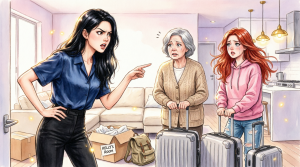
When he reached his floor, he saw the boxes first.
Three cardboard boxes sat beside his door.
One had KITCHEN written on it in black marker.
One had clothes spilling over the top.
The third was taped badly, one corner lifting away from the cardboard.
His mother’s car keys rested on top like a claim.
Trevor stopped so abruptly the grocery bag swung against his leg.
For a moment, his mind tried to make the scene belong to someone else.
Maybe a neighbor was moving.
Maybe the boxes had been left at the wrong door.
Maybe there was some explanation that did not involve the sick tightness forming behind his ribs.
Then he reached for his key.
It would not turn.
He tried again.
Nothing.
This was the same key he had used that morning.
It was on the ring with his office badge, mailbox key, and the tiny bottle opener Marco had given him as a joke when he moved in.
The metal scraped uselessly inside the lock.
That was when his body understood before his mind wanted to.
Someone had changed it.

He set the grocery bag down slowly.
The paper crinkled.
The root beer rolled against the frozen pizza.
Somewhere behind a neighbor’s door, a television laughed.
Trevor knocked.
No answer came.
He knocked again, harder this time.
Inside, he heard a drawer close.
Then footsteps.
Then a woman’s voice.
The door opened, and Leah stood there wearing one of his old college hoodies.
She held her phone in one hand and a mug from his kitchen in the other.
She blinked at him like he had arrived early to a place she had already been promised.
“Trevor,” she said. “You’re home early.”
He looked past her into his own living room.
A duffel bag sat on his couch.
Shoes were piled near his rug.
His throw blanket was dragged over the armchair.
A framed photo he did not recognize sat on his side table.
One of his plants had been moved to the floor.
Then his mother stepped out of the kitchen, wiping her hands on his dish towel.
“There you are,” she said. “We were wondering when you’d get back.”
The casualness was the part that almost made him lose his temper.
Not the boxes.
Not the hoodie.
Not even the changed lock.
The casualness.
His mother had walked into his home, rearranged his belongings, and still expected to conduct the scene as if he were late to a family meeting.
Leah leaned against the doorframe.
“Mom said you wouldn’t mind,” she said.
Trevor heard his own voice come out low.
“Wouldn’t mind what?”
His mother gave him the look she used when she wanted him to feel smaller without raising her voice.
“Leah needs some stability right now,” she said. “And you’ve done such a beautiful job with this place.”
She looked around as if his effort had been a decorating service.
Then she smiled.
“How thoughtful of you to prepare this place for your sister.”
The hallway seemed to hold its breath.
The bad tape on the box lifted and settled again.
The fluorescent light hummed above them.
Downstairs, a dog barked once and went silent.
Leah looked into the mug instead of at Trevor.
His mother kept her soft smile in place because she still believed softness made theft respectable.
Nobody moved.
Trevor stepped inside.
Leah moved back with a sharp little noise.
“Can you not make this weird?” she asked.
“This is my apartment.”
His mother’s smile thinned.
“Trevor, don’t start.”
Those two words did something to him.
They reached backward through years of swallowed objections, borrowed money, changed plans, canceled weekends, and quiet resentment.
Don’t start.
As if he had begun the problem by naming it.
Leah set the mug down on his bookshelf.
“I’m not taking anything,” she said. “I just need to stay here for a while.”
“A while?” Trevor asked.
“Until I get back on my feet.”
He looked at the boxes by the door.
“And changing the lock was part of getting back on your feet?”
His mother raised one hand.
“That was for everyone’s comfort.”
Trevor almost laughed.
“My comfort?”
Leah crossed her arms.
“You’re barely here. Mom said you’re always working or at Marco’s anyway.”
That sentence landed in a different place.
He knew exactly where she had gotten it.
Weeks earlier, during a phone call with his mother, Trevor had mentioned that he was not buying a bedroom TV yet because he was barely home enough to use the living room.
He had shared it casually.
He had thought it was conversation.
Now he understood it had been collected.
A person who plans to take from you will often call it listening.
Trevor walked to the coffee table and set down his keys.
His hands were steady.
That surprised him.
Inside, something had gone cold, but the cold was useful.
His mother followed him into the living room.
“You need to look at this from a bigger place,” she said.
“No,” Trevor said.
She blinked.
“Excuse me?”
“No.”
Leah gave a sharp little laugh.
“Wow. Okay.”
His mother lowered her voice.
“She is your sister.”
“I know who she is.”
“She has nowhere comfortable to go.”
“That doesn’t make my home available.”
His mother looked almost wounded.
Trevor recognized the expression and refused it.
He had seen that wound before.
It appeared whenever someone stopped handing her what she had already decided belonged to the family.

Leah stepped closer.
“So what, you’re just going to make me leave?”
“I’m going to ask you to leave.”
“Mom said this would be fine.”
Trevor nodded.
“That seems to be the problem.”
The room went still again.
His mother’s softness disappeared by degrees.
“You have a good job,” she said. “You’re stable. You can adjust.”
Then came the sentence that explained more of Trevor’s childhood than she probably meant it to.
“Leah needs this more than you do.”
There it was.
The old family math.
Need outweighed effort.
Chaos outranked discipline.
The person who built something became the person asked to surrender it.
Trevor looked around the room.
He saw the shelf he had mounted twice because the first attempt came out crooked.
He saw the couch he had reupholstered over three pizza-stained weekends with a friend.
He saw the little scratches on the floor from dragging the coffee table in by himself because delivery cost too much.
He saw the gray-blue paint drying smoothly over walls he had once taped with tired hands at midnight.
This was not just an apartment.
It was evidence.
His mother softened her voice again.
“Sweetheart, don’t make this ugly.”
Trevor looked at her.
“I’m not.”
He crossed to the cabinet beside the entryway and opened the bottom drawer.
Leah frowned.
“What are you doing?”
Trevor took out the black folder.
He had organized it after signing the lease, not because he expected this exact moment, but because he expected life to keep requiring proof from him.
Inside were lease records, payment confirmations, building forms, copies of emails with the property office, receipts for renovation supplies, and the move-in checklist he had photographed before unpacking a single box.
He placed it on the counter.
His mother’s eyes dropped to it.
For the first time since he had arrived, uncertainty moved across her face.
“Trevor,” she said carefully.
He opened the folder.
Leah’s voice got smaller.
“Why do you have that?”
He turned one page.
Then another.
He found the lease first.
Then the payment record.
Then the building policy about lock changes.
Then the maintenance request he had printed later, the one that would become the center of the argument after the first shock passed.
But in that moment, all he needed was the folder under his hand and the truth in black and white.
He looked at both of them.
“Only in your dreams,” he said.
The words were quiet.
That was why they worked.
His mother tried to speak over the silence.
“Trevor, you are overreacting.”
He slid the lease toward her.
“My name is the only name on this.”
“Family doesn’t need paperwork.”
“People who change locks on apartments they do not rent do.”
Leah looked at their mother.
“You said he agreed.”
His mother’s jaw tightened.
“I said he would understand.”
That was the first honest thing she had said all night.
Trevor turned the next page and placed the building’s lock-change policy beside the lease.
It stated that no lock could be altered without written approval from the named tenant or property office.
His mother stared at the page as if the words were rude.
Then Trevor found the maintenance request.
It had been submitted that afternoon, using his name, asking for an emergency rekey because the “primary occupant” had “lost access.”
The phone number listed below the request was not his.
It was his mother’s.
Leah read it once.
Then again.
Her face changed.
“Mom,” she whispered.
His mother did not answer her.
Trevor picked up his phone and called the building’s emergency line.
His voice stayed calm as he explained that his lock had been changed without his authorization and that two people were inside his apartment with boxes.
His mother took one step toward him.
“Hang up,” she said.
Trevor looked at her.
“No.”
The property manager on call asked whether Trevor was safe.
Trevor said yes.
He said the lease was in front of him.
He said he wanted the unauthorized occupants removed from the unit and the lock restored.
That was when Leah finally started crying.
Not loudly.
Not dramatically.
Just enough that the room shifted toward her by reflex, the way every room in Trevor’s life had shifted toward Leah when she showed distress.
This time, he did not move.
His mother did.
“This is what you’re doing to your sister?” she asked.
Trevor did not answer immediately.
He watched Leah wipe her face with the sleeve of his old hoodie.
He felt pity rise in him, but it no longer came with obedience attached.

“She can take her boxes,” he said.
Leah looked at him.
“I really thought you said yes.”
“No,” Trevor said. “You thought Mom had the right to say yes for me.”
That sentence hurt her more because it was true.
A few minutes later, Mr. Alvarez appeared in the hallway.
He had heard voices, but more importantly, he had seen the locksmith earlier.
He told the property manager on speakerphone that a woman matching Trevor’s mother’s description had met the locksmith at the door and said her son had asked her to handle it.
His mother’s face drained of color.
Marco arrived soon after because Trevor had texted him only one word before opening the folder.
Come.
Marco did not storm in or play hero.
He stood in the doorway beside Mr. Alvarez and said, “Trev, what do you need?”
It was a simple question.
It nearly broke him.
Not because Marco fixed anything.
Because for once, someone asked what Trevor needed before deciding what Trevor owed.
The property manager arrived with a maintenance worker and a clipboard.
The conversation became formal after that.
Names were written down.
The unauthorized rekey was documented.
The locksmith invoice was requested.
The lock was scheduled to be changed back that night.
Leah packed the mug first.
Then the hoodie.
Then the framed photo that had appeared on Trevor’s side table as if belonging could be staged with props.
His mother kept trying to make the property manager understand that this was a family matter.
The property manager looked at the lease and said, “Not when the tenant did not authorize entry.”
That sentence did what Trevor’s anger could not.
It made the room official.
Leah carried two boxes out herself.
Marco carried the third because it was heavy, but only after Trevor nodded.
His mother stood in the doorway until the last possible second.
“You are going to regret humiliating us like this,” she said.
Trevor looked past her at the hallway.
“I think I would have regretted letting you stay more.”
She waited for him to apologize.
He did not.
When the door finally closed, Trevor stood in the middle of his apartment and listened to the new silence.
It was not peaceful at first.
It was shaky.
The couch was still wrong.
The plant was still on the floor.
The dish towel smelled like someone else’s hands.
The grocery bag sat abandoned near the entryway, the pizza softening, the salad warming, the root beer no longer cold.
Trevor picked up the plant first.
Then the mug Leah had used.
Then the framed photo that had left a dustless rectangle on his side table.
He did not cry until Marco asked whether he wanted him to stay.
Then Trevor sat down on the floor beside the coffee table and covered his face.
He cried for the lock.
He cried for the folder.
He cried for every earlier moment when he had been told that being good meant being easy to take from.
Marco did stay.
He reheated the pizza even though the crust went strange.
Mr. Alvarez knocked once and left a small container of soup by the door without making Trevor talk.
The maintenance worker changed the lock before midnight.
Trevor watched the new key turn cleanly.
The sound was small.
It felt enormous.
The next morning, Trevor went to the property office and gave a written statement.
He removed his mother from every emergency contact form.
He changed his email password.
He asked for written confirmation that no lock service could be requested by phone without his direct approval.
He photographed the boxes’ scuff marks in the hallway, the moved furniture, the maintenance request, and the old key that no longer worked.
Not because he planned to destroy anyone.
Because he was done letting anyone destroy the record.
His mother called again and again that weekend.
He did not answer.
Leah texted once.
I really thought you knew.
Trevor stared at the message for a long time.
Then he wrote back, I hope you find a fresh start, but it will not be in my home.
She did not respond.
For a while, the quiet in the apartment felt unfamiliar.
Trevor had thought silence would feel immediately like victory.
It did not.
At first, it felt like withdrawal from chaos.
His phone did not light up with demands because he stopped rewarding the demands.
His mother’s sighs did not fill the room because he stopped answering the calls.
Leah’s emergencies did not become his schedule because he stopped letting love be measured by how much access he surrendered.
Weeks passed.
The gray-blue walls stayed gray-blue.
The shelf stayed level.
The plant recovered after he moved it back into the light.
Trevor bought the bedroom TV eventually, not because he needed it, but because he liked the idea of making a decision in his own home for no reason except wanting it.
One Friday night, he came home from work with another frozen pizza and another overpriced root beer.
There were no boxes outside his door.
His key turned.
The apartment opened.
He stood there for a second, listening to the clean hum of the refrigerator and the distant sound of traffic through the window.
The sentence that stayed with him was simple: I had trained everyone to believe I would always figure it out myself.
That was true once.
But figuring it out did not have to mean surrendering everything quietly.
Sometimes it meant opening the folder.
Sometimes it meant saying no in a voice calm enough to scare the people who had always counted on your guilt.
And sometimes home begins the moment you stop letting family use that word as a spare key.
THE END.