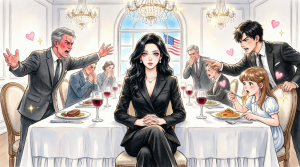
My Younger Brother Snarled At The Year-End Party, “YOU’RE JUST A BASTARD,” Then Dropped A Chewed Bone Onto My Daughter’s Plate. Everyone Burst Out Laughing. I Simply Said: “EVERYONE WILL GET WHAT THEY DESERVE.” They Had No Idea What Awaited Them The Next Day.
Part 1
I’m Diane Larson, thirty-five, and I’ve lived long enough in Missoula, Montana to recognize the kind of cold that doesn’t come from weather. The year-end party at my parents’ house always had its rituals: the same playlist, the same dry turkey, the same relatives circling the living room with paper cups of punch like they were at a polite wake instead of a celebration.
I brought my daughter, Grace, because I kept believing this year would be different. She’s nine, small for her age, the kind of kid who watches people before she decides where she fits. She wore the green sweater Ellen—my aunt, my dad’s younger sister—had picked out with her. A little sparkly in the collar. “Holiday armor,” Ellen had called it with a wink. Grace had smiled and said she liked how it caught the light.
When we arrived, the driveway was packed with familiar cars. The SUV I’d helped my parents buy sat closest to the garage. My brother’s beat-up sedan was angled too far into the grass, like the rules didn’t apply to him. That was typical. Evan had always taken up space like he couldn’t imagine a world that asked him to move.
Inside, my mom, Nancy, kissed the air beside my cheek and commented on Grace’s hair. My dad, Dennis, gave a quick pat on my shoulder and asked, “Work going okay?” the way someone asks about the weather.
Evan didn’t greet us. He didn’t need to. He’d been texting his friends on the couch, feet on the coffee table, laughing at something on his phone like the room existed to be his audience. When Grace walked by, carrying the plastic container of cookies she’d baked with me the night before, he glanced up and smirked.
“Look who’s here,” he said loud enough for everyone to hear. “Missoula’s favorite charity case and her little… accessory.”
Grace froze for a heartbeat. I felt her fingers tighten around the container. I kept my face calm and nudged her forward toward the kitchen like we hadn’t heard him, like his words were just noise.
Moms get good at selective deafness. You do it to survive.
The party moved into its usual rhythm. Aunts asked me if I was “dating yet.” Cousins asked if I still lived “in that apartment downtown,” like my zip code was a moral failure. My parents’ friends told me Grace was “so well-behaved” the way you tell someone their dog doesn’t bark.
Grace sat at the table quietly when dinner was served. She arranged her napkin in her lap, the way I’d taught her, and took small bites of mashed potatoes. She didn’t complain. She didn’t ask for anything. She just tried not to be a problem.
It shouldn’t have mattered, but it did. Because I’d seen how my family treated kids who demanded attention. They adored them. Evan’s stories were always “funny.” His mistakes were always “learning experiences.” His needs were always urgent.
My daughter’s needs were always inconvenient.
Dinner was almost over when it happened. People were half-finished with dessert—store-bought pie my mom claimed was “from that cute bakery”—and my dad was already turning the conversation toward finances, complaining about heating costs like he didn’t have a daughter who’d been paying them for years.
Evan stood up suddenly, chair scraping the tile. He was holding a chicken bone in one hand, gnawed down to the glossy white center.
He looked at Grace and his mouth curled.
“You know,” he said, voice sharp as a blade, “it’s wild you even think you belong here.”
The room went quiet in that way rooms do when everyone senses trouble but hopes someone else will manage it.
Grace’s fork stopped halfway to her mouth. Her eyes flicked to me, then down to her plate.
Evan leaned forward over the table, breath smelling like beer. “You’re a bastard,” he snarled, and then—like it was the natural conclusion to his sentence—he tossed the chewed bone onto Grace’s plate.
It landed with a wet little clink against the ceramic.
For a second, I didn’t move. My brain refused to accept the image: my daughter’s plate, her small hands, the chewed bone like an insult made physical.
Grace stared at it. Her face went blank in the way kids go blank when something is too big to process. Then her eyes welled, and she blinked hard like she was trying to push the tears back into her skull.
I looked up at my parents.
My mom laughed.
Not loud, not outright cruel—just a light chuckle like Evan had told an edgy joke and everyone was supposed to be impressed by his “honesty.”
My dad smirked into his coffee.
That sound did something to me. It wasn’t the bone. It wasn’t even Evan’s word, though it was vile enough to deserve consequences. It was my parents’ laughter. Their ease. Their comfort with my daughter being hurt.
It cut deeper than anything Evan could say.
Grace’s lips trembled. She didn’t cry loudly. She made no scene. She just sat there, shoulders pulled in, trying to make herself smaller than the chair.
I stood up slowly and lifted the bone off her plate with two fingers like it was contaminated. I set it down on Evan’s napkin.
My voice came out steady, but cold. “Everyone will get what they deserve.”
Evan’s eyebrows shot up. “Oh, come on. It’s just—”
“Grace,” I said softly, not looking at him, “honey, get your coat.”
Grace pushed her chair back carefully. I could see her trying to keep her face neutral, like she’d been taught that crying gives people permission to call you dramatic.
My mom sighed. “Diane, don’t be so sensitive.”
My dad said, “It’s family. Don’t make it weird.”
Family. The word they used when they wanted me to swallow my dignity.
Grace’s small hand slid into mine. It was warm and shaking.
We walked out. I didn’t argue. I didn’t explain. I didn’t give them the satisfaction of watching me fight for my place at their table.
The door slammed behind us.
In the car, Grace stared out the window at the snow piled along the curb. The streetlights made it glow pale and blue. Missoula looked quiet, almost peaceful, like the town hadn’t just watched my daughter get humiliated and done nothing.
She whispered, “Mom… did I do something wrong?”
My chest tightened so hard it hurt to breathe.
“No,” I said. “You did nothing wrong. You hear me? Nothing.”
Grace nodded, but her eyes stayed fixed on the dark glass.
That night, I drove through the snow-covered streets to my aunt Ellen’s house, because some people in this family had always been kind, and I needed to remember that before I did what I knew I had to do next.
Ellen opened the door before I could knock, like she’d sensed us coming the way good people do. She took one look at Grace’s face and my trembling hands and pulled us into the warmth.
Over tea, with Grace tucked on Ellen’s couch under a quilt, I told her everything—Evan’s word, the bone, my parents laughing like cruelty was entertainment.
Ellen listened without interrupting. When I finished, she leaned forward and rested her hand on mine.
“Diane,” she said, gentle but firm, “you’ve been their bank for years. You’ve paid his tuition. Their bills. Their lives. What have they given you in return?”
Her question landed like truth always does—heavy, undeniable.
Something snapped inside me, clean and final.
“You’re right,” I said. “I’m done.”
Ellen nodded. “Protect your daughter. Protect yourself.”
I pulled out my phone and typed a message to my mom and dad while my hands still shook.
I’m stopping all financial support. Effective immediately.
I hit send.
The weight that lifted off my shoulders wasn’t relief yet. It was certainty.
I didn’t know how they’d react.
But I was ready.
Part 2
If you asked my family, they’d tell you I’ve always been “the responsible one.” They say it like it’s a compliment, like responsibility is something you’re born with and not something you’re forced into when the people around you keep dropping the ball.
I learned early that my brother was allowed to want things. I was allowed to handle things.
Evan is two years younger than me. When we were kids, he broke his wrist trying to jump off the garage roof with an umbrella because he’d seen it in a cartoon. My mom cried and told him he was “so brave.” My dad ruffled his hair and said, “That’s my boy.”
When I got straight A’s and came home waving my report card like it was a flag, my mom said, “Good. Keep it up.” Then she asked me to help unload groceries.
That was my life in miniature.
So when Grace’s father disappeared halfway through my pregnancy, I didn’t call my parents for comfort. I didn’t call them at all. I knew how the story would go: I’d be the cautionary tale at family dinners. The example. The lecture. The quiet shame.
I built my life anyway.
I finished school, landed a steady job in operations for a regional financial services company, and worked my way up one promotion at a time. I bought Grace a secondhand crib. I learned how to stretch a paycheck. I learned how to say no to myself so my daughter could say yes to small things like school field trips and winter boots that didn’t leak.
And somewhere along the line, I started paying my parents’ bills.
It began small. A “temporary” gap in their budget when my dad’s hours got cut. A “one-time” medical co-pay. A “quick loan” to cover a car repair.
Then Evan decided he needed college.
Not because he had a plan. Because he didn’t want to work at the lumber yard like his friends.
“Just help him get started,” my mom said, voice sweet with expectation. “You want your brother to have options, don’t you?”
I did. Of course I did. I wanted Evan to have everything I never got—support, belief, room to fail safely.
So I wrote checks. I sent transfers. I paid tuition. Ten thousand dollars the first year alone, on top of rent and daycare and my own student loan payment.
Whenever I hesitated, my parents reminded me: family.
Whenever I asked for gratitude, they made it sound like I wanted a medal.
“You’re doing what a sister does,” my dad would say, like it was duty, not sacrifice.
And I told myself it would pay off in something you can’t quantify. Love. Respect. Belonging.
Except love that has to be purchased isn’t love.
It’s a subscription.
Grace grew up in the shadow of that arrangement.
Every year at holidays, I brought food, gifts, my best attitude. Every year, Evan showed up late, ate like a king, and found a way to make a joke at my expense.
He called me “Saint Diane” in front of relatives. He asked Grace loudly if she’d ever met her “mystery dad.” He’d smirk when she looked confused and say, “Just kidding. Kinda.”
My parents never corrected him. They laughed. Or worse—they looked away.
I told myself they didn’t notice. I told myself they didn’t understand how much it hurt.
But the truth, the one I’d avoided because it was too ugly, was that they noticed and chose comfort over courage.
That night at Ellen’s house, after Grace fell asleep on the couch, I sat at Ellen’s kitchen table staring at my phone.
My message to my parents had been delivered.
Three dots appeared almost immediately. Then disappeared. Then appeared again.
Finally, my mom texted: Diane, don’t be dramatic.
Ellen leaned over my shoulder and snorted. “Dramatic,” she muttered. “As if your kid didn’t just get a bone thrown at her.”
My dad’s message arrived next: Call us. We need to talk.
Translation: We need to pressure you until you fold.
Evan’s message came last: You’re seriously leaving? Over a joke? You’re always so sensitive.
I stared at the words until my eyes burned.
Ellen poured more tea and sat across from me. “Tell me something,” she said. “If you weren’t sending them money, what would your life look like?”
I imagined it—me not checking my bank account every day like it was a blood pressure monitor. Me not rationing my grocery list so my parents could keep their SUV. Me not waking up at night wondering what crisis they’d create next.
I imagined Grace in a life where holidays didn’t feel like a test.
“Calmer,” I said quietly.
Ellen nodded. “Then do that.”
I didn’t sleep much that night. Grace’s question replayed in my mind like a loop: Did I do something wrong?
I kept thinking about the bone on her plate, the way it looked like garbage where her food should’ve been. And I understood something with a clarity that made my stomach twist.
They weren’t just insulting my daughter.
They were teaching her where she belonged.
Or rather, where she didn’t.
In the morning, I drove Grace home through fresh snow. She was quiet in the back seat, hugging a stuffed rabbit Ellen had given her years ago.
At a stoplight, she said softly, “Are we in trouble?”
I glanced at her in the rearview mirror. “No,” I said. “We’re… changing things.”
Grace blinked. “Like moving?”
“Not yet,” I said, and that word felt like a promise. “But we’re not going back there.”
When we got home, I made pancakes even though it was a weekday. Grace ate two without looking at the clock. I packed her lunch with extra strawberries.
After I dropped her at school, I sat in my car for a long time in the parking lot, watching kids run through snow like it didn’t sting their cheeks.
Then my phone buzzed again.
My mom: Your brother needs tuition. Your father’s bills are due. Don’t punish us for one bad moment.
One bad moment.
Like cruelty had been an accident.
I typed back slowly, my hands steady now.
You chose to laugh. You chose him. I’m choosing my child.
Then I turned my phone off.
At work, Brenda noticed immediately. Brenda is my best friend and colleague, the kind of woman who doesn’t need you to say you’re falling apart—she sees it in the way you hold your shoulders.
“You okay?” she asked, shutting my office door behind her.
I told her the short version, because if I told her everything I might start shaking again.
Brenda’s eyes went hard. “They did that to Grace?”
I nodded.
Brenda exhaled sharply. “Diane,” she said, “you’re done. Do you hear me? Done. They don’t get to cash your kindness like it’s a check.”
That day, my parents kept calling. My brother left a voicemail that started with whining and ended with threats.
I deleted them all.
Because the truth was, I’d been afraid of being the bad guy.
But my daughter had been made to feel like she was nothing.
And I’d rather be the villain in their story than the weak link in hers.
Part 3
By the next morning, my phone was a storm.
My mom’s texts arrived in clusters, like she believed volume could substitute for reason.
How could you do this to us?
We raised you better than this.
You’re abandoning your family.
You’re selfish, Diane.
My dad sent one message that stung more than the rest because it was quiet and disappointed, like he was the injured party.
We are ashamed of you.
I stared at the screen until the words blurred. Shame was their favorite tool. It kept me obedient. It kept me paying.
Grace came into the kitchen in her pajamas, hair sticking up in soft chaos. She looked at my face and froze.
“Is Grandma mad?” she asked.
I swallowed hard. “Grandma is… upset,” I said carefully. “But that’s not your job to fix.”
Grace nodded like she understood, then asked the question that made me want to cry.
“Do we still have to go to their house on New Year’s?”
“No,” I said, and the relief in my own voice surprised me. “We don’t.”
Grace exhaled, small and shaky. “Okay,” she whispered, like she’d been holding that worry in her chest all week.
At school pickup, I felt eyes on me. Missoula is big enough that you can disappear if you want to, but small enough that gossip travels faster than weather.
A mom from Grace’s class approached with a sympathetic smile that didn’t reach her eyes. “Everything okay with your family?” she asked, soft but curious.
I forced a polite expression. “We’re fine,” I said.
Her gaze flicked to Grace. “Well… you know… family is family.”
There it was again.
That phrase people use like a rule, not a choice.
Grace climbed into the car and said, “That lady was looking at me weird.”
I glanced at her. “She was looking at the story she heard,” I said. “Not you.”
Later that day, my mom escalated the way she always did when she couldn’t control me directly: she went public.
She posted on Facebook, vague but pointed:
Some people turn their backs on family when they need them most. I pray they find their way back.
The post collected likes from distant relatives and old neighbors, people who didn’t know the truth and didn’t ask. Comments rolled in: Stay strong, Nancy. Kids today have no loyalty. Prayers.
Brenda sent me a screenshot with one word attached: Gross.
My aunt Ellen called. “Don’t you dare respond,” she said without hello. “Let her embarrass herself.”
“I’m trying,” I said, voice tight.
“You don’t owe the internet your pain,” Ellen replied. “You owe Grace your protection.”
That night, Evan called me directly.
I let it go to voicemail because I didn’t trust myself not to scream. He left a message anyway, voice sharp with entitlement.
“Diane, you can’t just cut me off. I need that money for college. You owe me.”
Owe.
Like my paycheck was his inheritance.
I listened twice, then deleted it.
When he called again, I answered.
“What?” I said, not bothering with softness.
Evan exhaled dramatically like I was the difficult one. “You’re ruining everything,” he snapped. “Mom’s freaking out. Dad’s stressed. And I’ve got tuition due. You’re really doing this because I made a joke?”
“It wasn’t a joke,” I said, voice flat. “You humiliated my daughter.”
He scoffed. “Oh my God, she’s fine.”
“She cried in the car,” I said quietly. “She asked me if she did something wrong.”
Evan went silent for a beat. Then he said, “Well… maybe she should toughen up.”
Something cold settled in my chest. “You don’t get to speak about my child like that ever again,” I said.
Evan laughed. “Listen to you. Acting like you’re some hero mom.”
“I’m her only parent,” I replied. “So yes. I’ll act like it.”
He tried another angle. “You’re punishing us because you’re bitter,” he said. “Because you don’t have a husband. Because you’re jealous—”
“I’m done,” I cut in. “You don’t get my money. You don’t get my time. You don’t get access to Grace.”
Evan’s voice rose. “You can’t do that!”
“I already did,” I said.
He started shouting, words tumbling out, but I hung up.
My hands shook afterward. Not because I doubted myself. Because the finality of it felt like stepping off a cliff even when you know the ground below is solid.
Grace watched me from the couch, hugging her rabbit.
“Was that Uncle Evan?” she asked softly.
“Yes,” I said.
“Is he mad?” she asked.
“Yes,” I replied honestly. “But mad doesn’t mean right.”
Grace nodded slowly. “I don’t like him,” she said, and her bluntness made me laugh, a short burst of relief.
“You don’t have to like him,” I said. “You don’t have to like anyone who’s mean to you.”
That weekend, I took Grace to the carousel downtown, the one that smells like popcorn and old paint. We rode the same horse three times. She laughed, real laughter, the kind that makes kids forget for a minute that adults can be cruel.
On the way home, she said, “Mom… are we poor now?”
My throat tightened. Kids feel instability like animals feel storms.
“No,” I said. “We’re okay. We’re actually… better.”
Grace frowned. “How?”
“Because our money stays with us,” I said. “And our peace stays with us.”
She thought about that, then nodded like it made sense.
That night, after she fell asleep, I opened my laptop and looked at my finances. I saw the steady drain my parents had become—utilities, insurance payments, “temporary” transfers that were never temporary.
I stopped every automatic payment I’d set up for them. One by one. Click. Confirm. Done.
Each cancellation felt like cutting a rope that had been strangling me slowly for years.
And then my inbox pinged.
A notification from our credit monitoring service.
I almost ignored it. I’d been getting alerts all week because stress makes you paranoid.
But something in my gut told me to open it.
New account activity detected.
My name.
A loan.
Ten thousand dollars.
My stomach dropped so hard I thought I might throw up.
Part 4
Brenda stepped into my office Monday morning with a folder tucked under her arm and a look on her face that made me sit up straight before she even spoke.
“Diane,” she said, closing the door behind her, “we need to talk.”
Brenda isn’t a dramatic person. She doesn’t panic. She problem-solves. So when she looks worried, you pay attention.
“What’s wrong?” I asked.
She slid the folder across my desk. “I was reviewing some financial records for a client,” she said, voice low, “and I saw something that made me check your credit alerts. I pulled the public filings.”
My pulse thudded in my ears.
Brenda tapped a page in the folder. “Your mom took out a loan using your name,” she said. “Ten thousand dollars. And it’s delinquent.”
For a second, I couldn’t breathe. The air in my office felt too thin.
“That’s… no,” I whispered. “She wouldn’t.”
Brenda’s eyes softened. “I wish I was wrong,” she said. “But look.”
There it was. My name. My social security number. My address—an old one, but still mine. A signature that looked like mine if you squinted, like someone had practiced copying it.
The betrayal cut deeper than the bone, deeper than Evan’s slur, because this wasn’t cruelty for sport.
This was theft.
My mother had forged my identity.
I stared at the documents until my vision blurred. “How could she do this?” I whispered.
Brenda leaned forward. “Because she’s gotten away with everything else,” she said quietly. “And because you’ve been paying. She thought you’d keep paying.”
A hot wave of nausea rolled through me. I pushed my chair back and stood, pacing once, then twice, like movement could keep my body from collapsing.
Grace. My credit. My housing. My job. Everything I’d built for us depended on stability. A delinquent loan could wreck it fast.
Brenda’s voice stayed steady. “You need to act now,” she said. “This isn’t about family feelings anymore. This is about protecting yourself.”
I swallowed hard, forcing air into my lungs. “What do I do?”
“Gather proof,” Brenda said. “Report it as fraud. Put a freeze on your credit. Call the bank today.”
My hands shook as I opened my laptop and logged into my credit monitoring. The loan sat there like a bruise. The account number, the payment history, the delinquency mark.
I saved screenshots. I printed everything. I made copies and scanned them into a file labeled Fraud.
I didn’t cry. I didn’t have the luxury.
By lunchtime, I called the bank listed on the loan.
A customer service rep answered, cheerful. “How can I help you today?”
“My name is Diane Larson,” I said, voice tight but controlled. “There is a loan in my name that I did not authorize. I’m reporting fraud.”
The rep’s tone changed immediately. “Okay, Ms. Larson. I’m going to transfer you to our fraud department. Can you verify—”
I gave my information, every detail sharp and precise. I emailed the evidence Brenda had collected. I filed an official dispute.
The fraud officer’s voice was professional, almost gentle. “We’ll investigate,” he said. “If this was identity theft, we’ll take legal action.”
Legal action.
The phrase should’ve scared me. Instead, it felt like oxygen.
Because for once, there was a process bigger than my family’s manipulation. For once, consequences didn’t depend on whether I felt guilty enough to let them off the hook.
That evening, my mom called.
I didn’t answer. She left a voicemail, voice frantic and syrupy at once.
“Diane, honey, we need to talk. There’s been a misunderstanding. Call me back.”
A misunderstanding.
My mother had forged my name and called it a misunderstanding.
My dad texted next: We can explain. Don’t do anything rash.
Rash. Like reporting fraud was impulsive.
Then Evan: What did you do? Mom’s crying. Fix it.
Fix it.
Always me. Always the repairman for their disasters.
I didn’t respond. I turned my phone off and made Grace mac and cheese.
Grace sat at the counter coloring. She looked up and asked, “Mom, are you mad?”
I took a breath and chose honesty that didn’t burden her.
“I’m serious,” I said. “When someone does something wrong, we handle it.”
Grace nodded slowly, then went back to coloring, drawing a little house with big windows and a swing set in the yard.
Two weeks later, the bank called.
“Ms. Larson,” the fraud officer said, tone grim, “we’ve concluded our investigation. The evidence points to fraud committed by your mother, Nancy Larson.”
Hearing it confirmed felt like a punch and a relief at the same time. I wasn’t crazy. I wasn’t imagining things. I wasn’t overreacting.
The bank froze the account. They removed the delinquency mark from my report pending final resolution. And they said the words that changed everything:
“We are pursuing legal action.”
That evening, my mom called again, voice shaking. “Diane, you have to stop this,” she pleaded. “Tell them it was a mistake. They’re coming after us.”
My dad joined in, tone softer, desperate. “We’re your parents. You can’t let this ruin us.”
They weren’t sorry.
They were scared.
“You did this to yourselves,” I said, voice cold. “I’m not withdrawing the complaint.”
My mom gasped. “How can you be so cruel?”
Cruel. The irony almost made me laugh.
“I’m not cruel,” I said. “I’m finished being used.”
She started crying harder, loud enough that I could hear my dad muttering in the background, trying to calm her, like he was managing a problem instead of facing a truth.
I ended the call.
Days later, news spread in our small town the way it always does: through whispers at grocery stores, through vague social media posts, through people who pretend they’re concerned while they chew on gossip like candy.
A cousin messaged me: Heard your parents might be selling the SUV. Everything okay?
Another: Your mom says you’re attacking them. Is that true?
I didn’t reply.
I focused on Grace.
On her homework. On her bedtime stories. On her small questions that needed steady answers.
One night she asked, “Will Grandma come to my school play?”
I swallowed. “No, honey,” I said softly. “Not this time.”
Grace nodded, quiet. “Okay,” she whispered, and it broke my heart that she’d learned how to accept disappointment so gracefully.
But then she looked up. “Aunt Ellen will come,” she said, certain.
“Yes,” I replied. “Aunt Ellen will come.”
And that was the beginning of a new truth in our house:
Family wasn’t the people who claimed you when you paid.
Family was the people who showed up when you didn’t.
Part 5
The first thing my parents sold was the SUV.
It appeared on Facebook Marketplace with a flattering photo taken at an angle that made it look newer than it was. “Great condition. Must sell ASAP,” the listing read. My mom’s voice in text form—urgent, dramatic, still pretending this was just “bad timing” and not the bill for years of entitlement.
A week later, a FOR SALE sign went up in their front yard.
That’s when the town really noticed.
In Missoula, people pretend they’re not watching until you give them something obvious. A sign in a yard is obvious. It says: something happened here.
My mom’s Facebook posts shifted from vague guilt-tripping to full martyrdom.
We’re doing what we have to do to survive.
Hard times reveal true hearts.
Some people forget who loved them first.
Every post got likes from people who had never once offered to help when my parents “struggled.” People love to cheer from the sidelines.
Then, one afternoon, a letter slid under my apartment door.
I recognized my mom’s handwriting immediately. Neat cursive, the same kind she used on birthday cards when I was a kid. The familiarity made my stomach twist.
I opened it, and my dad’s handwriting joined hers, heavier, more rigid.
Diane, you’ve torn this family apart. Fix your mistake. Start sending money again or you’ll regret it.
The audacity hit me like a slap. They’d been caught committing fraud in my name, and they were still issuing demands.
I crumpled the paper in my fist so tightly it tore.
Grace was in the living room practicing spelling words. She looked up, eyes wide. “Mom?”
I forced my face calm. “Nothing you need to worry about,” I said, and I meant it. She didn’t need to carry their poison.
That night, after Grace fell asleep, I blocked their numbers one by one.
Mom. Dad. Evan.
Gone from my contacts.
On Facebook, I blocked their profiles, cutting off the venomous posts and the comment threads where relatives performed concern like theater.
Each tap felt like shedding a weight I’d carried too long.
The next morning, I did something else I’d been putting off for years.
I signed a lease for a new apartment downtown.
My old place was fine, but it was too close to my parents’ neighborhood, too easy for surprise visits, too easy for them to pretend they could still barge into my life whenever they wanted. The new place was modern, close to my office, with big windows and a small balcony.
It had space for sunlight.
It had space for us.
Moving day was hectic, boxes stacked, Grace darting around like she was both excited and nervous. Ellen showed up with her old pickup truck and a determination that made me laugh through exhaustion.
“I’ve moved three people out of bad marriages,” she said, lifting a box like it weighed nothing. “Moving you out of a bad family habit is easy.”
Brenda arrived too, wearing leggings and a ponytail, carrying coffee and a bag of bagels like we were prepping for battle.
Grace watched them, eyes bright. “This is our home now, isn’t it?” she asked, voice small with hope.
I knelt and hugged her tightly. “Yes,” I said. “Just ours.”
That first night in the new apartment, I lay awake staring at the ceiling.
The silence was different.
No buzzing texts. No guilt trips. No phone calls that made my stomach drop. Just quiet. And for the first time, quiet felt safe, not lonely.
A week later, the bank’s legal process moved forward. I was asked to provide a statement. I gave it. I was asked if I wanted to press charges.
I hesitated for a heartbeat, guilt trying to crawl up from old habits.
Then I remembered the bone on Grace’s plate.
I remembered my mom laughing.
I said, “Yes.”
Not because I wanted revenge.
Because I wanted a line in the sand my family could never cross again.
Around that time, something else happened—something good, the kind that feels suspicious when life has been hard for too long.
My boss called me into her office and closed the door.
“Diane,” she said, smiling, “I have news. We’re promoting you to regional director.”
I blinked like I hadn’t heard correctly.
“You’ve been carrying this branch,” she continued. “You’re organized, steady, and you take care of your people. We need that across Montana.”
The raise that came with it wasn’t just money. It was air. It was stability. It was proof that my life wasn’t falling apart just because I stopped paying for other people’s comfort.
I left her office in a daze, then called Ellen first.
“You earned this,” she said, voice warm with pride. “You fought for it.”
Brenda screamed loud enough that I had to hold the phone away from my ear.
Grace didn’t fully understand what a regional director was, but she understood what it meant when I said, “We’re going to be okay.”
That spring, Ellen started taking Grace to dance classes at a studio near downtown. I’d always wanted Grace to have something that was just hers, something joyful, something that didn’t involve tiptoeing around other people’s feelings.
The first day, Grace walked into the studio in tights and a borrowed leotard, shoulders tense like she expected to be laughed at.
Then the teacher clapped her hands and said, “Welcome, Grace!”
And the other girls smiled.
Grace’s shoulders loosened like someone had untied a knot inside her.
She came home that night and spun in the living room, giggling.
I watched her and felt something I hadn’t felt in months:
Hope without fear attached to it.
Part 6
Court dates don’t look like justice on television.
They’re fluorescent lights and long waits and people in cheap suits carrying folders. They’re metal detectors and hard benches and the smell of stale coffee from a vending machine that never works properly.
The first time I walked into the courthouse in Missoula, I felt sick. Not because I doubted what I was doing, but because I knew my family would try to make me feel like the villain no matter what the facts said.
Ellen came with me, wearing her nicest coat and a scarf that made her look like she’d stepped out of a painting.
“You don’t go alone,” she said simply.
Brenda took a morning off work and sat behind us, arms crossed, eyes sharp. “If anyone looks at you sideways, I’ll stare them into next year,” she whispered.
I almost laughed. Almost.
My parents arrived together. My mom’s face looked puffy, eyes red like she’d practiced crying. My dad’s jaw was set hard, the way it got when he wanted to appear strong. Evan slouched behind them, hands shoved in his pockets, eyes darting around like he was hunting for sympathy.
My mom didn’t look at me at first. When she finally did, her expression was pure betrayal, like I was the one who’d committed a crime.
She whispered to my dad, loud enough for me to hear, “How could she do this to us?”
I stared straight ahead.
The prosecutor laid out facts. Documents. Signatures. The bank’s investigation. The loan application tied to my identity. The delinquent payments. The evidence of fraud.
Facts don’t care about tears.
When my mom’s lawyer spoke, he tried the only strategy available when truth is against you: he painted it as a family misunderstanding.
“She didn’t mean harm,” he said. “It was an error. A desperate moment. She’s a mother trying to keep her family afloat—”
Ellen’s hand tightened on mine, and I felt my anger rise like heat.
The judge, a woman with tired eyes and no patience, leaned forward. “Mrs. Larson,” she said to my mom, “did your daughter authorize you to take a loan in her name?”
My mom’s mouth trembled. “She—she helps us,” she stammered. “She always helps.”
“That is not an answer,” the judge said calmly. “Did she authorize it?”
My mom swallowed. “No.”
The word hung in the room like a bell.
No.
My dad’s shoulders sagged slightly. Evan looked suddenly uncomfortable, like it was different hearing it spoken aloud.
The judge didn’t raise her voice. She didn’t need to.
She spoke about identity theft. About fraud. About how family relationships didn’t exempt anyone from consequences.
My mom was offered a plea deal: restitution, probation, community service, mandatory financial counseling. If she violated terms, it would become worse. A lot worse.
My mom looked at my dad, then at Evan, then back at the judge, and finally at me, like she expected me to save her one last time.
Her eyes begged: Fix it.
I didn’t move.
Because this wasn’t about punishing her.
It was about teaching Grace—my daughter—that love does not require you to accept abuse.
Outside the courthouse after the hearing, my dad approached me.
He looked older than I remembered, lines deeper around his mouth. For a second, I almost saw the father he could’ve been.
“Diane,” he said quietly. “You didn’t have to take it this far.”
I stared at him. “You laughed,” I said. “When Evan threw a bone on my daughter’s plate.”
His face tightened. “That was—”
“No,” I cut in. “Don’t minimize it. You laughed. Mom laughed. You taught Grace that she wasn’t safe with you.”
My dad’s eyes flickered. “We’re family.”
“I have a family,” I said, voice steady. “Her.”
My mom stepped closer, tears streaming now, real or practiced—I didn’t care.
“You’re destroying us,” she sobbed.
“You forged my name,” I replied. “You did that. Not me.”
Evan scoffed behind them. “This is so dramatic.”
Ellen turned sharply, eyes blazing. “The only dramatic thing here is you,” she snapped. “You threw garbage onto a child’s food and called it funny.”
Evan’s face went red. “I was joking.”
Ellen’s voice didn’t soften. “If the punchline is a kid crying, it’s not a joke.”
For once, Evan had no response.
He looked away.
That night, at home, Grace asked, “Where did you go today?”
I hesitated. “I had to handle some grown-up paperwork,” I said.
Grace nodded thoughtfully. Then she said, “Are Grandma and Grandpa still mad?”
“Yes,” I admitted.
Grace stared at her homework for a moment, then said something that made my throat tighten.
“I’m kind of glad,” she whispered. “Because I don’t want them to think they can do that to me.”
I sat beside her and wrapped an arm around her shoulders. “They can’t,” I said. “Not anymore.”
Over the next month, whispers in town shifted.
Some people still sided with my parents. People always defend what feels familiar, even if it’s wrong.
But others started asking questions.
Brenda’s cousin messaged me privately: I’m sorry I believed the Facebook posts. I didn’t know what happened to Grace.
A neighbor stopped me in the hallway and said quietly, “I saw your mom’s SUV on Marketplace. I’m sorry. You didn’t deserve that.”
It wasn’t full vindication, but it was something better: truth cutting through the fog.
And in our apartment, truth felt like safety.
Grace kept dancing.
She kept laughing.
And I kept building.
Part 7
By summer, our life had a rhythm that didn’t revolve around panic.
Mornings were cereal and backpacks and Grace practicing spelling words while I made coffee. Evenings were dinner on the balcony when the sky turned pink over the mountains, the kind of quiet that feels earned.
My promotion to regional director meant travel—Bozeman, Helena, Kalispell—long drives across Montana with playlists and phone calls and the steady pressure of being in charge of more than just my own desk.
But the best part wasn’t the title.
It was the security.
I didn’t have to check my bank account in fear. I didn’t have to dread surprise “emergencies” that weren’t emergencies at all. I could say yes to Grace’s dance recital costume without doing mental math.
Ellen became a fixture in our week. She’d pick Grace up on Tuesdays, take her to dance, then bring her home with a smoothie and stories about her own childhood.
Grace started asking Ellen questions I’d never heard her ask anyone else.
“What was Mom like when she was little?” she’d ask.
Ellen would laugh and say, “Your mom was stubborn. She still is. She always stood up for people, even when it cost her.”
Grace would glance at me with pride.
Sometimes I caught her looking at old photos on Ellen’s phone—me at eight, missing two front teeth, smiling like the world couldn’t hurt me yet.
It struck me then how much kids need to see their parents as whole people, not just providers, not just protectors, but humans who’ve survived.
Brenda stayed my anchor at work. When stress hit, she’d step into my office, close the door, and say, “Breathe, Diane. You’ve flown through worse storms.”
One afternoon, she brought me a file without being asked.
“Just so you know,” she said quietly, “your credit report is clean now. The fraud note is gone. It’s official.”
I exhaled slowly, relief spreading through my chest like warmth.
“Thank you,” I said.
Brenda shrugged like it was nothing, but her eyes softened. “You did the hard part,” she replied. “You stopped letting them rewrite reality.”
That fall, the court required my mom to start restitution payments.
They weren’t big. My parents didn’t have much left once their financial lies collapsed. They’d sold the SUV. They’d downsized to a small rental outside town.
Evan had dropped out of college—turns out it’s hard to stay enrolled when your tuition source disappears and you have to face the truth that you never cared about school in the first place.
My cousin told me Evan was working at a hardware store now.
A part of me felt satisfaction I didn’t want to admit.
Not because I wanted him to suffer, but because I wanted him to learn what it felt like to work for something instead of taking it.
One day, a letter arrived from Evan.
Not a text. Not a voicemail. An actual letter, like he knew my number was blocked and my boundaries were solid.
I stared at the envelope for a long time before opening it.
Diane,
Mom says you’re ruining the family. Dad says you’re stubborn. Ellen says you’re right.
I still think you went too far with the bank stuff.
But… I guess I didn’t know about the loan. I swear I didn’t.
Also… Grace didn’t deserve what I said. I was drunk. It was stupid.
I’m not asking you to forgive me. I just want you to know I’m not… proud of it.
It wasn’t a full apology. Evan wasn’t suddenly kind. But it was the first crack in the wall of entitlement.
I didn’t respond immediately.
Instead, I showed Ellen the letter while Grace was at dance. Ellen read it, then looked up at me.
“He’s learning,” she said. “Slowly. In his own irritating way.”
“Should I reply?” I asked.
Ellen shrugged. “Only if it serves you,” she said. “Not him.”
That night, Grace came home glowing from dance. “Mom,” she said breathlessly, “Ms. Janelle said I have good turns!”
I clapped and hugged her. “Of course you do,” I said. “You work hard.”
Grace smiled, then grew serious. “Mom… do you think Uncle Evan is sorry?”
I paused, choosing my words carefully. “I think he’s sorry he got caught being cruel,” I said gently. “But that doesn’t mean he can’t grow. People can change. They just don’t change because you forgive them. They change because they decide to.”
Grace nodded slowly. “Okay,” she whispered. “I don’t want him around yet.”
“You don’t have to,” I said. “Not until you feel safe.”
Grace leaned into me, and I felt something settle deep in my bones.
This was what I’d been trying to build all along:
A home where safety wasn’t conditional.
A life where love didn’t come with a price tag.
Part 8
When Grace performed in her first real recital, I sat in the front row holding a bouquet of grocery-store flowers like it was a trophy.
The auditorium smelled like hairspray and stage paint. Parents buzzed with nervous excitement. Kids peeked through curtains, tights and tutus and brave little smiles.
Grace stood backstage with the other girls, hair slicked into a bun, gold ribbon tied perfectly. Ellen had helped with the bun. Brenda had brought glittery hairpins because she said, “If she’s going to shine, she might as well commit.”
When Grace stepped onto the stage, she didn’t look at the crowd. She looked straight ahead, chin lifted, shoulders squared.
And she danced.
Not perfectly—she wobbled once, recovered, kept going—but with a kind of stubborn joy that made my eyes sting.
When the music ended, she bowed, and the applause rose like a wave.
Grace’s face lit up.
She spotted me in the crowd and smiled so wide it felt like sunlight.
After the show, she ran into my arms and whispered, “Did you see me?”
“I saw you,” I said fiercely. “Every second.”
Ellen hugged her too. Brenda took a hundred photos. Grace’s cheeks were flushed, her eyes bright.
In the car on the way home, she said, “Mom, can we have a party?”
I blinked. “A party for what?”
Grace shrugged. “For… us,” she said. “For being okay.”
My throat tightened. “Yes,” I said. “We can have a party.”
So we did.
Not a big party. Not a family obligation party. A chosen party.
We invited Ellen. Brenda. A couple moms from dance class who’d been kind to Grace. Our neighbor downstairs who always brought our packages inside when it snowed.
We made chili. We hung paper snowflakes on the windows. Grace insisted on a dessert table with cookies she baked herself.
She set the table carefully, placing napkins like little squares of order.
At one point, she looked up at me and said, “Mom… no bones.”
I laughed, startled. “No bones,” I promised.
It was a joke, but it wasn’t. It was a boundary made into humor, a way of saying: we know what we won’t accept anymore.
The night went warm and loud and safe. Kids played in the living room. Adults talked on the balcony. Someone put music on. Grace danced in socks on the carpet, spinning until she collapsed giggling.
At midnight, after everyone left and the apartment was quiet again, I stood at the sink washing dishes and felt something I hadn’t felt in years:
Pride without fear.
Because for a long time, pride had been dangerous. It invited judgment. It invited demands. It invited my family to remind me I didn’t belong.
Now, pride felt simple.
Grace belonged with me.
I belonged with her.
In January, the court closed my mom’s case under the plea agreement. Restitution payments would continue. My mom had probation. She had to attend counseling sessions and financial education classes.
My parents stopped posting on Facebook. Either they got tired or someone told them they looked ridiculous. The town moved on to other gossip, the way towns do.
Sometimes I still caught whispers at the grocery store. Sometimes I still saw relatives’ eyes flick to me like they were measuring whether I’d “calmed down.”
I didn’t care.
Grace stopped asking about my parents. Not because she forgot, but because her world filled with other things: dance, friends, school projects, weekend mornings on the balcony with hot cocoa.
One snowy afternoon, Grace came home with a flyer.
Welcome Club: No One Eats Alone Week.
She held it out proudly. “We’re doing it at school,” she said. “It’s like… making sure nobody feels like an outsider.”
My heart lurched.
“Why did you sign up?” I asked gently.
Grace shrugged. “Because it’s awful,” she said simply. “And I know what it feels like.”
I pulled her into a hug and held her tight.
Sometimes kids turn pain into cruelty.
Grace was turning hers into care.
That night, as I tucked her in, she asked, “Mom, do you think Uncle Evan would ever be nice?”
I paused. “Maybe,” I said. “But niceness isn’t something we wait around for. If he becomes safe, we’ll decide what we want to do. If he doesn’t, we’ll still be okay.”
Grace nodded sleepily. “Okay,” she whispered.
When I turned off her light, I stood in the doorway for a moment, watching her breathe.
I thought about the moment at my parents’ table—the bone, the laughter, the humiliation—and how it could’ve been the start of Grace learning to shrink.
Instead, it became the moment we left.
It became the moment we chose.
Part 9
Two years after that year-end party, Missoula looked the same from the outside.
The mountains still held snow late into spring. The river still ran cold and fast. People still smiled in coffee shops and talked about weather like it was a personality trait.
But my life didn’t look the same.
Grace was eleven now, taller, steadier, with confidence that showed up in small ways: the way she met people’s eyes, the way she spoke up when something felt wrong, the way she laughed without checking who was listening.
She’d moved up in dance levels. She practiced turns in our living room, focused and determined, and I loved watching her because it reminded me of something I’d forgotten about myself: you can grow after being hurt.
One afternoon, while I was finishing a report for work, my phone buzzed with an unknown number.
I almost ignored it, but something made me answer.
“Diane?” a voice said. Evan’s voice, older, less smug.
I didn’t speak.
He cleared his throat. “I know you blocked me,” he said. “This is… a new number. I just… I need to say something.”
I felt my chest tighten, not with fear, but with caution.
“You have one minute,” I said calmly.
Evan exhaled. “I’m not calling to ask for money,” he said quickly. “I’m not calling to guilt you. I’m calling because… I’m sorry.”
Silence stretched.
He kept talking, words stumbling out like he hadn’t practiced them enough.
“I was awful,” he said. “To Grace. To you. I thought it was funny to be mean. I thought being the loudest made me important. It didn’t. It made me pathetic.”
I didn’t interrupt. I didn’t soften.
Evan continued, voice rougher now. “After Mom’s case, things got… bad. She was angry all the time. Dad got quiet. I got stuck. I started drinking more. I hated myself. And then this guy at work—older guy—he told me something. He said, ‘If you keep treating people like punching bags, you’ll end up alone.’”
He swallowed audibly. “I am alone.”
A part of me wanted to roll my eyes. Evan loved dramatic statements. But another part of me heard something new in his voice: not performance, but regret.
“I’m in therapy,” he added quickly, like he was offering credentials. “I’m working. I’m paying off debts. I’m not asking you to let me back in. I just… I want Grace to know I’m sorry. For that night. For the bone. For the word.”
My stomach tightened at the memory.
Evan’s voice cracked. “I didn’t understand what I was doing. I thought you’d always take it. Like you always did. And when you didn’t… it broke everything. But maybe it needed to break.”
I closed my eyes briefly.
Then I said the truth.
“You hurt my kid,” I said quietly. “You don’t get to skip over that.”
“I know,” Evan said immediately. “I know. That’s why I’m calling.”
I took a breath. “You don’t get access to Grace just because you’re sorry,” I said. “If you want to apologize, you can write a letter. I’ll decide if she reads it. And you’ll understand that she doesn’t owe you forgiveness.”
“I understand,” Evan said, voice small.
He sounded like someone who’d finally learned that apologies aren’t magic spells.
“Write it,” I said. “No excuses. No blaming Mom. No ‘I was drunk.’ Just accountability.”
“Yes,” Evan whispered. “I can do that.”
I hung up and sat very still.
That evening, I told Ellen. She listened, then nodded slowly.
“He’s late,” she said. “But late is better than never, if it’s real.”
“Is it real?” I asked.
Ellen shrugged. “Time will tell,” she replied. “But you’ve already won, Diane. You don’t need him to be good for your story to be good.”
A week later, a letter arrived.
Grace saw the envelope first and looked at me, eyebrows raised. “Who is it?”
I swallowed. “Your uncle,” I said. “He wrote something. You don’t have to read it.”
Grace stared at the envelope for a long moment, then said, “I want to.”
We sat on the couch together. I held the letter while she read, her lips moving slightly as she followed the words.
Evan wrote plainly. No fancy language. No dramatic flair.
He apologized for calling her a name. He apologized for making her feel unwanted. He admitted he’d used cruelty to feel powerful. He said she didn’t deserve any of it. He didn’t ask for forgiveness. He didn’t ask to see her. He just said he was sorry and he hoped she had a good life.
When Grace finished, she folded the letter carefully and set it on the coffee table.
She didn’t cry. She didn’t smile. She just breathed.
Then she said quietly, “He was really mean.”
“Yes,” I said.
Grace nodded. “But… I think he knows that now.”
“Maybe,” I said. “What do you want to do with the letter?”
Grace thought for a moment, then stood and taped it to the inside of her closet door, next to her dance ribbons and a photo of her and Ellen.
I blinked. “Why there?”
Grace shrugged. “Because I don’t want it on my wall,” she said. “But I also… don’t want to pretend it never happened.”
My throat tightened. “That’s wise,” I whispered.
Grace sat back down. “I don’t want to see him,” she said firmly. “Not yet.”
“You don’t have to,” I replied.
A month later, on New Year’s Eve, we hosted our own dinner again.
Ellen came with her famous cornbread. Brenda brought sparkling cider and silly party hats. Grace set the table with pride, napkins neatly folded, plates placed carefully.
No one joked at her expense. No one made her earn her place.
At midnight, as fireworks popped faintly somewhere across town, Grace stood on the balcony wrapped in a blanket and said, “Mom… we’re not outsiders.”
I kissed the top of her head. “No,” I said. “We never were.”
Inside, laughter filled the apartment—warm, safe, chosen.
And I realized the perfect ending wasn’t my parents learning a lesson or my brother becoming a better person.
The perfect ending was this:
My daughter growing up knowing her worth doesn’t depend on anyone else’s permission.
Me finally understanding that love should never feel like a debt.
We didn’t get a family that treated us right.
So we built one that did.
Part 10
The first time I saw my parents again wasn’t planned.
It was April, the kind of Montana spring day that can’t decide if it’s winter or not—sunlight in the morning, sleet by lunch, bright blue sky again by dinner. Grace had her first “big kid” showcase at the dance studio, not the little recital where everyone claps because the kids are adorable, but a judged performance with numbers and notes and a room full of serious faces.
She’d been practicing for weeks, barefoot turns on our living room rug, arms extended like she was pushing air out of her way. Every night she’d ask the same question in different forms: What if I mess up? What if they laugh?
And every night I’d answer the same way: If you mess up, you keep going. If someone laughs, it says more about them than you. Your job is to dance, not to shrink.
We arrived early. The studio smelled like rosin and hairspray and nervous excitement. Parents clustered in the lobby holding flowers and phones. Grace disappeared into the dressing room with the other girls, hair slicked into a bun, cheeks pink, eyes bright.
I was adjusting the strap of my purse when I heard my name.
“Diane.”
I turned.
My mom stood by the hallway entrance, shoulders stiff, hands clasped like she didn’t know what to do with them. My dad hovered half a step behind her, looking older than I remembered, his posture slumped, his eyes tired.
For a second, my body reacted before my mind did. My chest tightened. My palms went cold. Old reflex.
Then I remembered: I’m not trapped anymore.
Ellen was beside me, and I felt her steady presence like armor. Brenda was there too, holding a bouquet for Grace, her expression immediately sharpening as she clocked who had walked in.
My mom’s eyes flicked toward the studio doors. “We… saw the flyer,” she said, voice thin. “Someone shared it. We didn’t know if… if we could come.”
“You can’t,” Brenda said flatly, but Ellen lifted a hand gently.
“Let Diane speak,” Ellen murmured.
I looked at my mom and dad and realized something strange.
They weren’t furious. They weren’t smug. They didn’t look like people ready to demand. They looked like people who’d finally run out of leverage.
My mom swallowed. “We just wanted to see her,” she whispered. “We know we don’t deserve it.”
That sentence was so different from everything she’d ever said that it almost didn’t sound like her.
I didn’t rush to comfort her. I didn’t soften to make her feel better. I didn’t owe her that.
I kept my voice calm. “Grace is performing today,” I said. “This is her space. She gets to decide who’s in it.”
My mom nodded quickly, tears filling her eyes. “Of course,” she said. “Of course.”
My dad cleared his throat. “We’ve been… trying,” he said, awkward like the word tasted unfamiliar. “Counseling. Financial classes. Your mother’s—” he stopped, then forced it out, “—making payments like she’s supposed to.”
I didn’t congratulate them. Doing the bare minimum after committing fraud wasn’t redemption. It was responsibility—something they’d demanded from me my whole life without ever offering it back.
Ellen’s voice cut through quietly. “Have you spoken to Grace?”
My mom flinched. “No,” she admitted. “Diane blocked us.”
“She blocked you because you hurt her child,” Ellen replied, tone steady, not cruel. “That doesn’t go away because you’re uncomfortable with the consequences.”
My mom’s shoulders shook. “I know,” she whispered.
I took a slow breath. “Wait here,” I said. “I’ll ask Grace what she wants.”
Brenda’s eyebrows shot up, but she didn’t argue. Ellen squeezed my arm like she was saying: you’re doing this right.
I walked down the hallway to the dressing room. The muffled sound of music and girls giggling leaked through the door. Grace sat on the floor tying her ballet shoes, tongue between her teeth in concentration.
She looked up when I entered. “Mom? You okay?”
I knelt beside her. “Sweetheart,” I said gently, “Grandma and Grandpa are here.”
Grace’s hands froze on the ribbon.
“What?” she whispered.
“They saw the flyer,” I said. “They’re in the lobby. They want to watch you dance.”
Grace’s face went very still.
I didn’t push. I didn’t fill the silence with my own opinions. This was her decision.
After a long moment, Grace asked, “Is Uncle Evan here?”
“No,” I said quickly. “Just them.”
Grace swallowed hard. “Did they say sorry?”
I chose honesty. “They said they don’t deserve it,” I replied. “They said they know they hurt you.”
Grace stared down at her shoes. Then she whispered, “I don’t want them to see me dance.”
My heart squeezed, but I didn’t show it. I nodded. “Okay,” I said. “Then they won’t.”
Grace looked up, eyes glossy but steady. “Not because I’m scared,” she added quickly, like she needed me to know she wasn’t shrinking. “Because… this is mine.”
I smiled, pride swelling in my chest. “Exactly,” I said. “This is yours.”
When I returned to the lobby, my mom stood too quickly, hope flashing across her face.
I shook my head gently. “Grace says no,” I said.
My mom’s face crumpled. She pressed a hand to her mouth.
My dad closed his eyes, jaw tightening.
I didn’t apologize for her decision. I didn’t soften it.
“This is a consequence,” I said calmly. “Not a punishment. Grace is protecting her peace. The way I should’ve protected it sooner.”
My mom nodded, tears falling. “Okay,” she whispered. “Okay. We understand.”
She hesitated, then reached into her purse and pulled out a small envelope.
“I brought this,” she said, holding it out with trembling hands. “If… if you’ll take it.”
I didn’t take it immediately. I asked, “What is it?”
“A letter,” she said. “For Grace. She doesn’t have to read it. I just… I needed to write it.”
I took it, because sometimes the right boundary isn’t slamming the door forever—it’s controlling the door.
“We’ll decide,” I said.
My mom nodded like she’d expected nothing else.
Then, quietly, she said, “Diane… I’m sorry.”
The words weren’t dramatic. They weren’t polished. They didn’t come with excuses. They came out like they hurt.
“I’m sorry I laughed,” she whispered. “I’m sorry I let him do that to her. I’m sorry I used you for years and called it love.”
My dad’s voice broke. “I’m sorry too,” he said. “I was weak. I chose peace over you.”
I stared at them for a long moment.
And in that moment, I realized the perfect ending wasn’t them groveling. It wasn’t them suffering. It wasn’t even them changing.
The perfect ending was me being able to hear their apology without it controlling me.
“I hear you,” I said. “But that doesn’t mean you get access. Not yet. Maybe not ever. That’s Grace’s choice.”
My mom nodded, sobbing quietly. My dad wiped his eyes with the back of his hand, embarrassed.
Ellen stepped forward and said, voice firm but not unkind, “Leave now. Let her dance without carrying you.”
They did.
No scene. No arguing. No dramatic guilt trip.
They walked out of the studio lobby into the cold spring air like people who finally understood that love doesn’t come with automatic entry.
That night, Grace danced like fire.
She didn’t look for anyone’s approval in the crowd. She moved with confidence, arms strong, feet sure, eyes focused.
When she finished, the room erupted in applause, but what mattered more was her face—bright, proud, free.
Afterward, she ran into my arms.
“Did I do good?” she asked breathlessly.
“You did amazing,” I whispered. “And you did it for you.”
On the drive home, Grace stared out the window at the mountains, quiet for a while.
Then she asked, “Did they leave?”
“Yes,” I said.
Grace nodded slowly. “Good,” she whispered. “They listened.”
“They did,” I agreed.
When we got home, Grace went straight to her room and peeled off her dance shoes. She taped her performance number to her mirror next to her ribbons. Then she paused, turned, and looked at me.
“Mom,” she said softly, “thank you for choosing me.”
I swallowed hard. “Always,” I said.
Later, after she was asleep, I sat on the balcony with Ellen’s tea mug warming my hands and stared at the lights of Missoula below.
The ending I’d always wanted wasn’t revenge.
It was a moment where my daughter could stand in the world without wondering if she belonged.
It was a moment where I could say no without fear.
It was a moment where the people who hurt us finally felt the weight of their choices—and carried it themselves.
That was the perfect ending.
Not because they changed.
Because we did.
THE END!

