“Three months,” she said. Then she corrected herself: “No. Since the first week. But at first, I didn’t call it abuse. I called it jealousy.” No one said anything. Not even Linda, who always had words for everything. Outside, the patrol car finally turned on its lights. The front of my house was painted red and blue. I thought about how strange that was: my usual street, with its cracked sidewalk, my potted aloe vera plants, the corner bodega closing up, turned into a crime scene. An officer asked for my statement. I told him everything. The fork. The foot. The note written in eyeliner. The gun. The threat. As I spoke, I watched Danielle sitting with a blanket over her shoulders. She was twenty-two, but she looked twelve. Guilt bit into me again. “I didn’t know,” I said, more to myself than to the officer.
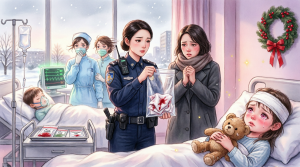
He lowered his notepad slightly.
“A lot of mothers don’t know, ma’am. Abusers make sure to isolate them.”
Danielle looked up.
“He took my phone away twice. He went with me to work. He told me what clothes to wear. He told me my mom manipulated me.”
I closed my eyes.
He had wanted to erase me from her life little by little, the way you bleach out a stain, until she was alone and obedient.
“Why didn’t you tell me?” I asked.
Danielle swallowed hard.
“Because I was ashamed.”
That was what broke me.
Not the hit.
Not the gun.
Not the ruined dinner.
My daughter’s shame.
That shame that wasn’t hers, but that he had placed on her like a boulder.
“The shame belongs to him,” I said. “Not you.”
Evan, handcuffed, managed to hear from the hallway. He laughed.
“Dani, tell them you’re exaggerating. Tell them your mom forced you. Tell them.”
She stood up, the blanket slipping from her shoulders.
For a second, I thought she was going to collapse.
But she walked toward him.
The officers tensed.
I did too.
Danielle stopped two steps away. She didn’t yell. She didn’t insult him. She didn’t raise her hand. She just looked at him as if she were finally seeing him without the fog of fear.
“You didn’t save my life,” she said. “You stole it from me in pieces.”
Evan clenched his jaw.
“You’ll come back.”
Danielle shook her head.
“No. Not this time.”
And then she did cry.
But that cry was different. It was no longer the silent crying at the table. It was a cry with air. With substance. With an exit.
They took him away shortly after.
As he crossed the doorway, Evan tried to look at me like at the beginning, as if he could still order me to obey. I held his gaze.
“You got a stain on your shirt,” I told him.
I don’t know why I said that.
Maybe because the white shirt was his disguise.
Maybe because seeing him covered in gravy reminded me that no monster enters a house showing its fangs. They enter with flowers, expensive cologne, “a pleasure to meet you,” wedding plans, pretty words, and a hand hidden under the table.
When the patrol car left, the house was in pieces.
Linda swept up the glass without being asked. My neighbor Tony brought a trash bag to throw away the broken pot. Someone left hot coffee on the table, as if the neighborhood knew that some nights need warmth so they don’t kill you from the inside.
Danielle sat next to me in the dining room.
The mashed potatoes were still there, cold.
The plates had dark stains.
The fork that fell three times was resting on the napkin, innocent like any object that doesn’t know it saved a life.
“Mom,” Danielle said, “I did want to come alone. But he wouldn’t let me. He told me if I didn’t bring him, he was going to come after you.”
I stroked her hair.
“Then you did the right thing.”
“I was afraid something would happen to you.”
“And I was afraid of losing you.”
She rested her head on my shoulder.
Outside, the city was still awake. A motorcycle drove by. A dog barked. In the distance, as if the world didn’t know what had just happened, someone played a classic country song. I thought about the big hospital downtown, so large and quiet, built to give refuge to those who had no one to care for them. That night, my house had also had to become a refuge. Small, broken, stained with gravy, but a refuge nonetheless.
Danielle took a deep breath.
“Now what?”
I looked at her feet. One was swollen, carefully bandaged. The other rested freely on the floor.
“Now we sleep with the door locked, but not with fear. Tomorrow we’re going to file a full report. We’ll go to the doctor. We’ll change the locks. We’ll talk to whoever we need to talk to.”
“What if he gets out?”
I didn’t want to lie to her.
“Then he finds us together, not alone.”
She took my hand.
“I thought you were going to be mad at me.”
“I am mad, yes.”
She shrank back.
“At him, Danielle. At him. At the world that teaches women to hide their bruises and smile at the dinner table.”
She stayed quiet.
Then she let out a small, broken laugh.
“The pot roast was good.”
I laughed too, even though my lip hurt.
“It was really good. That idiot ruined it for you.”
Linda yelled from the kitchen:
“I saved a little bit that didn’t hit the floor!”
For the first time that night, Danielle truly smiled.
It wasn’t a big smile.
It was just a sliver of light.
But I saw it.
And I knew that was our way out.
Later, when everyone left and the house was silent, Danielle fell asleep in my bed. I sat next to her, looking at her face without makeup, her irregular breathing, her fingers still tense even in her sleep.
In my apron pocket, I found the little piece of paper.
“Mom, don’t argue. He’s armed.”
I folded it carefully.
I didn’t throw it away.
I kept it in a box where I have her baby teeth, her first grade ribbon, and a picture of her at the county fair, eating cotton candy with her mouth full and laughing shamelessly. That huge, noisy fair, full of stalls, food, and people, had always seemed like the heart of the city to me because there, no one walks invisibly. And I swore, looking at my sleeping daughter, that Danielle would never feel invisible in her own life again.
At dawn, the light came through the window with an indecent softness.
There was a gravy stain on the wall that looked impossible to clean.
I got up to make coffee.
Danielle appeared in the doorway, one foot bare, carrying the blanket over her.
“Mom.”
“What’s wrong?”
“I’m afraid to go outside.”
I turned off the stove.
I went over to her.
“Then we’ll go out slowly.”
She opened her hand. She had the ring he had given her. It wasn’t an engagement ring yet, he said, but “so you start getting the idea.” She dropped it into the trash can.
The sound was small.
Almost nothing.
But for us, it was like hearing a massive door swing open.
That same day, when we headed out to the police station, the city smelled of fresh bread and gasoline. The sun hit the old brick facades. On the avenue, people were going to work, to the market, to school, to their normal lives.
Danielle walked holding my arm.
She limped.
But she walked.
As we passed the flower stand, she stopped.
“Mom, buy some sunflowers.”
“They’re not in season.”
“Then whatever they have.”
I bought white daisies.
She took one and held it against her chest.
“Last night I thought I was going to die,” she said.
“I did too.”
“But I didn’t die.”
I looked at her.
The wind moved her hair.
“No, honey. You didn’t die.”
Danielle lifted her face to the sun, and in her eyes, I saw something that wasn’t happiness yet.
It was something else.
It was a return.
It was a woman coming back to inhabit her body, her name, her voice.
And as we walked together, I understood that some mothers don’t save their daughters by fighting the monster.
Sometimes they save them by looking under the table.
Sometimes a neighbor with bread saves them.
Sometimes a silent phone call saves them.
And sometimes, just sometimes, love arrives right on time, with trembling hands, a split lip, and a whole house smelling like pot roast.
THE END.