The day I won the lottery did not look like the beginning of a war. It looked like a Tuesday that had forgotten how to be special, gray around the edges, cold coffee on the counter, unpaid bills spread across Grandpa Walter’s old dining table like a second tablecloth.
I was sitting in the house he had left me, the same house my parents always called “too much responsibility” when they wanted me to doubt myself. The wallpaper was peeling in one corner, the kitchen faucet dripped every twelve seconds, and my car outside coughed every time I turned the key, but for the first time in years, I could see a way out.
After taxes, the number came to $750,000.
Not millions. Not yachts and private jets and champagne fountains. Just enough to breathe. Just enough to pay off my student loans, replace my dying car, fix the foundation crack in Grandpa Walter’s house, and maybe, for once, sleep without feeling my life was one missed paycheck away from collapse.
I checked the numbers three times on my phone, then once more on my laptop because I was shaking too hard to trust my own eyes. My hands went cold first, then hot, and I started laughing in these broken, disbelieving bursts that sounded almost like crying.
I walked into Grandpa Walter’s kitchen and put both hands on the sink. “Grandpa,” I whispered to an empty room, “I can fix it now.”
That house had always smelled faintly like cedar and black coffee, even months after his funeral. When I was little, he used to tell me that houses listened, that if you loved a place long enough, it remembered who protected it.
He had protected me my whole life in quiet ways. He showed up to school plays when my parents forgot, slipped grocery money into my backpack in college when I claimed I was “fine,” and made sure the deed to his house was transferred legally and cleanly to me before anyone could contest it.
My parents had never forgiven him for that.
They said he was manipulated. They said he had been old and sentimental. They said he owed them more than he owed me because they were his children, as if blood automatically erased everything else.
But Grandpa Walter had not been confused a day in his life. He had looked me in the eye six months before he died and said, “Some people only love what they can control. Don’t ever hand them the keys to your life.”
I did not understand then how literal that warning would become.
At first, after I saw the winning numbers, I kept the ticket clutched so tightly in my hand that the edge bent. I told myself to calm down, to do this right, to think like an adult instead of a panicked kid who had spent too many years waiting for disaster.
So naturally, I made the worst decision of my life.
I called my mother.
She answered on the third ring, her voice clipped and distracted, like she was already annoyed before I spoke. “What now?”
“I won,” I said.
There was a pause, then a sharp exhale. “Won what?”
“The lottery.” My throat tightened around the words because even saying them out loud felt ridiculous. “Mom, I’m serious. I checked it four times. After taxes it’s around seven hundred and fifty thousand.”
Silence.
For one impossible second, I thought maybe she had dropped the phone. Then her tone changed so fast it made my stomach turn. “Don’t move. We’re coming over.”
My father was with her when they arrived twenty-three minutes later. I know because I checked the clock twice while pacing the living room, ticket in one hand, phone in the other, my pulse hammering against my ribs hard enough to hurt.
They did not come in smiling.
My mother came through the front door like she was entering a business meeting. My father followed with that familiar heavy expression that always meant I was about to be told I had handled something badly, even if nothing had happened yet.
“Show it to me,” my mother said.
I held up the ticket. My hand was trembling, and I hated that she could see it.
My father took it before I had fully decided to hand it over. He inspected it with narrowed eyes, then looked at my mother, and something silent passed between them that made the room feel smaller.
“Well,” he said slowly, “if this is real, it needs to be handled carefully.”
“I know,” I said. “I’ve already been looking up how to claim it.”
My mother gave a short, humorless laugh. “You?”
The word hit me harder than it should have. I was used to her tone, used to the tiny cuts she could hide inside ordinary conversation, but that day every one of them landed raw.
“Yes,” I said, trying to keep my voice steady. “Me. It’s my ticket.”
My father folded his arms. “And that is exactly why you shouldn’t be running around making decisions before you understand the legal and tax implications.”
I stared at him. “I just told you it was after taxes.”
“That’s not the point.” His voice sharpened. “Do you want to lose this because you got excited and did something stupid?”
I should have said no. I should have taken the ticket back and told them to leave. I should have remembered every time they had wrapped control in the language of concern and called it love.
Instead, I let myself feel relieved.
For one stupid, hopeful moment, I thought maybe this would be different. Maybe money had finally made me important enough to be taken seriously. Maybe they were acting cold because they were shocked.
My mother reached for the ticket. “We’ll handle the paperwork.”
Every instinct in my body flared awake at once. “Why would you handle it?”
“Because someone has to,” she snapped. “You’ve never dealt with anything remotely this large before.”
I held out my hand. “I can manage it.”
“You can barely manage that car,” my father said, jerking his chin toward the driveway. “And now you think you’re equipped to protect three-quarters of a million dollars?”
The shame rose so fast it felt automatic, old training waking up before reason could stop it. I hated that they could still do that to me, reduce me in seconds to a version of myself I had spent years trying to outgrow.
My mother softened her tone then, which was always the most dangerous part. “Honey, listen to me. We’re your parents. We’re trying to help.”
She stepped closer and put one hand over mine. “People get robbed over things like this. They get manipulated. They get sued. Let us keep the ticket safe while we talk to the right people.”
Safe.
That word hooked into all the fear under my excitement. I imagined scams, legal traps, some mistake that would destroy the one miracle I had ever been handed.
So I let go.
My father took the ticket. My mother immediately pulled out her phone and started talking about deadlines, offices, procedures, signatures. It sounded competent. It sounded adult. It sounded like exactly the kind of thing I had been taught I could not do without them.
By the time they left, the house felt wrong.
It was not just that the ticket was gone. It was the silence they left behind, thick and watchful, as if even the walls understood I had just made a terrible mistake.
That night I barely slept. I kept checking my phone for updates from them, replaying the conversation, telling myself I was being paranoid.
Around midnight, I heard a car door outside.
I went still.
The gravel driveway carried sound strangely at night, and through the half-open kitchen window I heard voices. My parents had come back, parking beside the detached garage as if they did not want to be seen from the road.
At first, I thought maybe they were bringing the ticket back.
Then I heard my mother laugh.
It was not a happy laugh. It was a hard, sharp sound, the kind she used when talking about people she considered foolish. I moved quietly toward the side window near the pantry and looked out through the narrow gap in the curtain.
They were standing under the porch light near the back steps.
“I’m telling you,” my mother said, “once the money clears, we move it fast.”
My father nodded. “And if they ask questions?”
“She panics easily,” my mother said. “We say it was some kind of scam, or an error, or that she misunderstood the numbers. She’ll doubt herself before anyone else does.”
My breath stopped.
For a second, I thought I had misheard. I actually pressed one hand to the wall to steady myself, because the alternative was that my own parents were calmly discussing how to steal my money while standing outside the house my grandfather had left me.
My father lowered his voice, but I still heard every word. “What about the property?”
My mother rolled her eyes. “Please. Don’t start with Walter’s house again.”
“I’m serious,” he said. “As long as she has the deed, she has somewhere to stand. Somewhere to run.”
My mother crossed her arms. “She doesn’t deserve that house any more than she deserves this money.”
I had heard cruelty from them my whole life. I had heard disappointment, contempt, sarcasm, blame. But there was something different in hearing them talk about me when they thought I was not there.
There was no performance in it. No attempt to sound reasonable. Just appetite.
My father glanced toward the house. “Then we fix both problems.”
My heart began hammering so hard I thought they might hear it through the walls.
My mother leaned closer to him. “First the money. Then the paperwork. Once it’s done, we tell her she imagined the whole thing. She’ll make a scene, and everyone will think she’s unstable.”
I bit the inside of my cheek so hard I tasted blood.
My father chuckled, low and ugly. “Should’ve known Walter would set her up one last time.”
“Walter was sentimental,” my mother said. “And now he’s dead.”
That was the moment something inside me cracked clean down the middle.
Not because I was surprised. Maybe the most terrible thing was that some part of me was not. Some part of me had been expecting this kind of betrayal for years, had just kept trying to earn a different ending.
I backed away from the window before they could see me and went straight to the bedroom where I kept Grandpa Walter’s file box. It held the deed, insurance paperwork, tax records, utility statements, all the documents I had organized after he died because nobody else had cared enough to do it right.
I checked the deed.
Still there.
I checked my bank app.
Nothing unusual yet.
I wanted to call the police right then, but what would I say? That I overheard my parents talking in the driveway? That they had my winning ticket and plans I could not yet prove? Fear kept tangling with disbelief until I could not tell one from the other.
By morning, I had barely slept at all.
At 7:12 a.m., I opened my bank app again while making coffee. The mug slipped from my hand and shattered in the sink.
A large transfer had gone through overnight.
Then another.
Then a new linked account appeared under my profile, one I had never opened, draining what little savings I had left into an institution I did not recognize.
I stared at the screen until the numbers blurred.
My whole body went numb, then violently hot. I called the bank, stumbling over my words so badly the first representative transferred me twice before someone in fraud finally understood what I was saying.
They froze the activity they could. They asked if I had authorized the new account. They asked whether anyone had access to my Social Security number, date of birth, identifying documents.
I laughed once, a terrible sound that did not feel human.
“My parents do,” I said.
The bank told me to come in. They told me to bring identification. They told me they would file a fraud report.
I did not go to the branch first.
I drove straight to my parents’ house.
The whole way there, my old car rattled so hard on the road that the steering wheel shook under my palms. I barely noticed. My vision had narrowed to a tunnel, and at the end of it were my mother’s face, my father’s voice, and the sound of them planning my erasure like it was household budgeting.
Their house looked exactly the same as it always had: trimmed hedges, polished brass mailbox, front porch swept clean enough to signal respectability from the street. It was the kind of house people trusted on sight.
I parked crooked in the driveway and went to the front door without knocking.
My father opened it before I could use my key code. He took one look at my face and knew.
“What are you doing here?” he asked.
“My money is gone.”
He did not blink. “What money?”
I stared at him.
My mother appeared behind him, one hand still holding a dish towel. “Why are you shouting this early?”
“Don’t,” I said. “Do not do this. Money was transferred out of my account into another account opened under my Social Security number. Give it back.”
My mother’s expression hardened with almost theatrical confusion. “What on earth are you talking about?”
“The lottery money,” I snapped. “The ticket you took. The account you opened. Give it back.”
She laughed.
Actually laughed.
It rang across the foyer like glass breaking. “You didn’t win anything.”
I felt my body go perfectly still. “Excuse me?”
“You heard me,” she said. “You got excited over nothing, and now you’re inventing stories because you can’t face being wrong.”
“That’s a lie.”
My father stepped forward, shoulders squared. “Watch your mouth.”
“No,” I said, louder now. “I heard both of you outside Grandpa’s house last night. I heard you talking about moving the money, about telling people it was a scam, about taking the property too.”
My mother’s eyes went flat. Whatever mask had been on her face fell away. “Then you should have learned to keep your mouth shut.”
For a second nobody moved.
Then she turned, walked to the entry table, and grabbed a manila envelope. She shoved it against my chest so hard it bent.
“Here,” she said. “Since you’re so obsessed with that property.”
My fingers shook as I opened it.
Inside were copies of documents with my grandfather’s name, the house address, and signatures that looked wrong even before my brain could process why. Transfer forms. Authorization pages. Legal language arranged to look official at first glance and rotten on the second.
Forged.
My father watched me read them with grim satisfaction. “The house is being handled.”
“No,” I whispered. “No, it isn’t.”
My mother folded the dish towel with terrifying calm. “You should be grateful we’re cleaning up your mess before you ruin everything your grandfather left.”
“My grandfather left it to me,” I said. “Legally.”
“And he made a mistake,” she said.
The words hit like a slap.
Something broke loose in me then, years of swallowed anger surging up so fast I could not stop it. “He didn’t make a mistake,” I said. “He knew exactly who you were.”
My father lunged first.
He did not hit me, but he grabbed my shoulder hard enough to spin me toward the open door. “Get out.”
I shoved back. “Not until you tell me where the money is.”
His face changed. I had seen him angry before, but this was something colder, something stripped of pretense. “You come into my house making accusations, calling your mother a thief, insulting the family, and you think you’re staying?”
“This isn’t your house,” I shot back. “And Grandpa’s house isn’t yours either.”
My mother’s mouth twisted. “Then go run to the dead man if you think he’ll save you.”
My father shoved me again, harder this time.
I stumbled backward over the threshold and nearly fell down the porch steps. The envelope scattered papers across the floorboards, forged signatures flashing white in the morning sun.
I bent to grab them, but my father slammed the door so violently the frame shook.
Then the lock clicked.
I stood on their porch with a handful of fake documents, my chest heaving, my face burning, and the full weight of what had just happened finally landed.
I had not just been lied to.
I had been robbed, gaslit, and thrown out like evidence they thought they could bury.
For a few seconds, I could not move. The neighborhood was quiet. Somewhere down the block, a lawn sprinkler clicked methodically over fresh-cut grass, as if the world had decided this was an ordinary morning.
Then I looked down at the papers in my hand.
And instead of breaking, I got angry.
Not the kind of anger that burns fast and leaves you shaking. The kind that goes cold and precise. The kind that makes you stop pleading and start counting.
They had the ticket.
They had my money.
They had forged documents touching Grandpa Walter’s property.
And they had made one fatal mistake.
They thought I was still the person they had trained me to be.
I got back in my car and drove away before they could look out the window and enjoy the sight of me unraveling. I did not go back to Grandpa Walter’s house. I did not go to a friend’s place. I did not go anywhere soft enough for grief to catch me.
I drove straight toward the one person Grandpa Walter had trusted when it came to anything that mattered.
Mr. Hargrove.
By the time I pulled into the parking lot outside his office, my hands were steady again.
And for the first time since I matched those lottery numbers, I was not thinking about what I had lost.
I was thinking about what I could prove.
I could feel my pulse pounding in my throat as I walked into Mr. Hargrove’s office. The law firm’s glass doors were framed by dark wooden panels, and the air smelled faintly of old books and polished mahogany. It was exactly the kind of place Grandpa Walter had always trusted, and it was exactly the kind of place that made me feel like I wasn’t just fumbling through this mess on my own.
Mr. Hargrove’s secretary—who had known me since I was a kid—looked up at me with surprise as I entered. She stood up quickly, looking concerned. “Is everything okay?” she asked, voice tinged with alarm as she noted the expression on my face.
I nodded quickly, not trusting myself to speak yet. “I need to see Mr. Hargrove. It’s urgent.”
She didn’t ask any more questions. She simply gestured for me to wait and went into the back office. I watched her disappear, then turned to stare at the polished reception desk. My thoughts were a mess—too many things to untangle, too many emotions rushing in all at once.
Moments later, the door to the back office opened, and Mr. Hargrove stepped into view. He was an older man, his hair silvered at the temples, his glasses perched low on his nose as if always in deep thought. He gave me a long, assessing look before speaking.
“Lena,” he said softly, his voice comforting despite the heaviness in the air. “What’s going on?”
For a moment, I couldn’t speak. Then I pulled myself together, forcing words out as I handed him the folder. “It’s my parents,” I said, my voice trembling despite my best efforts. “They’ve stolen my lottery winnings and forged Grandpa’s documents to take his house. I need help.”
His eyes scanned the folder quickly, his brow furrowing as he flipped through the pages. It was strange how fast things had gone from disbelief to anger to outright betrayal. I had no idea how long this had been brewing beneath the surface, but it felt like it had been a lifetime of quiet manipulation leading up to this one catastrophic moment.
“I’ll take care of this,” Mr. Hargrove said finally, looking up at me. “We’ll start with the bank fraud and the forged property documents. This will not stand.”
Relief flooded through me, but it was tinged with exhaustion. I had been running on adrenaline for too long, pushing away the reality of what had just happened. It was only now, with someone on my side, that the weight of everything started to settle in my chest.
“Thank you,” I whispered.
He smiled softly, a reassuring gesture. “No need to thank me yet. This will take time, but we’ll get your money back, and we’ll make sure your grandfather’s property is returned to you.”
I nodded, feeling a little lighter than I had in days.
Mr. Hargrove got straight to work. The next few hours felt like a blur. He contacted the bank, starting the paperwork for fraud reports, and made calls to lawyers who specialized in both criminal and civil cases. I gave him everything I had—photos of the forged documents, the bank transfer logs, and even the overheard conversation I had heard in my parents’ driveway.
“Start preparing yourself,” Mr. Hargrove warned me as he hung up with a colleague. “We’ll need to move quickly. Your parents aren’t going to let this go without a fight.”
I nodded grimly. I knew they wouldn’t.
By the time I left his office, it was late afternoon. I felt exhausted but strangely determined. The relief of having a plan, of knowing someone was finally handling the legal side of things, helped me push back the gnawing doubt that had threatened to consume me. But I couldn’t shake the feeling of powerlessness that lingered in my chest. I kept imagining my parents, sitting in their comfortable home, pretending none of this was happening. It made my stomach turn.
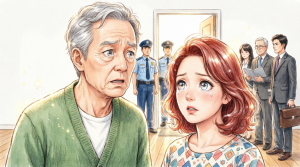
The next day, the knock came at my parents’ door. It wasn’t a knock I expected.
At first, I thought maybe it was just a coincidence, some random solicitor, or a neighbor asking for something trivial. But when I saw the group of officers walking up the driveway, I realized how wrong I was.
There were ten of them.
Behind them, ten lawyers.
And then, there I was, standing in the back, watching the whole thing unfold.
I had called Mr. Hargrove’s team first thing in the morning. With everything I had given them—fraud reports, proof of forged documents, and the recordings I had uncovered—they had moved quickly. The legal team had tracked the transfer of the money into the mysterious account my parents had opened. They had traced it through every step, from the moment they had deposited my winnings to the multiple shell accounts they had used to funnel the money away from me.
As I watched the scene unfold at my parents’ front door, I felt a mix of emotions. There was anger—more than I had ever allowed myself to feel. There was relief, too, but it was bittersweet. I had fought to make this happen, and it was finally working. But what did this mean for everything I had once believed about my parents? What did it mean for my relationship with them?
The officers entered first. Their presence made everything feel even more surreal. Mr. Hargrove’s team followed closely behind, the legal team carrying documents that would strip my parents of everything they had tried to steal.
“You can’t do this,” my mother’s voice rang out from the doorway. “This is our property. You have no right—”
“You’re under investigation for fraud and theft,” one of the officers cut her off. “And you are now under arrest.”
I could hear her voice shaking. She tried to stand her ground, but the evidence against her was overwhelming. There were no excuses, no ways to hide. They had gotten away with too much for too long, and now the walls were closing in.
It didn’t take long for the rest of the team to begin gathering evidence from the house. Devices were seized, computers, phones, anything that could hold a trace of the stolen money. It was all there—recordings, documents, emails, everything that proved just how far my parents had gone to take what wasn’t theirs.
Then, the piece of evidence that sealed the deal: Grandpa’s old safe.
The safe had always been a quiet presence in the house, tucked in the corner of his study, locked tight, only opened for certain occasions. I had never known what was inside, but I knew Grandpa trusted it.
The police found the key and opened it.
Inside, there were records—thick, yellowed folders with every detail of my parents’ involvement in the theft. There were recordings of them celebrating, their voices thick with greed. I listened to the recording with Mr. Hargrove by my side, and I could feel my heart race as I heard my father’s voice. He had been so sure no one would catch them.
“Just move the money. No one will ever know,” he said. “She’ll never be smart enough to figure this out.”
I stared at the floor, unable to process the sound of his voice—my own father, caught on tape in the act of betraying me. Betraying everything my grandfather had stood for.
It was over. It was all there.
I was going to get everything back. The money, Grandpa’s house, my dignity.
And maybe, just maybe, I would finally be free of them.
“Lena,” Mr. Hargrove said, his voice cutting through the haze of my thoughts, “they’ve made their choices. It’s time for you to make yours.”
The police moved in to place my parents in handcuffs. The sound of the cuffs clicking into place was almost satisfying, a moment of finality. It was the moment when I realized the fear had changed sides. They were the ones who would have to answer for their actions now.
As the officers led them away, I stood tall for the first time in what felt like forever. I didn’t feel sorry for them. I didn’t feel sorry for myself, either.
I was done being a victim.
I had inherited more than just money from Grandpa Walter. I had inherited proof, and a legacy of protection that I had no idea would become the key to taking back everything they had stolen from me.
The victory didn’t feel like winning.
It felt like freedom.
The weeks that followed felt like a strange limbo, like I was living in someone else’s story. I didn’t have time to sit and reflect. Things moved too fast, my life spinning in a new direction I hadn’t fully planned for, though I had no choice but to go along with it.
The police investigation was relentless. With the recording of my father’s confession, the bank fraud reports, the forged documents, and the evidence found in Grandpa’s safe, my parents had no way to deny the truth. Every day, more pieces of their life came to light—the lies, the schemes, the ways they had manipulated me and others for their own benefit. There was no running from it anymore.
But what struck me the hardest was the discovery of just how deep their betrayal ran.
I had spent years believing I was the problem. Believing I was the screw-up, the failure. But now, I could see how my parents had worked tirelessly to make sure I felt small enough to be controlled, to be invisible. I had never understood the extent of their manipulation until I was forced to face it head-on.
One evening, Mr. Hargrove called me. His voice was calm, but I could tell by the way he spoke that something had shifted.
“We’re moving forward with the civil suit,” he said. “We’ll be demanding full restitution for the $750,000 plus additional damages for emotional distress and punitive fines. You’ll also get your grandfather’s house back.”
I nodded, already hearing the words in my mind. “And what about the criminal charges?”
“The charges are being pursued separately, but they’re in the hands of the state now. I’ll update you as we go.”
“Thank you,” I said quietly. I couldn’t bring myself to say more. I had no idea what it would feel like to get the money back, or the house, or anything else. I was numb, and I hadn’t yet figured out how to feel about it.
I didn’t know what it would mean for me to have my life back—really back—after it had been stolen by the people who were supposed to love me.
That night, I stood in front of Grandpa Walter’s house. The movers had arrived earlier that afternoon, taking inventory and beginning the process of packing up the things I had been forced to leave behind when I was kicked out by my parents. For weeks, I had kept my distance from the house, unwilling to go back until everything was settled. But now, with the case moving forward, with the truth finally coming to light, I needed to see it. I needed to breathe it in.
The porch light flickered as I stood at the base of the steps, one hand resting against the railing. I hadn’t been back here since I was a kid, but everything about the house still felt familiar—the scent of wood and cedar, the way the floor creaked in the hallway, the old pictures on the walls that Grandpa had always kept close. It was still his house. It would always be his house, but now, it was mine.
I stepped inside, heart pounding as I walked into the living room. I ran my fingers over the worn fabric of the couch Grandpa had loved so much, the same couch that had witnessed so many quiet conversations between us. The walls seemed to echo with the memory of his voice, the way he used to tell me stories of the past—of his youth, of his time in the service, of everything he had seen and done. He had always been so steady, so grounded. It was hard to imagine anyone would ever want to take that away.
But they had.
I went up to the study, where Grandpa’s desk sat, covered in a few remaining papers. There were books on the shelf, notes, and old newspapers piled high. And there, in the corner, was the safe—locked, like it had been all those years. Grandpa’s safe.
I hadn’t expected to find it. In fact, I hadn’t really thought about it at all, not since the police had taken the key. But standing there in front of it, I realized just how much Grandpa had protected me, even in death.
I sank into the old chair behind his desk, staring at the safe, feeling the weight of everything that had happened. For so long, I had been focused on getting back what was rightfully mine, but now, sitting here in this room, surrounded by memories, I finally let myself feel something else.
Grief.
For everything I had lost. For everything I hadn’t had the chance to fully appreciate. And for the family that had once been mine, but was now nothing more than a shattered illusion.
My phone rang, snapping me out of my thoughts. I picked it up to see Mr. Hargrove’s name on the screen.
“Hello?”
“Lena, I just got the final paperwork from the judge,” Mr. Hargrove said, his voice steady. “You’ll be getting the $750,000 back, along with the house. Your parents have been served with the papers, and the civil suit is officially underway. I’m sending you the details now.”
I stood up from the chair, my heart pounding in my chest as I processed his words. This was it. This was the moment I had been fighting for. But it didn’t feel like a victory.
“Thank you,” I said again, but the words felt hollow.
“Take your time to digest it, Lena,” he added. “But know this—what your parents did to you was criminal. They’ve stolen from you, manipulated you, and abused your trust for years. This isn’t just about the money. It’s about your life. And you’re getting it back.”
He was right, I thought. It wasn’t just about the money. It was about control, about taking back my life from the people who thought they could take everything from me.
But even as I stood there, the legal victory slowly sinking in, there was something else growing inside me—something I hadn’t expected. A desire for closure. For answers.
I wasn’t just going to win this battle. I was going to make sure I understood the entire story. I had to know everything—how deep the betrayal went, what my parents had been hiding from me all these years.
I hung up the phone and stood there for a moment, lost in thought.
Then, I heard the knock at the door.
I didn’t expect anyone to be here, not this late, but when I opened it, I found someone I hadn’t seen in years.
My younger brother.
His eyes were filled with uncertainty, the same anxious energy I had seen in him when we were kids. “Lena,” he said softly, “can we talk?”
I stepped aside, motioning for him to come in. “What’s going on?”
“I… I heard about everything that’s been happening with Mom and Dad,” he said, his voice cracking slightly. “And I wanted to tell you… I’m sorry.”
I nodded slowly, unsure of what to say. He had always been the one to stay out of things, to hide in the background while our parents played their games. But now, here he was, standing in front of me, admitting something that should have been said a long time ago.
“I didn’t know,” he continued, his voice barely above a whisper. “I didn’t know how bad it had gotten. I just thought… I thought if I stayed out of it, it wouldn’t affect me.”
I crossed my arms, my emotions still raw from everything that had happened. “So, what? You just let them do whatever they wanted, and you never said anything?”
“I didn’t think I could stop them,” he admitted. “I thought they would just… do what they wanted, and I didn’t know what I could do. But seeing everything now… I’m sorry.”
His apology was real, but it felt so out of place. Like it was too late. I wanted to be angry. I wanted to shout at him for all the years he had sat silently by, never questioning our parents, never stepping up. But instead, I just stared at him, taking in the hollow regret in his eyes.
“I don’t know what to do with this, Sam,” I said finally. “I don’t know what to do with you.”
He lowered his gaze. “I get it. I don’t expect you to forgive me. I just wanted you to know.”
I exhaled slowly, trying to make sense of everything. My brother’s apology felt like the last piece of the puzzle falling into place. It wasn’t enough to fix everything, but maybe it was a start. Maybe there was still a chance to rebuild something that had been broken for far too long.
“Just don’t make the same mistake again,” I said quietly.
He nodded, his eyes filled with guilt.
I watched him leave, the door closing softly behind him. And for the first time in weeks, I finally felt like I could breathe again. It wasn’t perfect. It wasn’t over. But it was a step forward.
And for the first time, I wasn’t afraid of the future anymore.
The next few days were a blur of legal meetings, paperwork, and emotional recalibrations I didn’t know I was ready for. It was as if the entire world had shifted beneath me, and now I was finding solid ground again, but it felt unfamiliar and shaky, like learning to walk for the first time after a long time of crawling.
The victory I had fought for—the $750,000, the return of Grandpa Walter’s house—was not the relief I had expected. It didn’t bring closure, nor did it erase the years of pain and manipulation my parents had inflicted on me. If anything, it reminded me of everything I had lost in the process—the family I had once hoped to rebuild, the trust that had been broken beyond repair.
I hadn’t expected to feel so hollow after the fight was over. I had hoped the moment the police arrived at my parents’ door, everything would be wrapped up in a neat little package. That somehow the weight of the wrongs done would lift, and I’d feel free. But instead, a strange numbness had taken its place.
As the legal battle dragged on, there were moments when I found myself wandering through Grandpa’s house, touching things without really seeing them. The soft creak of the floorboards, the old grandfather clock ticking away in the corner—everything reminded me of him, of the times when life had been simple and stable. But now, it felt haunted by the ghosts of all that had been taken from me.
I didn’t want to admit it, but I was scared.
Scared of who I had become, of what this war with my parents had done to me. I had always tried to be strong, to stand up for myself, but now I felt like I had lost a part of who I was along the way. My sense of identity was tied up in them for so long that I didn’t know who I was anymore without their influence looming over me.
Mr. Hargrove had been a steady presence, helping me navigate the legal complexities, making sure everything was handled professionally. He had been a rock, but even his reassurances couldn’t fill the empty spaces that seemed to grow wider with every passing day.
One afternoon, after a long day of meetings, I sat at the kitchen table in Grandpa’s house, staring at the files spread before me. I was so tired. Tired of fighting, tired of losing parts of myself along the way. The documents in front of me felt like another weight, another task to be completed before I could finally breathe again.
That’s when my phone buzzed.
It was a text from Sam.
“I know I don’t deserve it, but I’m really sorry. If you ever need anything… I’m here. Take care of yourself.”
The message wasn’t long, but it was enough to make my heart tighten. I didn’t know how to feel about Sam anymore. His apology had been the first step, but I wasn’t sure how far that would take us. He had been absent for so long, choosing to sit in the background while my parents carried out their schemes. Could I really trust him now? Did I even want to?
I had no answers.
I stared at the text for a long moment, letting the words sink in. I didn’t respond right away. My thoughts were too tangled, too raw. In the end, all I could do was put the phone down and take a long, shaky breath.
The next day, I woke up to a knock at the door. When I opened it, I found a tall, young man standing on the other side. He was holding a brown envelope, his face a mix of uncertainty and hesitation.
“Lena?” he asked, his voice low but steady.
I nodded, confused. “Yes? Can I help you?”
He stepped forward, handing me the envelope. “I’m from the firm handling your parents’ criminal defense. They’ve requested to speak with you.”
My stomach dropped.
I could feel my heart hammering in my chest as I looked at the envelope in my hands. The last thing I wanted to do was talk to them again. After everything that had happened, after all the lies and the betrayal, how could they possibly have the nerve to reach out?
“They want to settle,” the young man continued, seeing the look on my face. “They’re offering a deal.”
I froze, staring at him. I could barely process the words. A deal? After everything? After they had tried to steal my life from me, they wanted to settle? My blood boiled at the thought.
“I don’t want to speak with them,” I said sharply, but the young man held up his hands in a gesture of calm.
“I’m just the messenger. I’ll leave this with you. It’s up to you whether or not you choose to respond.”
He turned and left, his footsteps echoing in the empty hallway behind him.
I stood there, the envelope feeling like a weight in my hands. The possibility of a “settlement” felt like an insult, a way for my parents to escape the consequences of their actions without having to face the full truth. It was a way for them to make it all go away.
But for a moment, I wondered—what would it look like if I took the offer? Would it give me some kind of closure? Would it be easier than dragging this out in court, fighting for something I wasn’t sure I would ever fully regain?
I opened the envelope slowly, hands trembling. The papers inside were full of legal jargon, but the message was clear. They were offering me a portion of the money they had taken, a small amount compared to what they had stolen, but enough to settle the case without going through the lengthy court process.
The offer felt like a slap in the face. A reminder that they saw me as a transaction, not as their daughter.
I wanted to throw the papers across the room. I wanted to tear everything up and tell them to go to hell. But instead, I sat down at the table, reading the offer again and again. The more I read, the angrier I became. They thought they could buy their way out of this. They thought they could make it all go away.
But they were wrong.
I stood up, the decision clear in my mind. I called Mr. Hargrove.
“I’m rejecting the offer,” I said without hesitation.
He paused for a moment before responding. “Are you sure?”
I could hear the concern in his voice, but I knew what I had to do.
“I’m sure,” I said. “This isn’t about the money anymore. This is about what they’ve taken from me—and I won’t let them get away with it.”
“You’re making the right choice,” he replied, his voice full of reassurance. “We’ll move forward with the suit.”
The decision was final.
But even as I rejected the offer, I realized that the real fight wasn’t about the money. It was about taking back my life. About standing up for myself after years of being manipulated and controlled. About finally putting my foot down and saying, “I’m not your pawn anymore.”
And for the first time since this whole nightmare began, I felt something I hadn’t felt in years—empowerment.
That night, I stood in Grandpa Walter’s study, the one place in the house that felt like mine, and stared at the empty space where the safe used to be. I couldn’t explain why, but it felt right to be there, to let the house breathe again, to let it heal.
I wasn’t finished yet. The road ahead was still long, but I was no longer afraid. I had learned the hard way that I couldn’t rely on anyone else to fight my battles for me. I had to do it myself. And I would.
I would win. Not just the money. But my life back.
The weeks after I rejected my parents’ settlement offer passed by slowly, the tension lingering in the air as if it had become a part of the house itself. The legal proceedings continued, but now everything felt different. The initial rush of anger and disbelief had faded into something deeper. It wasn’t just about winning anymore; it was about reclaiming who I had been before everything had fallen apart.
There were moments when the gravity of what I was doing hit me harder than I expected. There were days when I found myself standing in front of the bathroom mirror, staring at a version of myself that seemed unfamiliar—tired, worn, and yet somehow stronger than I had ever been. It was as if I had stepped into a new version of my life, and I had no choice but to walk forward, even though I couldn’t always see where the path was leading.
I wasn’t the same person I had been before. The version of me who had trusted my parents without question, the one who had held on to the hope that maybe, just maybe, they would love me in the way I had always wanted—they were gone. I had shed that person like a skin that no longer fit. Now, I was someone new. Someone who had learned that trust is not freely given, and that the people who should protect you are often the ones who can harm you the most.
But through all of this, there was one constant: Grandpa Walter.
His presence, his memory, and the quiet strength he had left me kept me grounded. It was his trust in me that I was fighting for, not just the money or the house, but for the person I had been when I was with him—before I ever knew that betrayal could run so deep.
One afternoon, I was sitting in Grandpa’s old study, the place where I had first made the decision to take control of my life again. The walls were still lined with his books, the shelves heavy with history and wisdom he had passed down to me over the years. I hadn’t spent much time in here since the chaos had begun, but today I needed the space. I needed the silence.
The doorbell rang, pulling me out of my thoughts. I wasn’t expecting anyone. I glanced at my phone. It was still early in the day, too early for the legal team to check in with me, and too late for anyone from the neighborhood to drop by unannounced.
I opened the door, half-expecting another lawyer or maybe a mail carrier with some piece of paperwork to keep the gears of this whole ordeal turning. But instead, I found Sam standing on the other side, his hands stuffed into the pockets of his jacket, his face tight with apprehension.
“Sam?” I said, feeling a mixture of confusion and curiosity. “What are you doing here?”
He hesitated for a moment, looking down at the ground as if trying to find the words he needed to say. “I don’t know if I’m doing the right thing,” he muttered. “But I need to talk to you. Really talk.”
I stood there for a moment, not sure whether I should let him in or send him away. It was hard to forget the years he had spent avoiding confrontation, the way he had chosen to side with our parents instead of taking a stand for what was right. And yet, here he was, standing in front of me, willing to face the consequences of his silence.
I stepped aside, letting him in. “Come on in,” I said, keeping my tone neutral. I wasn’t ready to forgive him, but I wasn’t ready to shut him out either.
He stepped inside, glancing around the house as if seeing it for the first time. “It feels different,” he said quietly. “I mean… it feels like it used to, but also not. Like everything’s changed.”
“Everything has changed,” I said, leading him to the living room. We both sat down on the couch, the space between us almost too large, as if the years of distance had carved a chasm I wasn’t sure I wanted to cross.
Sam opened his mouth, but then closed it again, unsure of how to begin. Finally, he just let out a long breath. “I should’ve been there for you. I know that now. I should’ve stood up to them. I should’ve—”
“You should’ve done a lot of things, Sam,” I interrupted, the bitterness in my voice sharper than I meant it to be. “But you didn’t. You stayed quiet while they did what they did. You stayed quiet while I was manipulated, lied to, and thrown away. And now you want me to just… what? Forgive you?”
He flinched, the weight of my words landing with the force I intended. I had been holding this in for so long, and it felt like the only release I could find. The truth had to come out, even if it was uncomfortable. Even if it meant facing the fact that the brother I had once loved unconditionally had failed me when I needed him the most.
“I didn’t know how to handle it,” he said softly, his voice breaking. “I didn’t know what to do. They told me I was too young to understand, that it wasn’t my place. And I—”
“And you believed them,” I finished for him, the words tasting bitter in my mouth.
He nodded, his eyes full of regret. “I’m sorry. For everything. For not seeing you. For not seeing how hard this was for you. I was scared, Lena. I didn’t want to make it worse. I didn’t want to lose them, too.”
“Do you realize what you’re saying?” I said, my voice low. “They took everything from me, Sam. Everything. And you stood by and let it happen. You let them lie to me. You let them use me. And now you’re sorry?”
“I know it doesn’t fix anything,” he said, looking up at me with a mixture of guilt and sincerity. “But I’m not asking you to forgive me. I’m just asking… Can we move forward? Can we try to rebuild something?”
The silence hung between us, thick and heavy. I didn’t have an answer. I couldn’t promise anything. I didn’t know if I could ever forgive him, or if I even wanted to. But I did know one thing.
I was done hiding from the truth. And I was done carrying all the pain alone.
“You have to show me, Sam,” I said quietly. “I can’t just pretend like nothing happened. I can’t erase the years of silence and betrayal with a few words. If you want to rebuild something, you have to prove it. And I’m not sure I’m ready for that.”
“I’ll prove it,” he said earnestly. “I’ll do whatever it takes.”
I didn’t know if he could or if he would. But I could see something in his eyes I hadn’t seen before—an understanding of the weight of what he had done. For the first time in years, I could see my brother, not as the silent bystander, but as someone who was ready to take responsibility.
I wasn’t sure where this would lead, but I knew one thing: this wasn’t the end.
This was just another beginning.
The fight wasn’t over. But I wasn’t fighting alone anymore.