The Whispered 911 Call That Accused A Father—Until One Scan Revealed The Truth Nobody Wanted To Face The call came in at 12:18 a.m., quiet enough that the dispatcher first thought the line had gone dead. Then a child whispered, “Please don’t hang up. I think something is really wrong with me.” Eight-year-old Lily Ramirez was curled on a worn couch in a small house near the edge of a Southern Texas neighborhood. Her knees were pulled toward her chest, both hands pressed against her swollen stomach, her face damp with sweat and fear. The room was dark except for a strip of kitchen light stretching across the carpet like a warning nobody had understood.
The refrigerator hummed beside a stack of unpaid bills, a half-empty medicine bottle, and a school note folded beneath a cracked plastic cup.
Lily had been told all week that pain sometimes passed if you waited long enough.
That was the first mistake.
The second was that every adult around her was too tired, too sick, or too desperate to realize waiting had become dangerous.
“My stomach is big,” Lily whispered into the phone, barely louder than the refrigerator.
The dispatcher, a woman named Angela Reese, changed her tone immediately.
“Sweetheart, are you alone right now?” she asked, already typing the address Lily had managed to give.
“My mom is asleep,” Lily said. “My dad is at work.”
“Can you tell me where it hurts?”
Lily swallowed, and the sound of her breath shook through the line.
“Everywhere. But mostly here. And it feels hot inside.”
Angela stayed calm, though something in Lily’s voice made her sit straighter.
“Did you fall? Did someone hurt you?”
There was a pause.
Then Lily said the sentence that would follow her father all the way into a hospital hallway.
“I think my dad did this to me.”
Angela did not interrupt.
She knew children often described pain with the only words they had, especially when fear made every memory feel connected.
“What makes you think that, honey?”
Lily cried once, then forced herself quiet.
“He gave me food from his work. His friend gave me some too. After that, it started hurting.”
Within minutes, paramedics were dispatched, and a police officer was sent to the Ramirez home.
By 12:31 a.m., red lights flickered across the curtains while Lily tried to sit up and failed.
The first paramedic through the door was a tall man named Aaron Price, who had spent twelve years learning when silence meant danger.
He knelt beside Lily instead of standing over her.
“Can I touch your shoulder?” he asked.
Lily nodded once.
When he lifted the edge of her oversized T-shirt, his professional expression tightened.
Her abdomen was swollen, rigid, and hot beneath his gloved hand.
That was not the belly of a child with ordinary stomach pain.
That was a body fighting something serious.
Officer Daniel Brooks arrived seconds later and took one look at Aaron’s face.
“Hospital now?” he asked.
Aaron nodded.
“Now.”
Across town, Miguel Ramirez was stacking crates in the back of a grocery store, moving slowly under fluorescent lights.
His name tag hung crooked from a faded shirt, and his hands smelled of cardboard, fruit, and sanitizer.
He had worked two shifts that week after his wife’s illness left them behind on rent.
He had told himself payday would solve everything.
Payday would buy medicine.
Payday would cover the clinic visit.
Payday would let him stop choosing between food, gas, and the emergency room.
Then Officer Brooks walked through the back entrance.
“Mr. Ramirez?”
Miguel turned with a crate in his hands.
“Yes?”
“Your daughter called 911. We need you to come with me.”
The crate slipped from his hands and cracked against the concrete floor.
“Lily?” he asked, already moving.
Officer Brooks watched him closely.
“She said she believes you and another man may have caused her pain.”
Miguel stopped so suddenly his shoulder hit the cooler door.
“What?”
His face did not twist into anger.
It collapsed.
“No. No, I would never hurt my daughter.”
Officer Brooks had heard that sentence before from people who meant it and people who did not.
But Miguel’s voice carried something that made the officer hesitate.
Not outrage.
Terror.
“I told her tomorrow,” Miguel whispered. “I told her I would take her tomorrow if it still hurt.”
The officer said nothing.
Some failures do not look like violence at first.
Some failures look like overtime, exhaustion, empty accounts, and a father convincing himself one more night will not matter.
But one more night had mattered.
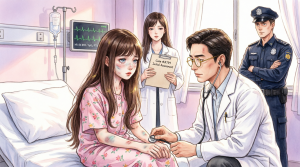
At South Texas Regional Children’s Hospital, Lily was placed in an emergency bay beneath lights too bright for midnight.
A nurse wrapped a bracelet around her wrist while Lily stared at the ceiling tiles.
“Is my dad mad?” she asked.
The nurse’s hand paused.
“No, sweetheart,” she said softly. “He’s scared.”
Miguel arrived moments later, still wearing his grocery-store shirt.
“Lily,” he called from the doorway.
Her eyes found him.
For one second, relief crossed her face.
Then shame replaced it, and she turned toward the wall.
That tiny movement hurt Miguel worse than any shouted accusation could have.
Dr. Elaine Porter entered with a clipboard and the kind of calm that made chaos lower its voice.
“Mr. Ramirez, you need to stay here while we examine her.”
“Please,” Miguel said. “I just want to hold her hand.”
“I understand,” Dr. Porter replied. “But first, I need answers.”
She asked about food, fever, medication, bathroom habits, falls, and how long Lily’s stomach had looked swollen.
Miguel rubbed both hands over his face.
“Three days. Maybe four.”
The nurse looked up.
Officer Brooks stopped writing.
Miguel heard the silence and seemed to shrink inside it.
“She said it hurt after eating soup from the store,” he continued. “I thought it was something bad in the food.”
“Did she see a doctor?” Dr. Porter asked.
Miguel’s eyes reddened.
“The school nurse sent a note. I signed it. I thought I could take her after payday.”
No one in the room spoke immediately.
The truth was beginning to take shape, and it was uglier than a simple accusation.
Not because Miguel had attacked his daughter.
Because he had delayed saving her.
Dr. Porter ordered bloodwork, toxicology, an abdominal ultrasound, and surgical evaluation.
Lily lay still while adults moved around her with urgent precision.
She did not scream.
That frightened the nurses more than screaming would have.
Children in severe pain sometimes go quiet when their bodies have spent too much energy fighting.
Miguel stood near the wall, fists closed, not in anger, but because every instinct told him to run to her.
Officer Brooks watched him, unsure where suspicion ended and heartbreak began.
Then Lily whispered, “I didn’t want him to lose work.”
Miguel’s head snapped up.
“What, mija?”
Lily kept her eyes on the ceiling.
“You said if you missed again, they might fire you.”
Miguel covered his mouth with both hands.
The accusation had sounded like fear of him.
Now it sounded like fear for him.
That difference broke the room open.
The ultrasound technician dimmed the monitor and spread warm gel across Lily’s swollen belly.
The probe moved slowly over the place where Lily’s small hands had been pressing all night.
The room filled with soft beeps, paper rustling, and the faint squeak of shoes on the polished floor.
Then the technician stopped moving.
Dr. Porter stepped closer.
Officer Brooks lowered his pen.
Miguel watched both women look at the screen, then at each other.
“What is it?” he asked.
Dr. Porter did not answer him immediately.
“Call pediatric surgery,” she told the nurse. “Now.”
The nurse moved fast.
No panic.
No wasted motion.
That made Miguel more afraid than panic would have.
“What is happening?” he demanded, voice cracking.
Dr. Porter turned the screen slightly away from Lily.
“It appears her appendix may have ruptured,” she said. “There is infection in her abdomen.”
Miguel stared at her.
The words did not land at first.
Appendix.
Ruptured.
Infection.
Not poison.
Not a bruise.
Not a deliberate act.
A medical emergency missed by every adult who had promised to protect her.
Lily’s mother, Rosa, arrived in a wheelchair moments later, pale beneath a thin cardigan.
She had been battling a severe respiratory infection for days, too weak to stand without help.
When she saw Lily surrounded by machines, she began crying before anyone explained.
Miguel turned toward her.
“I thought it was the food,” he said. “I thought we had until tomorrow.”
Rosa looked at him like she wanted to blame him, forgive him, and blame herself all at once.
“I heard her crying,” she whispered. “I thought she was having nightmares.”
Dr. Porter held up one hand.
“This is not the time for guilt to become noise,” she said firmly. “Right now, Lily needs every one of you steady.”
Then the nurse brought in the folded school clinic note from Lily’s backpack.
It was dated two days earlier.
Persistent abdominal pain.
Parent advised urgent medical evaluation.
Student appeared pale and guarded.
Miguel saw his own signature at the bottom.
He grabbed the bed rail as if the floor had moved.
“I signed it,” he whispered. “I signed the warning.”
Officer Brooks looked down at the note.
The case in his notebook was changing before his eyes.
There was no evidence that Miguel had poisoned Lily.
There was no evidence his friend from the grocery store had caused the swelling.
There was, however, evidence of a poverty-shaped delay that had nearly cost a child her life.
And that was harder for everyone to discuss.
Because it was not as simple as villain and victim.
It was a father who loved his daughter, a mother too sick to notice, a school system that sent a note home, and a medical system expensive enough to make fear feel rational.
It was a child who blamed food because she did not know how bodies fail inside.
It was a family trapped between danger and debt until danger stopped waiting.
Lily opened her eyes while Dr. Porter explained surgery.
“Am I in trouble?” she asked.
Every adult in the room froze.
“No,” Dr. Porter said immediately. “You did the right thing by calling.”
Lily looked toward Miguel.
“Even if I said Daddy did it?”
Miguel stepped forward, but stopped when Officer Brooks gently raised a hand.
His voice broke anyway.
“You saved your own life, mija.”
Lily’s lips trembled.
“I didn’t know what else to say.”
Miguel nodded, tears running down his face.
“You said enough.”
The surgery took nearly three hours.
Miguel sat in the waiting room with his elbows on his knees, staring at the floor as if answers might appear in the tile.
Rosa sat beside him, wrapped in a hospital blanket, coughing into tissues and crying without sound.
Officer Brooks stayed longer than required.
Maybe because he had a daughter Lily’s age.
Maybe because the story had become the kind that follows a person home.
At 4:46 a.m., Dr. Porter came out in blue surgical scrubs.
Miguel stood too fast and nearly stumbled.
“She’s alive,” Dr. Porter said.
Rosa sobbed.
Miguel pressed both hands against the wall, unable to hold himself upright.
“The infection was serious,” the doctor continued. “But we controlled it. She will need monitoring, antibiotics, and time.”
Miguel nodded rapidly.
“I’ll do anything.”
Dr. Porter’s expression softened, but only slightly.
“She also needs adults who do not wait when she says she is hurting.”
The sentence landed harder than any accusation.
Miguel did not defend himself.
He did not mention money.
He did not mention work.
He simply nodded and said, “I know.”
By morning, the first rumors had already started spreading.
A neighbor had seen police lights.
Someone at the grocery store had heard Miguel left with an officer.
A cousin posted a vague message online about “monsters hiding in plain sight.”
Within hours, the story became whatever people wanted it to be.
Some said Miguel had poisoned his daughter.
Some said Lily had lied.
Some said poor parents should not have children.
Some said doctors cared only after police got involved.
Almost nobody waited for the truth.
That was the third tragedy.
The truth was not clean enough for the internet.
It did not give people a perfect monster to hate.
It gave them a tired father, a sick mother, an ignored school note, a frightened child, and a hospital bill nobody wanted to discuss.
When Lily woke the next afternoon, Miguel was sitting beside her bed.
This time, no officer stood between them.
Her small hand rested under a blanket, attached to an IV.
Miguel leaned forward carefully.
“Can I hold your hand?” he asked.
Lily nodded.
He took it like it was made of glass.
“I’m sorry,” he said. “Not because you called. I’m proud you called.”
Lily watched him.
“I’m sorry because you told me you hurt, and I made you wait.”
Her eyes filled.
“I thought you would lose your job.”
Miguel closed his eyes.
“No job is worth you.”
Rosa cried quietly from the chair.
Lily looked between them, still pale, still exhausted, but alive.
“Can we go home later?” she asked.
Miguel squeezed her hand.
“When the doctors say it is safe.”
“And if my stomach hurts again?”
“Then we listen the first time.”
The investigation closed without criminal charges for assault or poisoning.
But that did not mean nothing happened.
Child protective services required medical follow-up, safety planning, and proof that Lily would receive care without delay.
The school reviewed how urgent health warnings were communicated.
The grocery store manager, after learning why Miguel had been working double shifts, quietly adjusted his schedule.
A local clinic connected the family to emergency care assistance.
None of it erased what had happened.
But it proved that consequences do not always have to look like handcuffs.
Sometimes consequences look like accountability, documentation, uncomfortable meetings, and a father never again confusing survival with delay.
Weeks later, Lily returned to school with a small scar and a bigger voice.
Her teacher asked if she wanted the class to know anything.
Lily thought for a long moment.
Then she said, “When your body hurts a lot, you should tell someone until they listen.”
That sentence traveled farther than any rumor.
Parents shared it.
Nurses reposted it.
Teachers printed it.
Some people argued under every post, because the internet can turn even a child’s survival into a battlefield.
Was Miguel negligent or overwhelmed?
Was the school responsible for not escalating?
Was healthcare too expensive, or had the parents simply failed?
Did Lily’s 911 call prove children should always be believed, or did it prove children can misunderstand danger?
The answer was not comfortable.
Children should be believed.
Children can also be wrong about the cause.
Adults must be wise enough to hear both truths at once.
Lily did not call 911 with a perfect diagnosis.
She called because pain had outgrown silence.
That was enough.
Miguel did not become innocent because he loved her.
Love does not erase delay.
But delay did not make him the monster the rumors wanted.
That was the truth nobody online wanted to share, because it left no easy hero except the child.
An eight-year-old girl saved herself with a whisper.
Not because every adult failed completely.
Because every adult failed just enough.
And sometimes, that is all it takes for a child to end up beneath hospital lights, asking if telling the truth will make someone angry.
Months later, Miguel kept the school clinic note folded inside his wallet.
The signature at the bottom remained visible, a permanent reminder of the night he almost lost his daughter to tomorrow.
Whenever someone asked why he carried it, he did not hide.
He said, “Because I thought love meant working harder.”
Then he would pause.
“Now I know love means listening sooner.”
Lily’s 911 call began as an accusation.
It ended as a warning.
Not just to one family, one hospital, or one exhausted father.
It warned every adult who has ever dismissed a child’s pain because life was inconvenient, money was tight, or morning seemed close enough.
Morning is not promised.
Pain does not wait politely.
And sometimes the smallest voice in the house is the only one brave enough to say something is wrong.
THE END.

