Grover walked between us.
Finally, the boy said, “You really think he should visit that man?”
“I think the man loved him.”
“That doesn’t answer the question.”
“No. It doesn’t.”
Desmond kicked a pebble.
“What if Grover wants to go with him?”
The question was barely above a whisper.
I stopped walking.
So did he.
So did Grover, because Grover hated being left out of anything.
“Then my heart will break,” I said.
Desmond looked at me.
“But I won’t punish Grover for it.”
His face twisted.
“I hate that answer.”
“I do too.”
He nodded.
Then he said, “I’m still mad at you.”
“I know.”
“I might be mad for a while.”
“You’re allowed.”
He looked shocked.
Kids like Desmond were used to adults demanding forgiveness on a schedule.
I had done that before.
Not anymore.
He took Grover’s leash from my hand.
I let him.
That was his first sign of forgiveness.
Not full.
Not clean.
But real.
For the next three weeks, we built Grover’s new life carefully.
No big announcements.
No smiling pictures for district papers.
No “miracle dog” nonsense.
Just routine.
The old owner visited every Saturday morning at the school field.
The first visit was awkward.
Desmond stood with his arms folded like a tiny security guard.
I stood beside him pretending not to do the same thing.
The man brought no toys.
No treats.
He asked permission before touching Grover.
That helped.
Grover remembered him.
There was no denying that.
He leaned against the man’s legs.
He licked his hands.
He wagged that soft careful wag from the first meeting.
But when the man walked toward his pickup after the visit, Grover did not follow.
He returned to Desmond.
Then to me.
Then he rolled in the grass like a fool.
The man laughed through tears.
“He’s happy,” he said.
Desmond said nothing.
But his shoulders dropped.
Week by week, the fear loosened.
Not vanished.
Loosened.
That is how most healing works.
People want one big scene.
One speech.
One hug.
One apology.
But real healing is smaller and more stubborn.
It is showing up again.
And again.
And again.
It is not using pain as a weapon just because you could.
It is letting a dog love more than one person without calling it betrayal.
By the end of August, Desmond started handing the man Grover’s brush.
Only for a few minutes.
Only under supervision.
But still.
That brush was no small thing.
It meant Desmond trusted him not to disappear with the dog.
It meant the man trusted Desmond to teach him the new routines.
It meant I stood there watching a fourteen-year-old boy explain skin care and medication history to a grown man who listened like the boy was a professor.
I nearly cried again.
I was becoming ridiculous in retirement.
Then school started.
I woke up the first Monday at five-thirty out of habit.
For thirty-eight years, that day had owned me.
I stood in my kitchen, holding a mug of coffee, listening to no alarm bells.
No grading stack.
No morning announcements.
No hallway duty.
Grover slept by the back door.
My house was quiet.
But not empty.
That was the difference.
At seven, Desmond knocked.
He wore a clean shirt.
His sneakers were still worn, but he had scrubbed the white rubber edges until they almost looked new.
He had grown again.
Teenage boys do that.
They stretch upward like grief is fertilizer.
“You ready?” I asked.
He looked nervous.
“I don’t know.”
“That makes two of us.”
We drove to school with Grover in the back seat, head between us, breathing happily into both our ears.
When we walked through the front doors, the hallway reacted like a wave.
Students gasped.
Then smiled.
Then moved aside.
But something was different.
They did not swarm him.
Desmond had spent the last week helping make rules.
Three students at a time.
Ask first.
No hugging around the neck.
No food.
No waking him.
No using him to avoid classwork.
That last one had been mine.
When we reached the old biology room, I stopped.
The nameplate had been changed.
A new teacher had the room.
For a second, I felt something inside me fold.
Then Desmond nudged me.
“Come on.”
Across the hall, the school had cleaned out a small storage room.
They painted it soft green.
Put in chairs.
A shelf of books.
A water bowl.
Grover’s orthopedic bed.
On the wall, they hung a framed copy of Desmond’s drawing.
Not the original.
I kept the original at home.
Under the frame was a small plaque.
Not “wellness mascot.”
Not “centerpiece.”
Just:
“CARE IS A RESPONSIBILITY.”
I stared at it.
The principal stood in the doorway.
“No brand names,” she said. “No slogans. No speeches. Just that.”
I nodded.
“Acceptable.”
She smiled.
From me, that was praise.
Our first volunteer day was not dramatic.
That made it perfect.
A nervous seventh grader read quietly beside Grover.
A senior sat on the floor for six minutes before a hard exam, breathing with his hand on Grover’s back.
Two girls who had not spoken all summer after an argument ended up brushing Grover together and apologized without saying the word apology.
Desmond logged every visit.
Time.
Student initials.
Grover’s behavior.
Stress signs.
Breaks needed.
He took it seriously.
More seriously than some adults took their jobs.
At lunch, I caught three boys from Desmond’s grade standing near the door.
A year ago, boys like that had mocked him.
Now one of them cleared his throat and said, “Is Grover free after third period?”
Desmond checked the schedule.
“Ten minutes.”
“Cool.”
They started to leave.
Then one turned back.
“Hey, Des. You eating with anybody?”
Des.
Not trailer park kid.
Not freak.
Not dog boy.
Des.
Desmond looked at me.
I looked away, pretending to inspect the supply shelf.
“Maybe,” he said.
“You can sit with us.”
The boys walked off.
Desmond stood frozen.
I kept my back turned because I knew how important it is for a boy to have a private face when his life changes.
After a moment, he whispered, “Did you hear that?”
“No,” I lied.
He laughed under his breath.
Grover wagged.
That afternoon, the old owner came for his scheduled visit.
He waited by the office until Desmond brought Grover out.
The man had found a steadier place to live by then.
A small room over a mechanic’s garage.
Nothing fancy.
But safe.
He had also started helping at the county shelter on weekends.
He said being around animals made him feel useful again.
Desmond pretended not to care.
But I saw him listening.
That day, the man brought a small photo.
Grover as a puppy.
Back when he was Sunny.
He was all paws and ears, sitting beside a woman in a backyard.
The man’s late wife.
He did not say much about her.
He didn’t need to.
Grief recognizes grief.
I looked at that photo and felt my own wife standing somewhere behind my shoulder.
Not in a ghostly way.
In the way memory enters a room without knocking.
Desmond studied the photo.
“He was goofy,” he said.
The man smiled.
“He still is.”
Desmond handed it back.
Then paused.
“You can put a copy in his folder.”
The man swallowed.
“I’d like that.”
Another small bridge.
That was the whole year, really.
Small bridges.
Some held.
Some cracked.
Some had to be rebuilt.
Not everyone liked the arrangement.
That was expected.
One parent complained that Grover got special treatment while some kids did not.
She was not entirely wrong.
A teacher said the room became a distraction.
Sometimes it did.
A few students tried to use Grover as an excuse to skip uncomfortable things.
We stopped that quickly.
Comfort is not the same as escape.
That became one of our rules.
The biggest argument came in October.
A student recorded Grover calming a crying classmate and posted it in a group chat.
By lunchtime, half the school had seen it.
By the next day, parents were calling.
Some said it was beautiful.
Some said it was private.
The crying student was humiliated.
The principal wanted a meeting.
Desmond was furious.
Not loud furious.
Cold furious.
“That’s not what he’s for,” he said.
He stood in the wellness room with the door closed, shaking.
“They turned her pain into something to pass around.”
The principal looked exhausted.
“We’re handling it.”
“Are you?”
His voice was sharp.
I almost corrected his tone.
Then I stopped myself.
He had earned that anger.
The school had spent months celebrating how Grover made people feel safe.
Now safety had been broken by a phone.
The student who recorded it was not evil.
Just thoughtless.
That made it harder.
Thoughtless harm is still harm.
The principal asked what consequence we recommended.
There was the controversy again.
Half the adults wanted punishment.
Half wanted education.
Desmond surprised me.
He said, “Make him work here.”
The room went silent.
The principal blinked.
“As a consequence?”
“As a responsibility.”
The student who recorded the video was assigned to help clean the wellness room after school for two weeks.
No posting.
No phone.
Just water bowls, towels, logs, and listening.
The first day, he rolled his eyes.
The third day, Grover fell asleep on his shoe.
The fifth day, he apologized to the girl.
Not because an adult forced the words.
Because he finally understood what he had treated like entertainment.
That incident changed the whole school more than any assembly could have.
We made a new rule and painted it on a card by the door:
“PAIN IS NOT CONTENT.”
I liked that rule.
I liked it so much I wished somebody had taught it to adults too.
Winter came again.
Grover’s first full winter healthy.
His coat had become thick and ridiculous.
He loved snow with the enthusiasm of a creature who had once nearly died cold and hairless, though he could not remember it the way we did.
Or maybe he did.
I was never sure.
Desmond came over for dinner most Fridays.
His mother joined when she could.
She was a tired woman with kind eyes and hands that never fully rested.
She thanked me too much.
I told her so.
She told me I complained too much.
I liked her immediately.
One Friday in January, she brought a pie from the diner.
No label.
No box.
Just foil over a dented pan.
She said, “It’s not fancy.”
I said, “Good. Fancy food is usually small and dishonest.”
Desmond laughed.
His mother laughed too.
For one second, my kitchen sounded like a home from long ago.
After dinner, Desmond washed dishes without being asked.
His mother watched him from the table, eyes shining.
“He’s different now,” she said quietly.
I pretended to organize forks.
“He was always different.”
“No,” she said. “He lets people see him now.”
That went straight through me.
Grover lay between our chairs, snoring.
The following spring, almost one year after Desmond had left the drawing on my desk, Grover got sick.
Not like before.
Not dying in a basket.
But enough to scare us.
He stopped eating breakfast.
For Grover, that was practically a medical emergency.
Then he refused his evening walk.
Desmond noticed before I did.
“He’s breathing wrong,” he said.
I listened.
“It’s probably fatigue.”
“No.”
He grabbed the notebook.
The old Grover Data notebook.
He flipped through pages, comparing resting breath counts.
Weight.
Gum color.
Energy levels.
His finger moved down the chart.
“He’s off.”
“Desmond—”
“He is.”
I wanted to dismiss him.
Not because he was wrong.
Because I was afraid he was right.
That is an ugly adult habit.
Calling fear reason.
We drove to the vet clinic.
The same expensive one where I had once told them to empty my savings account.
A younger vet examined Grover.
She listened to his chest for a long time.
Too long.
Desmond stood beside the table, one hand on Grover’s paw.
The old owner came too after we called him.
He arrived breathless, hair damp from work, fear plain on his face.
For once, nobody argued about who had more right to be there.
We were all just scared.
The vet said it might be a complication from old damage.
Not a death sentence.
Not if treated early.
Then she looked at Desmond’s notebook.
Her eyebrows rose.
“You kept all this?”
Desmond nodded.
“Yes, ma’am.”
“This is why you caught it early.”
He looked stunned.
She tapped the page.
“This matters. A lot.”
I watched his face change.
Not pride exactly.
Something deeper.
Recognition.
The world had told him he was too poor, too strange, too quiet, too easy to overlook.
But in that exam room, his careful attention became the thing that helped save a life.
Again.
On the drive home, Grover slept in the back seat.
The old owner followed us in his pickup.
Desmond stared out the window.
After a while, he said, “Science helped.”
I glanced at him.
“What?”
“My note. Last year. I said life isn’t saved by science.”
He looked embarrassed.
“I think I was wrong.”
I kept my eyes on the road.
“No,” I said. “You were fourteen. Fourteen-year-olds are allowed to be incomplete.”
He smiled a little.
Then I said, “Science helped because someone cared enough to measure.”
He nodded slowly.
“Never giving up helped because someone knew what the numbers meant.”
“Exactly.”
He looked back at Grover.
“So both.”
“So both.”
He was quiet for a long time.
Then he said, “I want to do this.”
“Do what?”
“Animals. Medicine. Maybe not doctor. I don’t know. Something.”
I tightened my hands on the wheel.
Not because I was upset.
Because I was not.
Because the boy who once placed coins on my desk for a miracle was now picturing a future.
A specific one.
That is no small miracle either.
“You’ll need strong grades,” I said.
“I know.”
“Science won’t be gentle with you.”
“I know.”
“Neither will people.”
“I know.”
“Then start with chemistry.”
He groaned.
I smiled.
That summer, we built a second doghouse.
Not because Grover needed one.
Because the county shelter had a few old dogs that needed temporary foster homes, and Desmond’s mother had finally moved them into a slightly better rental with a small fenced yard.
The first foster dog was a gray-muzzled mutt named Pickle.
Desmond hated the name.
The dog refused to answer to anything else.
Pickle was half blind, stubborn, and smelled like damp carpet.
I respected him immediately.
Grover acted offended for one full day.
Then he let Pickle sleep near his red doghouse.
Not in it.
Near it.
Progress.
The old owner helped repair the fence.
Desmond handed him tools without the old stiffness.
I watched them from the porch.
A boy, a man, two dogs, and a crooked red doghouse.
A strange pack.
A patched-together one.
The only kind I trust now.
At the end of that summer, Desmond came over with an envelope.
He placed it on my kitchen table.
For one terrible second, I thought it was another goodbye.
“What is that?”
“Open it.”
Inside was eight dollars and fourteen cents.
Same amount.
Different coins.
A few bills.
I looked up.
He stood very straight.
“I want to start a supply shelf at school,” he said. “For kids who find animals but don’t know what to do first. Food. Towels. Leashes. A list of safe numbers to call. Not medical advice. Just first steps.”
I stared at the money.
“It won’t be enough.”
“I know.”
“You’ll need permission.”
“I know.”
“You’ll need adults.”
He made a face.
“I know.”
“You’ll need a better name than supply shelf.”
“I was thinking the Eight Fourteen Shelf.”
I looked at him.
He looked back.
That number had once been all the money he had.
Now he was turning it into a door for someone else.
I cleared my throat.
“That name is acceptable.”
He smiled.
From me, that was practically fireworks.
The shelf started small.
A plastic bin.
Then a cabinet.
Then a corner of the wellness room.
No real organization.
No big donors.
No fancy campaign.
Just families bringing clean towels, sealed food, extra bowls, and handwritten notes that said things like:
“Someone helped us once.”
By October, the Eight Fourteen Shelf had helped three students get lost pets safely to adults who could handle the next step.
By December, the school added a lesson in biology about community care and animal health.
I came in to teach it.
Voluntarily.
Which would have shocked anyone who knew me before Grover.
I stood in front of a new class of students and held up two pictures.
Grover then.
Grover now.
The room went silent.
“This,” I said, pointing to the first picture, “is what neglect looks like.”
Then I pointed to the second.
“This is what responsibility can look like.”
A hand went up.
A girl in the second row asked, “Did love save him?”
A year ago, I would have hated that question.
Too soft.
Too imprecise.
Now I looked at Grover sleeping beside Desmond’s chair.
“Yes,” I said. “But not the kind of love people talk about when they don’t want to do the work.”
The students watched me.
“Love was medication at the right hour. Love was boring charts. Love was money spent without applause. Love was a boy coming back every day. Love was a man admitting he failed. Love was a school learning not to turn pain into entertainment.”
I paused.
“Love is not a feeling you announce.”
Grover snored loudly.
The class laughed.
I smiled.
“Love is what you keep doing after the announcement is over.”
At the end of class, Desmond walked me to the parking lot.
He was sixteen by then.
Taller than me.
That was unacceptable, but apparently legal.
He had better shoes.
Not expensive.
Just solid.
His shoulders no longer curled inward.
Kids nodded at him in the hall now.
Some still didn’t understand him.
That was fine.
Being understood by everyone is overrated.
Being safe with a few good people is better.
At my truck, he handed me a folded paper.
I froze.
“Another drawing?”
“Just open it.”
I did.
It was a new picture.
The same shadow monster from the first drawing was still there.
But smaller now.
Less sharp.
In front of it stood a boy, a dog, an old man, and another man holding a leash.
Behind them was a school.
Not perfect.
Crooked windows.
Cracked sidewalk.
A few dark corners.
But light came from the doorway.
Across the bottom, Desmond had written:
“Some shields are made of people who stay.”
I had to look away.
He knew.
He always knew.
Grover leaned against my leg.
The old owner pulled into the lot just then for his visit.
Desmond waved him over.
No stiffness.
No fear.
Just a wave.
The man waved back.
That was when I understood the ending would not be clean.
It would not be the kind of ending where one person wins Grover and everybody else learns a lesson.
Life is rarely that tidy.
Grover did not belong to the school.
He did not belong to the old owner.
He did not belong to Desmond.
He did not even belong to me, though he slept in my house and stole my toast.
Grover belonged to his own beating heart.
We belonged to the responsibility of loving him well.
That is harder than ownership.
Ownership asks, “What can I keep?”
Responsibility asks, “What does this life need from me?”
Most people prefer the first question.
It is easier.
It sounds stronger.
It fits better in arguments.
But the second question is where real love lives.
Years ago, I thought my life had ended in a quiet house.
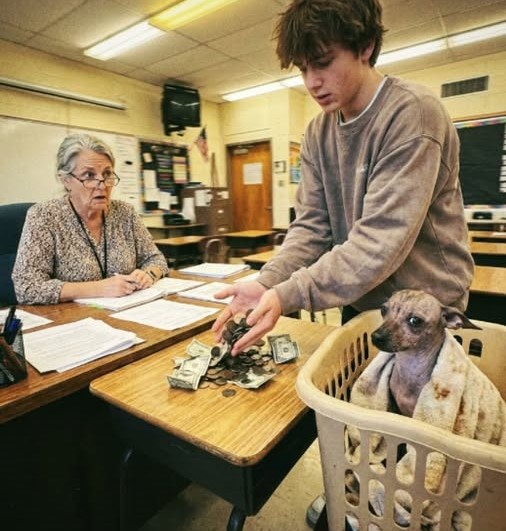
Then a bullied boy carried a dying dog into my classroom and paid tuition with everything he had.
Eight dollars.
Fourteen cents.
A laundry basket.
A plea.
I thought I was teaching him how to save something.
But Desmond taught me the lesson I had avoided my whole life.
You do not save a life once.
You save it every day you choose not to look away.
Every morning you show up.
Every apology you mean.
Every boundary you respect.
Every record you keep.
Every hard truth you tell before it becomes a betrayal.
Grover is older now.
His muzzle has gone pale.
He moves slower on cold mornings.
So do I.
Desmond still comes by on Fridays when he can.
Sometimes he brings schoolwork.
Sometimes shelter forms.
Sometimes just himself.
The old owner still visits.
Sometimes he and Desmond talk about dogs.
Sometimes about work.
Sometimes they sit beside Grover without talking at all.
That is healing too.
Not every silence is empty.
Some silences are full because nobody has to prove they deserve to be there.
Last week, I found Grover asleep in the backyard between the two doghouses.
The red one Desmond and I built.
And the second one we built for all the dogs who came after.
His tail twitched in a dream.
I sat beside him with my coffee.
My house was quiet.
But not empty.
Never empty now.
On the porch railing sat Desmond’s latest note, held down by a smooth stone.
He had left it before school.
Only one line this time.
“You taught me biology, but Grover taught us both how to stay.”
I read it twice.
Then I looked at that old dog, still breathing, still here, still saving people without knowing it.
And for once, I did not correct the boy.
Because he was right.
Science kept Grover alive.
But staying made him whole.
And maybe that is true for people too.
THE END.

