I was the strictest, most hated teacher in school until a bullied 14-year-old placed a dying dog and $8.14 on my desk, begging for a miracle.
“I don’t have enough money for a vet,” the boy’s voice shook, but his eyes locked onto mine with a desperate fire. “He’s the only living thing in this town that doesn’t laugh at me. You teach biology. Can you please teach him how to live?”
Desmond, a fourteen-year-old kid from the local trailer park who wore the exact same worn-out sneakers every single day, stood frozen in front of my desk.
Between us sat a cracked plastic laundry basket. Inside was a stray dog, completely hairless from a severe skin infection, his ribs jutting out sharply. He was taking shallow, ragged breaths.
Next to the basket, Desmond had carefully stacked exactly eight dollars and fourteen cents in crumpled bills and tarnished coins. It was every penny to his name.
I was sixty-two years old and widely known as the meanest teacher in the entire school district. I hadn’t smiled in a decade, not since my wife and our own dog passed away within months of each other.
My immediate, practical instinct was to call animal control. It was the logical, painless solution for a creature this far gone.
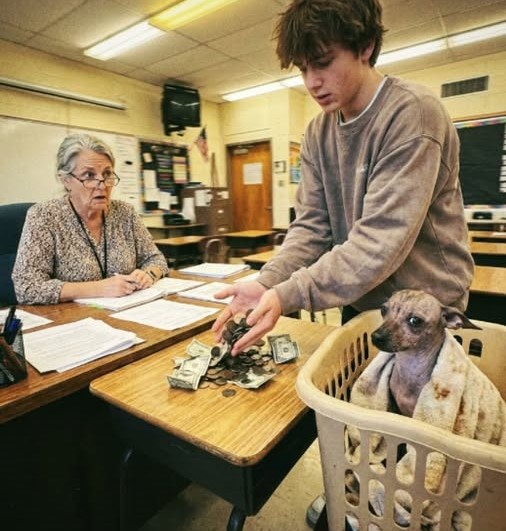
But then the dog slowly opened his eyes. They were deep brown, exhausted, yet filled with a quiet, lingering plea. He looked exactly how I felt on the inside. Broken, tired, and waiting for the end.
I looked at the bullied teenager offering everything he had for a creature society had completely thrown away. I reached out and scooped the change into my palm.
“This is tuition,” I told him, my voice completely flat. “As of today, this animal is my student.” I didn’t even stop at my house. I drove straight to the most expensive animal clinic in the county.
The vet took one look at the dog, shook his head, and rattled off a depressing list of severe issues: advanced heartworms, extreme malnutrition, and early organ distress. He warned me it would cost thousands of dollars with absolutely no guarantee of survival.
I thought about the deafening silence in my incredibly empty house. I pulled out my debit card.
“Empty my savings account if you have to,” I told him. “Just save him.” I named the dog Grover.
For three agonizing weeks, Grover lived in the intensive care unit. I visited every single afternoon, sitting on the floor of his pen, reading my biology textbooks out loud just so he would get used to the sound of my voice.
When I finally brought him home, he was weak but walking. For the first time in ten long years, I heard comforting footsteps in my house that weren’t my own.
But Grover needed constant monitoring and strict medication schedules. I couldn’t leave him alone. So, I filled out the necessary medical paperwork to register him as an official emotional support animal.
The following Monday morning, I walked into my first-period class with a dog on a heavy leash. The room of thirty rowdy teenagers went dead silent.
I set a thick orthopedic bed in the back corner of the room. “This is Grover,” I announced to the stunned class. “He is auditing biology. If any of you disturb him, you fail the semester.”
The change in the room was instantaneous. My classroom went from a tense, strict environment to a place of profound, protective calm. The toughest kids in school suddenly stopped talking back. Nobody wanted to wake the sleeping dog.
I officially appointed Desmond as my biology assistant. His daily job was to stay after school, log Grover’s weight gain, and help me administer his medication.
Almost overnight, the relentless bullying Desmond endured in the hallways stopped entirely. Why? Because Desmond held the exclusive bag of dog treats. If you wanted to pet Grover between classes, you had to be nice to Desmond.
Months passed, and the transformation was incredible. Grover’s coat grew back thick and golden. He began greeting every student at the door, his tail wagging so hard his entire body shook with joy.
Desmond changed, too. He stood taller in the halls. He started speaking up and participating in class. The three of us spent hours after school in that quiet classroom, just watching a dog learn how to be a normal dog again.
During a severe panic attack before midterms, a female student was sobbing uncontrollably in the back row. Without a word from me, Grover stood up, walked down the aisle, and rested his heavy head directly on her lap.
She buried her hands in his thick fur, slowly matching her ragged breathing to his calm, steady rhythm. From that moment on, Grover didn’t just belong to me. He belonged to the entire school.
Over winter break, knowing Desmond’s mother was working double shifts at a local 24-hour diner just to make rent, I invited the boy over to my house.
We built a custom red doghouse in the backyard. I bought him a heavy winter coat, pretending I found it on clearance. We drank hot chocolate on the porch, laughing loudly while Grover chased snowflakes and tackled snowdrifts.
I realized I hadn’t felt like a father in a very long time. It felt incredibly good.
By the time spring arrived, Grover was a magnificent, healthy animal. The vet called his recovery a medical miracle. But I knew the truth. It was just a fourteen-year-old boy who refused to give up, and an old man who finally decided to care.
I submitted my retirement papers that April. The district board wanted to throw a big assembly, but I declined. I just wanted to finish my final lessons and go home with my dog.
On the final day of the school year, the bell rang, and the halls erupted with summer joy. I was quietly erasing the chalkboard for the last time, Grover sitting faithfully at my feet.
The door creaked open. Desmond walked in, looking taller and infinitely stronger than the frightened kid from ten months ago.
He didn’t say a word. He just walked up to the exact spot on my desk where he had left his eight dollars and fourteen cents. He set down a folded piece of paper, gave Grover an affectionate pat on the head, and left.
I slowly unfolded the paper. It was a hand-drawn picture.
He had drawn a terrifying shadow monster with sharp teeth, surrounding a small stick figure of a boy and a dog.
But standing firmly between them and the monster was a massive, towering shield, blocking out all the darkness. Engraved across the front of the shield was my name.
I turned the paper over. On the back, written in neat blue ink, was a short message.
“Thank you for teaching me that sometimes, life isn’t saved by science. It’s saved by never giving up.”
I thought Desmond’s drawing was goodbye.
I was wrong.
It was the beginning of the hardest lesson Grover ever taught me.
I stood alone in that empty classroom, holding that folded paper in both hands while the last buses pulled away outside.
The halls were loud for a few minutes.
Then they went quiet.
That kind of quiet had been my punishment for ten years.
Before Grover.
Before Desmond.
Before eight dollars and fourteen cents cracked open the stone around my heart.
Grover sat at my feet, watching me with those deep brown eyes.
His tail thumped once against the floor.
Not happy.
Not playful.
Just aware.
Dogs know when a person is trying not to fall apart.
I sank into my chair and read Desmond’s note again.
“Thank you for teaching me that sometimes, life isn’t saved by science. It’s saved by never giving up.”
My eyes blurred before I could stop them.
I had spent my entire career teaching teenagers that facts mattered.
Cells mattered.
Organs mattered.
Systems mattered.
But there I was, an old biology teacher crying over a boy’s drawing because I finally understood something no textbook had ever explained properly.
A life could have a pulse and still not be living.
A person could keep breathing for years and still be gone.
Desmond had brought a dying dog into my classroom.
But somehow, that boy had dragged me in with him.
I folded the picture carefully and placed it inside my old leather grade book.
Then I looked down at Grover.
“Well,” I said, my voice rough, “looks like we passed.”
Grover stood, stretched his front legs, and pressed his head against my knee.
That was when someone knocked on the open classroom door.
Not a student.
Not Desmond.
The principal stood there with both hands wrapped around a folder.
She had that careful look people get when they are about to ask an old man for something they know he does not want to give.
I wiped my face fast.
Too fast.
She noticed anyway.
“I’m sorry,” she said softly. “I can come back.”
“No,” I muttered. “Say what you came to say.”
Her eyes shifted to Grover.
He wagged his tail.
Everybody liked Grover.
That had become one of the biggest problems in the building.
“The district office called,” she said.
I leaned back.
“That sentence has ruined many fine afternoons.”
She almost smiled.
Almost.
“They want to discuss Grover.”
My hand tightened on the edge of the desk.
“Discuss him how?”
She stepped farther into the room.
“The board has been getting emails from parents. A lot of them. Students too. They’re saying Grover changed the culture of this school.”
“He slept through most of it.”
“He made kids feel safe.”
“That wasn’t in his job description.”
“He had a job description?”
“No. That was the point.”
She took a slow breath.
“They want him to stay.”
The room went still.
Even Grover stopped wagging.
I stared at her.
“Stay where?”
“Here.”
The word dropped between us like a brick.
I looked around my classroom.
The chalkboard still had half-erased diagrams of the digestive system on it.
There were pencil marks on desks.
Old gum under chairs.
A faded poster of a frog skeleton curling at the corners.
This room had been my cage for years.
Then it became something softer.
Now they wanted to take the one living thing that had made my house feel like home again.
“No,” I said.
I didn’t raise my voice.
I didn’t have to.
The principal opened the folder.
“There’s talk of creating a student wellness room next year. They want Grover to be part of it. Supervised, of course. Proper paperwork. Limited hours. They said you could be invited back as a volunteer handler.”
“Invited back.”
My laugh came out dry.
“That’s generous. After thirty-eight years, I get to visit my own dog.”
Her face tightened.
“I told them this was delicate.”
“It isn’t delicate. It’s ridiculous.”
“I know what Grover means to you.”
“No,” I said. “You don’t.”
She looked down.
I felt mean the second I said it.
The old version of me would have enjoyed that.
The new version just felt tired.
She closed the folder.
“I’m not here to force anything. I’m here because the meeting is next Thursday. They asked you to attend.”
“No.”
“They’ll talk about him whether you’re there or not.”
That did it.
I stood so fast my chair scraped backward.
Grover rose with me.
“He is not equipment,” I said. “He is not a classroom resource. He is not a soft rug with a heartbeat.”
“I agree.”
“He is a dog.”
“I agree.”
“He sleeps on my kitchen floor. He drools on my slippers. He steals toast when he thinks I’m not looking.”
“I know.”
“He almost died.”
Her voice softened.
“I know that too.”
“No,” I snapped. “You know the school version. You know the golden dog greeting kids at the door. You know the miracle story everybody likes to repeat because it makes them feel better.”
I pointed at Grover.
“You did not sit on cold clinic tile at midnight listening to him struggle for breath. You did not count his pills. You did not wipe blood from his gums. You did not watch a fourteen-year-old boy pretend not to cry because he thought love meant losing the only friend he had.”
The principal said nothing.
The air between us went heavy.
Then Grover walked over to her and nudged her hand.
Traitor.
She rubbed his head with watery eyes.
“I’m sorry,” she whispered.
I looked away.
She left the folder on my desk anyway.
After she was gone, I stood there for a long time.
Then I opened the folder.
There were printed messages from parents.
Students.
Teachers.
People who had barely spoken to me before Grover arrived.
I read one from a mother whose daughter had panic attacks before school.
She wrote that Grover was the reason her child stopped begging to stay home.
I read one from a boy who said Grover helped him sit through lunch without feeling invisible.
I read one from a janitor who said the hallways were calmer because students lowered their voices around the dog.
Then I read one with no name.
Just one sentence.
“Please don’t take away the only good thing some of us have here.”
I closed the folder.
My hands were shaking.
That was the cruelest thing about love.
Once it saved you, everybody wanted a piece of it.
I drove home with Grover in the passenger seat.
He rested his chin on the window ledge, watching town slide by.
The diner where Desmond’s mother worked.
The tire shop.
The empty lot where kids cut through after school.
The little row of rental houses with sagging porches.
The town looked the same as it always had.
Small.
Tired.
Stubborn.
But I had changed.
And that made every street hurt differently.
When we got home, Grover went straight to his red doghouse in the backyard.
Desmond and I had built it over winter break.
The roof was a little crooked because Desmond had insisted on doing one side himself.
I had acted annoyed.
Secretly, I loved that crooked side.
It proved a boy had touched it.
A boy who was learning that his hands could build something instead of just hiding in his pockets.
I sat on the porch until dark.
Grover lay in the grass.
Fireflies came out.
For the first time since I submitted my retirement papers, I wondered if leaving school had been selfish.
That thought made me angry.
Then ashamed.
Then angry again.
I had given that building thirty-eight years.
I had given my patience.
My voice.
My weekends.
My marriage had survived school calendars and grading stacks and late conferences.
Then my wife died.
Then our old dog died.
And the school kept asking.
One more year.
One more committee.
One more unpaid evening.
One more piece of me.
I had nothing left when Desmond walked into my room.
Nothing.
Then Grover came home with me and put sound back into my house.
Now they wanted him too.
I said it out loud to the dark porch.
“He’s mine.”
Grover lifted his head.
The word sounded ugly once it left my mouth.
Mine.
Not ours.
Not his own.
Mine.
I rubbed my face with both hands.
“Blast it,” I muttered.
Grover came up the steps and sat beside my chair.
I looked at him.
“What do you want?”
His tail swept once.
Dogs never answer the question people most need answered.
The next morning, I found Desmond standing at my front gate.
It was barely seven.
School was out.
The boy had no reason to be there.
He wore the winter coat I had bought him, even though the morning was already warm.
His hair was flattened on one side like he had slept badly.
In his hand was a plastic grocery bag.
Grover saw him through the window and nearly broke my hip getting past me.
He shoved the door open with his shoulder and sprinted across the yard.
Desmond dropped to his knees.
Grover hit him like a small golden storm.
The boy laughed.
Really laughed.
Not the small careful laugh he used around adults.
A full laugh.
A child’s laugh.
I had not realized how badly I needed to hear it.
I stepped onto the porch.
“School’s out,” I said.
Desmond looked up.
His smile faded a little.
“I know.”
“You lost?”
“No, sir.”
He stood and held up the grocery bag.
“I brought his treats. I still had some left in my locker.”
“Your locker is supposed to be empty.”
“I emptied it.”
I stared at him.
He stared back.
The bag sagged between us.
Then he looked down at Grover.
“I didn’t know if I was still allowed to see him.”
There it was.
The thing I had been pretending not to see.
My heart tightened.
I walked down the steps slowly.
“Who told you that?”
“Nobody.”
“Then why ask?”
He shrugged.
But his eyes gave him away.
Because people like us always expected good things to be taken back.
Because when life had trained you to lose, you started apologizing before you even reached for something.
I took the grocery bag from him.
“You’re allowed.”
His shoulders loosened.
“A lot?”
I almost smiled.
“That depends on what you consider a lot.”
He looked at Grover, then back at me.
“Every day?”
I opened my mouth.
Stopped.
Every day meant something.
Every day meant responsibility.
Every day meant my quiet retirement would not be quiet.
Every day meant a fourteen-year-old boy walking through my gate like he belonged somewhere.
I glanced at Grover.
He was sitting between us, tongue out, looking delighted with the negotiation.
“Three mornings a week,” I said.
Desmond’s face fell for half a second.
Then he hid it.
“Yes, sir.”
“And Fridays for dinner.”
His head snapped up.
“What?”
“You heard me. Three mornings and Fridays for dinner. If your mother approves.”
“She will.”
“I said if.”
“She will.”
“Don’t argue with me before breakfast.”
He nodded hard.
But he was smiling.
That was how summer began.
Not with a vacation.
Not with rest.
With a boy, a dog, and an old man pretending he had not accidentally formed a family.
Desmond came Mondays, Wednesdays, and Fridays.
At first, he arrived too early.
Six-thirty.
Then six-fifteen.
Then one terrible morning, five-forty.
I opened the door in my robe and stared at him.
He stared back like he was reporting for military duty.
“Grover’s schedule said he used to eat at six during school.”
“It is summer.”
“He doesn’t know that.”
“Dogs do not read calendars.”
“But they know routine.”
I wanted to argue.
Unfortunately, he was right.
That irritated me.
So I made him eggs.
Desmond was awkward in my kitchen.
He stood near the counter like he expected to be told not to touch anything.
The first time I handed him a plate, he said thank you three times.
The third time, I snapped, “Eat before it gets cold.”
He ate fast.
Too fast.
I pretended not to notice.
Grover noticed.
Grover always noticed.
He lay under the table with his head on Desmond’s shoe.
By July, the boy knew where the plates were.
By late July, he corrected the way I folded towels.
By August, he had the nerve to say my coffee was too strong.
That almost got him banned from the house.
Almost.
We walked Grover on quiet back roads.
We rebuilt part of the fence.
We painted the red doghouse again because Desmond said the first coat had faded.
It had not.
But I bought paint anyway.
Some afternoons, Desmond brought schoolwork he claimed was “just to get ahead.”
I knew what that meant.
It meant the library was closed.
It meant his trailer was too loud or too hot or too lonely.
It meant he had found one place where no one called him strange for wanting quiet.
So we worked at the dining table.
Grover slept under it.
I taught Desmond biology beyond the textbook.
He learned how heartworms damaged blood flow.
How malnutrition changed muscle.
How skin infections could become whole-body storms.
He wrote everything down.
He kept a new notebook labeled “Grover Data.”
On the inside cover, he taped a picture of the dog from the day he brought him to me.
Hairless.
Sick.
Barely alive.
Next to it, he taped a new picture.
Grover in the backyard with his golden coat bright in the sun, ears flopping, mouth open like he was laughing.
Under the two pictures, Desmond wrote:
“Evidence.”
I asked him one afternoon what that meant.
He looked at me like I should know.
“That things can change.”
I had no answer for that.
A week before the board meeting, a letter arrived in my mailbox.
No return name.
Just my address written in blocky handwriting.
Inside was one page.
“I saw the dog in the school newsletter. I think he used to be mine.”
I read that line three times.
Then I sat down hard.
The letter said the dog’s old name had been Sunny.
It said he had gone missing over a year ago after the writer lost his rental and had to leave him with a relative for a short time.
It said the relative claimed the dog ran off.
It said the writer had searched but eventually believed Sunny had died.
Then someone showed him a printed school newsletter with Grover’s picture.
“I am not trying to cause trouble,” the letter said.
“I just need to see if it is him.”
The paper shook in my hand.
Grover lay across the room, chewing one of his stuffed toys.
Golden.
Healthy.
Ours.
No.
Not ours.
There was that word again.
Mine.
His.
Whose?
I wanted to tear the letter up.
I wanted to pretend I never got it.
That scared me more than the letter itself.
Because the old me could be cruel.
The new me had been trying not to be.
I called the number at the bottom before I could talk myself out of it.
A man answered.
His voice was careful.
Worn down.
I said my name.
There was a silence.
Then he said, “Is he alive?”
Not “Can I have him?”
Not “Where is my dog?”
Not “You better give him back.”
Just that.
Is he alive?
I looked at Grover.
He had flipped onto his back, paws in the air, completely undignified.
“Yes,” I said.
The man made a sound.
Half laugh.
Half sob.
I closed my eyes.
That sound ruined my anger.
We agreed to meet in the school parking lot the next afternoon.
Neutral place.
Public place.
Simple.
I did not tell Desmond right away.
That was my second mistake.
My first mistake was thinking love became simpler after it healed you.
The next day, I drove Grover to the school.
He was thrilled.
He thought we were back.
He jumped out of the truck and pulled toward the front doors, tail whipping side to side.
The building looked strange in summer.
Empty windows.
Locked doors.
No locker noise.
No sneakers squeaking.
No kids trying to act tougher than they were.
Just bricks and heat and silence.
The man was already there.
He stood beside an old pickup with faded paint.
He was maybe forty.
Maybe younger.
Life had aged him in the rough way it ages people who have had to choose between bad and worse too many times.
His shirt was clean but worn.
His hands were shaking.
Grover saw him.
Everything stopped.
The tail went still.
The man covered his mouth.
“Sunny?”
Grover stared.
One second.
Two.
Three.
Then Grover walked toward him slowly.
Not running.
Not exploding with joy.
Just walking.
The man dropped to one knee.
Grover sniffed his hands.
Then his shirt.
Then his face.
The man started crying before Grover even wagged.
And then Grover did wag.
Softly.
Carefully.
Like he was remembering a room he used to live in.
The man wrapped both arms around him.
“I’m sorry,” he whispered into Grover’s fur. “I’m so sorry, boy.”
I looked away.
I felt something sharp and childish rise in me.
Jealousy.
At sixty-two years old, I was jealous of a man hugging a dog he had lost.
It was not my proudest moment.
Grover leaned into him.
The man pulled back, touching the dog’s face like he could not believe the fur was real.
“He had a white patch here,” he said, pointing under Grover’s chin.
“He still does,” I said.
The man nodded, crying harder.
“It’s him.”
I wanted to say no.
I wanted to say lots of dogs had white patches.
I wanted to become a scientist again and demand proof.
But Grover had already given it.
The man sat on the curb for a long time with Grover beside him.
I stood a few feet away, feeling like an intruder in my own grief.
Finally, he looked up at me.
“You saved him.”
“A boy saved him.”
He frowned.
“A boy?”
I told him about Desmond.
Not all of it.
Just enough.
How he had found Grover.
How he brought all the money he had.
How he refused to let adults throw another living thing away.
The man listened with both hands buried in Grover’s fur.
When I finished, he stared down at the pavement.
“I didn’t throw him away.”
“I didn’t say you did.”
“But maybe I did.”
I said nothing.
He swallowed.
“I was sleeping in my truck that month. I told myself leaving him with my cousin was better than keeping him with me. My cousin said he got loose. I searched. I put up flyers. But I was moving from place to place. I didn’t have a phone half the time.”
His voice broke.
“I told myself he probably found a family.”
I looked at Grover.
Hairless.
Starving.
Dying in a laundry basket.
He had found something, all right.
Just not a family.
The man wiped his face with his sleeve.
“I don’t know what I’m supposed to ask.”
That made two of us.
He looked at me.
“I loved him.”
I believed him.
That was the worst part.
A bad man would have made this easier.
A careless man.
A cruel man.
A man I could hate.
But grief had taught me something.
Good people still fail what they love.
Sometimes because they are weak.
Sometimes because they are broke.
Sometimes because life corners them until every choice harms somebody.
I had failed my wife in small ways before she died.
Not the big dramatic ways people write about.
Small ways.
Papers graded instead of walks taken.
Emails answered instead of stories listened to.
I had loved her.
I had still failed her.
That is a painful truth.
I would rather have dissected a frog in front of a cafeteria than admit it out loud.
The man stood.
Grover stayed beside him.
My chest tightened.
Then Grover turned his head and looked at me.
His tail wagged once.
The man saw it.
He smiled sadly.
“He loves you too.”
I nodded because speaking was impossible.
Then a voice behind us said, “What’s going on?”
Desmond.
He stood at the edge of the parking lot with his bike tipped beside him.
His face was pale.
Too pale.
I had forgotten he sometimes rode by the school.
Forgotten or hoped he would not.
Both were bad.
He walked closer, eyes moving from me to Grover to the man.
“Who is that?”
“Desmond,” I said carefully.
The boy ignored me.
He looked at the man.
“Why are you touching Grover?”
The man let go immediately.
“I’m sorry.”
Desmond stepped forward.
Grover trotted to him.
The boy grabbed his collar like he was afraid the dog might evaporate.
“Why are you touching him?” he repeated.
The man looked at me for help.
I had no good help to offer.
“He knew Grover before us,” I said.
Desmond stared at me.
“What does that mean?”
“It means Grover may have belonged to him once.”
The word belonged hit the air hard.
Desmond’s eyes flashed.
“No.”
“Desmond—”
“No.”
His voice cracked.
I had heard that sound before.
The day he placed eight dollars and fourteen cents on my desk.
That same desperate fire.
Only this time, he was not begging for a miracle.
He was ready to fight one.
The man held both hands up.
“I’m not here to take him from you.”
Desmond didn’t answer him.
He looked at me.
“You knew?”
“Only since yesterday.”
“And you didn’t tell me?”
“I was going to.”
“When?”
I had no answer.
His face changed.
That hurt more than anger.
Anger means a person still believes you can be better.
This was disappointment.
“You said people shouldn’t make decisions about him like he’s a thing,” Desmond said.
“I know.”
“But you did.”
The words landed clean.
No yelling.
No drama.
Just truth.
I looked down.
The man shifted uncomfortably.
“I should go.”
“No,” Desmond said.
The man froze.
Desmond’s hands were shaking on Grover’s collar.
“You should say what you want.”
“Desmond,” I warned.
“No,” he said again, eyes still on the man. “Everybody keeps talking around it. The school wants him. Mr.—”
He stopped himself before saying my name.
That small break hurt.
“He wants him. You had him before. So say it.”
The man looked at Grover.
Then at Desmond.
“I want to know he’s safe.”
“That’s not an answer.”
“Yes, it is.”
“Do you want him back?”
Silence.
Even the trees seemed to hold still.
The man rubbed both hands over his face.
“Yes,” he whispered.
Desmond pulled Grover closer.
The man rushed on.
“And no. I don’t know. I wanted to see him and I thought maybe the answer would be simple, but it isn’t.”
“Because he’s better now?” Desmond said.
The man flinched.
I put a hand on Desmond’s shoulder.
He shrugged it off.
The man nodded slowly.
“I deserve that.”
Desmond’s eyes filled.
“You didn’t see him in that basket.”
“No.”
“You didn’t smell him.”
“No.”
“You didn’t count his ribs.”
“No.”
“You didn’t put your lunch money on a teacher’s desk because adults kept saying somebody else would handle it.”
The man’s face crumpled.
“No,” he said. “I didn’t.”
Desmond wiped his face angrily.
“He didn’t even have fur.”
“I know.”
“No, you don’t.”
“You’re right.”
That stopped him.
The man looked at Desmond with a kind of respect that many adults had never given him.
“You’re right,” he said again. “I don’t know what you saw. I know what I lost. That’s different.”
Desmond’s grip loosened a little.
Grover licked his hand.
The man looked at me.
“I won’t ask today.”
Today.
The word sat there like a warning.
Then he knelt and looked at Grover.
“Be good, Sunny.”
Desmond stiffened at the old name.
Grover wagged.
The man stood, walked to his pickup, and drove away.
We watched until he turned the corner.
Then Desmond picked up his bike.
He did not look at me.
“I’m going home.”
“Desmond.”
“I’ll come Friday for Grover.”
“Desmond.”
He got on the bike.
His voice was small when he finally spoke.
“You should’ve told me.”
Then he rode off.
Grover whined.
I stood in the parking lot with the dog and felt thirty-eight years of education collapse into one simple lesson.
Trust takes months to grow.
Seconds to bruise.
And sometimes an apology is only the first bandage.
That night, I did not sleep.
Grover did not either.
He paced from the bedroom to the kitchen.
Kitchen to living room.
Living room to front door.
At two in the morning, I found him lying beside Desmond’s extra pair of work gloves in the mudroom.
The boy had left them after fixing the fence.
Grover rested his nose on them.
I sat on the floor beside him.
“I messed it up,” I said.
Grover sighed.
Dogs forgive faster than boys.
Maybe because dogs do not have to survive middle school.
The board meeting came two days later.
I wore my old brown suit.
The one my wife used to say made me look like a tired funeral director.
I put Desmond’s drawing in my inside pocket.
Then I clipped Grover’s leash on.
“You ready?”
Grover sneezed.
I chose to take that as a yes.
The district building was too cold.
It always was.
Adults filled the room with folders, paper cups, and serious faces.
Some parents came.
Teachers too.
A few students sat in the back, whispering until Grover entered.
Then the room softened.
That dog had more authority than anyone behind the long table.
Desmond sat in the last row.
Alone.
He would not look at me.
That hurt, but I deserved it.
The man who had called Grover Sunny was there too.
He stood near the wall, cap in hand.
When Desmond saw him, his jaw tightened.
The principal opened the meeting by explaining the idea.
A wellness room.
A supervised animal support program.
A place for students to reset during hard days.
Grover would be the “centerpiece.”
I hated that word.
Centerpiece.
Like he was flowers at a banquet.
People spoke.
A mother said her daughter needed Grover.
A teacher said test days were calmer with him in the room.
A counselor said students who refused to talk to adults sometimes talked while petting the dog.
A father stood up and said the school had no right to rely on one man’s private pet.
Another parent said if Grover helped children, taking him away was selfish.
There it was.
The room divided right down the middle.
Some looked at me like I was a hero.
Some looked at me like I was stealing comfort from children.
Both were wrong.
That is the problem with being made into a symbol.
People stop seeing your hands shake.
Then the old owner stepped forward.
“I’m the man who had him first,” he said.
The room went dead silent.
Desmond looked at the floor.
The man told his story.
Not dramatically.
Not to win.
He explained the lost rental.
The cousin.
The missing dog.
The year of thinking the worst.
He did not excuse himself.
That made people listen harder.
When he finished, somebody whispered, “Then he should get him back.”
Somebody else whispered, “Not after what happened.”
The principal called for quiet.
But the room had changed.
Now it was not just school versus teacher.
It was past versus present.
Bloodless paperwork versus lived love.
Who gets to claim a saved life?
The person who loved it first?
The person who saved it last?
The community that healed because of it?
Or the living creature who never asked to become anyone’s lesson?
My name was called.
I stood slowly.
Grover stood with me.
Of course he did.
I walked to the front.
My knees hurt.
My throat was dry.
I looked at Desmond.
He still wouldn’t look up.
So I spoke to the room.
“I have been a teacher for thirty-eight years,” I began.
“That means I have seen adults make many bad decisions while using very polished language.”
A few people shifted.
Good.
They were awake.
“I have heard children called data points. I have heard exhaustion called attitude. I have heard loneliness called behavior. And now I am hearing a dog called a centerpiece.”
The principal lowered her eyes.
I was not trying to shame her.
Only the word.
“Grover came into my classroom dying. A boy brought him there because he believed one adult might help when every other adult had become a maybe.”
Desmond finally looked up.
I kept going.
“I paid the bills. The boy paid first.”
I reached into my pocket and took out the folded drawing.
“Eight dollars and fourteen cents. That was his tuition. Not because it was enough money. Because it was everything.”
The room was very still.
I held up the drawing.
“This is what he gave me yesterday. A boy and a dog behind a shield.”
I swallowed hard.
“He thinks I was the shield.”
My voice cracked.
“I wasn’t.”
Grover leaned against my leg.
“The shield was routine. Care. Food. Medicine. A classroom that got quiet. Students who decided kindness had a job to do. A principal who bent rules just enough to let a wounded dog sleep in the back of a biology room.”
I looked at the old owner.
“And maybe the shield was also a man who loved a dog and lost him before any of us knew his name.”
The man pressed his cap against his chest.
I looked back at the board.
“But Grover is not a trophy for the best sad story.”
That line made the room breathe differently.
I felt Desmond watching me.
“He is not mine because I paid. He is not Desmond’s because he found him. He is not the school’s because students love him. And he is not simply returned to the past because the past had him first.”
A woman in the front row wiped her eyes.
I did not stop.
“If we teach these children anything next year, let it be this: love is not ownership.”
Grover’s leash was warm in my hand.
“Love is responsibility.”
I turned to Desmond.
“And responsibility starts with telling the truth before someone has to discover it in a parking lot.”
His eyes filled.
Mine did too.
“I failed at that this week.”
The room disappeared for a moment.
It was just the boy and me.
“I’m sorry,” I said.
Not as a teacher.
Not as an old man protecting his pride.
Just as one human being who had hurt another.
Desmond’s mouth tightened.
But he nodded once.
That was enough for now.
I faced the board again.
“I am retired. Grover lives with me. That will not change today.”
A few people murmured.
I raised a hand.
“But if Grover’s health allows it, we will return once a week as volunteers. Not as decoration. Not as a cure-all. Not as an excuse to underfund human care or ignore lonely children until a dog does the work adults should have noticed.”
Some people looked uncomfortable.
They should have.
“Grover can help. He cannot replace people.”
I looked at the students in the back.
“And Desmond, if he chooses, will be trained as my student assistant. Not because he owns access to the dog. Because he earned trust by showing up when it was hard.”
Desmond stared at me.
“The old owner may visit Grover too, if Grover is comfortable and if we all agree on boundaries like decent adults.”
The man nodded quickly.
Too quickly.
I almost smiled.
“Because this dog has been passed through enough human fear.”
I placed one hand on Grover’s head.
“He does not need another person claiming him.”
I took a breath.
“He needs a pack that finally puts him first.”
For a few seconds, nobody spoke.
Then one person clapped.
I never found out who started it.
Maybe a student.
Maybe a parent.
Maybe the janitor in the back.
But soon the room filled with applause.
Not loud.
Not cheerful.
More like people admitting something they did not know how to say.
Desmond was not clapping.
He was crying silently.
That mattered more.
After the meeting, people surrounded Grover.
Too many hands.
Too many voices.
His ears went back.
I saw it immediately.
So did Desmond.
He pushed through the adults without apology.
“Back up,” he said.
The adults looked surprised.
He looked terrified and brave at the same time.
“I said back up. He’s overwhelmed.”
Nobody moved.
So I used my teacher voice.
“Back up.”
They moved.
Desmond crouched in front of Grover and rubbed the spot under his chin.
Grover’s breathing slowed.
The old owner watched from a few feet away.
He did not step closer.
That was his first gift.
Later, in the parking lot, Desmond walked beside me in silence………………………………………