Regina’s hands trembled as she unfolded the second sheet of paper. Her husband leaned over her shoulder while the two nurses exchanged uncomfortable glances near the doorway. The page contained no insults. No dramatic threats. Just a list. Every property sold. Every bank account closed. Every investment transferred. Every legal authorization revoked. And at the very bottom, one sentence typed in bold: “As of this morning, you no longer have access to any asset belonging to Elena Márquez de Castillo.” For the first time in years, my daughter looked afraid. “Where is she?” she demanded. The lawyer beside her adjusted his glasses nervously. “Mrs. Regina… according to these documents, your mother acted fully within her legal rights.” “That’s impossible!” Regina snapped. “She’s confused! She’s old!” One of the nurses quietly cleared her throat.
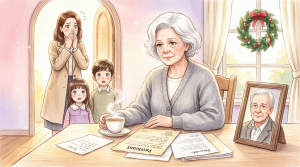
“She appears very coherent from what I can see.”
Regina spun toward her with eyes full of venom.
“I wasn’t talking to you.”
But the illusion had already cracked.
Her husband slowly picked up another document from the floor.
“What is this?”
It was the final notice from Attorney Márquez.
The house no longer belonged to me.
It had already been sold to a development company two days earlier.
They had ninety days to vacate.
Regina’s face drained of color.
“You sold the house?” she whispered.
The words seemed to wound her more deeply than losing me.
Not “Where is my mother?”
Not “Is she safe?”
Only the house.
The lawyer finally spoke carefully.
“Mrs. Regina… there’s more.”
He handed her another sealed envelope.
Inside was a single key and a card.
STORAGE UNIT — CENTRAL DISTRICT.
Regina grabbed her purse immediately.
“We’re going now.”
Her husband hesitated.
“Shouldn’t we try calling your mother first?”
“She’s manipulating everyone,” Regina hissed. “I know her.”
No.
She never knew me at all.
By the time they reached the storage facility that evening, rain had started falling across the city.
The manager escorted them to Unit 214.
Regina shoved the door open.
And froze.
Inside the unit sat everything I had chosen to keep from my old life.
My husband’s books.
Old family photo albums.
The dining table where Regina used to do homework beside me.
Boxes labeled CHRISTMAS DECORATIONS.
CHILDHOOD DRAWINGS.
FAMILY VIDEOS.
On top of everything rested one final envelope.
Her husband opened it this time.
Inside was a handwritten letter.
“Regina,
If you are reading this, then you came looking for what was left.
So let me tell you what remains.
Not the house.
Not the accounts.
Not the jewelry.
Those things were never the most valuable parts of my life.
You were.
Or at least, you used to be.
I remember when you were six years old and had nightmares during thunderstorms. You would climb into my bed and hold my arm until you fell asleep.
I remember selling my wedding earrings so you could attend university.
I remember sitting beside you in the hospital after your first miscarriage while you cried against my chest for hours.
I remember defending you when your father thought you were becoming selfish.
I said he was wrong.
I said you had a good heart.
Perhaps I was wrong.
Or perhaps somewhere along the way, you forgot that money is not love, and inheritance is not gratitude.
You stopped seeing me as your mother long before I stopped seeing you as my daughter.
That is the tragedy in all of this.
I am not punishing you, Regina.
I am freeing myself from you.
The money you expected to inherit has already been placed into charitable trusts, educational funds, and medical foundations under your father’s name.
Families will eat with it.
Children will study with it.
People abandoned by their own relatives will survive because of it.
And that gives me more peace than leaving it in the hands of someone waiting for my funeral.
You once asked me why old people become cold.
The answer is simple:
Because eventually they realize love offered conditionally is not love at all.
Do not search for me.
If one day you truly miss your mother and not her possessions, sit quietly and remember the woman who spent her entire life loving you before you became ashamed of her aging.
That woman was real.
And she deserved better.
— Mom.”
The storage unit fell silent.
Even the rain outside seemed distant.
Regina stared at the letter without blinking.
Her husband sat slowly on an old chair, rubbing his forehead.
One of my grandsons, Mateo, who had secretly come with them, picked up a dusty photo album from a box.
“Mom,” he whispered softly, “is this Grandma?”
Regina looked over.
It was a picture of me at thirty-two, smiling beside a birthday cake while holding her in my arms.
Young.
Happy.
Alive in a way she probably no longer remembered.
Mateo turned another page.
Then another.
Photographs spilled out like ghosts.
Christmas mornings.
School plays.
Family vacations.
Moments Regina had forgotten in her hunger for more.
And suddenly, her face crumpled.
Not elegantly.
Not dramatically.
Ugly, painful sobs tore out of her chest while she dropped to her knees on the cold concrete floor.
“I didn’t mean…” she choked. “I didn’t mean…”
But intentions matter very little after cruelty becomes habit.
Miles away from them, I sat on the balcony of a small coastal apartment overlooking the sea.
No mansion.
No servants.
No crystal glasses.
Just peace.
The ocean breeze carried the scent of salt through the curtains while I held a cup of tea in both hands.
For the first time in decades, nobody needed anything from me.
Nobody demanded signatures.
Nobody measured my worth by what I could give.
Attorney Márquez called that evening.
“She received the letters,” he said gently.
I closed my eyes.
“And?”
A pause.
“She cried.”
I looked toward the horizon where the sun melted into gold across the water.
“Good,” I whispered. “Maybe now she’ll finally understand what losing someone truly feels like.”
After we hung up, I opened the small wooden box resting beside my chair.
Inside was the silver bracelet Regina had given me years ago.
For a long moment, I considered throwing it into the ocean.
But instead, I clasped it around my wrist.
Because despite everything, love does not disappear cleanly.
Sometimes it remains like an old scar:
healed on the surface,
aching underneath during storms.
Months later, a letter arrived at my apartment with no return address.
Inside were only three lines written in shaky handwriting.
“Mom,
I finally understand that you were never asking for gratitude.
You were only asking to be loved.”
There was no signature.
There didn’t need to be one.
I folded the letter carefully and placed it beside my husband’s photograph.
Then I walked barefoot onto the beach as the waves rolled toward me under the evening sky.
And for the first time in my life, I no longer felt like someone’s burden.
I felt like my own person again.
Free.