My name is Captain Linda Morse, and I was thirty-three years old when my own brother tried to kill me over the house our father built with his hands. I know how that sounds. It sounds like something people say after too much grief and too little sleep, something sharpened by memory until it becomes more dramatic than the truth. But the truth had blood on it. The truth had cold coffee spreading across oak floorboards. The truth had a quitclaim deed with my name misspelled once and my signature line circled in red. The truth began three days after we buried Arthur Morse. Dad had lived on Washington Avenue for almost forty years, long enough for the neighbors to stop calling it the Morse house and start calling it Arthur’s place. He had laid the oak floor himself when I was little, one board at a time, kneeling there with a carpenter’s pencil behind his ear and sawdust on his forearms. He used to say a man should understand the ground under his own feet. I did not know then how much that sentence would matter. I was fifteen when my mother died of cancer, and after that the house changed shape around us. The kitchen became quieter. The dining room stayed too neat. Dad kept my mother’s embroidered tablecloth folded in the sideboard until church holidays, when he would bring it out and smooth it with both hands as if smoothing it could bring her voice back into the room.
Damian was already gone by then in every way except technically.
He was seven years older than me, old enough to have a car, a girlfriend, and a practiced way of making absence sound like ambition.
He missed doctor’s appointments because he had interviews.
He missed chemo visits because traffic was bad.
He missed my high school awards dinner because he had a client dinner that somehow mattered more than the only family still sitting at our table.
I learned not to expect him.
Dad never said that part out loud.
He only made two plates, then sometimes three, then threw the third one away untouched.
When I got into West Point, Dad hugged me so hard he nearly crushed the acceptance letter.
Damian sent a text two days later: proud of you, kid.
I saved it anyway.
That was the embarrassing thing about being the younger sibling.
You can know exactly who someone is and still keep hoping they will become who you needed.
After West Point came the Army.
After the Army came Afghanistan.
I learned how to read a road for disturbed dirt.
I learned how to sleep through alarms until the right sound told my body to move.
I learned that fear does not always arrive as panic.
Sometimes fear is a clean, quiet space inside your chest where every detail becomes sharp.
When Dad’s health started failing, I used leave days to come home.
I fixed gutters.
I shoveled snow.
I argued with insurance companies from the kitchen table while Dad pretended not to listen from his recliner.
I measured pills into plastic organizers labeled by weekday.
Damian visited when it was convenient, usually with Saraphina beside him and a bottle of expensive wine he never stayed long enough to drink.
Saraphina had married my brother five years earlier.
She was beautiful in a controlled way, all angles, gloss, and calculated pauses.
She treated affection like a negotiation and family history like clutter.
The first Christmas she spent at Washington Avenue, she told Dad the house had “great bones” and then asked whether he had considered selling before maintenance swallowed the equity.
Dad smiled politely.
I watched his hands tighten on his coffee mug.
That was my first warning.
The second came when she asked me, two months before Dad died, whether military pensions were enough for “single women who wanted to keep impractical properties.”
I told her I had handled worse logistics than a mortgage.
She smiled like I had missed the point.
Maybe I had.
Three days after the funeral, the house still smelled like lilies, coffee, lemon oil, and casseroles.
The church ladies had filled the kitchen counters with aluminum trays.
Tuna noodle.
Baked ziti.
Scalloped potatoes.
Green bean casserole with canned onions because everyone knew Dad secretly loved them.
The blue-marker labels had started curling from steam.
Outside, Ohio was giving us its best autumn performance, red and yellow maple leaves scraping across the porch in dry little bursts.
Inside, grief sat in every chair.
I sat on the sofa with my hands around a mug I had reheated twice and never drank.
Upstairs, footsteps moved in the guest room.
A second later, Damian and Saraphina came down the stairs like they owned them.
Damian was forty, broad-shouldered, and wearing one of those expensive quarter-zip sweaters men buy when they want to look relaxed and prosperous at the same time.
His hair was trimmed perfectly.
His face was arranged into concern.
I could tell he had practiced it.
Saraphina wore a black silk blouse, thin gold hoops, and a phone already pressed to her ear.
“No, I said sell it,” she snapped. “I’m not interested in waiting for a rebound.”
She caught me looking and did not lower her voice.
She did not even pretend to remember we were in a mourning house.
Damian sat in Dad’s old brown armchair, leaned forward, and laced his fingers together.
“Lin,” he said softly, using a nickname he had not used in years, “we need to talk about practical things.”
Practical.
That word landed wrong.
There are words people use when they want to make greed look clean.
Practical is one of them.
He said the house was too much for one person.
He said my schedule was demanding.
He said I had obligations.
Saraphina ended her call and slid the phone into her purse.
“What Damian is trying to say is it’s a dead asset,” she said. “Beautiful lot, sure, but emotionally you’re clinging to timber and plumbing.”
I looked at her.
Then I looked at him.
This was the living room where Dad taught me to shuffle cards.
This was where he fell asleep through baseball games with his glasses sliding down his nose.
This was where he had once stayed up all night helping me rebuild a science project volcano because Damian had knocked the first one off the counter and called it an accident.
Timber and plumbing.
“It’s my home,” I said.
My voice came out rougher than I wanted.
I had spent so many days not crying in front of people that my throat felt permanently bruised.
Before Damian could answer, the doorbell rang.
For one irrational second, I felt grateful, as if the house itself had asked for help.
Alistair Finch stood on the porch.
Mr. Finch had been my father’s lawyer for forty years.
He still wore the same brown wool coats and carried the same battered leather briefcase he had carried when I was in middle school.
He looked tired, kind, and careful in the way people look when they know one wrong sentence can split a family open.
We sat at the dining room table.
The white tablecloth with tiny embroidered blue flowers was still on from the post-funeral meal.
My mother had made it before cancer took her.
Saraphina did not sit so much as arrange herself.
Damian drummed his fingers once and stopped when Mr. Finch looked up.
Dad’s will was simple.
The house belonged to me.
Not because Dad loved Damian less.
Not because I had charmed an old sick man into changing papers.
The will stated that Arthur Morse left the property on Washington Avenue to Captain Linda Morse, with the requirement that I pay Damian half the appraised value within five years.
The probate packet included the deed transfer file, the Franklin County appraisal schedule, and a signed witness affidavit dated six weeks before Dad’s final hospital stay.
Mr. Finch read each part slowly.
He placed the papers flat on the embroidered tablecloth.
At 3:56 p.m., he slid a copy toward Damian.
At 4:04 p.m., Damian stopped blinking normally.
At 4:18 p.m., Saraphina lifted her phone and took a picture of the final page when she thought Mr. Finch was looking down.
I saw the reflection in the glass-front cabinet.
Soldiers learn to notice small movements.
The hand near the pocket.
The wire under the shirt.
The woman photographing a legal document three days after a funeral while pretending she is adjusting her purse.
Mr. Finch explained that the arrangement was fair.
Dad had wanted me to have the house because I had stayed connected to it, but he wanted Damian compensated.
Half the appraised value within five years.
No tricks.
No secret punishment.
No disinheritance masquerading as love.
Fair.
Painfully fair.
It should have ended there.
Mr. Finch left just after five, promising to file the final probate notice the next morning.
I walked him to the porch.
The air had turned colder, and leaves were collected in damp piles along the steps.
He touched my shoulder gently.
“Your father wanted you safe here,” he said. “Remember that.”
I wish I had asked him to stay for coffee.
I wish I had closed the door and locked it behind him.
I wish I had understood that some people do not see fairness as closure.
They see it as an obstacle.
When I came back inside, Damian was standing in the living room with a different stack of papers.
Saraphina stood by the sideboard, phone in one hand, the other resting near her purse.
The funeral lilies behind her had begun to brown at the edges.
“Sign these,” Damian said.
I looked down.
A quitclaim deed.
A waiver of inheritance rights.
A private sale agreement.
The documents were clumsy, but the intent was not.
My name was misspelled once.
My signature line was circled in red.
“No,” I said.
Damian smiled once.
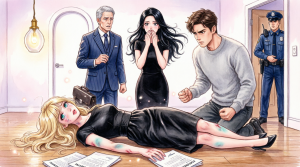
Then he hit me.
The first punch was not loud in the way people imagine violence being loud.
It was worse than loud.
It was clean.
It cracked through the room and reached my body before my mind could accept that my brother had crossed that line.
The second punch drove the air out of my lungs.
I hit the oak floor hard, cheekbone striking a knot in the wood Dad had sanded smooth himself.
My mug shattered somewhere behind me.
Cold coffee spread under my wrist.
The house seemed to go still around us.
The refrigerator kept humming.
The clock kept ticking.
A casserole tray in the kitchen gave a soft metallic pop as it cooled.
Saraphina did not scream.
She did not call 911.
She did not say his name like a wife shocked by what her husband had become.
She watched.
That was the part that stayed with me longest.
Not Damian’s fist.
Her calm.
Damian dropped his knee into my side, and something in my ribs gave with a hot, bright snap.
Pain turned the room white at the edges.
He shoved the pen toward my face.
“Sign it,” he snarled. “Sign it or die here.”
I tasted blood.
Lemon oil.
Coffee.
Dust.
My fingers closed around nothing.
For one ugly heartbeat, training moved through me like a second bloodstream.
I knew how to break his grip.
I knew where to drive my elbow.
I knew what angle would make his knee useless.
Then my ribs burned again, and I could not get a full breath.
My jaw locked.
My hands went white against the floorboards.
I thought of Dad kneeling there years before with sawdust on his sleeves, telling me a home was not the walls.
It was who refused to leave you bleeding inside them.
Damian grabbed my wrist and tried to force the pen between my fingers.
The papers slid under my arm.
Saraphina’s voice came from above us, low and flat.
“Finish it, Damian,” she said. “Put her down.”
Those words did something to him.
They gave him permission.
His face changed from furious to committed.
He lifted his fist again.
Then the front door burst open.
“Damian Morse, step away from her.”
The command filled the house.
Not loud.
Certain.
Damian froze above me.
Saraphina turned toward the door, and for the first time that afternoon, her face lost color.
Mr. Finch stood on the threshold with his battered briefcase in one hand.
Behind him stood Officer Caleb Grant, a local patrolman I recognized vaguely from Dad’s funeral because he had helped direct traffic outside the church.
A neighbor hovered on the porch, one hand over her mouth.
For a second, nobody moved.
Then Mr. Finch saw the blood on the oak floor.
He saw the forged papers beside my hand.
He saw Damian’s fist still half-raised.
His face changed.
It was not anger first.
It was grief.
“Arthur trusted you both,” he whispered.
Saraphina recovered before Damian did.
“This is a family matter,” she said, smoothing the front of her blouse. “Linda is unstable. She’s been under tremendous stress. She’s military. You know how they can be after deployments.”
I would have laughed if breathing had not hurt so badly.
Officer Grant stepped inside.
“Sir,” he said to Damian, “stand up and move away from her. Now.”
Damian raised both hands, trying to transform himself from attacker into reasonable man.
“She fell,” he said. “We were arguing, and she fell.”
The pen was still in my hand because he had forced my fingers around it.
The circled signature line was smeared with blood.
Then Saraphina’s purse made a sound.
A voice played from inside it.
Damian’s voice.
“Sign it or die here.”
The room stopped breathing.
Saraphina’s phone had been recording.
Maybe she had started it to capture me agreeing under pressure.
Maybe she wanted proof that I had signed willingly.
Maybe she thought she was clever enough to edit violence into consent.
But she had captured everything.
Her own voice came next, calm as ice.
“Finish it, Damian, put her down.”
Officer Grant’s expression hardened.
Damian looked at Saraphina.
Saraphina looked at the purse.
Mr. Finch closed his eyes for one second, like he was apologizing silently to my father.
Then the officer moved.
I remember the sound of Damian protesting.
I remember Saraphina saying she was calling someone.
I remember Mr. Finch kneeling beside me without touching my ribs, his old hands trembling just above my shoulder.
“Linda,” he said, “stay with me.”
I wanted to tell him I had stayed through worse.
I wanted to tell him Dad would be furious about the coffee on the floor.
Instead, I said, “The papers.”
Mr. Finch understood.
He collected them carefully.
Not quickly.
Carefully.
He used a clean folder from his briefcase and slid the quitclaim deed, the waiver, and the private sale agreement inside without smearing the blood further.
That was the first kind thing anyone did for me after the door opened.
He treated the truth like evidence.
The ambulance came six minutes later.
I know because Officer Grant called it in at 5:23 p.m., and the dispatch time later appeared in the police report.
My ribs were fractured.
My cheekbone was bruised.
My wrist was sprained from where Damian had tried to force the signature.
At Riverside Methodist, a nurse with tired eyes and gentle hands helped clean blood from my mouth.
When she asked if I felt safe going home, I looked at the ceiling tiles and said, “I don’t know where home is right now.”
That was the first time I cried.
Not on the floor.
Not in front of Damian.
Not when Saraphina called me unstable.
Only when a stranger asked a simple question and I realized the answer had been taken from me for a while.
Damian was arrested that night.
Saraphina was not arrested immediately, and that almost broke something in me.
But Mr. Finch kept the recording.
Officer Grant preserved the phone.
The police report listed the forged documents, the blood-stained signature line, the audio recording, the witness statements, and the emergency room intake notes.
A week later, Saraphina tried to claim she had been afraid of Damian and had only spoken to “de-escalate” him.
The recording did not love her version.
Neither did the timestamp.
Neither did the papers she had photographed at 4:18 p.m.
The prosecutor called it attempted coercion tied to assault.
Mr. Finch called it a betrayal of a dead man’s trust.
I called it what it was.
My brother tried to turn inheritance into a weapon.
The criminal case took months.
I moved out of Washington Avenue during the first part of it, not because I was giving up the house, but because every creak of the floorboards made my body brace for another blow.
Mr. Finch arranged for locks to be changed.
A contractor repaired the broken mug scar in the floor as much as wood could be repaired.
The stain never vanished completely.
I stopped trying to make it.
Some marks become part of the record.
Damian eventually accepted a plea that included assault, attempted extortion, and filing-related fraud counts connected to the documents.
Saraphina’s attorney fought harder.
She was careful.
People like Saraphina often are.
They stand far enough from the blood to pretend they never wanted it spilled.
But her voice was on the recording.
Her photo of the will was recovered from her phone.
A deleted message to Damian, sent at 4:26 p.m., said: Make her sign before the lawyer files.
That sentence changed the room in court.
I watched her face when it appeared on the screen.
For months she had looked at me like I was dramatic, damaged, unreliable.
Then those seven words sat in front of the judge, and her polish finally cracked.
She pleaded later too.
Not dramatically.
Not with tears that meant anything to me.
Just quietly, once the paperwork cornered her the way she had tried to corner me.
I returned to Washington Avenue in spring.
The maples were bare then, just beginning to bud.
The house smelled different after months of cleaning, fresh paint, and open windows.
No funeral lilies.
No old coffee.
No casseroles lined up like grief in aluminum trays.
Mr. Finch met me there with a new folder.
Inside were copies of the final probate filings, the protective order, the appraisal schedule, and a payment plan for Damian’s share that would go through the court, not through my hands.
Dad’s will had held.
The house was mine.
But standing in that living room, I understood something I had not understood before.
Winning a house back does not instantly make it feel safe.
Safety has to be rebuilt the same way Dad laid the floor.
One board at a time.
I started small.
I replaced the broken mug with one from the same church sale where Dad bought the first set.
I polished the sideboard with lemon oil on Sundays.
I planted mums by the porch steps because Dad always forgot and then complained the house looked unfinished in October.
Some nights, I sat in the brown armchair and listened to the house settle.
At first every sound made me flinch.
Then, slowly, the sounds became ordinary again.
Pipes.
Wind.
Leaves.
Old wood remembering weather.
The oak floor still has one place where the grain catches differently.
Most people would never notice.
I notice every time.
I used to think that mark meant violence had entered the house and changed it forever.
Now I think it means the house witnessed the truth and kept it.
My father wanted me safe there.
He did not live to make that happen.
But his lawyer came back for a forgotten briefcase.
A neighbor did not look away.
A recording meant for a lie captured the truth.
And I refused to sign.
I refused when my ribs cracked.
I refused when my brother held a pen to my hand.
I refused when Saraphina stood calm and cold and told him to finish it.
That is what I remember most clearly now.
Not the pain.
Not the fear.
The refusal.
Because a home is not only timber and plumbing.
A home is who refuses to leave you bleeding inside it.
And sometimes, it is also who you become when someone tries to take it from you.

