THEY BROKE INTO MY HOUSE WITH BASEBALL BATS… THEN TRIED TO TAKE MY CHILD WHILE I WAS PREGNANT
The first sound was not shouting. It was glass exploding across my living room like a gunshot inside a church. For one frozen second, I thought a car had crashed through the house. Then I heard my mother scream my name downstairs like she wanted the entire neighborhood to hear it. “Sarah!” The voice ripped through the walls with the kind of fury that does not belong inside families anymore. Then came Jessica. My older sister sounded even worse. Her voice was sharp, breathless, almost excited. Like she had waited years for permission to destroy me. I stood upstairs outside my daughter Emma’s bedroom with one hand pressed against my stomach. Six months pregnant. Barefoot. Terrified. The house still smelled like warm laundry and lavender baby shampoo. A half-folded pile of blue onesies sat on the hallway chair waiting for my unborn son. Emma was sleeping peacefully.
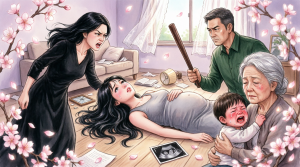
Eighteen months old, clutching her stuffed rabbit with sticky peanut butter fingers from lunch.
And downstairs, my family was smashing my home apart with baseball bats.
People online love saying family is everything.
But sometimes family becomes the first place violence learns your name.
That is the part nobody wants to admit publicly.
Especially not parents who spend years pretending they are “protecting the family.”
Five years earlier, my parents cut me off completely.
No calls. No holidays. No birthdays. Nothing.
Why?
Because I refused to hand over my nursing school tuition money to my sister Jessica.
Jessica had another “business opportunity.”
That phrase alone used to make my stomach tighten.
By twenty-six, she had already burned through nearly ninety thousand dollars.
Three failed businesses. Three dramatic collapses. Three excuses.
My parents called her misunderstood.
They called her brilliant.
They called me selfish.
That is how favoritism survives inside toxic families.
One child becomes the dream while another becomes the sacrifice.
Jessica destroyed things.
I cleaned them up.
Jessica borrowed money.
I worked night shifts.
Jessica blamed everyone else.
My parents blamed me.
The roles were assigned early.
And they never intended to let me leave them.
But I did.
I married David.
I finished nursing school while pregnant with Emma.
We bought a small house after years of saving every dollar possible.
Nothing inside it was luxurious, but every inch belonged to us.
Secondhand couches.
Garage-sale lamps.
Cracked kitchen tiles David repaired himself after twelve-hour shifts.
That house was built from exhaustion.
From skipped vacations and reheated leftovers and overtime pay.
It was not just property.
It was proof we survived.
And survival makes some people furious when they expected your failure.
Then came the phone call in March.
I almost ignored it when my mother’s name appeared on my screen.
Five years of silence usually kills curiosity.
But something inside me answered anyway.
Her voice trembled dramatically from the first second.
Not with guilt. Not with love. With panic.
Jessica owed one hundred fifty thousand dollars to loan sharks.
Dangerous people, according to my mother.
Their retirement savings were gone.
Their mortgage was collapsing.
And then came the real reason for the call.
“You need to sell your house.”
Not “Can you help?”
Not “We are desperate.”
Just an expectation.
Like my life still belonged to them.
I actually laughed at first because the request sounded insane.
Then I realized she was serious.
She wanted me to destroy my children’s stability so Jessica could survive another catastrophe she created herself.
“No,” I said quietly.
Silence.
Then my father grabbed the phone.
“You owe this family,” he said.
I remember staring at Emma playing on the carpet beside me.
Tiny socks. Tiny hands. Tiny laugh.
And suddenly something inside me became ice cold.
“No,” I repeated.
My father breathed heavily into the receiver like he could not believe defiance existed.
Jessica shouted something in the background.
Then my sister took the phone.
“You’ll regret this,” she whispered.
People say threats are obvious.
They are not.
Sometimes threats sound calm.
Sometimes they sound almost casual.
Sometimes the most dangerous sentence in your life arrives quietly.
Two weeks later, my living room window exploded inward.
Glass sprayed across the couch and hardwood floor downstairs.
The sound shook the entire house.
I grabbed my phone instantly.
My hands already knew this was not random.
Then came another crash.
Wood splintering. Furniture breaking.
Jessica screamed from downstairs.
“Where is she?”
I ran to Emma’s room before my brain fully caught up.
Every survival instinct inside motherhood activated at once.
I locked the bedroom door.
My hands shook so violently I nearly dropped my phone dialing 911.
The dispatcher answered calmly.
“911, what’s your emergency?”
I whispered because terror had squeezed the air from my lungs.
“My family broke into my house,” I said.
“They have bats. My baby is upstairs. I’m pregnant.”
Even now, that sentence sounds unreal.
Like dialogue from a movie nobody would believe.
Downstairs, another object shattered.
Then footsteps hit the staircase hard and fast.
Emma was still asleep.
Thank God for those extra seconds.
My mother called my name sweetly from outside the hallway.
“Sarah, honey, open the door.”
That voice terrified me more than the screaming.
Because abusive people always become gentle right before violence.
The doorknob rattled.
Hard.
Then came the first strike against the bedroom door.
The entire frame shook.
Emma woke instantly and started crying.
Not confused crying. Terrified crying.
Every parent knows the difference.
I pressed my back against the door instinctively.
One hand under my belly protecting Michael.
The dispatcher kept talking through the phone.
“Police are on the way.”
But fear does not care how many sirens are coming.
Fear only counts seconds.
Another hit.
Then another.
Wood cracked beside the lock.
Emma stood inside her crib screaming for me with both arms stretched outward.
Her tiny face was red with panic.
And then the door burst open.
My father stood there holding a baseball bat.
Breathing heavily. Sweat darkening his collar.
I had not seen him in five years.
And the first thing he did after returning was break into my child’s bedroom.
That realization rewired something permanently inside me.
My mother shoved past him immediately.
Her eyes locked onto Emma.
“Give her to me,” she demanded.
Not “Are you okay?”
Not “Let’s talk.”
Just possession.
Like Emma belonged to them more than me.
“No,” I said.
Jessica lunged before I could reach the crib.
She slammed into me sideways so hard my shoulder hit the floor.
Pain exploded through my ribs instantly.
My phone skidded beneath the dresser.
Still connected to 911.
My mother lifted Emma from the crib while my daughter screamed hysterically.
Reaching for me.
I tried to crawl toward them.
Jessica pinned my arms with her knee.
“You always thought you were better than us,” she hissed.
Then she slapped me across the face.
Once.
Twice.
The taste of blood filled my mouth immediately.
My father watched everything happen from the doorway.
Bat hanging loosely beside him.
He did nothing.
That part destroyed me more than the violence itself.
Because deep down, children always believe their parents will stop things before they become evil.
Mine did not.
My mother bounced my screaming daughter on her hip while staring down at me coldly.
Almost annoyed.
Like I was inconveniencing her.
Jessica leaned close enough for me to smell coffee on her breath.
“No money?” she whispered.
“Then maybe you don’t deserve another baby either.”
Then she looked directly at my stomach.
Time stopped.
People online argue constantly about what real evil looks like.
They imagine monsters. Serial killers. Strangers in dark alleys.
But sometimes evil wears your childhood memories.
Sometimes it knows your middle name.
Jessica lifted her foot slowly.
And every instinct inside me collapsed into one animal decision.
Protect the baby.
I twisted sideways across the carpet, curling my body around Michael completely.
My cheek smashed against the floor.
I could hear Emma screaming for me.
Could hear my own heartbeat pounding through my ears.
Jessica’s shadow moved above me.
Then suddenly another voice exploded from under the dresser.
The dispatcher.
“Ma’am, officers are at the front door!”
Everything froze instantly.
Jessica stopped moving.
My mother stopped bouncing Emma.
And for the first time that afternoon, my father looked afraid.
Not guilty.
Afraid.
Because abusers fear witnesses more than consequences.
The police entered seconds later.
And the entire performance collapsed immediately.
Jessica started crying.
Actual tears.
My mother claimed they were “trying to help.”
My father lowered the bat and pretended everything became a misunderstanding.
That is another thing people never discuss enough.
Violent families rehearse innocence faster than actors.
The officers separated everyone quickly.
One female officer wrapped a blanket around me while I shook uncontrollably on the nursery floor.
Emma clung to my neck so tightly it hurt.
She would not let go.
One officer found my phone still connected beneath the dresser.
The dispatcher had heard almost everything.
The screaming.
The threats.
The impacts against the door.
Even Jessica mentioning my unborn child.
Suddenly my family’s version of reality stopped mattering.
Evidence entered the room.
And evidence does not care about family loyalty.
The police photographed everything downstairs.
Broken glass. Destroyed furniture. Blood near the crib.
The smashed bedroom door looked like something from a crime documentary.
Not a family disagreement.
A crime scene.
Neighbors gathered outside watching quietly from sidewalks and driveways.
Some recorded videos on their phones.
By evening, clips had already spread across local community pages online.
That is when the public arguments exploded.
Some people called my parents monsters immediately.
Others insisted “there must be more to the story.”
There always are people desperate to excuse abusive parents.
Especially mothers.
Society still treats motherhood like automatic sainthood.
People struggle accepting that some mothers destroy their children instead of protecting them.
My mother leaned into that belief instantly.
Within forty-eight hours, relatives started messaging me privately.
“Your parents were desperate.”
“Jessica was struggling mentally.”
“You should not involve police against family.”
One cousin even wrote something I will never forget.
“They only broke things because they love you.”
Love.
The most abused word inside violent homes.
Real love does not smash nursery doors with baseball bats.
Real love does not threaten unborn children.
Real love does not terrify toddlers into screaming panic attacks.
But online, people argued anyway.
Some said I should forgive them because “family is family.”
Others demanded prison time.
Videos from outside the house spread rapidly across social media.
Millions of views arrived within days.
People became obsessed with one detail especially.
The fact my parents attacked while I was pregnant.
That detail changed everything publicly.
Pregnancy still triggers protective instincts in strangers who ignore abuse otherwise.
Suddenly everyone had an opinion.
Talk shows reached out.
Podcast hosts emailed me.
True-crime creators dissected every photograph from the scene.
Body-language “experts” analyzed police footage frame by frame.
Complete strangers debated whether my mother looked remorseful enough while holding Emma.
The internet transforms trauma into entertainment frighteningly fast.
But beneath the spectacle, another conversation started spreading everywhere.
The “golden child” discussion.
Thousands of people shared stories nearly identical to mine.
Different names. Same pattern.
One sibling protected endlessly.
Another sacrificed endlessly.
Parents draining one child financially to rescue another repeatedly.
Parents demanding loyalty while offering none.
Comment sections filled with survivors describing childhoods built entirely around keeping dysfunctional siblings comfortable.
The responses became overwhelming.
Women wrote about parents stealing college funds.
Men described being pressured into mortgages for irresponsible brothers.
One message haunted me for weeks.
“My parents bankrupted me to save my sister three times,” a woman wrote.
“When I refused the fourth time, they stopped speaking to me.”
That sentence felt terrifyingly familiar.
Because abusive family systems survive through emotional blackmail.
Not logic. Not fairness.
And when control fails, rage replaces manipulation.
The district attorney eventually filed charges.
Burglary. Assault. Child endangerment. Criminal threats.
My parents looked stunned in court photographs.
Jessica looked furious.
Not ashamed. Furious.
Like consequences themselves were offensive.
Internet debates intensified after the hearing.
Some people accused me of destroying my family publicly for attention.
Attention.
As if anyone would choose national humiliation voluntarily.
Others said I should drop charges because prison would “hurt everyone involved.”
That phrase always fascinates me.
Nobody worries violence hurts everyone involved until victims fight back publicly.
Then suddenly peace matters more than justice.
David became my anchor through all of it.
Quiet. Exhausted. Furious in ways he rarely showed openly.
One night after Emma finally fell asleep, he sat beside me in silence for almost twenty minutes.
Then he asked one question.
“Do you know how close they came?”
I could not answer.
Because I did know.
And I did not know how to survive understanding it fully.
For months afterward, Emma panicked whenever someone knocked loudly on doors.
She screamed if she heard glass break on television.
Trauma lives inside children physically before they understand language for it.
I started therapy after Michael was born safely that summer.
A healthy baby boy. Ten fingers. Ten toes.
I cried harder during his birth than Emma’s.
Not from pain. From relief.
Because Jessica almost took that moment away forever.
Therapy forced me to confront something ugly.
Part of me still wanted my parents to apologize sincerely.
Even after everything.
That is the cruelest part of parental abuse.
Children keep hoping long after hope becomes dangerous.
But apologies never came.
Instead, my mother released a statement online through relatives claiming I exaggerated events “during pregnancy stress.”
Pregnancy stress.
As though smashed windows and bats were hallucinations.
Jessica claimed she never threatened Michael directly.
Even with recorded audio suggesting otherwise.
My father refused interviews entirely.
Silence became his strategy.
The same silence he used while watching Jessica attack me.
The trial became a media circus locally.
Every hearing attracted cameras.
Commentators argued about entitlement, toxic parenting, financial manipulation, and generational abuse.
People projected their own families onto ours constantly.
And maybe that explains why the story exploded so violently online.
Because deep down, millions recognized pieces of themselves inside it.
Not the bats.
Not the break-in.
But the emotional structure underneath.
The favored sibling.
The invisible child.
The guilt.
The pressure.
The impossible expectations.
The terrifying moment someone finally says no.
That is when toxic families often become most dangerous.
Not while controlling you.
While losing control of you.
Experts later explained something that changed my perspective completely.
Boundaries expose people faster than conflict ever will.
Healthy people respect them.
Abusive people attack them.
My “no” cost me my parents.
But maybe I lost them long before that day anyway.
Sometimes people ask whether I regret refusing to sell the house.
Never.
Because if I had surrendered once, it would never have ended.
There is always another debt.
Another emergency. Another demand.
People who feed entitlement eventually become its next meal.
The house still carries scars today.
We replaced the window. Rebuilt the nursery door.
But some marks remain intentionally.
A faint dent near the hallway frame.
Tiny scratches across hardwood downstairs.
Proof.
Not because I enjoy remembering.
Because forgetting can become dangerous.
Emma is older now.
Old enough to ask difficult questions sometimes.
“Why did Grandma make me cry?” she asked once quietly.
Nothing prepares you for answering that.
I told her something simple instead.
“Some people hurt others when they cannot control them.”
She nodded like children sometimes do when they understand sadness instinctively.
Then she asked another question.
“Did you protect me?”
That one shattered me completely.
“Yes,” I told her.
“With everything I had.”
And I would again.
Every single time.
That is the truth buried beneath every headline and viral clip and courtroom argument.
This was never about money alone.
It was about ownership.
My parents believed access to me remained permanent regardless of abuse.
Jessica believed desperation excused cruelty.
And when I refused submission, violence arrived.
That reality unsettled people online because it destroyed comforting myths about family automatically meaning safety.
Some homes raise children.
Others train hostages.
The internet keeps debating whether my parents deserve forgiveness.
Maybe people ask the wrong question entirely.
The real question is why society pressures victims to forgive faster than it pressures abusers to change.
Why are survivors expected to restore peace they never destroyed?
Why does protecting yourself offend people more than being harmed?
I still think about the moment Jessica lifted her foot toward my stomach.
How quickly hatred erased humanity from her face.
And I think about the dispatcher’s voice cutting through the room seconds later.
Police are at the front door.
Those seven words separated life before and after forever.
Because sometimes survival arrives disguised as timing.
Sometimes justice begins with a phone line left open accidentally.
And sometimes the most dangerous people in your life are the ones who taught you your first prayers.
That truth makes people uncomfortable.
Good.
Maybe discomfort is necessary.
Maybe more people need to speak openly about what happens behind closed doors inside families obsessed with appearances.
Because silence protects abusers beautifully.
Exposure terrifies them.
My parents spent years teaching me loyalty mattered more than self-respect.
They were wrong.
And the day they smashed through my front window with baseball bats proved it more clearly than words ever could.
THE END.

