By the time I said, “Seems I’m not family,” my heart was beating so hard I could feel it in my fingertips.
The words came out calm, steady, almost conversational. They hung in the warm Roman air like the last note of a song, vibrating between the glasses and silverware and carefully ironed white tablecloth. Twelve faces turned toward me. Some looked shocked. Some looked vaguely entertained. One—my husband’s—held the faintest hint of a smirk he hadn’t had time to wipe away. Twelve places at the table. Twelve chairs. Twelve sets of cutlery laid with military precision. And not one of them was mine. Shawn’s chuckle still rang in my ears. “Oops, guess we miscounted,” he’d said, like we were all in on some light-hearted little joke. The others had laughed in that easy, practiced Caldwell way—just enough amusement to show they got it, not enough to look cruel. They’d expected me to flush. To stammer. To insist there must be a mistake, to embarrass myself by begging for a chair. Instead, I stood there in my midnight blue gown, my hand resting lightly on the back of the empty space where my chair should have been, and I smiled. “Seems I’m not family,” I repeated, just loud enough for the staff to hear too. Eleanor’s birthday smile froze, the corners of her mouth trembling for a fraction of a second. Richard cleared his throat, the way he always did when life didn’t follow his script. Melissa’s eyes glittered, half-delighted, half wary, waiting to see if I’d explode. Shawn shifted in his seat, eyes darting briefly toward his mother, then back to me. “Anna,” he said, that warning softness in his voice. “Don’t be dramatic. It’s just—” “—a miscount,” I finished for him. “I heard you.” No one rushed to fix it. No one leapt up and said, “Take my seat.” No one called to a waiter and said, “We need one more chair, there’s been a mistake.” I’d spent years reading rooms, gauging dynamics, smoothing over awkwardness at other people’s events. I knew the difference between a genuine error and a carefully staged moment. This wasn’t a mistake. This was choreography. I let my gaze travel slowly around the table. Eleanor, sixty-nine today, though she’d never admit it. Perfectly coiffed silver hair, vintage Chanel suit in a shade that matched the label’s current campaign. Diamonds catching the candlelight. She looked almost triumphant under the veneer of concern. “Is something wrong, dear?” she asked, her voice pitched just a little too loud. “You look upset.” There it was. The first line of the scene. “I’m not upset,” I said. My voice surprised me. It wasn’t shaking. It wasn’t shrill. It was just… done. “The seating arrangement is very clear.” A flicker passed through Shawn’s eyes—annoyance, then a flash of something that looked suspiciously like fear. He knew I’d seen it. The missing chair was only the last straw; the real damage had been done long before we landed in Rome.
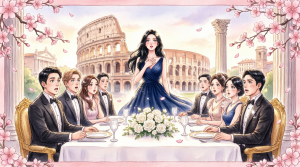
I stepped back from the table, letting my hand fall from the bare patch of floor where a chair should have been.
“I’ll see myself out,” I said.
Someone laughed nervously. Someone else muttered my name like a warning. A waiter glanced at me, then at Marco, the maître d’, torn between the guest of honor’s power and mine.
I turned and walked away.
The views from Aroma’s rooftop terrace were everything I’d promised Eleanor they would be—the Coliseum bathed in amber light, the city stretching out in soft, honeyed layers. I didn’t look back to take it in. I’d memorized every angle hours earlier when I’d done my final walkthrough.
I walked past the other diners, past the bar, past the discreetly stationed staff I’d charmed and directed throughout the day. No one tried to stop me. Perhaps they assumed I’d be back. Perhaps they thought I was going to the restroom to cry.
But I didn’t cry.
Not when I pushed open the heavy glass doors and stepped into the hallway.
Not in the elevator, where my blurred reflection stared back at me in the brass panel.
Not when the doors slid open to the lobby and I walked past the display of expensive wines I’d personally selected for tonight’s pairing.
The humiliation burned. It was a hot, bright, almost physical pain under my sternum. But somewhere beneath it, under the hurt and the anger and the disbelief, something very cold and very clear was crystallizing.
By the time I stepped out onto the cobblestone street outside the restaurant, that cold clarity had taken over.
Across the narrow street, a small café clung to the corner like it had been there for a hundred years and refused to move. A single free table sat under a striped awning, just far enough away that I could see the rooftop of Aroma but not hear the conversations.
I crossed over, heels tapping like punctuation.
“Un espresso,” I told the waiter, as if I hadn’t just walked out of a Michelin-starred restaurant where my entire marriage had been laid out like a carcass.
He nodded, wrote nothing down, and disappeared inside.
I sat, smoothed the skirt of my gown, and pulled my phone from my clutch.
I had thirty minutes.
Thirty minutes before the first course arrived.
Thirty minutes before the staff realized the account on file had been changed.
Thirty minutes before the Caldwell family discovered what happened when you treated the woman who built your celebrations like hired help.
I opened the event management app.
The one I had designed. The one that ran Elite Affairs, my company. The one that had once made the Caldwell name shine brighter in Boston society.
My fingers moved in a practiced rhythm through menus and tabs. Each tap was a reminder of why, exactly, they had ever needed me.
Reservation: Aroma, private rooftop, party of 13. Now 12.
Event coordinator: Anna Morgan Caldwell.
Billing: Elite Affairs corporate account, with backup card—mine, not theirs.
I switched the status from “Confirmed” to “Cancelled – Client Request.” The app prompted for verification.
Are you sure?
Yes.
A flutter of panic tried to rise in my chest as I hit confirm, but I shoved it down. The panic wasn’t about whether I should do it. It was about the finality of what it meant if I did.
There was no going back after this.
Good, I thought. There’s nothing to go back to.
My espresso arrived in a tiny white cup on a saucer with a single sugar cube. I nodded my thanks without looking up, already moving on to the next screen.
Vendor: Tenuta Santa Lucia – vineyard lunch, party of 14, private tasting and tour.
Vendor: Private guide – Vatican Museums and Sistine Chapel.
Vendor: Yacht charter – Amalfi Coast, full day, with catering.
Vendor: Villa in Tuscany – four nights, staff included.
All of it booked under my name.
All of it secured on my company’s credit line.
All of it cancelable at a single, decisive tap.
It wasn’t supposed to be this way.
Five years earlier, when I met Shawn, I thought my life was finally catching up to my ambition. Back then, I was still just Anna Morgan. No double-barreled last name, no Beacon Hill town house, no invitations embossed with gold that expected my presence.
Just a kid from a cramped apartment in Dorchester who’d clawed her way through business school, built a tiny event planning firm out of nothing, and somehow, miraculously, turned it into Elite Affairs—Boston’s darling.
The night I met Shawn, I was too busy to notice him at first.
The ballroom at the Four Seasons had been transformed—my doing, obviously. Crystal chandeliers dimmed to exactly the right warmth. A wash of projected light making it look like ripples of water slid constantly across the walls. The silent auction tables laid out in a path I’d mapped three times to maximize flow and donations.
My team moved through the crowd like ghosts, fixing details no one else saw: a crooked name card here, a candle that had burned low there.
I was standing near the stage, checking the timing on my phone, when a man’s voice spoke at my shoulder.
“So you’re the wizard.”
I glanced up, already half composing a polite brush-off. And then I had to stop and reassess.
He was tall, with dark hair that looked like it had been carefully messed on purpose. Strong jaw, expensive suit, the kind of smile that suggested he was used to people saying yes before he even asked the question.
“I’m the planner,” I corrected. “Wizards are in a different department.”
He laughed in that easy, practiced way of someone used to being charming. But there was a spark of genuine curiosity in his eyes as he looked around the room.
“My mother’s been trying to figure out who did it,” he said. “The board wanted this gala to feel… what did they say…” He squinted, recalling. “Less stuffy, more aspirational.”
“That sounds like a committee,” I said. “Committees never ask for things directly.”
“And yet here it is,” he said, gesturing. “Aspirational. Less stuffy. Very… whatever the opposite of committee is.”
“It’s just a matter of knowing who you’re really trying to impress,” I replied. “Spoiler: it’s never the board.”
He grinned. “And who am I trying to impress?”
“You?” I studied him briefly. “You came with a group. Colleagues. No date. You’re checking your watch, which means you have somewhere to be after this. You have a drink but haven’t touched it. So you’re trying to impress one person who isn’t here yet, and you’re hoping they read about this gala tomorrow.”
He raised his eyebrows. “You got all that from my watch?”
“I got it from the fact that you keep glancing at the donor list every time you walk past the silent auction,” I said. “You’re looking for your own name. Or your family’s.”
“Guilty,” he said. He offered his hand. “Shawn Caldwell.”
I knew the name, of course. Everyone in Boston who wanted to know anything vaguely important knew it.
Old money. Shipping. Railroads. Investment firms. Generational wealth that moved quietly and confidently through the city.
I shook his hand. “Anna Morgan.”
“And you’re the reason my mother hates the board a little less this month,” he said. “She’s Eleanor Caldwell.”
“I know,” I said before I could stop myself.
His smile widened. “I’ll tell her I found you.”
He did. One job led to another. It started with a charity luncheon at the Caldwell mansion in Newton, all clipped hedges and columns and the kind of driveway that speaks a language of its own.
Then there was an anniversary party for one of Richard’s business partners. A graduation celebration for Shawn’s younger sister, Melissa. By the time summer rolled around, half my calendar was filled with events bearing the Caldwell name.
With each one, I learned a little more about their world.
I learned that their wealth was like background music—always there, never loud, but impossible to ignore. It was in the way Eleanor never looked at prices, only at whether something was “appropriate.” In the way Richard spoke about “our guys” at the SEC as if federal regulators were merely another set of vendors.
I learned that old money doesn’t brag. It implies.
By the time Shawn finally asked me out six months after that gala, I’d grown used to their particular brand of entitlement.
“Dinner?” he’d said, leaning against one of the ballroom’s pillars as we wrapped up another charity function. “Someplace where you’re not in charge for once.”
“Does that place exist?” I asked. “I’m not sure I believe you.”
“It does,” he said. “And I promise not to rearrange a single flower.”
I should have noticed Eleanor’s expression the first time he brought me to dinner as his girlfriend instead of his planner. The way her smile tightened, the way her eyes flicked over my dress, my hair, my hands, measuring, cataloging.
“You’ve done very well for yourself,” she said over dessert, her tone light, her gaze sharp. “Self-made success is so… American.”
It sounded like a compliment. It felt like an assessment.
I ignored it. Back then, I ignored a lot.
I ignored the way people’s eyebrows rose when they heard my last name wasn’t something out of the Social Register.
I ignored the little jokes about how lucky I was to have “caught” Shawn.

