At my parents’ anniversary dinner, my father announced, “We’re giving your trust fund to your sister. She actually achieved something.”
My sister smirked.
I calmly pulled out my phone and showed them my bank account.
My mother gasped. “That’s… that’s $67 million?”
I smiled. “The trust fund you’re talking about? I cashed it out at eighteen and tripled it. But there’s something else you should know.”
My name is Emma. I’m twenty-nine years old, and the Sterling Club has never been my kind of place.
The chandeliers hung heavy over the dining room, and the waiters’ coats probably cost more than my car. But it was my parents’ thirtieth anniversary, so I came. I sat there in my simple black dress, the only woman at the table not covered in diamonds.
My sister Vanessa was holding court, of course. She laughed that high, tinkling laugh that always set my teeth on edge, talking about her new condo, her upcoming trip, and her perfect life.
“Oh, Emma,” she said, tapping one acrylic nail against her wineglass while glancing at my water. “How are those little projects of yours coming along? Still playing on your computer?”
My mother smiled tightly, the kind of smile that pretended to apologize for me. My father just looked at my dress, then at Vanessa’s, and his disappointment was clear.
They saw the other daughter. The quiet failure. The one who didn’t measure up.
I just smiled and took a sip of water. I let them laugh. I let them judge. They thought this was just another dinner where they could remind me of my place.
They had no idea I was about to end the entire game.
They thought I was breaking.
I was just waiting.
Growing up, my house was always loud. It was loud with Vanessa’s laughter, Vanessa’s music, Vanessa’s friends, and Vanessa’s dramas.
My sister was born for the spotlight. I was born for the shadows.
It was the little things at first, the things you try to tell yourself don’t matter. When Vanessa was sixteen, our parents threw her a massive party at a downtown hotel. There was a DJ, a three-tiered cake, and more than a hundred guests. My father gave a speech about his shining star.
When I turned sixteen six months later, my mother gave me a card with fifty dollars inside.
“Why don’t you buy yourself a new textbook, honey?” she said, patting my arm. “You’re not a party girl like your sister, and that’s okay. You’re the smart one.”
The smart one.
That was my label. It didn’t mean they respected my intelligence. It meant I was quiet. It meant I was low-maintenance. It meant I was the one they didn’t have to worry about, so they just didn’t.
Vanessa was the social one. She was beautiful, charming, and knew how to work a room. She was the one they bragged about. Her life was a series of easy, visible achievements: prom queen, sorority president, an internship at an art gallery secured by one of my father’s friends.
I was the one in my bedroom with an old computer I had bought with saved-up chore money. I wasn’t just playing on it like they told their friends. I was taking it apart and putting it back together. I was learning to code. I was building things.
When I was seventeen, I built a simple program that helped my high school library manage its entire inventory. It was my first real project, and I was so proud. I brought my parents to the library to show them.
My dad looked at the screen. “That’s nice, Emma,” he said. “Very neat. Did you hear? Vanessa just got asked to the formal by the quarterback.”
My mother smiled at the librarian. “She’s always been so good with hobbies.”
Hobbies.
That was all it ever was to them.
I went to college. I got a full scholarship for computer science. My parents drove me to the dorm. My mother cried because she was losing her baby, but I knew she was really just practicing for when Vanessa, the real daughter, left for college the next year.
While Vanessa was majoring in art history and going to formals, I was in a basement lab with three other people. We were working on an idea, a new way for students to manage their course loads and share notes. It was clunky at first, but it was ours.
My sophomore year, we won a state-level tech grant. It was twenty thousand dollars. It was the most money I had ever seen.
I called home, my hand shaking. “Mom, Dad, you won’t believe this. We won the grant. Twenty thousand dollars.”
There was a pause.
“Oh, honey, that’s wonderful,” my mother said. Her voice was distracted. “Listen, can I call you back? Your sister just announced she’s studying abroad in Florence for a semester, and we’re planning the cutest going-away party for her.”
I clicked the phone shut. I sat there in the buzzing fluorescent light of the lab, and I just stopped.
I stopped expecting them to see me.
I stopped trying to make them proud.
I realized right then that their pride was a closed loop. It was reserved for Vanessa.
I took my half of the grant money, and instead of spending it, I invested it. I put it all into a few tech stocks I had been watching. It felt like the only thing I could control.
I kept working. I built my app. I graduated summa cum laude. I sent them an invitation to the ceremony. I was giving a small speech as one of the top students in my department.
They didn’t come.
“Oh, Emma, you know your father’s back is tricky,” Mom said over the phone. “And it’s just so long to sit through a graduation. We’ll be there in spirit. Vanessa is sending you a new scarf. Isn’t that sweet?”
I gave my speech. I accepted my diploma. I walked off the stage, and I didn’t look for them in the crowd.
I learned to expect nothing. It was safer that way.
After college, I got a small, cheap apartment. My parents were horrified.
“But Emma, it’s so plain,” my mother said, wrinkling her nose at my secondhand furniture.
Vanessa, meanwhile, had graduated and moved into a stunning downtown loft. My parents co-signed the lease and furnished the entire thing.
“She needs to be in a good neighborhood,” my father explained. “It’s important for her career in the art world.”
Her career was being an assistant at the same gallery, mostly planning parties. But that was a real job.
Mine was not.
I was working eighteen-hour days. My college app had gotten some attention. I had a team. We were building something bigger.
My parents just knew I worked with computers. They thought I was a secretary or a repair person.
“It’s a shame you didn’t get a job at a real company, Emma,” my father would say at Sunday dinners. “Microsoft, or even Dell. This little startup thing, it’s not stable. You should be thinking about a 401(k).”
I tried one last time.
I was twenty-five. We had just secured our first round of major seed funding. It was three million dollars. I had never felt so alive.
I drove to my parents’ house. I had a bottle of champagne in my bag. I walked in.
They were in the kitchen with Vanessa. She was crying.
“He just… he just broke up with me,” she wailed, “after I bought tickets to Cabo.”
My mother was rubbing her back. “He’s a fool, sweetie. A terrible, terrible fool.”
My father was on the phone. “Yes, I need to cancel a credit card. My daughter’s… well, there’s been some fraud.”
I stood in the doorway. My three-million-dollar victory felt small. Foolish, somehow.
I turned around. I put the champagne back in my car. I drove back to my office.
I never tried to tell them about my work again.
From that day on, I built a wall. I smiled at family dinners. I nodded. I listened to them praise Vanessa for getting a two-percent raise. I listened to them criticize my tiny apartment. I listened to them tell me I should get out more and find a nice man.
I just nodded.
And I worked.
I learned to live a double life.
The Emma they saw was the quiet, failed, smart one. The real Emma was someone they had never met.
And they never would, until tonight.
The Sterling Club was suffocating. The air was thick with the smell of old money and expensive perfume. My mother had picked it, of course. It was the only place she and my father celebrated anything important.
It was a stage.
And tonight, Vanessa was the star and the pilot.
“Oh my God, you guys. He was so rude,” Vanessa was saying, swirling her deep red wine. “He told me my carry-on was technically too big. I mean, me? Can you imagine?”
My mother gasped, playing her part. “No, Vanessa. How awful for you. What did you do?”
“I just looked at him and said, ‘Do you know who my fiancé is?’” Vanessa said with a laugh. “That shut him up. Robert’s firm basically owns that airline.”
My father chuckled. “That’s my girl. Don’t let anyone push you around.”
I watched them. My father glowing with pride, his tie perfectly straight. My mother leaning in, her eyes sparkling with secondhand glamour. They hung on Vanessa’s every word.
The appetizers arrived, tiny, complicated things on huge white plates.
“Anyway,” Vanessa continued, “the Maldives were just divine. We had an overwater bungalow. Robert and I have decided we’re never doing a regular beach vacation again. It’s just so common.”
“Oh, the pictures you sent were beautiful, sweetie,” Mom said. “That blue dress. You looked like a model.”
“I know, right?” Vanessa preened. “Now we just have to finalize the wedding plans. Three hundred guests is a lot to manage. The caterer is being a nightmare about the vegan options, but our wedding planner is a miracle worker. She’s the same one who did the governor’s daughter’s wedding.”
My father sat back, beaming. “Whatever it costs, honey. It’s your special day. You only get one.”
I thought about my own special days.
The college graduation they missed.
The day I sold my first company, which I celebrated alone with a slice of pizza and a cheap bottle of champagne in my tiny apartment.
The day I signed the lease on my first real office space, and my only witness was the notary.
Their version of special was about spending money. Mine was about making it.
The main courses came. Vanessa had the lobster. My parents had the filet mignon. I had ordered the salmon.
Vanessa looked at my plate. “Oh, Emma. Still being so sensible.”
My mother jumped in, her voice full of that fake, bright concern. “And Emma, good. Just good.”
My father cut into his steak. “You know, Emma, I was talking to Bill Harrison the other day. His daughter just made junior partner at her law firm. She’s only twenty-eight. A real go-getter.”
I nodded. “That’s great for her.”
“He’s just saying, honey,” my mom added quickly, “that we worry. This computer thing you do, it’s so isolating. You’re in that little apartment all the time. You’re not meeting anyone. You’re not building a life.”
A life.
To them, a life was a husband, a big house, and a job you could describe at a cocktail party. I’m a lawyer. I’m a gallery director. I’m a doctor.
I could never say, “I’m the CEO of a tech firm I built from scratch, and I’m currently managing a portfolio of assets that would make your head spin.”
They wouldn’t understand it. They wouldn’t believe it.
To them, I was just Emma, the quiet one, the one who was good with hobbies.
Vanessa laughed that high, tinkling laugh again. “Oh, Mom, leave her alone. She’s trying, right, Em? I’m sure one of these days you’ll hit it big with one of your apps.”
She said apps like it was a dirty word, like it was something children played with.
“Maybe,” I said, and I took a bite of my salmon.
The rest of the dinner went on just like that. Vanessa detailed her fiancé’s latest promotion, his new car, and their plans to buy a summer home in the Hamptons.
My parents listened. They glowed. They praised. They asked all the right questions.
“And his bonus this year?”
“Dad, you’d be so proud.”
“A wonderful young man. Vanessa, you chose well.”
I sat there. I was invisible.
I was a ghost at their table. I wasn’t their daughter. I was a backdrop. I was the before picture, and Vanessa was the after.
I watched them. I watched the way my father’s eyes crinkled when he smiled at Vanessa. I watched the way my mother touched Vanessa’s hair, her hand gentle and full of love.
They had never looked at me like that. Not once. Not ever.
I wasn’t angry. I was cold.
I was a surgeon looking at a patient. The patient was my family, and I was finally seeing with perfect clarity that the patient was gone.
This relationship was over. It had been over for years.
I just needed to sign the death certificate.
The waiter came. “Would you be having dessert this evening?”
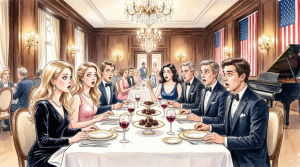
“Oh, yes,” my father said, sitting up straight. “Bring us the chocolate lava cakes and a bottle of your best champagne. We have an announcement.”
He looked at me. His eyes weren’t warm. They were serious. They were the eyes of a businessman about to close a deal.
Vanessa looked at me, too. Her eyes were different. They were sharp, and she was smirking.
I knew in that instant this wasn’t an anniversary announcement.
This was an execution.
And I was the one on the block.
I just sat there and waited.
The waiter set down the desserts, four molten chocolate cakes spilling onto white porcelain plates. He poured the champagne.
My father raised his glass. “To thirty years,” he said, looking at my mother. “And to a wonderful family.”
My mother smiled. Vanessa raised her glass.
“To Mom and Dad.”
I raised mine. “Congratulations.”
We all drank. The champagne was expensive, and it tasted like ash in my mouth.
My father set his glass down. The clink was very loud in the quiet restaurant. He cleared his throat.
“Emma,” he said.
He didn’t look at me. He looked at the tablecloth.
“Your mother and I, we’ve been doing some financial planning for the future.”
I waited. I kept my hands folded in my lap.
“When you both turned eighteen,” he continued, “we gave you your trust funds. Your grandmother was very generous. One point two million dollars each. It was a gift, a head start, a foundation to build a responsible life upon.”
He finally looked at me. His face was a mask of tough love. It was the face he used when he was about to be cruel for my own good.
“We’ve been watching you, Emma. We’ve been concerned. Deeply concerned.”
My mother chimed in, her voice soft and full of false pity. “Honey, we see you in that tiny, tiny apartment. You wear the same simple clothes. You’re not… you’re not living. We know you try hard with your little projects, but that money, it’s just gone, isn’t it?”
I didn’t say anything. I let her words hang in the air.
It’s gone, isn’t it?
My father leaned forward. “You blew it, Emma. You blew a million-dollar head start. We don’t know how. We don’t know what you spent it on, but it’s gone. You had a golden opportunity, and you threw it away on nothing.”
Vanessa took a delicate bite of her cake. She was looking at me, her eyes wide with fake sympathy.
“Oh, Emma,” she whispered. “All of it?”
“We see Vanessa,” my father said, his voice warming as he turned to her. “We see the beautiful home she’s built with Robert. We see her smart investments, her career, her maturity.”
“Vanessa has been so responsible,” my mother added, reaching out to pat my sister’s hand. “She understands the value of money. She’s building a legacy.”
My father nodded. “Exactly. A legacy. And that is a parent’s number one concern. What we leave behind. And we need to know. We have to know that what we’ve built will be in responsible hands.”
The air was very, very still. I could hear the faint sound of a piano from the lounge.
“So,” my father said, his voice dropping, “your mother and I have made a decision. We’ve spoken to our lawyers. We are restructuring our will. The remaining inheritance, the portion that would have been yours, we are transferring it all to Vanessa.”
I looked at Vanessa.
Her face was a perfect mask of shock. “Oh, Daddy. Mom. I don’t know what to say. Are you sure?”
But her eyes were dancing. Her smirk was just barely hidden behind her champagne flute.
She knew. She had known this was coming.
This was her idea.
My father nodded, his face firm. “We are sure. It’s the only responsible thing to do. We need to protect the family’s assets. We need to protect… well, we need to protect you from yourself, Emma.”
Protect me from myself.
I stared at him. I stared at my mother, who was nodding with a sad, this-hurts-me-more-than-it-hurts-you look on her face. I stared at my sister, who was already spending my money in her mind.
This was it. The final betrayal.
They hadn’t just ignored my successes. They hadn’t just dismissed my life. They had now officially declared me a failure. A charity case. A child who couldn’t be trusted.
They took away the one thing they thought I had left: my future, my inheritance.
My mother leaned in. “Emma, honey, please say something.”
They were waiting. They were waiting for the explosion. They wanted the tears. They wanted the screaming. They wanted me to yell that it wasn’t fair. They wanted me to break down, to beg, to prove them right. To prove I was the unstable, emotional, failed daughter.
I looked at my father. I looked at my mother. I looked at my sister.
I picked up my fork. I took a small bite of my lava cake. It was rich and sweet.
I swallowed.
Then I looked at my father and said one word.
“Okay.”
The silence that followed my okay was a vacuum. It sucked all the air from the table.
My father’s face, which had been set in stern resolution, crumpled. He blinked.
“What? What did you say?”
“I said okay,” I repeated. My voice was perfectly level. I took another bite of cake. “Okay.”
My mother’s voice came out in a high-pitched squeak. “That’s… that’s all you have to say? Emma, did you hear your father?”
“I heard him,” I said. “You’re giving my inheritance to Vanessa. Okay.”
Vanessa was the one who recovered first. She put her hand on my arm, her nails digging in slightly. Her voice dripped with fake, sticky concern.
“Em, it’s nothing to be ashamed of,” she said, loud enough for the nearby tables to hear. “We all make mistakes. And don’t you worry. Robert and I will take such good care of you. If you ever need anything, a new computer or help with your rent, you just have to ask. I’ll always be there for my little sister.”
Little sister.
I was two years older than her.
She was gloating. This was her victory lap. She was painting me as a charity case, a pathetic creature she would now be responsible for.
My father’s confusion turned to anger. My calm okay was an insult. It was not the reaction he had prepared for. He had prepared for tears. He had prepared for a fight. He had a whole speech ready about responsibility and tough love.
My quiet acceptance stole his power.
“Don’t you okay me, young lady,” he snapped, his voice low and sharp. “This is not some small thing. This is your future. A future you threw away. You had your chance, Emma. You had the exact same one point two million as your sister. Look at her. She has a home, a stable career, a successful man. She built something.”
He gestured at me, his hand slicing the air.
“And what do you have? A one-bedroom apartment you can barely afford. A hobby that clearly pays nothing. No husband, no prospects. You are twenty-nine years old, and you have nothing to show for your life. We are disappointed, Emma. We are profoundly and deeply disappointed.”
There it was.
The word.
Their favorite weapon.
Disappointed.
It used to shatter me. It used to send me running to my room, vowing to try harder, to be better, to finally get them to see me.
But tonight, the word hit me and fell to the floor.
It had no power anymore.
“I understand,” I said.
“No, you don’t understand,” my mother cried. She was actually tearing up, but they weren’t tears for me. They were tears of frustration. I was ruining her scene.
“We are doing this because we love you. We are trying to help you. Why are you being so cold? Why won’t you talk to us?”
“We’ve been talking my whole life, Mom,” I said, my voice still quiet. “You just haven’t been listening.”
“That’s not fair,” she shot back.
“It’s not,” I agreed.