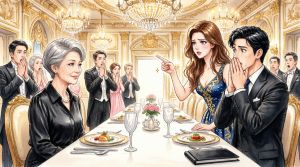
“Oops. Forgot our wallet again,” Belle said.
She laughed as she said it, a sound that tinkled like cheap wind chimes—bright, hollow, and performative. It was a laugh designed to be the punchline to a private joke, just loud enough to carry across the white tablecloth, but soft enough to sound effortless.
Daniel, my son, lifted his beer glass in a salute that lacked all irony. “Thanks, Mom. You always save us.”
The waiter didn’t even pretend to hesitate. He placed the check at my elbow, the same trajectory as always, tucked neatly inside the black leather folder like a verdict we had all agreed upon years ago. His glance was professional but laced with a terrible familiarity. He knew the script. He knew who the protagonist was, and more importantly, he knew who the financier was.
I smiled. It was the same practiced shifting of facial muscles I had used a hundred times before. Polite. Painless. Invisible.
My purse sat in my lap, heavy with the weight of expectation, right where they knew it would be. But I didn’t reach for it. My hands remained folded on the napkin, still and cold.
“How strange,” I said, my eyes fixed on the black folder. “This time, so did I.”
Belle’s laughter didn’t stop abruptly; it faded, like a radio song losing its signal, dissolving into static. Daniel blinked, the beer glass pausing halfway to his mouth. For a second, the table was a tableau of confusion. The grandchildren, Leo and Sophie, were still busy with their coloring menus, aggressively scribbling over cartoons, blissfully unaware of the sudden, suffocating pause in the air.
“Well,” I added gently, pushing back my chair. The wood scraped against the floor, a harsh sound in the quiet restaurant. “If you need a minute to sort it out, I can wait in the car.”
I stood up. My coat, a charcoal wool trench, was already draped over my arm, prepared for a quick exit. I hadn’t ordered dessert. I hadn’t finished my tea. That had been deliberate. I didn’t plan to stay long enough for the sugar to settle.
Daniel opened his mouth, then closed it, looking like a fish gasping on a dock. Belle shifted in her seat, her eyes darting toward the waiter, who was stepping back from the table with the awkward energy of someone realizing they were standing inside a blast zone.
“I’ll see you later,” I said. I nodded once, a gesture of finality, and turned.
The air outside was cooler than I expected, biting at my cheeks. I stood on the curb for a moment, hands deep in my coat pockets, listening to the muffled clink of silverware and laughter behind the glowing windows of The Gilded Fork. I waited for the surge of adrenaline, the shaking hands, the anger.
But I didn’t feel angry. I didn’t feel triumphant, either. I just felt still. Like a clock that had finally stopped ticking after years of running too fast.
They would catch up soon. or maybe they wouldn’t. Either way, I knew where this was headed, because I had written the ending three hours ago.
Three hours earlier, I had already made the decision.
I was seated in the booth when they arrived. I had asked the hostess for a spot by the window, somewhere quiet where I could watch the parking lot and not feel boxed in by the cacophony of happy families. The hostess hadn’t questioned it; I suppose I have the face of a woman who requires a perimeter.
Belle had picked the place. It was a new spot downtown, the kind of establishment that served lobster on slate tiles and cocktails garnished with sprigs of burnt thyme. Everything on the menu had at least two unnecessary adjectives. Everything on the bill would have at least three digits.
They were fifteen minutes late.
Belle swept in first, wearing a “boho-chic” dress that probably cost more than my first car, pretending her lateness was a charming quirk rather than a character flaw. Daniel followed, his face illuminated by the blue glow of his phone, distracted. The kids trailed behind, already arguing over who got the window seat.
No one apologized.
“Hope you didn’t wait long,” Belle said, sliding into the booth without making eye contact. She began scanning the cocktail list immediately.
I smiled. “Not at all.”
The waiter arrived. They ordered with the confidence of royalty. Appetizers for the table. Two cocktails. Steak. Scallops. Something “truffle-dusted.”
“And for you, ma’am?”
“Lemon chicken,” I said. “And water. No ice.”
I had checked the prices online before I came. It had become a habit—a grim pre-game ritual for these dinners I didn’t ask for, at places I wouldn’t have chosen, with bills I never saw until I was signing the receipt. Somewhere along the line, my role in this family had shifted from ‘Guest’ to ‘Sponsor.’ They treated it like a heartwarming tradition. I had begun to treat it like soil erosion—a slow, steady washing away of my resources.
“Mom, you should try this sangria,” Daniel said, nudging his glass toward me.
“I’m fine, thank you.”
I watched them eat. I watched them laugh. I listened to Belle’s complaints about the exorbitant daycare fees and Daniel’s frustrations with his manager, a man he described as “visionless.” I nodded in the right places. I asked follow-up questions. I smiled when Leo showed me his coloring page, a chaotic storm of red crayon.
But I didn’t take out my wallet. Not this time.
I sat with that quiet resolve for a while. Long enough to decide that tonight, the play would have a different ending. Then, I folded my napkin, set it on the table, and waited for the moment the check arrived.
It came quickly. And when I walked out, leaving them with the bill, I thought it was over.
But back home, as I slipped off my shoes and turned on the harsh fluorescent light of my kitchen, my phone buzzed.
The house was quiet—steady. No voices, no demands, just the faint tick of the wall clock and the low hum of the refrigerator. I made a cup of weak tea, let it cool beside me, and unlocked my screen.
A notification from my banking app. The Gilded Fork. Processed immediately.
$324.50.
I stared at the number. Their solution hadn’t been to pay for it themselves. Their solution was to use the “emergency” credit card I had given Daniel three years ago for—and I had been very specific about this—emergencies. A blown tire. A broken furnace.
It turned out they hadn’t forgotten their wallet at all. They just preferred using mine.
I unlocked my laptop. The screen glowed blue in the dim kitchen. I navigated to a file I hadn’t touched in months, though I knew its contents by heart.
Maris_Family_Expenses.xlsx.
It opened like a familiar ache.
I scrolled.
Three days earlier:
190 to Paws & Claws Veterinary. Their dog, not mine.
Two weeks before that: $480 to Serenity Spa. Belle called these treatments “essential for her migraines.” She had sent the request with a winking emoji and the text: Mama, you’re a lifesaver.
Every line of it was there. Without apology. Without repayment.
Each row was a favor I couldn’t say no to. Each column was a quiet “yes” that had been taken as a baseline. Car repairs, school supplies, cell phone bills for a plan I was no longer on but still paid for. The spreadsheet was neat, color-coded, and complete.
And in the “Reimbursed” column? An unbroken chain of zeros.
I scrolled to the bottom, found the first empty cell, and typed slowly.
March 28th. Dinner. Five people. Unauthorized.
I formatted the font to match the rest. I pressed save. The cursor blinked at me, a rhythmic pulse.
It wasn’t just the money. If they had asked, if they had been struggling, I would have given them the shirt off my back. It was the assumption. It was how easily I had been folded into the background, reduced to a utility. The way they handed me the bill without flinching. The way the waiter knew it would be mine before I even opened my mouth.
A week before this dinner, Daniel had sent a text. No greeting. No “Hi Mom.” No “How are you?”
Car repairs urgent. Can you cover?
I had read it twice, waiting for the rest of the sentence to load. It didn’t. I paid it that afternoon. I didn’t even tell him I had done it. The confirmation email went into a folder I labeled “Household” because I still hadn’t created one just for “Daniel’s Life.”
I sat there in the kitchen, the tea growing cold, and realized the truth. They hadn’t stopped asking because I said yes too often. They stopped asking because I never said no at all. Somewhere between the first favor and the hundredth, expectation had replaced gratitude, and silence did the rest.
I looked at the total sum at the bottom of the spreadsheet. $61,245.00.
That was the price of my silence.
I set my phone face down on the table. I didn’t scream. I didn’t throw the mug. I simply opened my physical notebook, the one usually reserved for grocery lists.
I wrote a sentence I hadn’t allowed myself to think until that moment.
I have been covering more than I should. I love you, but I need balance.
I read it aloud. My voice sounded thin, reedy. I tried again.
“I love you, but I need balance.”
I stood in front of the bathroom mirror, holding the note at eye level. I read it as if I were talking to someone I respected, not someone I feared upsetting. My reflection didn’t flinch, but I saw the tightness in my jaw, the way I kept smoothing my shirt even though it wasn’t wrinkled.
I changed a word. Balance became Boundaries. Then Respect. Then back to Balance.
Eventually, I folded the paper once, twice, and slid it into the card slot of my wallet. I left it there, snug and quiet. Not to be dramatic. Just to be ready.
That night, I turned off the lights at 10:00 PM. I lay in bed with the ceiling fan ticking above me, slicing the darkness. I didn’t sleep. My mind paced the floor. I thought about everything I wouldn’t say, the parts I would cut for their comfort. I thought about how quickly Belle changed the subject when I brought up needing to get my own brakes checked.
At 2:17 AM, I got out of bed. I stood in the kitchen in silence, palms flat on the counter, breathing in the quiet.
They had used the emergency card for lobster. That was the breach. That was the moment the levees broke.
I knew what I had to do. And I knew the note in my wallet wasn’t enough.
In the morning, I chose a different coat—the one with the inside pocket—and moved the note. But I didn’t use it.
Daniel texted at 10:00 AM. Dinner tonight? We want to make up for the confusion yesterday. Our treat.
“Our treat.” The words sat on the screen, suspicious and alien.
I typed back: Okay.
They picked the place again. The Azure Room. Something trendy with mood lighting and hand-painted menus that didn’t list prices, only ingredients. It was the kind of restaurant that felt curated, not cooked in.
Belle arrived first, swinging a new purse in soft, buttery leather, kissing the hostess on both cheeks like they were old friends. Daniel followed, checking his watch, catching the light as he assessed the time without urgency. The kids came in last.
I was already at the table.
Belle air-kissed my cheek. “So glad you could make it. I told Daniel we needed some family time.”
I smiled and nodded. “It’s good to see you all.”
When the waiter came to take orders, I waited until the rest of them finished listing appetizers and substitutions. They ordered the calamari. The ribeye for Daniel. The sea bass for Belle.
“Just the garden salad and the lemon chicken for me,” I said. Then, lowering my voice slightly, I looked the waiter in the eye. “And could I get a separate check, just for mine?”
The waiter didn’t flinch. He was a professional. He nodded and wrote it down.
No one else noticed. Belle was busy photographing her wine glass. Daniel was checking his email.
The meal proceeded as they always did. The conversation moved to school pickup complaints, the neighbors who were too loud, and Daniel’s latest frustration at work.
“If they’d just let me take the lead,” he said, punctuating the sentence with a forkful of steak, “I could turn the whole department around.”
I didn’t say much. I didn’t need to. I just watched. I watched the wine disappear. I watched the ease with which they consumed.
When the plates were cleared and the kids began begging for chocolate lava cake, the waiter returned.
He held two black check folders.
One was placed in the center of the table. Thick. Heavy.
The other was placed neatly at my elbow.
I opened mine. $37.00 even.
I had brought exact cash. I counted it out—two twenties—folded the receipt, and slid the folder toward the edge of the table.
“This is for mine,” I said quietly.
I was already reaching for my coat.
They hadn’t looked up yet. The check in the middle lay untouched, a landmine waiting for a footfall.
I stood, adjusting the strap on my purse, and stepped back from the table. Behind me, the server hovered in silence, still holding a pen.
Silence landed on the table like a dropped glass. Not loud, but sharp. Impossible to ignore.
Daniel looked up from the center check. His brow furrowed, not in anger, but in genuine confusion—as if the actors in a play he was watching had suddenly started speaking a different language.
“Wait… you’re not covering?” he asked. He gave a half-laugh, waiting for the punchline.
I slipped my arm into the second sleeve of my coat. “I’ve paid for mine.”
Belle blinked, her fork halfway to her mouth. “Oh. I mean… we just assumed… since you usually…”
“I know,” I said, smoothing my collar.
Daniel shifted in his seat. “It’s not a big deal. I just… didn’t bring my wallet. Again.”
Of course he hadn’t.
Belle reached for her phone, frowning at the screen like it had personally betrayed her. “Let me check our balance. I think we can transfer…” She trailed off, her face paling slightly.
“You’ll sort it out,” I said gently. “Enjoy the rest of your night.”
I stepped away from the table before the next excuse could form. Behind me, I could hear the faint rustle of panic—Belle whispering frantically, Daniel swearing under his breath, the clumsy sound of a purse zipper opening too fast.
The door to the restaurant let out a soft chime as I pushed it open.
Outside, the air was crisp. I exhaled, and for the first time in years, I felt the weight of the atmosphere leave my chest. Not just the dinner, but the months, maybe years, of pretending not to notice how easily I had become their safety net.
I didn’t look back.
The sidewalk was damp from an earlier drizzle. My car was parked two blocks away, and for once, I was grateful for the walk. I needed the space. I needed the stillness. I passed two couples headed toward the entrance, laughing, arm in arm. Their voices faded as I turned the corner.
By the time I reached the car, I could already picture them splitting the check, doing the math, figuring out what to do without me at the center of the equation.
I drove home without the radio.
The house was dark when I arrived, exactly as I’d left it. I hung my coat, poured a glass of water, and opened my laptop.
No one called that night.
I left my phone on the kitchen counter—screen down, volume off. I made toast. I didn’t eat it. I sat at the table in silence and watched the clock slip past midnight without a single buzz or ping.
It didn’t surprise me. They didn’t know how to respond to a boundary. They only knew how to respond to an open door.
The next morning, my phone lit up at 8:12 AM.
What was that?
Just those words from Daniel. Like the night before had been a glitch in the system he expected me to reboot.
I stared at the screen for a while, then typed back slowly.
A change.
That was all. No follow-up came.
I opened my banking app. The linked credit card I’d added Daniel to last year—”just in case”—was still active.
I tapped into settings. Remove Authorized User.
It took less than a minute.
After that, I logged into the utility account. The auto-payments for their house had been running from my checking account since last autumn.
Cancel Recurring Payment. Click. Confirm.
Then the grocery app—recurring deliveries to their address, tied to my card.
Cancel.
I even changed my password. Guest123 became Ceramics24!.
When it was done, I closed my eyes and breathed. There was no surge of satisfaction. Just air. Just quiet.
Back at the table, I opened my laptop and created a new spreadsheet. No template, no categories from the past. Just a clean, white page.
I named it: For_Me.xlsx.
In the first row, I entered the date and wrote: Breakfast. One slice of toast. No cost.
It was small. But it was mine.
I saved the file. Then I stood up, got dressed, and drove to the post office. I needed stamps. While I waited in line, I saw a flyer for a community ceramics class posted on the bulletin board. It was a messy flyer, printed on yellow paper, with tear-off tabs at the bottom.
I took a photo of it without thinking.
Back home, I put the phone on the charger and brewed a fresh pot of tea—the good kind, the loose-leaf Earl Grey I always saved for when guests came over. This time, I poured just one cup.
Belle showed up the next afternoon.
She was standing at my door with a tight smile and sunglasses still on. She didn’t call ahead. She never did.
“I was in the area,” she said. Like that explained the universe.
I nodded once and stepped aside.
She sat at the kitchen table like it was still hers to take, smoothing her skirt and glancing around as if trying to decide how much of the room had changed since her last visit. I moved slowly, deliberately, filling the kettle and setting out two mugs—the good ones, white porcelain with blue trim.
I didn’t ask what kind she wanted. I just made the tea I liked.
“You could have just told us,” she said after a pause. Her voice was tight. “There was no need to make it… weird.”
I stirred a spoonful of honey into my cup. The metal spoon clinked softly against the porcelain.
“It didn’t feel weird to me.”
Belle shifted. “Daniel’s confused. He’s not angry. He just… didn’t expect it.”
She stopped short and tried again.
“You’ve always helped. It’s just… what we do.”
I looked at her. Really looked at her. “I know.”
She blinked at that, like she expected resistance, maybe even guilt. She wanted me to apologize for disrupting the ecosystem. I gave her neither.
The silence stretched between us, wider than the table. She didn’t drink her tea. I didn’t fill the space with small talk.
After a few more stalling glances and a check of her phone—she didn’t need to make a call—Belle stood up.
“Well. I should get going.”
I walked her to the door but didn’t linger. She looked like she wanted to say something else—perhaps throw a hook to see if I would bite—but she thought better of it.
I closed the door gently behind her.
I stood there a moment, waiting for something to stir in me. Relief? Regret? Anger?
Nothing came. Just the hum of the refrigerator.
Later that evening, I sat at the same kitchen table and opened my notebook, the same one I used for grocery lists and passwords. I turned to a blank page and wrote one line across the top.
They’re not upset that I stopped paying.
I paused.
They’re upset that I started counting.
I meant it. I capped the pen and placed the notebook next to my tea.
Then I opened my laptop and found the photo I’d taken of the ceramics flyer. The email address was blurry but legible. I typed it carefully into a new message and hit send.
The ceramics class met on Tuesday evenings in the back room of the community center. The walls smelled faintly of clay and vinegar. The instructor, a woman named Mrs. Gable with clay in her gray hair, didn’t ask about my grandchildren or my son’s job. No one asked what I used to do or who I supported.
That felt like its own kind of gift.
I signed up without overthinking it. Just filled out the form, wrote the check, and dropped it off at the front desk. The woman who took it smiled and said she liked my handwriting. I wrote that compliment down later in my notebook. Not because it mattered to anyone else, but because it mattered to me.
Two days later, I booked a weekend in Astoria.
I found a small Airbnb above a bookstore, with a window that looked out over the marina and the grey, churning Columbia River. No agenda. No one else’s schedule. Just a quiet kitchen and enough space to think in full sentences again.
I bought a used bicycle from a man on the east side who had recently downsized to an apartment. It wasn’t elegant—a dusty blue cruiser with a rusty chain—but the tires held air and the bell worked. He helped me load it into the trunk, and I rode it around my neighborhood that same afternoon.
I hadn’t realized how stiff my shoulders had been until I felt the wind hit my face.
Each purchase went into a new tab in my spreadsheet.
Tab Name: For Me.
Line 1: Community Ceramics. $120.
Line 2: Airbnb Astoria. $274.
Line 3: Saturday Breakfast. $9. Paid in full.
No notes. No explanations. Just clean lines recorded clearly, like any other investment.
I didn’t tell Daniel or Belle about the new tab. I didn’t need to. I wasn’t hiding anything. For the first time in a long time, I felt the difference between removing myself from something and stepping into something else.
I wasn’t punishing them. I wasn’t trying to prove a point. I was just choosing differently. Choosing what filled me instead of what drained me. Choosing what gave back instead of what quietly disappeared into the void of their expectations.
They hadn’t called again, and I hadn’t reached out.
I thought about them sometimes, mostly in the evenings, in the quiet between dinner and dishes. I wondered if they’d noticed the silence growing between us, and what they thought it meant.
But I didn’t chase the answer.
Instead, I added one more line to the spreadsheet, saved the file, and shut the laptop. The screen went black, reflecting my own face, calm and steady, back at me.

