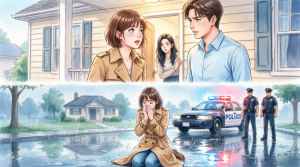
Defense attorneys argued community ties. Lack of prior convictions. Health conditions. Olivia’s two young children at home.
When Olivia’s lawyer mentioned her children, she began to sob.
The judge looked at her over reading glasses.
“Ms. Brennan, the court is aware you have children. The court is also aware you are accused of restraining another child while a firearm was pointed at her.”
Olivia went silent.
Bail was denied.
Trial was set.
As bailiffs led them away, Mom twisted toward me.
“You always wanted this,” she hissed.
I almost responded.
Troy’s hand found my wrist.
Not to stop me. To remind me I did not need to answer every poison dart.
Dad did not look back.
Olivia did.
“I hope you’re happy,” she cried. “You destroyed this family.”
I met her eyes.
“No,” I said. “You did.”
The bailiff moved her through the door.
Afterward, reporters shouted questions outside.
“Claire, did your grandmother’s inheritance cause this?”
“Do you blame yourself for bringing your daughter there?”
“Will you forgive your family?”
That last question stopped me.
I turned toward the nearest camera.
“No.”
One word.
No explanation.
No performance.
No trembling plea for privacy.
Just no.
That clip aired that night.
People online debated whether I sounded cold.
They could debate from homes where their fathers had not aimed weapons at their children.
I had other work to do.
Marcus filed civil suits the next morning.
Emergency asset freezes were granted within days. My father’s house, my mother’s rental property, Olivia and Nathan’s joint accounts, brokerage funds, vehicles. Their attorneys screamed that the freezes punished people before conviction. The judge disagreed. The recorded threat, the child’s injury, the financial motive, and the risk of asset transfer were enough.
Discovery revealed the rot beneath the surface.
Dad’s business was drowning. Lines of credit maxed out. Tax liens. Hidden loans. Gambling withdrawals dressed as “consulting expenses.”
Mom’s rental property was mortgaged nearly to death.
Olivia and Nathan looked successful from the outside, but designer bags, leases, private school deposits, and credit cards had hollowed their life out.
Grandma Ruth’s money had not been greed’s temptation.
It had been their exit plan.
And when she left it to me, they did not see a granddaughter.
They saw a locked vault.
One afternoon, Marcus slid a document across the table in his office.
“What is this?” I asked.
“An email from your father to Olivia. Three weeks before the shooting.”
The subject line read: Claire problem.
My stomach tightened.
The email was short.
Lunch might be the only way. Bring Emma. Claire won’t risk a scene in front of the kid.
I read it once.
Then again.
My hands went numb.
They had not brought Emma into danger by accident.
They had counted on my love for her as the thing that would make me obey.
That was the moment my grief changed shape.
Until then, I had thought I was mourning a family.
But you cannot mourn something that was never alive.
Part 6
Emma’s scar healed faster than I did.
Within weeks, the angry red line near her temple softened beneath fine blonde hair. She stopped needing the bandage. Then the antibiotic ointment. Then the careful sponge baths where I kept one hand braced under her chin because I was terrified of hurting her.
She began running again before I was ready.
Two-year-olds do not respect trauma timelines.
She chased bubbles across the living room one morning, shrieking with laughter, and I nearly dropped the wand because the sound was so bright it hurt. Troy sat on the floor nearby, eyes wet, pretending to be very interested in a toy giraffe.
The doctors were cautiously optimistic.
No neurological damage. No major developmental changes. Some nightmares, some clinginess, some fear around loud sounds. Dr. Singh said we would watch, support, and not force memory into words Emma did not have.
“She may remember pieces,” Dr. Singh told me. “Or she may remember fear without narrative. Your job is to make safety consistent.”
Consistent.
That became my new religion.
Same bedtime songs. Same nightlight. Same words every time she woke crying.
You are safe.
Mommy is here.
Daddy is here.
Nobody scary can come in.
The apartment changed too.
New locks. Cameras. Security film on the windows. A list of forbidden contacts taped inside the front closet for babysitters. Emma’s preschool had copies of the protective orders before she returned.
I used to think safety was a feeling.
Now I knew it was a system.
Troy moved back to Seattle temporarily, then permanently. Not into my apartment, though people assumed that. He rented a place ten minutes away and showed up for every appointment, every therapy session, every court date. We were better with a boundary between us. Better with Emma as the bridge and no expectation of becoming what we had already failed to be.
One night, after Emma fell asleep between us during a movie, Troy carried her to bed and returned to find me staring at the paused screen.
“What?” he asked.
“Do you think we should have tried harder?”
“At marriage?”
“At everything.”
He sat beside me.
“No,” he said after a moment. “I think we tried badly for too long. Now we’re doing one thing right.”
“What thing?”
“Putting her first without making each other bleed for it.”
That was the closest thing to peace I had felt in months.
Meanwhile, the case grew uglier.
Defense attorneys attacked from every angle.
They claimed I had manipulated Grandma Ruth into changing the will. They suggested the recordings were edited. They hinted I was unstable, vindictive, motivated by inheritance money. My mother’s lawyer floated the idea that she had been “in shock” and therefore not responsible for her words. Olivia’s attorney painted her as a frightened bystander controlled by our father.
Then prosecutors found the text thread.
Olivia to Mom: If Claire doesn’t sign, Dad needs to scare her.
Mom: He will.
Olivia: Not too much. She cries and gets dramatic.
Mom: Emma being there will keep her soft.
I read those messages in Marcus’s office.
Emma being there will keep her soft.
My body went cold.
There was nothing soft in me when I finished reading.
Hannah Cross prepared me for trial like she was teaching me to walk through fire without looking down.
“They will try to make you angry,” she said. “They will ask cruel questions. They will imply you caused this by refusing to share the inheritance.”
“I did refuse.”
“And you had every legal and moral right to refuse. Your refusal did not cause a firearm to be aimed at your child.”
I nodded.
“You know that intellectually,” she said. “Now practice knowing it under attack.”
So we practiced.
Why didn’t you just sign if you feared for your daughter?
Because I believed giving control to armed extortionists would not make my daughter safer.
Isn’t it true you had a hostile relationship with your parents?
Yes. They became hostile when they did not receive my grandmother’s money.
You benefited financially from their arrest, didn’t you?
No. My daughter benefited from surviving them.
Again and again.
Until the words became a shield.
The trial began in September, under a sky the color of old metal.
On the first day, I wore navy. Not black. I did not want to look like grief had dressed me. Troy sat beside me. Marcus behind us. Daniel Park in the witness list. Dr. Foster. Lieutenant Morrison. Paramedics. Forensic specialists. Bank records experts.
The courtroom was packed.
News crews filled the hallway. Strangers who had followed the case sat in the back. Relatives divided themselves like geography: those who believed the recording, those who believed family could not be guilty if it looked respectable enough, and those who came only for spectacle.
My parents and Olivia entered in suits.
Not orange now. Clean, polished, rehearsed.
Dad looked like a retired businessman who had misplaced his good fortune.
Mom wore pearls.
I stared at them.
Those same pearls.
For a moment, I was back in the living room. Emma crying. Mom laughing. Dad’s hand steady.
Then Emma’s voice came into my mind from that morning.
Good enough.
No.
Surviving was not good enough.
Justice had to happen too.
Hannah Cross stood for opening statements.
“This case is about greed,” she said. “It is about three adults who believed a two-year-old child’s life was an acceptable bargaining chip.”
The room went silent.
And for the first time since the gunshot, I felt the truth enter a place big enough to hold it.
Part 7
The recording played on the second day.
Hannah warned the jury first.
The audio would be disturbing. The video would show a child in fear. The actual discharge would be heard but not shown in graphic detail. Anyone who needed to leave could do so.
No one left.
I sat between Troy and Marcus while the courtroom lights dimmed slightly and the screen came alive with the view from my coat button. The angle was imperfect, tilted toward the dining room, catching pieces of faces, the edge of the table, Emma’s blocks scattered across the rug.
My mother’s voice filled the room first.
You always were difficult just to feel important.
I gripped Troy’s hand.
Then Dad’s voice.
Sign these.
My own voice, calmer than I remembered.
No.
Papers rustled. A chair scraped. Emma babbled softly in the background, unaware.
Then the gun appeared at the edge of the frame.
A collective breath moved through the courtroom.
Dad’s voice sharpened.
Sign the loan papers right now.
Emma cried.
Someone in the jury box covered her mouth.
Olivia’s voice came next.
She’s leverage.
Hearing it again was worse than remembering it. Memory had fog. Recordings had teeth.
Mom laughed.
Trash like you owns nothing worth keeping.
I felt Troy’s hand tighten so hard it almost hurt.
Then my voice.
Let her go first. She’s two.
Dad: Or else.
Emma screamed, “Mommy!”
The shot cracked through the speakers.
The judge’s jaw tightened.
A juror began crying.
My father stared at the table. My mother closed her eyes. Olivia sobbed into a tissue, but I watched carefully. She cried when she heard herself implicated. Not when Emma cried.
The recording stopped before the paramedics arrived.
The silence afterward felt like a verdict before the verdict.
Defense attorneys still did their work.
They questioned Daniel about chain of custody. He explained the devices, the timestamps, the cloud backups, the metadata. Calm, precise, impossible to rattle.
They questioned the forensic audio expert. He confirmed no edits, no splices, no manipulation.
They questioned Lieutenant Morrison. She described the scene: the gun, the blood, the documents, the suspects’ statements, the inconsistencies.
Then Dr. Foster took the stand.
She explained Emma’s wound with clinical restraint. The bullet grazed the scalp, narrowly missing catastrophic injury. A fraction of an inch, a slight shift in angle, a toddler moving at the wrong moment—any of those could have turned survival into death.
I stared at my lap during that testimony.
Troy left the courtroom afterward and vomited in a trash can.
I stood beside him in the hallway while he rinsed his mouth at a water fountain.
“I’m sorry,” he said.
“For what?”
“For not being able to sit through that.”
I looked at him, this man I had once loved badly and now respected deeply.
“You’re her father,” I said. “You sat through enough.”
My testimony came on the fourth day.
The witness stand smelled faintly of wood polish. The microphone was too close to my mouth. I could see everyone: the jury, the judge, the defendants, my relatives, the reporters.
Hannah began gently.
“Ms. Caldwell, why did you go to your parents’ home that day?”
“Because my mother invited me to lunch. She said she wanted to repair our relationship. I wanted to believe her.”
“What was the conflict in your family at the time?”
“My grandmother Ruth left her estate to me. My parents and sister believed they were entitled to it.”
“Did you steal that inheritance?”
“No.”
“Did you manipulate your grandmother?”
“No. I cared for her.”
Hannah walked me through the months of pressure, the threats, the decision to document visits. Then the lunch. The papers. The gun.
When she asked what happened after Emma tried to run to me, my voice failed.
The judge gave me a moment.
I looked at my father.
He looked away.
I looked at my mother.
She stared back, cold and dry-eyed.
I looked at Olivia.
She was crying again.
Then I looked at the jury.
“He fired,” I said. “Emma fell. And I thought she was dead.”
The words left me hollow.
Hannah let silence sit.
Then she asked, “What did you do?”
“I pressed my cardigan to her head and told them to call an ambulance.”
“Did they?”
“Not at first.”
“Who finally called?”
“My mother. After I screamed.”
The cross-examinations were brutal.
Dad’s lawyer asked why I didn’t simply sign to save my child.
“Because my father had already shown he was willing to use her as a weapon. Signing would not make him safe.”
Mom’s lawyer asked if I had always resented my mother.
“I wanted her to love me. That was different.”
A murmur moved through the courtroom.
Olivia’s lawyer suggested I had been jealous of my sister’s closeness with our parents.
I turned toward Olivia.
“No,” I said. “I pitied her for needing their approval. I just didn’t know she would trade a child for it.”
Olivia’s sob caught loudly.
Her lawyer objected.
Sustained.
But the jury had heard it.
By the end of the day, I felt scraped raw.
Outside the courtroom, Aunt Patricia approached me.
“You could still stop this,” she hissed. “You could ask for mercy.”
I looked at her.
“Emma got mercy by luck,” I said. “They can ask the court for theirs.”
I walked away before she answered.
That night, Emma slept curled against me, warm and alive.
The trial continued without mercy.
And every day, my family’s lies got smaller.
Part 8
The defense called my father first.
That was their mistake.
Richard Caldwell had always been convincing in rooms where people wanted to admire him. Golf clubs. Charity dinners. Business lunches. Family gatherings where he held court and everyone laughed just a little too hard.
But a courtroom is not a dinner table.
On the stand, under oath, his charm looked thin.
His attorney guided him gently.
He said he loved Emma.
He said the gun was meant only to scare me.
He said he never intended harm.
He said I had been unreasonable, poisoned by Grandma Ruth’s money, unwilling to help family.
He said the weapon “discharged.”
Not fired.
Discharged.
As if it had acted alone.
Hannah Cross stood for cross-examination with a folder in one hand.
“Mr. Caldwell, did you bring the loan documents to the lunch?”
“Yes.”
“Did you bring the firearm?”
“Yes, but—”
“Yes or no first. You brought both.”
“Yes.”
“Was the firearm loaded?”
“I keep it loaded for protection.”
“Protection from whom? Your daughter and granddaughter?”
His jaw tightened.
“No.”
“Then why bring it into the living room?”
“I was upset.”
“You were upset, so you pointed a loaded gun at a two-year-old?”
“I didn’t point it at her exactly.”
Hannah clicked the remote.
A still frame from the recording appeared on the screen.
The barrel angled toward Emma.
The courtroom went silent.
My father’s face reddened.
“Does that refresh your memory?”
He said nothing.
“Mr. Caldwell?”
“Yes.”
“Yes, it was pointed at Emma?”
His mouth twisted.
“Yes.”
Hannah moved through him with surgical precision. The emails. The debt. The planning. His statement on the recording. The location of his finger. His failure to call emergency services immediately. His claim that Emma was leverage, supported by Olivia’s voice and Mom’s texts.
By the end, his shoulders sagged.
He no longer looked like a patriarch.
He looked like a man trapped under the weight of his own words.
Mom testified next.
Her lawyer tried to make her sound passive. Shocked. Afraid of Dad. A woman swept into a terrible situation by a domineering husband.
Then Hannah played Mom’s laughter.
The sound filled the courtroom again.
My mother closed her eyes.
“Mrs. Caldwell,” Hannah said, “were you afraid when you laughed?”
Mom’s lips pressed together.
“I was nervous.”
“You were nervous when you called your daughter trash?”
No answer.
“You were nervous when you said her life meant nothing?”
Mom’s face hardened. The mask cracked.
“She destroyed us,” she snapped.
The jury saw it.
A flash of the woman from the living room. Entitled. Furious. Honest in cruelty.
“She took what was ours.”
Hannah paused.
“What was yours?”
“My mother’s estate.”
“Your mother’s will specifically excluded you, did it not?”
“She was manipulated.”
“By Claire caring for her?”
Mom’s eyes glittered.
“She always knew how to play innocent.”
There it was again.
The old story.
Claire the difficult one. Claire the manipulator. Claire the problem.
But now the story had to stand beside a recording of a gunshot.
It could not survive.
Olivia was last.
She looked fragile on the stand. Cream blouse. Pale makeup. Voice trembling.
She said she froze.
She said Dad scared everyone.
She said she held Emma only to keep her from running into danger.
For a moment, I saw a few jurors soften.
Then Hannah showed the email.
Lunch might be the only way. Bring Emma. Claire won’t risk a scene in front of the kid.
Olivia had replied: I’ll help keep Emma busy if things get tense.
Hannah looked at her.
“What did you mean by that?”
Olivia cried. “I didn’t mean this.”
“That wasn’t my question.”
“I meant I would distract her.”
“By holding her shoulders while your father aimed a gun?”
“No.”
“Did Emma try to run to her mother?”
Olivia whispered, “Yes.”
“Did you stop her?”
“Yes.”
“Did she cry?”
“Yes.”
“Did you let her go?”
Olivia broke then.
“No.”
The word was small.
The damage was not.
Closing arguments came two days later.
Hannah spoke simply.
“Each defendant wants you to believe the worst moment defines the crime. The gunshot. But this crime began before the trigger was pulled. It began with debt. With entitlement. With documents prepared in advance. With a plan to use a child’s presence to pressure her mother. The gunshot was not an accident separate from that plan. It was the natural end of treating a child as leverage.”
The jury deliberated for seven hours.
Those seven hours were longer than the ambulance ride. Longer than surgery. Longer than any night I had spent listening for Emma’s breathing.
When the jury returned, the courtroom filled so quickly the bailiff had to order people back from the doors.
I sat still.
Troy’s knee bounced beside mine.
The foreperson stood.
For Richard Caldwell: guilty on all counts.
For Linda Caldwell: guilty on all counts.
For Olivia Brennan: guilty on all counts.
My mother wailed.
Olivia collapsed forward, sobbing.
Dad stared straight ahead, face empty.
Troy exhaled like he had been holding his breath for months.
I did not cry.
Not because I wasn’t relieved.
Because I understood something then.
A verdict is not an ending.
It is a door closing with a long echo.
Sentencing came two weeks later.
Dad received thirty-five years.
Mom received twenty-five.
Olivia received eighteen, with parole eligibility far enough away that her children would grow up before she came home.
When Olivia cried, “What about my kids?” Judge Wilkins looked at her coldly.
“You should have considered children before you helped terrorize one.”
I felt nothing soft.
After court, Aunt Patricia screamed at me in the hallway.
“She’s your sister!”
I stopped.
“No,” I said. “She was Emma’s aunt. That was the part she should have remembered.”
Part 9
The civil cases were quieter but no less brutal.
No cameras in the hallway. Fewer reporters. Less public outrage. Just documents, valuations, depositions, insurance arguments, asset disclosures, and lawyers turning greed into numbers.
Marcus said civil court was where people learned consequences had receipts.
Dad’s house was valued at $820,000.
Mom’s rental property at just under $500,000, though the mortgage ate more than she had pretended.
Olivia and Nathan’s accounts were complicated. Some money was his. Some hers. Some joint. Some hidden behind spending that looked like wealth if you didn’t understand debt.
The court froze what it could.
Nathan divorced Olivia before the civil trial ended.
I did not blame him.
But I did not comfort him either.
He had spent years enjoying the version of Olivia who knew how to flatter powerful people and step over anyone inconvenient. He had not held Emma, but he had benefited from the family myth that I was unstable, greedy, and cold. When he came to me once outside Marcus’s office and said, “I didn’t know she could do something like this,” I believed him.
Then I said, “You knew she could lie.”
He had no answer.