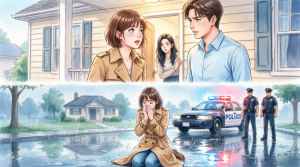
My Dad P.o.i.n.t.e.d a G.u.n at My Two-Year-Old Daughter’s Head and Yelled, “Sign the Loan Papers”
Part 1
The first thing I remember is the sound of my daughter’s little shoes on my parents’ hardwood floor.
Tap. Tap. Tap.
Emma had insisted on wearing her sparkly pink sneakers even though they were too tight and left faint red marks on her heels. She was two years old, which meant every choice was a hill worth dying on. Pink sneakers. Yellow cup. Bunny hair clips. No jacket unless she could zip it herself.
That morning, before we left my apartment, I had knelt in front of her and braided her pale curls into two crooked pigtails. She kept turning her head to watch cartoons, so one braid came out higher than the other. I remember laughing and kissing the top of her head.
“Good enough,” I told her.
She grinned at me in the mirror.
Good enough.
Those words would come back later and make me sick.
My mother had invited us to lunch. That alone should have warned me. Linda Caldwell did not invite people to lunch unless she wanted something witnessed, controlled, or forgiven. But she sounded different on the phone that morning. Soft. Almost tired.
“Claire,” she said, “your father and I don’t want to keep fighting. Bring Emma over. I made chicken salad. We can talk like adults.”
Talk like adults.
In my family, that phrase usually meant I would be expected to sit quietly while everyone explained why I was selfish.
Still, I went.
Because Emma loved the little wooden blocks at their house. Because a part of me, stupid and wounded, still wanted parents who could look at me without calculating what I owed them. Because my grandmother Ruth had died six months earlier, and grief does strange things. It makes old doors look less dangerous than they are.
Grandma Ruth had left me almost everything.
Three million dollars in property, investments, and cash.
My parents had expected that money. They had practically decorated their future with it. My father, Richard, had already talked about paying off his business debts. My mother had circled lake houses online. My older sister Olivia told people she was “helping manage the estate,” even though Grandma Ruth’s will named me and only me.
The letter attached to the will was short.
Claire cared for me when others cared for my assets.
That sentence had destroyed my family.
At first, the pressure came dressed as concern.
“You’re young,” Dad said. “You don’t understand money at this level.”
Mom told me, “We raised you. Ruth only had anything because this family helped her.”
Olivia said, “You know this looks bad, right? Like you manipulated a dying woman.”
Then the calls got darker.
Dad showed up at my apartment at midnight once, pounding on the door hard enough to wake Emma. Mom left voicemails calling me greedy, ungrateful, poisoned by money. Olivia told mutual relatives I had isolated Grandma Ruth in her final months, as if she hadn’t been too busy vacationing in Cabo to visit.
That was when I hired a private investigator.
His name was Daniel Park, and he had the calm voice of a man who had spent years watching people lie from across parking lots. My attorney, Marcus Reeves, recommended him after I played him one of Dad’s voicemails.
“You need documentation,” Marcus said. “Do not meet them alone without it.”
So Daniel gave me a small camera hidden in a coat button and a second audio recorder inside my key fob. I felt ridiculous wearing them to my parents’ house. Paranoid. Dramatic.
Then Dad came home during lunch carrying a folder.
The room changed the moment he stepped in.
Emma was on the living room rug stacking blocks into a lopsided tower. Sunlight came through the tall front windows and landed in squares across the floor. The house smelled like mayonnaise, coffee, and my mother’s rose perfume.
Dad dropped the folder on the dining table.
“Sign these,” he said.
I wiped Emma’s fingers with a napkin and stood. “What are they?”
“Loan documents. Temporary transfer authority. We need to restructure some debt.”
I looked at the papers.
They gave him access to my inheritance accounts as collateral for a business loan. Not temporary. Not harmless. A legal trap with my name at the bottom.
“No,” I said.
His face hardened. “Don’t embarrass yourself.”
“Dad, I’m not signing this.”
Mom laughed from the sofa, pearls shining at her throat. “You always were difficult just to feel important.”
Olivia stood near Emma, arms crossed. She wore cream slacks and heels that clicked whenever she shifted her weight. “Claire, just sign it. You don’t even know what to do with that kind of money.”
“I know not to hand it to people who tried to steal it.”
Dad moved faster than I expected.
One second, the gun was not there. The next, it was in his hand.
Black metal. Steady grip. Pointed not at me.
At Emma.
My mind went white.
Emma froze beside her blocks. Her little mouth opened, but no sound came out.
“Sign the loan papers,” Dad said, voice low and shaking with fury, “right now.”
Mom’s smile did not vanish. It widened.
Olivia grabbed Emma by the shoulders when she tried to run to me.
“Don’t,” I whispered.
Dad raised the gun slightly.
“Or else.”
And in that moment, with my daughter trapped between my sister’s hands and my father’s weapon, I understood that I had not walked into a family lunch.
I had walked into a hostage situation.
Part 2
Time did not slow down the way people say it does.
It sharpened.
I saw everything at once.
Emma’s bunny clips, one crooked above her left ear. The smear of chicken salad on my mother’s white plate. Olivia’s red nails pressing into my daughter’s tiny shoulders. My father’s finger too close to the trigger. Dust floating through a rectangle of sunlight like the room had no idea evil had entered it.
“Dad,” I said carefully, “put the gun down.”
“Sign.”
Emma began to cry.
Not loud at first. A confused, breathy sound, like she was asking the room why everyone had changed shape.
“Mommy,” she whimpered.
I took one step toward her.
Olivia tightened her grip.
“Stay where you are,” Dad snapped.
My mother sighed dramatically. “This is what happens when you spoil children, Richard. They grow up thinking everything belongs to them.”
I looked at her.
“You’re talking about money while he points a gun at my baby.”
Mom tilted her head, lips pursed. “Your life means nothing if you tear this family apart. Trash like you owns nothing worth keeping.”
Trash like you.
There was a time those words would have broken something in me.
But Emma was crying.
That made me stronger than hurt.
“The camera is recording,” I said.
It was a gamble.
A partial truth.
The button camera was recording, yes. The key fob in my purse was too. But I wanted them scared enough to stop.
Dad’s eyes flicked to my coat.
Olivia’s hands loosened for half a second.
Mom said, “She’s bluffing.”
Of course she said that.
She had spent my whole life betting that no one would believe me.
Dad shoved the papers toward me with his free hand. “Last chance.”
I moved slowly toward the table, keeping my eyes on Emma. “Let her go first.”
“No.”
“She’s two.”
“She’s leverage,” Olivia said.
I turned my head and stared at my sister.
Her face changed when she realized she had said it out loud.
Leverage.
Not niece. Not Emma. Not child.
Leverage.
The word seemed to hang in the room, ugly and final.
Dad’s jaw tightened. “Sign, Claire.”
I reached for the pen.
Emma sobbed harder. Her face was red, wet, terrified. She twisted against Olivia’s hands, trying to reach me.
“Mommy!”
Olivia hissed, “Stop moving.”
That snapped the thin thread I had left.
I lunged.
Not at Dad. At Emma.
My hand closed around the sleeve of her yellow dress. Olivia yanked her back. Dad shouted something I did not understand.
Then the gun went off.
The sound cracked the room in half.
Emma stopped crying.
She folded sideways onto the floor.
For one second, no one moved.
The smoke smell hit first, sharp and metallic. Then my mother’s laughter died into a choking sound. Olivia stumbled backward with both hands covering her mouth. Dad lowered the gun slowly, his face draining gray.
I dropped to my knees so hard pain shot up my legs.
“Emma.”
Blood spread into her blonde curls near her temple. Too much red. Too bright. My cardigan was off before I remembered taking it off. I pressed it against the wound with both hands.
Her chest moved.
Shallow.
But moving.
“Call an ambulance,” I said.
Nobody answered.
I looked up.
My father stood frozen, the gun hanging at his side. My mother clutched her pearls. Olivia was crying now, silent and useless, backed against the wall.
“I said call an ambulance.”
Still nothing.
I screamed it then.
“Call an ambulance now!”
Mom fumbled with her phone, fingers shaking so badly she dropped it once. While she dialed, I bent over Emma and pressed harder.
“You’re okay,” I whispered. “You’re okay, baby. Mommy’s here. Stay with me.”
Her eyelashes fluttered.
A tiny sound left her mouth.
That sound kept me alive.
Dad finally spoke.
“It was an accident.”
I did not look at him.
“You pointed a loaded weapon at a toddler’s head.”
“I didn’t mean—”
“You told me to sign papers or else.”
My voice sounded strange. Calm. Empty. A voice from some other woman’s body.
Mom whispered into the phone, “There’s been an accident.”
I lifted my head.
“Tell them it is a gunshot wound to a two-year-old child.”
Her eyes widened.
“Say it.”
She swallowed. “A gunshot wound. She’s two.”
Dad staggered back like the words had struck him.
Good.
Let reality find him.
The ambulance arrived in eight minutes.
Eight minutes can be an entire lifetime when your child’s blood is warm under your hands.
Paramedics rushed in with bags, gloves, controlled voices. One gently moved my hands, checked the wound, and said, “Graze. Possible skull injury. We need to move.”
Graze.
That word became a rope.
Not gone.
Not gone.
Not gone.
Police arrived just behind them. Two uniformed officers and a woman in a dark jacket whose badge said Lieutenant Sarah Morrison. She stepped into the living room and saw the whole scene: gun on the coffee table where Dad had finally dropped it, papers scattered across the dining table, blood on the floor, my family standing together like criminals waiting for instructions.
“I’m going with my daughter,” I told her.
“You are,” she said. “But tell me what happened.”
I pulled the button camera loose from my coat with trembling fingers. Then I grabbed the key fob from my purse and handed both to her.
“My father threatened to shoot my daughter if I didn’t sign loan papers giving him access to my inheritance. My mother encouraged him. My sister held Emma still so she couldn’t run.”
Morrison’s expression hardened.
“Then he pulled the trigger,” I said.
Behind me, Mom gasped, “Claire!”
I turned once.
Just once.
The paramedics were lifting Emma onto a stretcher. Her small body looked breakable under white gauze and straps. My father had tears on his face now. My mother looked offended, as if I had embarrassed her. Olivia was whispering, “No, no, no,” into her hands.
Lieutenant Morrison looked at them and said, “Richard Caldwell, Linda Caldwell, Olivia Brennan, you are being detained pending investigation.”
Dad started yelling. Mom cried. Olivia screamed my name.
I followed Emma out.
And as the ambulance doors closed, I looked through the small rear window at the house where I had once begged to be loved.
All I felt was ice.
Because my family had just made one mistake they could never take back.
They had left my daughter alive.
Part 3
The ambulance smelled like plastic, blood, and antiseptic.
A paramedic with tired eyes worked over Emma while another spoke into a radio.
“Pediatric trauma, incoming. Female, age two. Gunshot graze to the head. Consciousness altered. Vitals holding.”
Gunshot.
Female.
Age two.
Each word felt like a hammer hitting bone.
I sat strapped beside the stretcher, one hand curled around Emma’s foot because it was the only part of her I could safely touch. Her pink sneaker blinked with tiny lights whenever the ambulance jolted over a bump.
She had begged for those shoes.
I stared at the flashing lights in the sole and tried not to think about how close I had come to never hearing her beg for anything again.
“Emma,” I whispered. “Mommy’s here.”
Her eyelids fluttered, but she did not wake.
The paramedic glanced at me. “She’s breathing on her own. That’s good.”
Good.
Good was pancakes on Saturday. Good was Emma laughing at bubbles in the bath. Good was not a bandage wrapped around her head while sirens tore through Seattle traffic.
But I nodded because nodding was easier than falling apart.
At Seattle Grace, they took her through double doors I could not follow past. For the first time since the gun fired, she was out of my sight.
That was when my knees gave out.
A nurse caught my elbow before I hit the floor. She guided me into a plastic chair in a waiting area that smelled like coffee, bleach, and fear. People looked at me. I must have been covered in blood. Emma’s blood. My cardigan was gone, cut away or dropped somewhere, I didn’t know.
A pediatric surgeon named Dr. Angela Foster came to me ten minutes later.
She had kind eyes and no wasted movement.
“The bullet appears to have grazed the side of her head,” she said. “There’s significant bleeding because scalp wounds bleed heavily, but initial imaging does not show penetration of the skull.”
I did not breathe until she finished.
“No brain injury?”
“Not from what we see so far. We need to clean and close the wound properly, possibly under anesthesia. We’ll monitor for swelling or complications.”
“She’ll live?”
Dr. Foster’s face softened.
“Yes. I believe she will live.”
I made a sound I did not recognize.
Not crying.
Not laughing.
Something animal.
The nurse put a hand on my shoulder, and I let her because I had no strength left to stop anyone from touching me.
While they worked on Emma, I made calls.
First, Marcus Reeves, my attorney.
He answered on the second ring despite it being Sunday.
“Claire?”
“My father shot Emma.”
Silence.
Then his voice changed. “Where are you?”
“Seattle Grace.”
“Is she alive?”
“Yes.”
“I’m coming.”
Then Daniel Park.
“The device recorded?” I asked.
“I’m checking backups now,” he said. “The button cam transmitted until police took it. The audio key fob should be intact.”
“I gave both to Lieutenant Morrison.”
“Good. I’ll preserve cloud copies and send chain-of-custody documentation to your attorney.”
His calm steadied me.
Evidence. Records. Dates. Files.
Things the world could measure when pain was too big.
Then I called Troy.
My ex-husband lived in Phoenix. Our marriage had ended quietly two years earlier, not from hatred but from exhaustion. We were better parents apart than spouses together. He loved Emma with the kind of fierce tenderness that made me forgive many of the ways he had failed me as a husband.
He answered cheerful.
“Hey, what’s up?”
“Troy,” I said, and broke on his name.
“What happened?”
“My father shot Emma.”
I heard something fall on his end.
“She’s alive,” I said quickly. “She’s in surgery. It grazed her head. They think she’ll live.”
“I’m getting on a plane.”
“Troy—”
“I’m getting on a plane.”
He hung up.
Marcus arrived in fifty-two minutes wearing a wrinkled blazer and the expression of a man already building a case in his mind. He sat beside me in the waiting room, briefcase on his knees.
“Tell me everything.”
I did.
The lunch invitation. The papers. The gun. Mom laughing. Olivia holding Emma. The shot. The recording devices.
Marcus wrote nothing down at first.
He only listened.
When I finished, he said, “They planned coercion. They brought documents and a weapon. Your sister restrained the child. Your mother encouraged the threat. That is not a family dispute. That is multiple felonies.”
“I want prison.”
“You’ll likely get it.”
“I want more.”
His eyes lifted.
“I want civil suits. Medical bills, trauma, punitive damages, everything. I want the house. Mom’s rental. Olivia’s accounts. I want everything they tried to steal to go where it should have gone in the first place.”
“To Emma.”
“Yes.”
Marcus closed his briefcase slowly. “Then that’s what we’ll pursue.”
“Can they move assets?”
“I’ll file emergency freezes first thing tomorrow. Tonight, I’ll draft notices. We also need restraining orders.”
“Do it.”
He looked at me carefully. “Claire, you’re in shock.”
“I know.”
“Do you understand what you’re asking?”
“Yes.”
“Good,” he said. “Because I agree.”
Three hours later, Dr. Foster returned.
Emma was stable. The wound was closed. No skull fracture. No brain damage visible. Observation for several days. Pain medication. Follow-up imaging. A scar that would likely fade beneath her hair.
“She is very lucky,” Dr. Foster said.
Lucky.
No.
Lucky would have been a grandfather who loved her.
But I only nodded.
When they let me see Emma, she lay in a pediatric ICU bed, tiny under white sheets, head bandaged, lashes dark against pale skin. Machines beeped softly. An IV was taped to her hand.
I sat beside her and touched her fingers.
“I’m sorry,” I whispered. “I’m so sorry I took you there.”
Her hand twitched in mine.
Outside the window, afternoon faded into hospital-gray evening.
Troy arrived just after midnight.
He ran into the ICU with wild eyes and travel-wrinkled clothes. When he saw Emma, he stopped like someone had punched him in the chest. Then he turned to me and pulled me into his arms.
I held on.
For the first time all day, I cried like a mother instead of a witness.
And over Troy’s shoulder, watching my daughter breathe, I made a promise I would keep for the rest of my life.
No one who helped put Emma in that bed would ever be family to us again.
Part 4
Emma woke the next morning confused and thirsty.
Her eyes opened slowly, blue and unfocused, then filled with tears when she tried to turn her head and pain stopped her.
“Mama,” she whimpered.
I was on my feet before the monitor finished beeping.
“I’m here, baby. I’m right here.”
Her bottom lip shook. “Owie.”
“I know.” I stroked her cheek with one finger. “The doctors fixed you. You’re safe.”
Troy stood on the other side of the bed, face pale from no sleep. He held her stuffed rabbit, the one he had bought from the hospital gift shop at three in the morning because he could not stand having empty hands.
Emma blinked at him.
“Daddy?”
His face crumpled.
“Hey, bug,” he whispered. “I came fast.”
She accepted the rabbit, clutched it weakly, and fell back asleep within minutes.
That was how the next few days went. Sleep, pain, confusion, nurses, doctors, whispered updates, alarms that made my heart stop until someone told me they were routine.
I did not leave the hospital.
Troy tried to make me eat. Marcus brought coffee and legal documents. Dr. Foster gave updates. A child psychologist named Dr. Maya Singh came by and explained that Emma might not remember the event clearly because of her age, pain, and shock.
“That doesn’t mean her body won’t remember,” Dr. Singh said. “Watch for sleep changes, fear responses, separation anxiety. We’ll monitor over time.”
Over time.
The phrase felt impossible.
Time had divided itself into before the gunshot and after.
On Emma’s second hospital day, Lieutenant Morrison came to see me.
She wore a navy jacket, no uniform, hair pulled back, folder in hand. Her face softened when she looked at Emma sleeping, then hardened when she turned to me.
“We reviewed the recording,” she said.
Troy sat straighter.
“And?” I asked.
“The evidence is strong. Very strong.”
I did not ask if she heard my daughter cry. I could tell from her eyes that she had.
“Your father is claiming accidental discharge,” she continued. “His attorney says he only brought the gun because he felt threatened by your refusal to discuss the estate.”
I laughed once.
It sounded dead.
Morrison opened the folder. “The recording captures him saying, ‘Sign the papers right now or else.’ It also captures your mother encouraging him and your sister saying Emma was leverage.”
Troy swore under his breath.
Morrison nodded slightly, as if she agreed but could not say so.
“All three are being charged with attempted murder, assault with a firearm, child endangerment, extortion, and conspiracy. Prosecutors may adjust charges after arraignment, but that’s where we are.”
“What about bail?” I asked.
“The state will request no bail or extremely high bail. The child victim, the firearm, the premeditation, the family relationship, and the financial motive all weigh heavily.”
“Good.”
Morrison studied me. “You understand this will get public.”
“It already is.”
And it was.
By the third day, reporters had found the story.
Heiress’s family accused in shooting of toddler.
Inheritance dispute turns violent.
Grandfather charged after child wounded.
My parents’ names spread across local news. Olivia’s smiling real estate headshot appeared beside a blurry image of my parents’ house. Comment sections filled with horror, speculation, conspiracy, and strangers turning Emma’s suffering into entertainment.
Some relatives chose sides immediately.
Aunt Patricia, my mother’s sister, texted: I hope you’re proud of yourself. Your father made one mistake and you’re ruining everyone.
One mistake.
I forwarded it to Marcus and blocked her.
Cousin Jeremy posted: Funny how money makes people lie.
Blocked.
Olivia’s husband, Nathan, called Troy instead of me. Troy stepped out into the hallway to answer. When he came back, his jaw was tight.
“What did he want?”
“He says Olivia is innocent. Says your parents manipulated her. Says she would never hurt Emma.”
“She held her.”
“I told him that.”
“And?”
“He hung up.”
Troy sat beside me, elbows on knees, hands clasped.
We had failed at marriage in many ordinary ways. Too much resentment. Too many sleepless nights. Not enough grace. But in that hospital room, we were aligned down to the bone.
Emma first.
Always.
On Wednesday, Emma was discharged with a bandaged head, antibiotics, pain medication, and a discharge packet thick enough to qualify as a book. The nurses gave her stickers. Dr. Foster gave her a tiny stuffed bear in scrubs. Emma wanted to walk herself out, wobbly and determined, and cried when we insisted on the wheelchair.
That stubbornness almost undid me.
At home, my apartment felt both familiar and foreign. The couch still had one of Emma’s socks tucked between cushions. Her sippy cup sat on the drying rack. Sunlight fell across the rug where she usually built towers.
I had thought the hospital was the battlefield.
I was wrong.
Home was where the echoes came.
Emma refused to sleep unless I sat beside her. She startled whenever a door closed too hard. She cried when I tried to wash the dried hospital smell from her hair because the bandage area hurt.
That night, after she finally slept, Troy and I stood in the kitchen under the dim light above the stove.
“Do you blame me?” I asked.
He looked at me sharply. “For what?”
“For taking her there.”
“No.”
“I should have known.”
“You suspected they might pressure you. You didn’t know your father would point a gun at a toddler.”
The word toddler made my knees weaken.
Troy reached for my hand.
“Claire,” he said, “listen to me. They did this. Not you.”
I wanted to believe him.
Some part of me did.
But guilt is not logical. It is a mother sitting beside a crib at two in the morning, counting breaths and replaying every choice.
The next morning was the arraignment.
I did not want to go.
I also knew I had to.
Because my parents and sister would stand before a judge and try to become victims.
And I wanted them to see my face when the world refused to let them.
Part 5
The courthouse smelled like wet wool, old paper, and coffee that had been burned down to bitterness.
Rain streaked the tall windows. Reporters gathered near the entrance with cameras tucked under their jackets, whispering into microphones. Troy walked on one side of me. Marcus walked on the other. I wore a black coat with no hidden camera this time. I didn’t need one.
The truth had already learned how to speak.
Emma stayed home with a pediatric nurse Marcus helped arrange and a security officer Troy insisted on paying for. I hated that we needed security. I hated that my two-year-old’s recovery had become something requiring locks, watch schedules, and legal instructions.
But I hated many things now.
Hate, I was discovering, could be organized.
Inside the courtroom, my relatives had claimed two rows behind the defense table. Aunt Patricia sat stiff-backed in a purple scarf, eyes red and furious. Cousin Jeremy leaned back with arms folded, performing disgust for an audience that did not care. Nathan sat alone, face gray, hands clasped tightly. He did not look at me.
When the side door opened, the room shifted.
My father came in first.
Orange jumpsuit. Shackled wrists. Gray stubble on his jaw. He looked smaller than he had in my parents’ living room. That offended me. I wanted the jury, the judge, the world to see him as he had been: tall, red-faced, gun steady, voice full of ownership.
Instead, he looked like an old man.
A dangerous costume.
Mom came next. Her hair, usually perfect, showed gray roots. Without pearls and lipstick, she looked stripped down, but not humbled. When she saw me, her eyes filled with something that was not remorse.
Accusation.
Olivia came last.
She had been crying. Mascara shadows marked her face. She searched the room, found Nathan, then found me. Her lips moved silently.
Claire.
I turned away.
Judge Patricia Wilkins presided. She was known, Marcus whispered, for having little patience with crimes against children. She looked over the charges with a still expression, then asked for pleas.
“Not guilty,” Dad’s attorney said.
“Not guilty,” Mom’s attorney said.
Olivia’s lawyer stood. “Not guilty.”
The words landed badly in my chest.
Not guilty.
As if Emma’s blood had been a misunderstanding.
As if Olivia’s hands had not held her still.
As if my mother’s laughter had not filled the room.
The prosecutor, Hannah Cross, was a compact woman with sharp eyes and a voice that cut cleanly through every objection. She requested all three defendants be held without bail.
“The evidence includes audio and video recordings of the defendants threatening the victim’s mother, using a firearm to extort financial signatures, restraining a two-year-old child, and discharging the weapon. The child survived by chance.”
By chance.
My hands tightened in my lap.