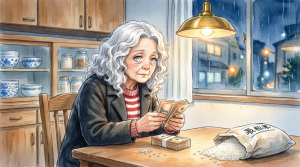
you were using me.
Mrs.
Rose’s hand shook.
Again?
She read the line twice.
I have been giving her money for you for almost a year, Mom.
Every month.
She told me she delivered it.
She told me you were grateful but embarrassed to call.
I believed her until Mr.
Hanley from the pharmacy called me last week and said your medicine had been sitting unpaid for two months.
Mrs.
Rose made a small sound.
Mr.
Hanley.
The pharmacist had known her since Lewis was a boy.
She remembered him touching her arm gently when she said she would come back for the medicine later.
I started asking questions, the note continued.
I found the envelopes in Clara’s desk.
Some were opened.
Some still had your name on them.
I don’t know how much she kept.
I don’t know why she did it.
But I know you went hungry while I thought I was helping you.
Mrs.
Rose pressed the note to her chest and closed her eyes.
The kitchen was silent except for the rain tapping above the sink.
She wanted to feel relief.
Instead, she felt something heavier.
Her son had not forgotten her.
But he had believed a lie for a year.
At the bottom of the note, the writing grew more uneven, as if Lewis had been rushing.
There is $4,000 in this rice.
I know it is not enough for what you suffered, but it will cover food, medicine, and repairs for now.
Tomorrow morning, please come to the store before opening.
Use the back entrance.
I need to talk to you alone.
And one more thing.
Do not call me tonight.
Clara checks my phone.
Mrs.
Rose read the last line three times.
The rain no longer sounded peaceful.
It sounded like fingers tapping on glass.
She sat at the table until the lamp hummed above her and the rice lay open in front of her like a secret.
The money frightened her.
The note frightened her more.
She thought of Clara’s cold face at the gate.
The way she had said, “We helped last month.” The way she had looked at Lewis, daring him to disagree.
Then Mrs.
Rose thought of Lewis’s hand on her elbow.
His touch had been brief, but now she remembered something else.
When he placed the rice in her arms, his fingers had pressed twice against the side of the bag.
Not random.
A signal.
She had been too hurt to understand.
Mrs.
Rose did not sleep much that night.
She cooked a small bowl of rice and ate slowly because her stomach was not used to food.
Then she counted the money, not because she wanted to, but because fear made her careful.
Four thousand dollars exactly, divided into neat bundles.
She put most of it in the old cookie tin beneath her bed.
The note she folded and tucked inside her Bible, between pages worn thin from years of turning.
At dawn, the rain had stopped.
Mist hung low over the road.
Mrs.
Rose dressed in her best clean blouse, the pale blue one Lewis had bought her three Christmases ago.
She brushed her hair, pinned it back, and placed the pharmacy card in her bag.
Then she walked to town.
The hardware store stood on
Main Street between a tire shop and a small diner.
The sign above the entrance read LEWIS & SON HARDWARE, though there had never been a son.
Mrs.
Rose had once teased him about the name.
“Planning ahead?” she had asked.
Lewis had grinned and said, “No.
That ‘son’ is me.
Yours.”
Remembering it now made her chest ache.
She went around to the back, as the note instructed.
Before she could knock, the door opened.
Lewis stood there.
He looked different from the night before.
No polished smile.
No phone in hand.
His eyes were red, and his shirt was wrinkled like he had slept in it.
For a second, neither of them spoke.
Then he whispered, “Mom.”
Mrs.
Rose looked at him, and all the strength she had gathered on the walk almost broke apart.
Lewis stepped forward and reached for her, but stopped short, as if he was not sure he had the right.
“I’m sorry,” he said.
The words came out cracked.
“I’m so sorry.”
Mrs.
Rose’s lips trembled.
“Did you know I was hungry?”
He flinched as if she had slapped him.
“No.”
“Did you know I was missing medicine?”
“No, Mom.
I swear to God, no.”
She studied his face.
He looked older than he had at the gate.
Not seventy, not like her, but worn down by something he had been carrying in silence.
Lewis opened the back door wider.
“Come in.
Please.”
Inside, the store smelled of lumber, metal, and coffee.
Shelves stood in long rows.
The lights were still half off.
Somewhere near the front, a radio played low, though no customers had arrived yet.
In the small office behind the counter, Lewis pulled out a chair for her.
Mrs.
Rose sat.
He remained standing for a moment, then reached into a drawer and took out a stack of envelopes tied with a rubber band.
Her name was written on all of them.
Some in Lewis’s hand.
Some opened.
Some still sealed.
Mrs.
Rose stared at them until her vision blurred.
“I found these two nights ago,” Lewis said.
“In Clara’s home office.
I was looking for a tax folder.
They were behind files in the bottom drawer.”
Mrs.
Rose touched the top envelope.
It was dated eight months earlier.
“I gave her money every month,” he said.
“Sometimes cash.
Sometimes grocery cards.
I asked her to drop them by because she said you seemed more comfortable with her.
She told me you didn’t want me fussing over you.”
Mrs.
Rose gave a bitter little smile through her tears.
“She rarely came inside my house.”
Lewis closed his eyes.
“I should have checked.”
“Yes,” she said softly.
“You should have.”
He nodded.
No excuse came.
That mattered to her.
“I wanted to hand you the money last night,” he said.
“But Clara was standing right there.
When you came to the gate, she had just found out I called the pharmacy.
She knew I suspected something.
I thought if I accused her there, she’d take the bag, or make a scene, or follow you.
So I put the money in the rice and acted like…”
“Like you were ashamed of me,” Mrs.
Rose finished.
Lewis looked at the floor.
“Yes.”
The office went very still.
Mrs.
Rose could hear the hum
of the old refrigerator in the corner.
She could hear a truck passing outside.
She could hear her own breathing, uneven and tired.
“I was ashamed,” Lewis said finally.
“But not of you.”
He knelt in front of her chair, the way he had when he was a boy and needed forgiveness after breaking a window or lying about homework.
“I was ashamed that I let my wife stand between us.
I was ashamed that I believed her because it was easier than asking hard questions.
I was ashamed that my own mother had to walk through the rain to ask me for food.”
Mrs.
Rose’s tears fell silently.
Lewis did not wipe them away.
He did not rush her.
He only stayed there, looking up at her with his hands open.
Then the bell above the front door rang.
Both of them froze.
Lewis stood.
A woman’s voice carried through the store.
“Lewis?”
Clara.
Mrs.
Rose’s fingers tightened around her bag.
Lewis’s face changed.
The softness vanished, replaced by something steady and hard.
“She wasn’t supposed to come this early,” he said.
Clara’s heels clicked across the floor, quick and sharp.
“Lewis, why is the back door unlocked?” she called.
“And why didn’t you answer my texts?”
She appeared in the office doorway and stopped.
Her eyes moved from Lewis to Mrs.
Rose, then to the envelopes on the desk.
For the first time since Mrs.
Rose had known her, Clara looked afraid.
Only for a second.
Then she recovered.
“What is this?” Clara asked.
Lewis picked up the stack of envelopes.
“That’s what I was going to ask you.”
Clara laughed, but the sound was too thin.
“Are you seriously doing this in front of your mother?”
“Yes,” Lewis said.
“Because she’s the one who went without food while you kept what was meant for her.”
Mrs.
Rose looked down at her hands.
She had imagined anger would feel hot.
Instead, it felt cold and clear.
Clara stepped into the office.
“I did not keep anything.
You’re confused.”
Lewis placed the envelopes on the desk one by one.
“March.
April.
June.
September.
Two grocery cards still inside.
Three cash envelopes opened.
And this one—” He held up a torn envelope.
“This had a receipt from the pharmacy.
You told me you paid it.”
Clara’s face tightened.
“I was going to.”
“When?” he asked.
“After my mother collapsed?”
She looked toward Mrs.
Rose.
“Don’t act innocent.
You always needed something.
Every month it was another problem.
Medicine.
Groceries.
Repairs.
I was trying to protect our household.”
Mrs.
Rose lifted her eyes.
“Our household?” she asked quietly.
Clara’s mouth shut.
Lewis turned to his wife.
“She helped build this store.”
Clara rolled her eyes.
“She washed clothes thirty years ago, Lewis.
That doesn’t mean she gets to drain us forever.”
The words landed with such ugliness that even Lewis seemed stunned by them.
Mrs.
Rose did not move.
She had expected denial.
She had expected tears, maybe excuses.
She had not expected the truth to come out so cleanly.
Lewis spoke in a low voice.
“You are going to leave this office.”
Clara stared at him.
“You don’t mean that.”
“I do.”
“This is because of her?”
“No,” Lewis said.
“This is because of you.”
Clara’s eyes flashed.
“You’ll regret
humiliating me.”
Lewis reached into the drawer and pulled out his phone.
“I already called Daniel.”
Clara went pale.
Mrs.
Rose recognized the name.
Daniel was Lewis’s accountant, a quiet man who had once brought her a chair during a store event when he noticed her standing too long.
“He’s reviewing the personal accounts and the store withdrawals,” Lewis continued.
“If you kept my mother’s money, you may have kept more.
We’ll find out.”
Clara took one step back.
For all her sharp words, she had nothing ready for that.
“You would choose her over your marriage?” she whispered.
Lewis looked at Mrs.
Rose.
Then he looked back at his wife.
“I should have chosen truth long before today.”
Clara stood there breathing hard, her eyes wet now, though Mrs.
Rose could not tell whether it was sorrow or fury.
“You’re making a mistake,” she said.
Lewis did not answer.
After a long moment, Clara turned and walked out.
The bell above the front door rang violently as she left.
The office remained silent after her footsteps disappeared.
Mrs.
Rose released a breath she had not realized she was holding.
Lewis sat in the chair across from her and covered his face with both hands.
“I don’t expect you to forgive me today,” he said.
Mrs.
Rose looked at the envelopes on the desk.
Forgiveness was not a door she could open just because someone knocked.
She loved her son.
That love had never been in question.
But love did not erase the image of a closed gate, or the shame of asking for food while his wife watched like she had come to steal.
“I believe you didn’t know everything,” she said.
Lewis lowered his hands.
Her voice stayed gentle, but it did not bend.
“But you knew enough to visit me.
You knew enough to ask me yourself.
You didn’t.”
His eyes filled again.
“You’re right.”
Mrs.
Rose nodded.
That was all she wanted in that moment.
Not excuses.
Not promises wrapped in panic.
Just the truth standing upright between them.
Over the next hour, Lewis made calls while Mrs.
Rose sat beside the office window with a cup of coffee warming her hands.
He called the pharmacy and paid every outstanding balance.
He called a repairman about her roof.
He called the grocery store and arranged weekly deliveries, not through Clara, not through anyone else, but directly under Mrs.
Rose’s name.
Then he placed a small checkbook on the desk.
“This account is yours,” he said.
“Only yours.
I already opened it.
My deposits will go straight there.
No one else can touch it.”
Mrs.
Rose looked at him carefully.
“I don’t want to be bought, Lewis.”
He shook his head.
“You’re not.
This is not payment for forgiveness.
This is responsibility.”
That answer, more than the money, softened something in her face.
By noon, Daniel arrived with a folder and a grave expression.
Mrs.
Rose did not stay for the full discussion.
She did not need every number.
She had seen enough in Clara’s eyes when the envelopes came out.
Lewis drove her home himself.
This time, he did not drop her at the road.
He carried groceries into her kitchen.
He fixed the loose hinge on her cupboard.
He checked the window that rattled in
the wind.
For a while, neither of them spoke about the gate.
Then, as he placed a new bag of rice on the shelf, Mrs.
Rose said, “You know, I almost didn’t open it last night.”
Lewis turned.
“I thought about saving it,” she said.
“Making it last.”
His face crumpled.
He crossed the small kitchen and took her hands.
“I’m sorry, Mom.”
This time, Mrs.
Rose let him hold them.
“I know,” she said.
It was not full forgiveness.
Not yet.
But it was a beginning.
Weeks later, people in town noticed changes.
Clara stopped coming to the hardware store.
Lewis moved into a small apartment above the shop while legal papers were handled.
The store sign stayed the same, but the way Lewis spoke of his mother changed.
He no longer mentioned her only on holidays or in sentimental stories told to customers.
He visited every Sunday.
Sometimes Mrs.
Rose let him cook.
Sometimes she made him sit while she cooked for him, because old habits were stubborn things.
Sometimes they talked.
Sometimes they sat quietly, two people learning how to cross a bridge that had nearly burned down without either of them noticing the first flames.
One afternoon, Lewis brought over a framed photograph from the store’s opening day.
In it, Mrs.
Rose stood beside him, younger then, wearing her best dress.
Lewis had one arm around her shoulders, grinning like the whole world had finally opened.
He placed it on her kitchen shelf.
“I should have kept this where I could see it,” he said.
Mrs.
Rose looked at the photograph for a long time.
Then she reached up and straightened the frame.
“That boy remembered me,” she said softly.
Lewis swallowed.
“I’m trying to be him again.”
Mrs.
Rose touched his cheek, the way she had when he was small.
“No,” she said.
“Be better than him.
He was only a boy.
You’re a man now.”
Outside, the road was dry, and the evening light lay warm across the porch.
Inside, the cupboard was no longer empty.
There was rice, bread, tea, medicine, and a small envelope tucked safely in a drawer.
Not hidden in fear.
Kept as a reminder.
The bag of rice had looked like rejection at the gate.
In truth, it had carried money, proof, and a son’s desperate apology.
But it also carried something harder to face: the fact that love can still fail when pride, silence, and the wrong person stand between two hearts.
Some people in town said Lewis deserved credit for making things right.
Others said a good son should never have needed a secret note to notice his mother was hungry.
Mrs.
Rose never joined those arguments.
She only knew this: forgiveness may open the door, but trust has to walk home slowly, in the rain, one painful step at a time.

