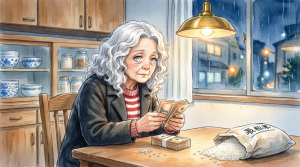
A 70-year-old mother went to her son’s house to ask for money for food.
He only handed her a bag of rice and coldly sent her away, but when she opened it at home, what she found inside made her knees go weak.
The rain began just as Mrs.
Rose reached the bend in the road.
It was not a heavy rain at first.
Just a fine, misty drizzle that floated through the orange light of sunset and settled on her thin gray hair.
The dirt path beneath her feet had turned soft in places, and every few steps her cane sank into the mud before she could pull it free again.
She stopped once beside a leaning fence post and pressed a hand against her chest.
Her heart was beating too fast.
Not from the walk alone, though the walk was hard enough.
Her knees hurt in the damp weather, her back had been stiff since morning, and the soles of her old shoes were so worn she could feel the stones under them.
What hurt worse was where she was going.
Mrs.
Rose had spent three days pretending she was not hungry.
On the first day, she had told herself she was simply not in the mood to eat.
On the second, she had boiled water and stirred in a pinch of salt, then sat at the little kitchen table as if it were soup.
On the third, she had opened her cupboard six times, staring at the same bare shelf, hoping something might appear if she looked long enough.
Nothing did.
There was a cracked mug.
A jar with two tea bags.
A paper packet of medicine she was supposed to take with food.
Food she did not have.
So before sunset, she had taken her old cloth bag from the hook by the door, placed her medical papers inside, counted the coins in her palm, and made the decision she had been avoiding for weeks.
She would go to Lewis.
Her son.
Her only child.
The boy she had raised after his father died with one hand on a laundry tub and the other wiping tears from her face where no one could see.
Lewis had been five when his father’s truck rolled off the highway during a storm.
People from the church had brought casseroles for a week.
After that, the house went quiet, and Mrs.
Rose learned that grief did not stop bills from arriving.
She washed clothes for families who barely looked at her.
She cleaned motel rooms until her fingers cracked from bleach.
She mended shirts by lamplight after Lewis fell asleep, saving every dollar she could to keep him in school.
When he wanted sneakers, she said hers were still good.
When he needed money for a field trip, she told him she had already eaten at work.
When he dreamed of opening a hardware store one day, she smiled until her cheeks hurt and said, “Then we’ll make it happen.”
And somehow, they did.
Lewis grew into a sharp, ambitious man.
He learned numbers quickly.
He worked under a contractor after high school, then sold tools from the back of a borrowed pickup.
Years later, his name hung in big blue letters over the busiest hardware store in town.
Everyone
said Lewis had made something of himself.
Mrs.
Rose never corrected them.
She only smiled and said, “He always had it in him.”
She did not mention the years she had gone without.
She did not mention selling her wedding bracelet to help him make the first payment on his shop.
She did not mention that he had once cried into her apron because he was afraid no one would believe in him.
She remembered.
That was enough.
Lewis now lived on the good side of town, past the paved road and the row of new houses with trimmed lawns.
His home sat behind a tall black metal gate with a keypad and a small camera above the bell.
A wide driveway curved toward the front porch, where bright lights glowed against polished stone.
His truck was parked near the garage, freshly washed, its chrome catching the last of the sunset.
Mrs.
Rose stood outside the gate and stared at it for a moment.
She felt foolish suddenly.
Her coat was thin.
The hem of her dress was damp.
Her old cloth bag looked even older beside all that shine.
She almost turned back.
Then her stomach cramped so sharply she had to grip the cane with both hands.
“No,” she whispered to herself.
“He is my son.”
She lifted one shaking finger and pressed the bell.
The sound rang through the property, bright and clean, nothing like the broken buzzer on her own door.
She waited, listening to the rain tick against the metal gate.
No one came.
She pressed again.
This time, she heard footsteps somewhere beyond the gate.
A lock clicked.
One side opened just wide enough for a woman to appear.
Clara, her daughter-in-law, stood there in a cream sweater with her hair tied neatly behind her head.
She looked warm, dry, and annoyed.
Her eyes moved over Mrs.
Rose’s wet shoes, her cane, her faded bag.
“What are you doing here?” Clara asked.
Mrs.
Rose swallowed.
“I’m sorry to come without calling,” she said softly.
“I wanted to see you all.
And I wondered if Lewis was home.”
Clara did not open the gate any wider.
“He’s busy.”
“I won’t keep him long.” Mrs.
Rose tried to smile, but it came out weak.
“I just need to ask him for a small favor.”
Something tightened around Clara’s mouth.
“A favor?”
Mrs.
Rose looked down at her hands.
She had planned what to say on the walk there, but now the words felt humiliating in her throat.
Before she could answer, Clara turned her head and called, “Lewis.
Your mother’s here.”
The way she said it made Mrs.
Rose feel like a package had been left at the wrong door.
A minute later, Lewis came out from the house.
For one brief second, Mrs.
Rose forgot the hunger, the rain, the shame.
She saw only her son walking toward her, tall and well dressed, with a phone in one hand and his watch shining under the porch light.
He looked tired.
Or maybe guarded.
“What’s going on, Mom?” he asked.
“I’m in the middle of something.”
Mrs.
Rose gripped the handle of her bag.
“I know, son.
I’m sorry.
I wouldn’t have come if it wasn’t important.”
His eyes flicked toward Clara.
Clara crossed her arms
and waited.
Mrs.
Rose felt her face grow hot.
“I don’t have any food left,” she said.
“I thought maybe you could lend me a little money.
Just enough for groceries.
I’ll pay it back when I can.”
Lewis did not answer right away.
The silence stretched so long that the rain seemed louder.
Then he sighed.
“Mom, things are tight right now.”
Mrs.
Rose blinked.
She looked past him at the truck, the lights, the house big enough to fit her entire little home inside its front room.
“Tight?” she repeated before she could stop herself.
He shifted his weight.
“Business expenses.
Deliveries.
Payroll.
You don’t understand how it works.”
Clara gave a small laugh through her nose, like the explanation should have been obvious.
Mrs.
Rose lowered her head.
“I understand enough, Lewis.
But I have nothing.
Not bread.
Not milk.
Nothing.”
His jaw clenched.
“Mom…”
“Even twenty dollars,” she whispered.
“Even ten.
I can make it last.”
Clara’s voice cut in softly, but there was nothing soft in it.
“We helped last month.”
Mrs.
Rose looked at her, confused.
“No, dear.
I don’t think—”
“We did,” Clara said, her eyes fixed on Lewis.
“Didn’t we?”
Lewis stared at the wet driveway.
Mrs.
Rose watched him, waiting for him to correct her.
He did not.
Something small and painful moved through her chest.
Lewis turned abruptly and walked toward his truck.
For a second, Mrs.
Rose thought he was leaving.
Then he opened the back and pulled out a medium-sized bag of rice.
He carried it to her with both hands.
“Here,” he said.
Mrs.
Rose looked at the bag.
It was heavy.
More than she expected.
“This will keep you going for a few days,” he continued.
His voice had gone flat, almost businesslike.
“We’ll talk about money later.”
She reached for it because she did not know what else to do.
The bag pressed against her chest, cold and solid through the thin fabric of her coat.
She could feel grains shifting inside.
“Thank you,” she said, though the words nearly broke.
Lewis glanced toward the gate.
“Go home before the rain gets worse.
I don’t want you getting sick.”
He put one hand lightly on her elbow and guided her backward.
Not cruelly.
Not gently either.
Like a man removing a problem from the entrance of his house.
The gate began to close before she had fully turned away.
Mrs.
Rose stood on the outside, her cane in one hand and the rice in the other, watching the black bars slide together until her son disappeared behind them.
For a moment, she could not move.
The rain gathered on her eyelashes.
Her throat tightened.
She wanted to knock again, not for money this time, but to ask him if he remembered.
Did he remember her carrying him when fever made his little body shake?
Did he remember her standing outside his classroom in the rain because he had forgotten his lunch?
Did he remember the night he opened his store, when he hugged her so hard she could barely breathe and said, “None of this happens without you, Mom”?
But the gate was closed.
And Mrs.
Rose had never been good at begging twice.
So she turned toward home.
The walk back felt longer.
The
bag of rice dragged at her arms.
Twice, she stopped to switch it from one side to the other.
Her fingers ached.
Her cane slipped in the mud.
A car passed too close and splashed dirty water over the hem of her dress.
Still, she did not curse Lewis.
She tried not to.
“He must be under pressure,” she whispered.
“Maybe business is not as good as it looks.”
A few steps later, she added, “Clara seemed upset.
Maybe I came at a bad time.”
Then, more quietly, “At least he gave me rice.”
She repeated that thought until she almost believed it.
By the time she reached her house, night had settled fully over the road.
Her home sat at the edge of a narrow lot, small and weather-beaten, with peeling white paint and a porch light that flickered when the wind blew.
One corner of the roof still leaked when the rain came from the east.
Inside, the air was cold.
Mrs.
Rose locked the door behind her, set her cane against the wall, and placed the rice on the kitchen table.
The table wobbled under the weight.
She took off her damp coat and hung it over the chair.
Then she stood still for a moment, staring at the bag.
Her stomach growled.
A strange little laugh escaped her, half shame and half relief.
“Well,” she murmured, “rice is better than nothing.”
She took a pot from the cupboard, rinsed it, and reached for the bag.
The top was tied tightly with string.
Her fingers were stiff from the cold, so it took several tries before the knot loosened.
When it finally gave way, she opened the top and dipped a cup inside.
The cup hit something hard.
Mrs.
Rose stopped.
She frowned and pushed her hand deeper into the rice.
Her fingers brushed plastic.
Not the thin plastic of the rice bag, but something smooth and wrapped.
Her heartbeat changed.
She pulled slowly.
A packet came out, sealed inside a clear plastic sleeve and dusted with grains.
Beneath it was another.
Then another.
Mrs.
Rose stared.
The first packet held folded bills.
Not one or two.
Stacks.
Her breath caught so sharply she had to grab the table.
She pulled out the second packet and found a pharmacy card, a grocery gift card, and several receipts folded together.
The third packet held a white envelope with her name written across the front.
Mom.
Lewis’s handwriting.
The room seemed to tilt around her.
She sat down slowly before her knees could fail.
For a long moment, she did not open it.
She only touched the letters of her name, tracing the curve of the M with one trembling finger.
Then she tore the envelope carefully along the edge.
Inside was a note.
Mom,
Please don’t believe what you saw at the gate.
Mrs.
Rose covered her mouth.
The rest of the words blurred until she wiped her eyes with the back of her hand and forced herself to read.
I know how I looked.
I know how I sounded.
I hated every second of it.
Clara has been watching everything I give you.
She told me if I handed you cash again, she would make sure you never stepped through our gate and she would tell everyone