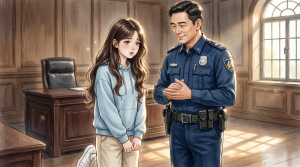
There it was. The question adults ask too, only children ask it cleaner.
“I don’t know,” I said. “But they did bad things. Very bad things. And when people do things that hurt children, we judge them by those choices.”
“Even if they made cookies?”
“Even then.”
“Even if they hugged me before?”
“Even then.”
She nodded and looked down at the fox.
“I don’t want cookies from people who lie.”
“Me neither.”
We moved that summer.
Not far. Across town, into a smaller house with blue siding, creaky floors, and a backyard big enough for a swing set. I could not afford it alone on leave, legal expenses, and the mess of divorce, but my parents helped with the down payment. So did a police benevolent fund I had contributed to for years and never imagined needing.
Leaving the old house hurt in strange ways.
I thought I would feel relief watching the movers carry out furniture Garrett had touched. Instead, grief came for ordinary objects. The kitchen table where Maya learned to write her name. The doorway where we measured her height in pencil marks. The bathtub where she once gave every toy animal a “spa day” and flooded the hallway.
Trauma steals places too.
On moving day, Maya stood in the empty living room staring at the wall where the family photo had hung.
“Do we have to remember this house?” she asked.
“No.”
“Can we remember just some things?”
“Yes.”
“Like when we made snowflakes and taped them to the windows?”
“We can keep that.”
“But not Daddy making pancakes?”
I swallowed.
“You get to decide later. You don’t have to decide today.”
She thought about that.
“Okay. Today I remember snowflakes.”
So that was what we carried.
Not the whole house.
Just paper snowflakes.
The trial preparation began in earnest in late summer. Garrett’s attorney pushed for a deal. The prosecution wanted cooperation against higher-level participants. Detective Warren called it strategy. I called it unbearable.
“He could get less time by talking?” I asked.
“He could get a guaranteed sentence by providing information that helps convict others,” she said. “It’s ugly, but it may protect more children.”
More children.
That phrase ended every argument.
Maya might not have to testify if Garrett accepted the plea and if the corroborating evidence remained strong. But the prosecution still prepared her gently, just in case.
Dr. Morrison used dolls, drawings, and courtroom pictures. She showed Maya where a judge sits. Where attorneys stand. Where she might sit if needed. She explained that telling the truth was not the same as being responsible for what adults did with it.
Maya listened seriously.
Then she asked, “Will Daddy see me?”
“Maybe,” Dr. Morrison said. “But not unless we decide it is safe and necessary.”
Maya looked at me.
I said, “You do not have to protect him.”
“I know.”
But she said it like she was practicing.
The plea came in September.
Garrett accepted thirty-five years in exchange for full cooperation, device passwords, financial routing information, and testimony against the others. He would have to admit in court that I did not know. That Maya was manipulated. That the family acted deliberately.
When Richard told me, I sat in my new kitchen while afternoon sun fell across unpacked boxes.
Thirty-five years.
Maya would be forty-two before he could even hope to walk free.
It was not enough.
It was also a lifetime.
“Do I have to forgive him if he says sorry?” Maya asked that night.
I did not ask who told her the apology might come. Children hear things through walls, through adult faces, through shifts in air.
“No,” I said.
“What if he really means it?”
“You still don’t have to.”
“What if God wants me to?”
We had not gone to church since the arrests. Claudia’s church connections were tangled through the investigation, and Maya could not sit near stained glass without shaking.
I chose my words carefully.
“I think any God worth listening to cares more about protecting hurt children than making them comfort the people who hurt them.”
Maya looked relieved.
“Okay.”
The day before Garrett’s sentencing, she asked to go.
Dr. Morrison advised against it at first. So did I. So did Linda. But Maya said something that changed the room.
“I want to see the door close on him.”
So we prepared.
No one promised closure. No one promised healing. But we built a plan: sit near the exit, leave anytime, headphones in her bag, Dr. Morrison present, James waiting outside the courtroom if I needed him.
That night, Maya slept badly.
So did I.
At dawn, while I ironed a black blouse I had not worn since my father’s funeral, my daughter came into the kitchen holding the stuffed fox.
“If I see him,” she said, “will he still look like Daddy?”
I turned off the iron.
The steam rose between us.
“Yes,” I said. “He might.”
Her face tightened.
“Then how will I remember he isn’t safe?”
I crossed the kitchen and knelt in front of her.
“By listening to your body. By holding my hand. By remembering that sometimes unsafe people look familiar.”
Maya nodded.
But when we walked into court hours later and Garrett turned toward us in an orange jumpsuit, I felt her hand go ice cold in mine.
And I knew the hardest door had not closed yet.
Part 6
Garrett looked smaller in jail clothes.
That was the first thing I hated myself for noticing.
Not worse. Not monstrous. Smaller.
His hair had gone gray at the temples. His shoulders rounded forward. He kept his hands folded in front of him on the defense table like a man trying to look sorry enough to survive what he had done.
Maya sat between me and Dr. Morrison. Her fingers threaded through mine. She did not cry. She did not look away. She watched him with a stillness that belonged to courtrooms, not children.
The judge read the charges in a voice without decoration.
Production and distribution of illegal child exploitation material.
Conspiracy.
Abuse of minors.
Digital trafficking across state lines.
Each phrase was a stone dropped into water. Ripples moved through the courtroom. Garrett’s attorney stared at his notes. The prosecutor, Caroline Voss, stood straight, hands clasped in front of her.
I did not look at Garrett until he turned around.
His eyes found Maya first.
Then me.
Once, that look would have meant something. At our wedding, at the hospital when Maya was born, over coffee in our kitchen when he said he loved the way I made the world feel safe.
Now it was just a face trying to borrow memory.
The judge asked whether he wished to speak.
Garrett stood.
For a few seconds, he said nothing. Then he turned enough for his voice to reach us.
“Maya,” he said.
My daughter’s hand tightened.
“I know I don’t deserve to say your name. I know I don’t deserve anything from you. What I did was evil. Your mother did not know. She never knew. We lied to you. I lied to you. You were good. You were always good. Nothing that happened was your fault.”
Maya trembled, but her eyes stayed open.
Garrett’s voice broke.
“I’m sorry.”
The words hung there.
Small. Late. Useless.
Dr. Morrison had warned me that apologies from abusers can be complicated. They can help victims if they validate truth. They can also reopen wounds if they ask for forgiveness.
Garrett did not ask.
That was the only decent choice he made in that room.
The judge sentenced him to thirty-five years.
No one gasped. No one shouted. Courtrooms are quieter than people imagine when lives end in public.
Maya leaned toward me and whispered, “Is that long?”
“Yes.”
“How long?”
“Until you’re grown. Long after.”
She nodded.
When deputies led Garrett away, he looked back once. I did not.
Maya did.
She watched until the side door closed behind him.
Then she exhaled so deeply her whole body seemed to shrink.
“The door closed,” she whispered.
“Yes.”
The others were sentenced over the next several months.
Raymond received forty-two years. Evidence showed he had been deeper in the operation than anyone first understood, and prior misconduct surfaced during the investigation. Quentin got thirty-five. Claudia got thirty.
Claudia’s sentencing was the hardest for me to attend.
I went without Maya.
I needed to see that woman in front of a judge. I needed my memory of her—floral blouses, bun, cinnamon cookies, criticism disguised as manners—to merge with the official truth.
She stood in a gray suit that did not fit as neatly as her old clothes had. Her hair was loose around her face. She looked older, but not weaker. Her eyes still held that hard little shine I had mistaken for standards.
When asked if she wished to speak, she said, “I loved my granddaughter.”
The prosecutor objected to nothing. The judge simply watched.
Claudia continued, “I made terrible choices. I let things happen in my home that should never have happened. But I was manipulated by men in my family, and I hope someday Nora understands—”
I stood.
Not dramatically. Not shouting.
Just stood.
The judge looked at me. “Ma’am?”
“I apologize, Your Honor,” I said. “I need to step out.”
Because if I stayed, I would have said something the courtroom did not need.
In the hallway, James was waiting.
He had attended every major hearing he could. Not as my partner officially. As my friend.
He handed me a bottle of water.
“She trying to rewrite it?” he asked.
“Yes.”
“Let her try. The sentence won’t care.”
He was right.
Thirty years.
Claudia cried when the judge delivered it.
I felt nothing.
That frightened me for a while.
Shouldn’t there have been satisfaction? Relief? Something bright and clean?
Instead, there was only a heavy quiet. Consequences did not heal Maya’s nightmares. Prison did not unmake the secret. Sentencing did not restore the years ahead of us to what they would have been.
It only stopped the people who hurt her from hurting her again.
That was enough.
It had to be.
When the final sentencing ended, the prosecutor thanked me for cooperation I had barely been allowed to provide. The FBI sent formal victim updates. Other families reached out through advocates, not directly, sharing grief from parallel rooms.
Some children were younger than Maya.
Some had been hurt longer.
Some had no parent who had believed them quickly.
That knowledge became another burden. Another reason to keep going.
I returned to work six months after the day on Oakmont Drive, but not to patrol.
The first time I tried to sit in a cruiser again, my body betrayed me. The radio crackled with a welfare check involving a child, and my hands went numb. I could smell Claudia’s furniture polish. I could see Maya in the hallway.
Linda found me in the locker room afterward.
“You’re not weak,” she said before I could speak.
I laughed once, bitterly. “That obvious?”
“You’re traumatized.”
“I’m supposed to handle trauma.”
“No. You’re trained to respond to emergencies. You are not trained to be immune to your own life.”
She offered me a transfer to the training division.
At first, it felt like defeat. A desk. Classrooms. Recruits who still believed procedure was something you memorized instead of something that held you together when your world caught fire.
Then I taught my first class on recognizing hidden abuse.
I stood in front of twenty-four recruits and looked at their young, earnest faces.
“Predators do not always look like strangers,” I said. “Sometimes they look like coaches, relatives, church volunteers, neighbors, spouses. Sometimes they smile at you across dinner tables. Your job is not to decide who seems nice. Your job is to see what is there.”
The room went still.
I did not tell them details. Those belonged to Maya. But I told them enough.
About the anonymous call.
About the nice neighborhood.
About the mistake I almost made because I recognized the address and wanted it not to be true.
About my partner stopping me from rushing in.
“Procedure is not red tape,” I said. “Sometimes it is the only thing standing between rage and justice.”
After class, a recruit lingered.
“What if it’s someone you know?” she asked. “How do you trust yourself?”
I thought of Claudia’s door. Garrett’s white face. Maya’s hand in mine in court.
“You don’t trust yourself alone,” I said. “You trust your training. You trust your partner. You document what you see, not what you wish were true.”
That night, when I came home, Maya was doing homework at the kitchen table. She looked up and smiled.
A real smile.
Not the old one exactly.
Something rebuilt.
“Good class?” she asked.
“Good enough.”
“Did you help them learn?”
“I hope so.”
She nodded like that mattered.
Then she said, “Maybe when I grow up, I’ll help kids too.”
My heart lifted and broke at once.
Before I could answer, the doorbell rang.
Maya froze.
So did I.
Through the security camera, I saw a woman standing on our porch with a sealed envelope in both hands.
I did not know her face.
But I knew the street name on the return label.
Oakmont Drive.
Part 7
I did not open the door right away.
That was progress.
The old me—the officer, the fixer, the woman who answered every knock because doors were meant to be opened—would have stepped onto the porch before thinking. The new me looked at the security screen first, checked the locks, and moved Maya behind me without making her feel like a burden.
“Go to the living room,” I said gently.
“Who is it?”
“I don’t know yet.”
“Is it them?”
“No.”
“Are you sure?”
“As sure as my whole life.”
She went, but slowly.
The woman on the porch was maybe in her seventies, with a raincoat buttoned to her throat and gray hair escaping from a knit hat. She held the envelope like it weighed more than paper. She did not ring again.
I opened the door with the chain on.
“Yes?”
Her eyes moved over my face.
“Officer Hale?”
That name hit me wrong.
I had gone back to my maiden name, Nora Reed, after the divorce finalized. Hearing Hale felt like finding a stain on clean clothes.
“Reed,” I said. “Nora Reed.”
“Oh.” She swallowed. “I’m sorry. I’m Ruth Bell. I lived two houses down from Claudia.”
Lived.
Past tense.
I looked at the envelope.
“I was the one who called.”
The world narrowed.
For nearly a year, the anonymous tipster had been a ghost in my mind. A voice without a body. A person who saved my daughter and disappeared because they thought recognition did not matter.
Now she stood on my porch with shaking hands.
I closed the door, removed the chain, and opened it fully.
“Come in.”
Ruth stepped into the entryway and immediately began crying.
Not loudly. Not for attention. Tears slipped down her cheeks as if they had been waiting behind her eyes for months.
“I’m sorry,” she said. “I told myself I wouldn’t do this.”
I guided her to the kitchen. Maya watched from the living room doorway, alert but not panicked. I gave Ruth tea because my hands needed something ordinary to do.
She sat at the table and stared at the mug.
“I should have called sooner,” she said.
I sat across from her.
“Tell me what happened.”
Ruth lived across from Claudia for twelve years. She had watched birthday decorations go up, delivery trucks come and go, relatives gather on weekends. She noticed more cars at the house about two years before the arrest. Not suspicious alone. Families gather. People host. Children play.
Then came the crying.
“At first I thought it was tantrums,” she said. “Children cry. I didn’t want to be nosy.”
Her hands tightened around the mug.
“But it was too often. And it stopped too suddenly sometimes.”
I understood what she meant.
Crying that stops naturally fades. Crying that is stopped has an edge.
She saw children leaving with their heads down. She saw curtains drawn on sunny afternoons. She once saw Raymond carrying a black equipment case into the house and thought perhaps they were doing family photography.
Then, on the day of the call, she saw Maya through a side window.
“I knew she belonged to Garrett,” Ruth said. “I’d seen her with him. She was standing in the hallway, and her face…” Ruth covered her mouth. “I saw the bruise.”
She called ten minutes later.
“Why didn’t you identify yourself?” I asked.
“I was afraid,” she said, ashamed. “Claudia knew everyone. Her husband knew people at the city office. Raymond had a temper. I thought if I was wrong…”
She looked up at me.
“But I wasn’t wrong.”
“No.”
“I’m so sorry I waited.”
For a moment, I saw what guilt had done to her. Not the performative guilt of my in-laws, not the kind that tried to bargain consequences down. Ruth’s guilt had made her smaller. Quieter. It had followed her across town after she moved away from Oakmont.
I thought of how many nights I had asked myself why I didn’t see sooner.
Maybe guilt visits everyone near evil, even those who finally act.
“You called,” I said. “That matters.”
“Not soon enough.”
“My daughter is alive because you called.”
Ruth cried harder.
Maya appeared beside me.
I turned, ready to send her back, but she looked calm. Careful, but calm.
“You’re the lady?” she asked.
Ruth wiped her face. “Yes, sweetheart.”
Maya studied her.
Then she said, “Thank you.”
Ruth made a sound like something inside her had come loose.
Maya stepped closer but did not hug her. She did not owe hugs to anyone. Instead, she placed one hand on the kitchen table.
“I was scared nobody would come,” Maya said.
“I’m sorry,” Ruth whispered.
“But you did.”
Ruth nodded.
“I did.”
That was all Maya needed. She returned to the living room, where a cartoon murmured softly from the television.
Ruth handed me the envelope before she left. Inside was a written statement, not for court—the trials were over—but for Maya someday if she wanted it.
It said what she saw. Why she called. That Maya was brave. That the children deserved to be believed. That the shame belonged only to the adults who harmed them.
I placed it in Maya’s file.
Not the evidence file.
The truth file.
There is a difference.
Two years passed in uneven steps.
Maya turned eight, then nine. She learned to ride a bike in the parking lot of an empty church that was not Claudia’s church. She chose a blue helmet with silver stars. The first time she rode ten feet without me holding the seat, she shouted, “Don’t let go!”
“I’m right here,” I called.
Then she looked back and realized I had already let go.
She did not fall.
That became a metaphor I kept private.
Healing was not one victory. It was a hundred ordinary returns. Grocery stores without panic. A school concert where cameras stayed far away from her. Sleepovers, eventually, but only at homes we knew well and after Dr. Morrison helped us create safety plans that did not make Maya feel broken.
She still had hard days.
Anniversaries were brutal. The Tuesday after the first warm spring rain sent her into silence for hours. The smell of cinnamon made her nauseous until we replaced the association by baking terrible cinnamon rolls together and throwing the first batch away because we both cried into the frosting.
We learned not to chase normal.
We built safe.

