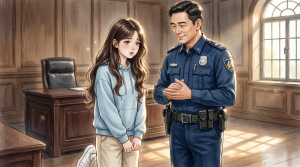
I’m A Police Officer I Responded To An Anonymous Tip About Child A.b.u.s.e At An Address
Part 1
The call came in at 2:47 on a Tuesday afternoon, right when the sun was turning the windshield into a sheet of white glare.
I remember the exact minute because I had just taken the first sip of coffee I had been carrying around since breakfast. It was cold, bitter, and tasted faintly like the paper cup. My partner, James Martinez, was driving, one hand on the wheel, the other tapping against his thigh in time with some old rock song playing low on the radio.
Dispatch crackled through.
“Unit Twelve, welfare check. Anonymous caller reports possible child endangerment at 4782 Oakmont Drive. Children heard crying for extended period. Caller reports visible bruising on at least one child through a window.”
James turned the music off.
I picked up the tablet and read the details again. “Caller refused to identify themselves. Said it’s been happening more than once.”
James’s jaw tightened. He had two boys at home, six and nine. Child calls changed his whole face. Mine too, though I had learned to hide it better.
“Address?” he asked.
“4782 Oakmont Drive.”
The name touched something in the back of my mind, but I was tired. We had just cleared a domestic dispute across town where a man threw a coffee mug through a kitchen window because his wife bought the wrong kind of ham. My thoughts were still full of broken glass, crying neighbors, and the sour smell of alcohol in a warm house.
“Oakmont is east side,” James said, already turning.
“Nice neighborhood.”
“Bad things own cars too.”
He was right.
I had been a police officer for almost eleven years. Long enough to stop believing evil had a preferred zip code. Long enough to know that some of the worst screams came from houses with hydrangeas, seasonal wreaths, and children’s bikes parked neatly by the garage.
Still, Oakmont Drive was quiet in the way money can buy. Wide lawns. Trimmed hedges. Two-story colonials with porch swings nobody used. Mailboxes shaped like little barns or birds or boats. A woman in yoga clothes walked a golden retriever past a house with a basketball hoop and an American flag.
Nothing looked wrong.
That was what made my stomach start to tighten.
James slowed as we approached the numbers.
“4768,” he said. “4774. Should be next one.”
Then I saw it.
Pale yellow siding. Dark green shutters. White porch columns. A decorative mailbox shaped like a birdhouse, painted blue and yellow. I knew that mailbox because my husband Garrett had installed it two summers before as a birthday gift for his mother.
My breath caught.
“Stop the car.”
James braked immediately. “What?”
“That’s Claudia’s house.”
“Who’s Claudia?”
“My mother-in-law.”
He looked from me to the house, then back again.
For one second, neither of us moved.
The patrol car idled beside the curb. The heater blew warm air against my knees. Across the street, a wind chime rang gently on someone’s porch. It all felt too ordinary for the way my pulse had started hammering.
“You’re sure?” James asked.
“I’ve eaten Christmas dinner there. Easter brunch. Maya’s birthday cake. I know that house.”
My daughter’s name moved through me like a warning bell.
Maya was seven. She was supposed to be at school. Second grade. Mrs. Peterson’s class. I had dropped her off that morning with a peanut butter sandwich, a library book about whales, and a loose front tooth she kept wiggling with her tongue.
Garrett was supposed to pick her up after school.
He had told me he had a client meeting later, but he would get her first. That was our Tuesday routine. I worked late. He handled pickup. Sometimes he stopped by Claudia’s for “just a quick visit” because his mother liked seeing Maya.
I had never liked how strict Claudia was with my daughter.
Sit properly. Speak clearly. Don’t interrupt. Don’t be dramatic.
But I had told myself it was generational.
That word would haunt me later.
“This has to be wrong,” I said. “Maybe dispatch got the number wrong.”
James checked the call log. “4782 Oakmont. That’s what we got.”
“Maybe a prank.”
“Maybe.”
But he did not sound convinced.
Protocol pushed in around us. A possible child endangerment call. An address tied to my family. My daughter possibly connected. My body wanted to run straight up the walkway and tear the house apart with my hands. My training told me to breathe.
“I should recuse,” I said, though the words scraped my throat.
“If we call another unit, we lose time.” James looked at the house. “I’ll take lead. You stay behind me. You know how this works.”
I nodded.
But knowing how something works and surviving it are different things.
We walked up the path side by side. Claudia’s garden gnomes grinned from the flower beds, red hats dusted with pollen. The porch smelled like lemon cleaner and winter boxwood. A decorative sign beside the door read bless this home.
James knocked hard.
“Police. We need to speak with the homeowner.”
Footsteps moved inside.
My hand rested near my belt. Not on my weapon. Near it.
The door opened.
Claudia stood there in a floral blouse and khaki pants, silver hair twisted into its usual perfect bun. She was the kind of woman who wrote thank-you notes within twenty-four hours and corrected restaurant servers for saying “no problem” instead of “you’re welcome.”
When she saw me, the color left her face.
Not surprise.
Fear.
Then she looked at James and said, “Officer, what is this about?”
Officer.
Not Nora.
Not What are you doing here?
She pretended not to know me.
A cold line moved down my spine.
James kept his tone neutral. “We received a call about possible child welfare concerns at this address. We need to come inside and make sure everyone is safe.”
Claudia gripped the doorframe. “There must be some mistake. I’m here alone.”
Then I saw movement behind her.
A small shape near the hallway.
Pink shirt. White daisies. Dark hair falling loose from a ponytail.
My heart stopped.
“Maya?”
The child stepped into view.
My daughter stood in the foyer of my mother-in-law’s house with a purple-black bruise swelling across one cheek, tears cutting clean tracks through dirt on her face, and one arm held stiffly against her body.
For a second, the whole world narrowed to her mouth forming one broken word.
“Mommy.”
I lunged.
James grabbed my arm so hard it hurt.
“Don’t,” he hissed. “We do this right.”
Through the front window beyond Claudia’s shoulder, I saw people in the living room. Garrett’s brother Raymond. His wife Miranda. Garrett’s father. Several children I did not recognize.
And behind them, half-hidden by the couch, stood a camera on a tripod pointed at the center of the room.
James’s voice dropped to a whisper.
“Call backup now.”
Then I looked again and saw the laptop, the lights, the frightened children, and the careful setup of something far worse than a family secret.
Part 2
My fingers did not want to work.
That is the part I remember with a strange kind of shame. I was trained for this. I had drawn my weapon in alleys, talked down armed men, carried bleeding strangers out of wrecked cars. I knew radio codes better than my own childhood phone number.
But with my daughter standing bruised in the foyer, my hand trembled so hard I missed the button on my shoulder mic the first time.
James did not let go of my arm.
That grip kept me human.
“Breathe,” he whispered.
Claudia tried to pull the door inward. James shifted his boot into the gap before she could close it.
“Ma’am,” he said, voice sharp now, “do not shut this door.”
“This is private property.”
“This is an active welfare check involving children in possible danger.”
“You have no right—”
“I have every right to secure a child in immediate risk.”
Maya looked at me from behind Claudia, eyes huge, one cheek swelling, lips trembling. She did not run to me. That told me more than any statement could have.
She was afraid of what would happen if she moved.
I forced myself to turn slightly away and keyed my radio.
“Dispatch, Unit Twelve. Immediate backup needed at 4782 Oakmont Drive. Multiple children present. Possible child exploitation scene. Request supervisor, CPS, medical, and additional units. Expedite.”
The dispatcher acknowledged. Her voice stayed professional, but I heard the change underneath.
James spoke again. “Claudia, step aside.”
Her eyes flashed toward me. “Nora, this is not what you think.”
The use of my name hit wrong.
She had pretended not to know me when she thought she could control the doorway. Now she wanted family.
“What is it, then?” I asked.
Her mouth opened.
No answer came fast enough.
Through the window, movement sharpened inside. Raymond stood from the couch. Miranda reached toward one of the children. Garrett’s father, Quentin, moved toward the coffee table where the laptop sat open.
“Hands visible!” James shouted. His hand went to his weapon. “Everyone away from the electronics!”
The living room froze for half a second, then broke into panic.
That was all the confirmation I needed.
James pushed the door wider. Claudia stumbled backward, protesting.
I stepped in behind him, training dragging me through the worst moment of my life.
The house smelled like furniture polish, stale coffee, and something warm from the oven. Cinnamon maybe. Claudia had always baked when family came over. I used to think it meant comfort.
Now the smell made me nauseous.
“Police!” James shouted. “Nobody moves. Hands where I can see them.”
Two officers came through the doorway behind us, then another. Boots hit hardwood. Radios crackled. The quiet suburban house cracked open into commands and motion.
I kept my eyes on Maya.
She stood near the hallway, clutching a teddy bear I had never seen before. Her shoulders were hunched like she was trying to make her body smaller. Her right wrist was angled wrong, swollen beneath the cuff of her sleeve.
“Baby,” I said, keeping my voice low. “Come to me.”
Maya glanced at Claudia.
That glance nearly broke me.
Claudia moved one hand toward her. “Maya, stay where you are.”
My weapon came up before thought finished forming.
“Do not touch my child.”
Claudia froze.
Her face twisted. “You’re making a terrible mistake. Garrett will explain.”
Garrett.
The name entered the room like smoke.
I could not think about him yet. If I did, I would lose the thin line of control James had helped me hold.
“Maya,” I said again. “Walk to me. Eyes on me.”
She took one step.
Then another.
Nobody moved.
Her small sneakers made faint squeaks on the polished floor. Ten feet. Seven. Five.
When she reached me, she grabbed my uniform and collapsed against my legs.
“Mommy, I tried to be good,” she sobbed. “They said you knew.”
The room tilted.
“What?”
“They said you knew. Daddy said you knew.”
For one second, all the commands, all the radios, all the bodies in the room faded behind those words.
Daddy said you knew.
James looked at me, and I saw his face harden in a way I had never seen before.
“Get her out,” he said. “Now.”
Another officer, Sarah Thompson, moved toward the other children. She crouched with palms open, voice soft.
“Hi, sweetheart. I’m Officer Sarah. We’re here to help. Nobody is in trouble.”
The children did not move.
They had the hollow, watchful stillness I recognized from too many cases. Children who had learned that adults could use soft voices before doing terrible things.
I scooped Maya up. She cried out when I touched her arm.
“Sorry, baby. I’m sorry.”
Outside, the afternoon sunlight seemed obscene.
The street had changed in minutes. Patrol cars blocked the curb. Neighbors stood on lawns in slippers and cardigans. An ambulance turned onto Oakmont with lights flashing but no siren. A CPS van followed.
Maya buried her face in my shoulder.
“Don’t let them take me back.”
“They won’t.”
“Promise?”
“I promise.”
I said it like I had authority over the universe.
A paramedic named Joyce hurried over. I knew her from accident scenes. She was older, calm, with gray hair tucked under a knit cap.
“Nora,” she said quietly. “Let me look at her.”
Maya screamed when I tried to set her down.
“No! Please, Mommy!”
“I’m not leaving,” I said. “I’m right here.”
It took five minutes to get her onto the gurney. Joyce spoke gently the whole time. She checked Maya’s eyes, her wrist, the bruise on her cheek, the marks visible where her shirt had slipped at the collar.
I stood beside them and felt each observation enter me like a blade.
“Likely fracture,” Joyce murmured. “Possible concussion. We need Children’s.”
“I’m riding with her.”
“Of course.”
Then a dark sedan pulled into Claudia’s driveway.
Garrett.
My husband stepped out wearing his navy work suit, tie loosened, briefcase in hand. For a second, he looked confused enough to be innocent. Then his eyes moved from the police cars to his mother in handcuffs, to the ambulance, to me.
Something shifted in his face.
Not shock.
Calculation.
“Where’s Maya?” he demanded, starting toward us.
Two officers blocked him.
“That’s my daughter,” he snapped. “Nora, what is going on?”
Maya lifted her head from the gurney.
Her face crumpled when she saw him.
“Daddy,” she whispered, “I told. I’m sorry.”
Garrett went white.
I saw it. So did James.
The apology of an abused child is not ordinary fear. It is confession shaped by someone else’s lies.
Maya looked at me, desperate. “Daddy said I was helping. He said you knew, Mommy. He said it was our special family secret.”
Everything inside me went still.
Not calm.
Still.
Like water freezing solid in one instant.
Garrett opened his mouth. “Nora—”
James stepped in front of him. “Garrett Hale, you’re coming with us.”
“For what?”
“For questioning.”
“I just got here!”
But his eyes had already betrayed him.
The ambulance doors closed between us, cutting off his voice, his family, the house, the neighbors, the entire life I had believed I lived.
As the ambulance pulled away, Maya clutched my hand with desperate strength.
“Am I bad?” she whispered.
I looked down at my child, bruised and shaking under a white blanket, and understood that my husband had not only hurt her.
He had made her believe I helped.
Part 3
Children’s Hospital had a hallway painted with jungle animals.
A smiling monkey swung from a vine near the nurses’ station. A giraffe stretched up one wall beside the elevator. Bright parrots flew over doorways. Someone had designed it to make terrified children feel less terrified.
That afternoon, the cheerful animals watched my daughter arrive on a gurney with a fractured wrist, a swollen cheek, and eyes that would not stop searching every room for exits.
I stayed beside her through everything.
X-rays. Blood pressure. Neurological checks. Photographs of injuries. A full exam by a pediatric specialist trained to document abuse without causing more harm. Every time someone new entered, Maya grabbed my sleeve.
“Is this person okay?” she whispered.
“Yes.”
“Do they know Daddy?”
“No.”
“Do they know Grandma?”
“No.”
Only then would she let them come closer.
The doctor was named Dr. Levin, a woman with warm brown eyes and a voice careful enough to hurt. She explained each step to Maya before doing it.
“I’m going to look at your arm now.”
“I need to take a picture of this bruise because it helps us tell the truth about what happened.”
“You can say stop if you need a break.”
Maya said stop often.
Every time, Dr. Levin stopped.
That mattered.