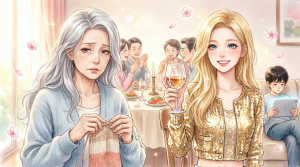
Still, I followed her into a room with a big table and about ten other people my age or older. Some couples. Some alone. One man in a wheelchair with a baseball cap pulled low.
Carla smiled at all of us. “We like to start with a simple question,” she said. “What brought you here today?”
I braced myself for the usual polite answers.
“Looking to downsize.”
“Curious.”
“My kids thought it would be a good idea.”
I wasn’t ready for how honest they were.
“My daughter lives three states away,” one woman with a braided bun said. “I don’t want her getting a call one day that I’ve fallen and nobody noticed for three days.”
A man with kind eyes cleared his throat. “My wife died two years ago. I’ve tried to make friends at the senior center, but I feel like a visitor in my own life. I want… neighbors. People who know if my porch light stays off too long.”
A woman in a denim jacket laughed softly, but there was no joy in it. “I raised my kids. Then I raised my grandkids. My body finally said no. I don’t want the next chapter of my life to be just an afterthought in someone else’s emergency plan.”
Heads nodded.
No one seemed shocked.
Those words sank into me like stones into a pond.
Then it was my turn.
I could have kept it vague.
“I’m just looking.”
“I’m exploring options.”
Instead, I heard myself say, “I retired as a nurse, and then I started working again without a paycheck.”
A couple of people glanced at me.
I continued, “I’ve been raising my grandsons while their parents chase jobs and bills. I love them. But I walked out of my grandson’s birthday party two weeks ago because I realized that in my family, love and free labor had gotten tangled up. And then the whole thing went online, and now I’m the villain or the hero depending on who you ask.”
I expected awkward silence.
Instead, someone said softly, “Oh, you’re her.”
Another woman added, “I read something like that. About ‘the grandma who quit.’ I didn’t know it was real.”
I huffed out a breath. “Trust me. It’s very real.”
Carla didn’t look alarmed.
She looked… compassionate.
“You don’t have to be anything here,” she said. “Not the hero. Not the villain. Just… a person who’s tired.”
That almost undid me.
Because under all the anger and online commentary and careful speeches, that’s what I was.
Tired.
Too tired to be everyone’s village without having a village of my own.
After the circle, Carla gave us a tour.
There was a shared kitchen with big pots hanging from hooks and a long table scarred with knife marks and coffee rings.
A laundry room with a sign-up sheet.
A small library with sagging shelves and a puzzle in progress on a card table.
We passed a bulletin board covered in handwritten notes.
“Tuesday: Soup Night. Bring a bowl, not a dish.”
“Need help changing a lightbulb in 3B. Knees not what they used to be.”
“Looking for someone to teach me how to use video chat so my grandson stops saying I’m ‘lagging in real life.’ Cookies offered as payment.”
I read that last one twice.
Because for the first time in a long time, the kind of “help” being asked for didn’t feel like a one-way street.
It felt… shared.
Mutual.
We stepped out into the community garden.
Raised beds, some tidy, some wild.
A few people in hats, weeding and gossiping.
A woman with dark skin and a floral scarf tied over her hair waved a trowel at me.
“You new?” she called.
“Just visiting,” I said.
She shook her head. “That’s what they all say. I’m Maryam.”
I walked over.
She handed me a pair of gloves without asking if I wanted them.
“Here. Grab a side of this stubborn thing,” she said, pointing at a weed with a root system like a secret.
We tugged together.
It came out with a satisfying pop.
“There,” she said. “Proof life still lets go if you pull evenly.”
I smiled. “How long have you lived here?”
“Two years,” she said. “Moved in after my third grandchild’s arrival. My daughter cried. Thought I was abandoning her.”
I swallowed. “Did you?”
“Abandon her?” She shook her head. “No. I just stopped letting her abandon herself.”
She stuck the weed into a bucket, wiped her forehead. “I raised four kids on one income,” she said. “Then I found myself raising my son’s kids when his marriage fell apart. One day I looked at my hands and realized they’d never stopped working for other people. I wanted to see what they felt like when they were just… mine.”
I looked down at my own hands.
The same hands that had delivered babies, held dying patients, tied little sneakers, scrubbed toilets that weren’t mine, knitted blankets that were called boring.
“They still come?” I asked. “Your kids. Your grandkids.”
“Oh yes,” she said. “Sometimes too much.” She laughed. “But it’s different. They come here. To my space. To my life. I’m not just background in theirs anymore.”
A lump rose in my throat.
Before I could answer, a small voice carried across the garden.
“Grandma!”
I turned.
Noah was barreling down the path, Liam right behind him, with Jessica and Mark walking more slowly, taking everything in like they weren’t sure they’d entered the right story.
I blinked. “What are you doing here?”
Jessica lifted a hand, a little sheepish. “We asked for the address,” she said. “We wanted to… see. If that’s okay.”
It was more than okay.
It was terrifying.
The boys skidded to a stop in front of me.
Noah looked around, eyes wide. “This is like… a tiny town,” he said. “Do you get your own house?”
“An apartment,” Carla said, appearing behind me with her ever-present clipboard. “But it feels like a house when you shut the door.”
Liam tugged my sleeve. “Is there a game room?” he whispered.
Carla grinned. “We have a common room with board games and a very opinionated Scrabble club. That count?”
He nodded solemnly.
Jessica scanned the garden, the walking aids, the gray hair, the shared spaces.
“This isn’t… a nursing home,” she said slowly.
“No,” I replied. “It’s what happens when people your age realize they don’t have a plan and people my age get tired of pretending that’s okay.”
She winced, but she didn’t argue.
Instead, she asked, “Can we… walk with you?”
So we did.
We walked the path together.
I watched my grandsons peer into the library, poke their heads into the common kitchen, wave awkwardly at older residents who waved back like they’d been waiting for them.
Mark touched the bulletin board notes. “This is… kind of brilliant,” he admitted. “Everyone asking for help. Everyone helping.”
I shrugged. “Radical concept, isn’t it?”
We ended up back in the garden.
Maryam had set aside a little patch of soil.
“Here,” she said, thrusting a small tomato plant into Noah’s hands. “Every new maybe-resident plants something. If you move in, you’ll see it grow. If you don’t, we’ll still eat it. That way we’re connected, either way.”
Liam clapped. “Can I help?”
“Of course,” she said. “Two workers, one plant, perfect ratio.”
We knelt together.
The boys dug, their small fingers scooping out the earth.
I pressed the plant in, covering the roots gently.
Noah patted the soil, serious. “What if you don’t move here?” he asked.
“Then this plant will still exist,” I said. “And you’ll know there’s a spot in the world where something is growing because we were here one morning.”
Jessica watched us, eyes shiny.
“It feels like…” She hesitated.
“Like letting go and holding on at the same time?” I offered.
She nodded.
Before we could say more, Mark’s phone buzzed.
He glanced at the screen, frowned.
“Sorry,” he murmured, stepping aside.
I turned back to the boys.
“Want to see the library?” I asked.
They nodded enthusiastically.
We were halfway to the door when I heard Mark say, “Mom? Calm down. Slow down. What happened?”
Something in his voice made my stomach drop.
I turned.
His face had gone pale.
“When?” he whispered into the phone. “Is she okay? Is she—”
A cold dread slithered into my chest.
He met my eyes.
“It’s my mom,” he said. “She collapsed in the lobby of her condo. The paramedics took her to the hospital.”
Sharon.
Gigi.
The woman with the tablets and the cruise brochures and the unlimited screens.
Liam burst into tears. “Is she gonna die?”
Mark knelt in front of him. “We don’t know yet,” he said honestly. “They said she’s awake. That’s good. But we need to go.”
Noah clenched his jaw, eyes wet. “Can we see her?”
“If they let us,” Jessica said, voice shaking.
Mark looked at me.
“Come,” he said. “Please.”
There was no decision to make.
Boundaries don’t mean you stop showing up when someone is lying in a hospital bed.
Boundaries mean you don’t carry everyone there on your back.
“I’ll drive behind you,” I said. “We don’t all need to pile into one car.”
On the way out, I caught Maryam’s eye.
She gave me a knowing nod.
“Go,” she said. “We’ll water your tomato.”
Hospitals smell the same no matter how they’re decorated.
Antiseptic, fear, stale coffee.
The emergency department was crowded.
We checked in at the desk.
“We’re here for Sharon Malone,” Mark said, his voice too loud.
The nurse on duty, a man with tired eyes and a badge that said “Luis,” nodded.
“She’s stable,” he said. “They think it’s a mild stroke. She’s asking for you.”
Liam gripped my hand so tightly my fingers ached.
We followed Luis down a corridor lined with curtained bays.
Machines beeped.
Voices drifted in and out—TVs, monitors, muffled sobs, the rustle of curtains.
When we reached Sharon’s room, I had a flash of her in that white linen suit at the birthday party, perfume and laughter filling the doorway.
Now, she lay on a narrow bed in a hospital gown, her hair flattened, face slack in a way I had never seen.
One side of her mouth drooped slightly.
Her right hand curled on the blanket like it was trying to remember how fingers worked.
For a moment, I didn’t see “Gigi.”
I saw a woman my age who had spent her retirement learning pickleball tournaments and learning how to pose for cruise photos while quietly ignoring the way her heart labored in the background.
“Mom,” Mark said, voice thick.
Her eyes flicked toward him.
Her speech was slurred, but her humor was intact.
“Don’t… sound… like I died,” she mumbled. “Not… yet.”
Liam sobbed.
Noah stepped closer to the bed, gripping the rail.
“Hi, Gigi,” he whispered.
She turned her head slightly, taking in the boys, then Jessica, then finally me.
A flicker of something crossed her face—guilt? Shame? Fear?
“Hey, Sharon,” I said softly. “Quite a way to get attention.”
Her good eyebrow twitched.
“You… got… online,” she slurred. “I had… to… upstage you.”
It was such a Sharon thing to say that I laughed.
The sound came out half-sob.
Mark swallowed. “They said you were lucky,” he said. “A neighbor found you fast. If you’d been alone in your condo—”
“I was… alone,” she said. “Lots of… alone.”
Her eyes filled.
It was the first time I’d ever seen her look small.
Not glamorous.
Not performative.
Just… human.
Jessica wiped her cheek. “You could have asked for help,” she whispered. “You didn’t even tell us you weren’t feeling well.”
Sharon’s eyes flashed with the old pride.
“Didn’t want to be… a burden,” she muttered.
Something in me snapped again.
Not in anger this time.
In recognition.
We were all afraid of the same thing, weren’t we?
Being a burden.
Being an appliance.
Being the person everyone resents needing.
I stepped closer.
“Sharon,” I said, “you showed up twice a year with gifts and jokes. You let us do the messy work and took the fun parts. But you’re not a burden now. You’re just… a woman who wanted to be loved without being needed for anything hard.”
Her eyes met mine.
For once, she didn’t roll them.
A tear slid down her temple.
“I was… jealous,” she forced out. “Of you. They had you every day. They look… at you like… like you’re theirs. I thought if I… bought the right things… I could… catch up.”
My breath caught.
“You were jealous of me?” I whispered.
Her good hand flexed weakly. “You had… the lifetime. I had… the highlights.”
The room went quiet.
No monitors beeping, no hallway noise.
Just the sound of two old women finally telling the truth.
“I was jealous of you,” I admitted, my voice shaking. “You kept your freedom. Your time. Your energy. You weren’t the one plunged into their sick days and tantrums. You got to be the hero. I got to be the infrastructure.”
We stared at each other across the thin hospital blanket.
Two sides of the same coin, finally seeing the tarnish.
“I think we both lost,” I said softly.
She sniffed. “Maybe… we can… both win?”
Noah sniffled. “How?”
Sharon’s smile was crooked now, but it was real.
“By… not… pretending your grandma is… magic,” she said. “Either of us.”
I swallowed past the lump in my throat.
Mark cleared his throat. “They want to keep Mom here a few days,” he said. “Then probably rehab. Then… we’ll figure out what’s next.”
Sharon rolled her eyes. “I am not… moving into… a sad room… with bingo.”
“You might move into a not-sad place with a garden and cranky neighbors,” I said.
She blinked. “Maple… Court?”
I stared. “You know it?”
She gave a weird little shrug. “I looked it up,” she slurred. “After the article. Thought… maybe… people like us… live there. Didn’t want to admit it.”
I shook my head, half amazed, half unsurprised.
Of course she’d looked.
Of course she’d pretended she hadn’t.
“We’re not dead yet,” I said. “We can rewrite some things.”
The boys edged closer.
Liam reached up carefully and touched Sharon’s hand.
“Gigi,” he said, voice wobbling, “you scared us.”
She squeezed his fingers weakly. “Scared… myself… too.”
Noah leaned into me.
I put an arm around him.
We stood there—a messy, flawed, frightened family—staring at one of its pillars and seeing, for the first time, the cracks that had always been there.
The weeks after the stroke were a blur of rehab appointments, school counselor meetings, therapy sessions, co-housing tours, and very tired adults trying to fake confidence for small eyes.
Sharon moved into a short-term rehab facility.
She hated the food.
She flirted with the physical therapist.
She made friends with the woman in the next bed.
Classic Sharon.
I visited her with the boys on Tuesdays.
On Thursdays, I went back to Maple Court.
Sometimes with Jessica.
Sometimes alone.
Sometimes, on brave days, with a small box of my things—photos, books, the mug I like best—to see how they looked on the shelves of a demo unit.
I didn’t say yes immediately.
I swung back and forth between desire and dread.
If I moved, was I abandoning my family?
If I didn’t, was I abandoning myself?
One evening, I sat at my kitchen table with a legal pad.
On one side, I wrote:
“Reasons to stay exactly where I am.”
On the other:
“Reasons to move.”
Under “stay,” I wrote:
- Familiar.
- Close to kids.
- Fear. (I circled that one.)
Under “move,” I wrote:
- People my age.
- Shared responsibilities.
- Safety.
- My own life.
Then I added one more:
- To show my grandsons what boundaries look like in real time, not just in speeches.
The next day, I called Carla.
“I’d like to put down a deposit,” I said.
She didn’t cheer.
She didn’t make it dramatic.
She just said, “Welcome home, Eleanor.”
Moving out of a house is like opening a time capsule you forgot you buried.
I found the tiny shoes Jessica wore home from the hospital.
Old birthday cards.
Notes from patients’ families.
The crayon drawing Noah did when he was three that said “GRAMA EL BEST CHEF” in letters that looked like they’d been blown in by the wind.
Jessica and Mark helped sort.
The boys helped pack.
“What’s this?” Liam asked, holding up a photo of me at 30, in my nurse’s uniform, hair dark, eyes tired but burning.
“That’s your grandma when she still thought she could fix the world by herself,” I said.
Noah smirked. “She’s still trying.”
“Not as much,” I replied. “Now she knows the world has to meet her halfway.”
We stacked boxes labeled “Keep,” “Donate,” “Maybe.”
I kept less than I thought I would.
It was strangely freeing.
One afternoon, as we were packing up my bedroom, Noah climbed onto the bed with the knitted blanket in his arms.
“The counselor asked me to write about something that makes me feel safe,” he said. “I wrote about this.”
My eyes stung.
“You can keep it at your house,” I said.
He shook his head. “No. I want it on your bed,” he said firmly. “So when I sleep over, it smells like you. And so you remember…”
He trailed off.
“Remember what?” I asked.
“That we see you now,” he said quietly.
For a moment, the air left the room.
I sat down next to him.
“Come here,” I whispered.
He crawled into my arms, bigger now but still willing, and I held him like I did when fevers spiked and bad dreams stalked him.
Only this time, the monster under the bed was the fear of being forgotten.
Move-in day at Maple Court was chaotic and sacred in equal measure.
Diane showed up with a tray of lasagna.
Maryam brought a potted basil plant.
Carla handed me a packet of information about shared chores and community nights.
Jessica and Mark carried boxes up the stairs.
The boys argued over who got to decide where my books went.
Sharon wasn’t there in person.
But she’d insisted on sending something from rehab.
A small box, labeled in shaky handwriting: “For Eleanor’s New Life.”
Inside was a framed photo from Noah’s ninth birthday.
Not the part where I walked out.
The moment before.
The moment I’d missed because I was fussing with plates and napkins.
Noah, eyes squeezed shut, cheeks puffed, about to blow out the candles.
Liam, leaning in, his face pure delight.
Behind them, slightly blurred, Sharon and I stood on either side, both leaning toward the boys, both smiling.
I stared at it longer than I meant to.
We looked like… a team.
We hadn’t been one then.
But maybe we could be something like it now.
On the back of the frame, in her uneven, post-stroke handwriting, Sharon had written:
“We were both there, even when we didn’t see each other. Maybe we can do better with the time we have left. — S.”
Tears blurred my vision.
Older people cry differently than kids.
It’s not loud.
It’s quiet.
Like water seeping through a crack that’s been there a long time.
I put the photo on the shelf across from my bed, next to the knitted blanket Noah had carefully spread out.
Liam placed the basil plant on the windowsill.
“It’s small,” he said, “but it smells big.”
Jessica stood in the doorway, taking in the room—my bed, my chair, my corner bookshelf, my lamp with the warm light.
“It looks like you,” she said softly.
“Better than looking like a storage closet for everyone else’s life,” I replied.
She swallowed. “I’m… proud of you,” she whispered. “I don’t know if I could do this.”
“Yes, you could,” I said. “You’ve done harder things. You just haven’t done this one yet.”
She stepped forward and hugged me.
This time, I didn’t pat her back like I was soothing a child.
I held her like she was my equal.
Because she is.
Because she had chosen to grow instead of clinging.
Mark popped his head in. “The boys want to know if they can see the game room,” he said.
“Go ahead,” I told them. “But remember, the Scrabble club is ruthless.”
They ran off.
Jessica wiped her eyes. “What about… helping with the boys?” she asked. “We said two mornings. That offer is still there. No pressure.”
I thought of my doctor.
Rest as medicine, not as a reward.
“I’ll take one morning,” I said. “Fridays. That way you can breathe at the end of the week. And I’ll pick them up from school one day every other week, not because you’re drowning, but because I want to hear about their day when it’s fresh.”
She nodded, relief and respect mingling in her expression.
“And if you need more?” I added, “Ask early. Not at the edge of collapse. And remember I can say no.”
She met my eyes. “I know,” she said. “I really do know that now.”
We heard a cheer from down the hall.
“Noah just beat someone at checkers,” Mark said, smiling. “An eighty-year-old man named Pete is demanding a rematch.”
“Perfect,” I said. “Let him learn that old people can still surprise him.”
A week after I moved in, I wrote one last post.
Not to start a fight.
Not to win the internet.
Just to close the loop.
I opened the neighborhood app, clicked into the same space where the first storm had started, and typed:
“Update from the Grandma.
Some of you might remember a post about a grandmother who ‘quit’ helping with her grandkids.
That was me.
Since then, a lot has happened. There were tears. Fights. Counselor visits. A mild stroke in the family that reminded us everyone we rely on is mortal, including the ‘fun’ grandparents.
I moved into a co-living community for older adults. My daughter and son-in-law cut back on the kids’ activities and got on a waitlist for after-school care. They hired a sitter two afternoons a week. I watch the boys one morning because I want to, not because I’m the only option.
My grandsons have seen me say no and then still show up at the hospital, at school, at the game room down the hall from my new apartment. They’ve seen me plant a tomato plant just for me. They’ve helped me do it.
We are not a fairy-tale ending. We are a work in progress.
But here is what I’ve learned at 64:
You don’t teach your children and grandchildren to respect you by giving until you collapse. You teach them by loving them fiercely and letting them see your limits.
You can say, ‘I love you’ and ‘I can’t do that’ in the same breath.
You can leave a room to protect your heart and still come back to the table when people are ready to treat it gently.
And sometimes, the most loving thing an older person can do for their family is to show them what it looks like to build a life that doesn’t disappear when they’re not needed.
If you’re the exhausted grandparent reading this: your worth is not measured in miles driven or meals cooked.
If you’re the overwhelmed parent reading this: your parents are not your childcare plan. Ask for help from systems, not just people whose bodies are already paying the price.
We only get so many years where our hands still work, where our legs still move us to pickleball courts and gardens and libraries.
I have decided to spend mine as a person, not a resource.
And my family, slowly and imperfectly, is learning how to love me that way too.
— Eleanor (formerly known as ‘Everyday Grandma’).”
I hovered over “Post” for a second.
Then I clicked.
This time, when the responses started rolling in, I didn’t obsess over every one.
I read a few.
I saw an older woman say, “I thought I was the only one who felt this way.”
I saw a young dad write, “Calling my mom today. Not to ask for help. Just to say thank you.”
I saw someone else simply comment, “I hope I’m as brave at 64 as you are.”
Brave.
The word didn’t quite fit.
I didn’t feel brave.
I felt… honest.
Finally.
That night, back in my little apartment, I made myself a cup of tea.
I sat in my chair by the window, the city lights flickering beyond the glass.
The basil plant smelled sharp and green.
The tomato plant in the garden below waited for morning.
On my bed, the knitted blanket was slightly rumpled from where Liam had flopped on it during his first official sleepover at “Grandma’s new place.”
My phone buzzed.
A photo from Jessica.
The boys asleep in their own beds at home, the blanket’s twin—another I’d started knitting years ago and never finished until now—pulled up to their chins.
Text beneath it:
“Love you, Mom. Thanks for teaching us that the village has a heart too.”
Another message arrived a second later.
From an unknown number that I knew anyway.
Sharon.
“PT says I walked 20 steps today without the cane. Told him I’m training to beat you at pickleball in your fancy new village. Don’t get too comfortable.”
I laughed aloud.
Old women threatening each other with low-impact sports.
What a gift.
My eyes filled, but I didn’t wipe them away.
Tears at this age aren’t a weakness.
They’re proof we’re still open.
Still feeling.
Still here.
I looked around my small, warm space.
My books.
My photos.
The slice of cake plate I’d kept from Noah’s party, now holding my keys.
The sound of my neighbor’s TV through the wall.
The distant echo of children’s laughter from the common room where someone’s grandkids were visiting, probably being crushed at checkers by a retired engineer.
I thought of all the older women reading some version of my story, wondering if it was too late to ask for more than survival.
I wished I could sit with each of them at a worn kitchen table, take their hands, and say what I had finally learned to say to myself:
You are not done yet.
Your story does not end with being useful.
It ends—with any luck—with being you.
Loved.
Seen.
Respected.
Even when you’re not cutting the cake.
I turned off the lamp.
The room settled into soft darkness.
For years, I had been the last one awake in someone else’s house, checking locks, folding laundry, rinsing plates, making sure everyone was safe before I allowed myself to lie down.
Now, as I slid under the blanket I’d made with my own hands, I realized something simple and profound:
For the first time in a very long time, I was not the last one to go to bed because everyone else needed me.
I was just a woman in a small room, in a building full of people who had carried too much and were learning to carry differently.
I closed my eyes.
In the quiet, I could almost hear it—the sound of the village breathing.
Not because it was working.
Because it was finally resting.
Thank you so much for reading this story!
I’d really love to hear your comments and thoughts about this story — your feedback is truly valuable and helps us a lot.
Please leave a comment and share this Facebook post to support the author. Every reaction and review makes a big difference!
This story is a work of fiction created for entertainment and inspirational purposes. While it may draw on real-world themes, all characters, names, and events are imagined. Any resemblance to actual people or situations is purely coincidenta

