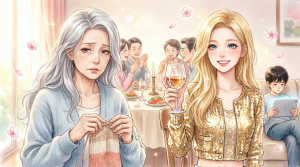
She gestured to the women around the court—women my age, older, some with gray hair, some with bright sneakers and tired smiles.
“They call it ‘help,’” Diane said, “but they treat it like an entitlement.”
A woman nearby overheard and chimed in without missing a beat. “My daughter told me I was ‘ruining her life’ because I wouldn’t babysit during my chemo week.”
Another woman said, “My son called me ‘dramatic’ because I asked for one weekend a month to myself.”
Someone else laughed, bitter and familiar. “My favorite is when they say, ‘It takes a village,’ but they only want the village when it’s convenient.”
I stood there, stunned.
Because I thought I was alone.
I thought I was uniquely failing at being the kind of grandmother everyone expects—a woman who says yes until she dies.
But here they were.
A whole room of “villages” learning they were allowed to be people.
Diane handed me a paddle. “You playing?”
I hesitated. “I’m rusty.”
Diane grinned. “So is everyone. That’s the point.”
I stepped onto the court.
The first serve sailed too high.
The ball smacked the floor behind me.
I laughed—an actual laugh, not the kind that’s a shield.
Diane winked. “See? You’re alive.”
And for an hour, I was.
I ran.
I swung.
I missed.
I cheered when I hit something right.
I felt my heart pound for me, not for someone else’s schedule.
When I got back to my car, my phone had seventeen missed calls.
Jessica.
Mark.
Jessica again.
And one voicemail from the school.
My stomach tightened, but I pressed play.
A calm administrative voice: “Hello, this is the school office. Liam is feeling unwell and would like to go home. Please call us back.”
There it was.
The old hook in my chest.
The reflex that says: Go. Fix. Save. Be the infrastructure.
I sat in the car with my hands on the steering wheel and breathed.
This was the controversial part, the part that would make people argue in comments if they heard it:
I did not rush to the school.
I called Jessica.
She answered on the first ring, voice frantic. “Mom! Oh my God. Liam is sick. The school called. I can’t leave, I’m in—”
“I know,” I said.
“You know? And you didn’t come?”
“I’m in my car,” I said. “I’m not far.”
Relief flooded her voice. “Thank you, thank you—”
“But I’m not going,” I finished.
Silence.
Then her voice sharpened. “What do you mean you’re not going?”
“I mean,” I said, steady, “you’re his mother. Go get him.”
Jessica’s breathing turned tight. “I can’t. I have—”
“You can,” I said, quietly. “You just don’t want to deal with the consequences.”
Her voice rose. “How dare you—”
“No,” I said. “How dare you.”
I didn’t shout. I didn’t insult her.
I just spoke the truth like a door closing.
“You don’t get to outsource the hardest parts of motherhood to me and keep the easiest parts for yourself. You don’t get to let me be the bad guy all week and then expect me to save the day when it’s inconvenient.”
Jessica’s voice cracked. “You’re punishing Liam.”
“I’m protecting Eleanor,” I said.
And then, because I am not heartless, because I am still a grandmother, I added: “If you truly cannot go, call Mark. If he can’t go, call Sharon. If she can’t go, then yes—call me again. But you need a plan that doesn’t start and end with my spine.”
There was a long pause.
Then Jessica’s voice dropped, smaller. “Okay,” she whispered.
And for the first time, she sounded like a woman realizing she had built her life on a foundation that could walk away.
I hung up.
I sat there for another minute, shaking.
Because boundaries don’t feel empowering at first.
They feel like grief.
They feel like withdrawal.
They feel like learning a new language in your own family.
That evening, Mark called me and asked to meet.
Not at their house.
At mine.
That mattered.
They arrived after dinner, both of them looking like they’d aged in twelve hours.
Noah carried the blanket.
Liam carried a small paper bag and looked embarrassed.
They sat at my kitchen table like it was a courtroom.
Jessica’s eyes were red. Mark’s shoulders were tense.
Noah placed the blanket carefully on my lap like it was sacred.
Liam slid the paper bag toward me.
Inside was a slice of chocolate cake.
Not the whole cake. Just a slice.
It was a little squished.
The frosting was smeared.
It looked like a child had handled it with clumsy guilt.
Liam whispered, “We saved you some.”
My throat tightened again, but this time it didn’t feel like pain.
It felt like something breaking open.
Jessica cleared her throat. “Mom,” she said, voice rough, “I posted something… and it was wrong.”
I didn’t respond yet.
I let her sit in the discomfort.
Because discomfort is where change grows.
She swallowed. “I made it about me. I wanted people to tell me I wasn’t… the bad guy.”
Mark finally spoke. “And you weren’t wrong to leave,” he said, looking directly at me. “We’ve been treating you like the solution to everything.”
Jessica flinched at his honesty.
Mark continued anyway. “We told ourselves it was family. But we didn’t act like family. We acted like… like we were entitled.”
Jessica’s eyes filled again. “I didn’t realize how much I was—” She stopped, ashamed. “I didn’t realize I was letting Noah talk to you like that.”
Noah’s face crumpled. “I’m sorry,” he whispered again. “I didn’t know.”
I reached for his hand. “Now you do,” I said softly.
Liam blurted, “Gigi left this morning.”
Jessica’s mouth tightened. “She said she had a ‘reservation’ and she can’t handle ‘this level of chaos.’”
Mark’s laugh was short and bitter. “The chaos she helped create.”
I held up my hand. “We are not here to attack Sharon,” I said. “We are here to fix us.”
Jessica nodded quickly, grateful for the redirect.
Mark leaned forward. “We need to make changes,” he said. “Real ones.”
Jessica’s voice came out small. “I don’t want to lose you.”
I looked at her for a long moment.
Then I said the sentence that I hope every exhausted grandmother and every overwhelmed parent hears someday:
“You don’t lose people when they set boundaries. You lose them when you refuse to respect them.”
Jessica’s tears finally fell, not dramatic, just tired.
“I’m sorry,” she whispered. “Not because I need you tomorrow. Because I… I forgot you were a person.”
There it was.
The core of it.
Not tablets.
Not birthday parties.
Not work schedules.
The quiet cultural sickness of modern life: we forget the people who hold us up are people.
I took a breath.
Then I laid it out, not as a threat, not as a punishment, but as a truth.
“If I come back into your routine,” I said, “it will be different.”
Jessica nodded, desperate. “Anything.”
I shook my head gently. “Not anything. That’s how we got here.”
I held up one finger. “You will not undermine me in front of the boys. If I say no screens until homework is done, it stands.”
Second finger. “You will not call me sensitive when I’m hurt. You will listen.”
Third. “You will build a backup plan that is not me. A real one. Because I am allowed to get sick. I am allowed to have a life.”
Mark nodded, serious. “Agreed.”
Jessica whispered, “Agreed.”
I looked at Noah and Liam. “And you two,” I said softly, “you will learn something that matters more than any game.”
Noah’s eyes widened. “What?”
“You will learn gratitude,” I said. “Not because you owe me worship. Because gratitude is how you keep love alive.”
Noah nodded slowly.
Liam pushed the cake slice closer. “You can have the frosting part.”
I laughed through tears, because of course he would.
I picked up the fork.
I tasted the cake.
It was a little dry from sitting out.
It was messy.
It was imperfect.
It was real.
And as I sat there with my family—tired, cracked open, finally honest—I realized the viral message I’d been circling for two days wasn’t a slogan.
It was a warning and a promise:
Love is not free labor.
And the “village” is not an infinite resource.
If you want people to keep showing up for you, you don’t buy them with shiny gifts.
You respect them.
You see them.
You treat them like human beings—before they have to walk away just to prove they exist.
Part 3 — When the Village Goes Viral
By Monday morning, I wasn’t just the “Everyday Grandma” who walked out of a birthday party. I was a story on a screen, a cautionary tale or a villain—depending on which stranger on the internet you believed—and my private boundary had become everyone else’s public debate.
I found out before I even finished my coffee.
The first clue was the buzzing.
My phone lit up with messages from numbers I didn’t recognize, from people I barely knew, from women I hadn’t spoken to in years.
“Is this about you??”
“Just saw a post in the neighborhood group… if it is about you, I’m on your side.”
“Wow. Didn’t think you had it in you. Good for you?”
I didn’t understand at first.
I don’t belong to many online groups. I signed up for the neighborhood app just to see when they were doing bulk trash pickup.
But curiosity is its own gravity.
My hands shook a little as I opened the link one of them sent.
It was Jessica’s post.
Not the first one, the “My mom abandoned us” version. I’d already seen that screenshot the day before.
This was a follow-up.
She’d edited it, made it more polished, more heartbreaking. Less raw and more… presentable.
“Update: Some of you asked for context. My mom has always been a strong, independent woman. She worked nights as a nurse, she pushed through everything. I admire her. But she has always had this ‘all or nothing’ streak.
My husband and I asked her to help with our boys so we could keep up with our jobs and bills. Yes, we rely on her. Yes, we appreciate her (or at least we thought we showed it).
Then at my son’s birthday party, she walked out. No notice. No conversation. Just… gone. Now my kids are confused, our routine is shattered, and I feel like a terrible daughter and mother.
Has anyone else had a parent suddenly step back like this? Did you ever repair it? I’m not here to bash her. I’m just scared and sad and looking for advice.”
Not here to bash me.
But there I was, dissected like a frog in ninth-grade biology.
The comments were worse.
They weren’t all cruel. That made it worse somehow.
Some people wrote things like:
“She’s not your nanny. Set boundaries with work, not your mom.”
Others:
“Grandparents today are so sensitive. My mom would never leave me hanging like that.”
And then the ones that stabbed without drawing blood:
“Sounds like she might be depressed. Maybe get her checked for cognitive issues?”
I read those twice.
Cognitive issues.
I’d spent my career assessing other people’s cognition. Watching for confusion, for slippage, for the slow erosion of self that disease brings.
Now my refusal to be exploited was being filed under possible mental decline.
I put the phone down.
My coffee had gone cold again.
This time, I didn’t reheat it.
I poured it out, made a new pot, and told myself I wouldn’t look again.
The universe laughed.
Because when I got to the recreation center for pickleball, half the court already knew.
Diane was waiting by the benches, arms folded, paddle dangling from her fingers.
She didn’t say hello.
She said, “Well. You broke the internet.”
I blinked. “I did what?”
She pulled out her own phone. “Somebody took your daughter’s post and shared it to one of those big parenting spaces. You know, the ones with ten thousand people and not enough common sense.”
She scrolled, then handed the phone to me.
The title at the top of the screenshot read:
“Grandma Just Quit Her ‘Job’ Raising Her Grandkids. Mom Devastated. Thoughts?”
Below it, Jessica’s words again, stripped of even the thin intimacy of our local neighborhood app. Now it was content. A prompt.
The comments were a bonfire.
“Good for Grandma. Free child care is a privilege, not a right.”
“This is what happens when people have kids they can’t afford.”
“These older folks forget we’re drowning out here. She had her life, now it’s our turn to struggle.”
“If my mom did that, I’d never speak to her again.”
“If my daughter posted about me like that, I’d never babysit again.”
Diane tapped the screen where one comment stood out, circled by someone:
“I want to hear Grandma’s side.”
I exhaled slowly.
“I never agreed to have a ‘side,’” I said.
Diane snorted. “Welcome to the age where everything is a debate topic. You’re a character now. ‘Grandma Who Quit.’”
I made a face. “I don’t want to be a character.”
“Too late,” she said. “Might as well be a human one.”
We walked onto the court, but my mind wasn’t there.
Every time I swung, I saw words floating in front of the ball.
Selfish. Exploited. Entitled. Burned out. Depressed. Hero. Villain.
Do you know what’s funny?
I’ve had patients die in my arms.
I’ve watched monitors flatline.
I’ve walked families through the worst day of their lives with nothing but my tired voice and a box of tissues.
But somehow, being miscast by strangers on a screen made my hands shake.
Not because their opinions were correct.
Because their opinions were easy.
It’s always easier to diagnose someone else than to look at your own life.
After the game, I sat in the locker room and pulled out my phone again.
This time, I didn’t open Jessica’s post.
I opened the “Start a new thread” box on that same neighborhood platform.
My heart pounded in my ears.
I didn’t post under my full name. I didn’t attach a photo.
I typed three words:
“From the Grandma.”
Then I let my fingers move.
“I’m the grandmother from a post that’s going around.
You don’t know my name. Please keep it that way. I’m not here to expose my family. I’m here to explain why some of us are walking away.
For six years, I set my alarm for 5:45 AM. I drove to my daughter’s house. I dressed my grandsons, fed them, drove them to school, cleaned their bathrooms, washed their clothes, supervised homework, handled meltdowns, sat through therapy sessions, cooked dinner, and took the late-night phone calls when someone couldn’t sleep.
I did this without a paycheck, without benefits, without a sick day.
People say, ‘That’s family.’ I agreed. Until I realized I was the only one living by that definition.
At my grandson’s birthday party, he called my handmade gift ‘boring’ and told me nobody wanted it. My daughter laughed. My grandson’s other grandmother had just bought them expensive devices and unlimited access. I was the broccoli. She was the candy.
In that moment, I saw my future: decades of being the invisible infrastructure while someone else got the ribbon-cutting ceremony.
I didn’t walk out because I stopped loving them.
I walked out because I finally realized love without respect turns you into an appliance.
I’m not perfect. I have made my own mistakes as a mother. I worked long shifts when my daughter was young because rent was due and food doesn’t appear on tables out of thin air. She carries that hurt. I carry the guilt.
But here’s the thing: grandparents are not a childcare plan. We are not a substitute for affordable daycare, flexible jobs, or a functioning support system.
We are people. With bodies that ache. With lives of our own. With limits.
If you love your ‘village,’ stop treating them like an endless resource.
Signed,
A tired grandmother who finally said no.”
I sat there, staring at the draft.
My thumb hovered over “Post.”
I could almost hear the future clattering toward me: more comments, more opinions, more strangers turning my life into a lesson plan.
But another thought pushed in front of the fear.
Maybe some tired woman somewhere needed to read this.
Maybe some overworked daughter needed to read it too.
I hit “Post.”
Then I put my phone in my bag like it was a grenade and went home.
I lasted forty minutes.
Then the buzzing started again.
Diane texted first.
“You broke the neighborhood app. Again. Come see.”
I opened the thread.
It had more responses than anything I’d ever posted in my life.
Heart emojis.
Furious faces.
Paragraphs.
Micro-essays.
People telling their stories—grandparents, parents, even a few adult grandchildren.
One comment stopped me cold:
“My grandma died of a stroke in her car, on her way to pick us up from school. She had complained of headaches for months, but my mom ‘couldn’t do it without her.’ I’m 29 now and I still dream about her sitting at a red light alone. Let your elders rest before they collapse.”
I felt my chest tighten.
Another:
“I’m a single mom. I depend on my parents. But you’re right. I depend on a system built on unpaid labor and guilt. That’s not fair to them. Or me. Or my kids. We’re all exhausted.”
Of course, there were others.
“Okay but why have kids if you’re just going to dump them on your parents? This is a bigger problem.”
“This sounds like boomer self-pity.”
“Some people would kill for involved grandparents. Be grateful.”
It wasn’t unanimous applause.
It wasn’t a movie.
But something was happening.
The story had stopped being just about me.
It had become a mirror.
I should have known it wouldn’t stay anonymous for long.
That evening, Jessica showed up at my door with the thread open on her phone and fire in her eyes.
She didn’t knock.
She walked in like she still held a key.
“Mom,” she said, voice trembling, “what is this?”
I set down the dish I was rinsing. “Hello to you too.”
She thrust the screen toward me. “Did you write this?”
I dried my hands slowly. “Yes.”
“You turned our family into content,” she snapped.
I raised an eyebrow. “I wrote about my experience without using your name or my grandsons’ names. You posted about me first with enough details that half the neighborhood knew exactly who you meant.”
“That’s different,” she shot back. “I was asking for help.”
“So was I,” I said. “Just from a different kind of crowd.”
Jessica’s face flushed. “They’re sharing it,” she said, words coming faster now. “It’s all over the platform. People at work saw it. One of my coworkers messaged me, asking if I was ‘the daughter.’”
Ah.
There it was.
The real wound.
Not just fear.
Embarrassment.
“I didn’t name you,” I repeated quietly.
“You didn’t have to,” she said. “You painted this picture of an ungrateful daughter exploiting her saintly mom.”
I flinched. “Is that what you read?”
“That’s what they read,” she threw back. “You should see some of the messages I’ve gotten. People calling me ‘selfish,’ ‘entitled,’ telling me I deserve to be cut off. You sicced the internet on me.”
I took a breath.
Careful.
Slow.
“I did not tell anyone to attack you,” I said. “I told my story. The same way you told yours.”
She paced my small kitchen like a caged animal.
“Do you know what my boss said today?” she asked. “She asked if everything at home was ‘stable enough’ for me to stay on big accounts. She said I seemed ‘distracted.’ She’s worried my ‘drama’ will spill into work.”
Guilt pricked me.
Not dagger-sharp.
Needle-sharp.
“Jessica,” I said softly, “I’m sorry that happened. Truly. But if one anonymous post threatens your job, the problem isn’t the post. It’s the fact that you’re one crisis away from collapsing.”
She stopped pacing.
Her eyes glistened. “I am one crisis away from collapsing. That’s what I’ve been trying to tell you.”
We stared at each other.
Two women, two generations, both drowning in different waters.
I lowered my voice. “And instead of asking for systemic help, you built your life on me.”
“I thought that’s what family does,” she whispered.
“Family helps,” I said. “Family doesn’t replace childcare centers, flexible hours, and sane work expectations. That’s too big a load for one person, Jessica. Even if that person loves you.”
She sank into a chair.
For the first time, I saw something in her I hadn’t been willing to see: not just entitlement.
Terror.
“What if I can’t do it?” she asked, voice cracking. “What if I can’t juggle it all without you?”
I sat down across from her.
“That,” I said, “is exactly the question you should be asking your employer. Your husband. Your government. Yourself. Not just your mother.”
She looked up sharply at the word husband.
“Mark is trying,” she said. “He leaves work early when he can. He helps on weekends. He—”
“I know,” I said. “He’s a good father.”
She swallowed. “Then why does it still feel impossible?”
“Because it is impossible,” I replied. “You’re living in a system that demands two full-time incomes, full-time parenting, and free full-time elder support. Somebody always pays the price. For a while, it was me.”
We sat in silence.
Jessica wiped her cheeks.
“I didn’t realize you were so… angry,” she said.
“I didn’t either,” I replied. “Until I stopped moving long enough to feel it.”
Her phone buzzed on the table.
We both glanced at it.
School.
Her eyes widened. “I need to take this.”
She answered. “Hello? Yes, this is… Oh. Is he okay?”
My chest clenched.
I could tell from her face which he it was.
Noah.
Her knuckles whitened around the phone. “We’ll be right there.”
She hung up, already standing. “Noah got into an argument at recess,” she said, breathless. “He shoved another boy. They’re saying things at school about… us. About you. About the posts.”
It felt like someone poured ice water down my spine.
“Let me get my coat,” I said.
She didn’t argue.
Not this time.

