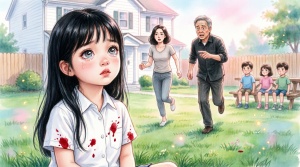
I read it on my phone while sitting in my car after work, too tired to drive for a minute. Rain ticked softly on the windshield. Somebody in the next car over was singing badly with the radio. Life went on being rude and ordinary.
I didn’t answer.
Not because I wanted the last word.
Because silence was, finally, clean.
That fall, I took Lily to the coast for the first time since the move.
Not to the old house. Just the coast.
A rented condo. cheap seafood. wind loud enough to flatten our hair. Lily shrieked at the water as if oceans were brand-new inventions. She chased gulls, buried her ankles in sand, and insisted on collecting shells too broken for any purpose except love.
Watching her run, I realized something with such force I had to sit down on the beach towel.
She was not living inside that day anymore.
I was the one who kept returning to it in full color, full sound, full smell.
She carried it in fragments.
I carried it in sequence.
That mattered.
So the next week I called Dr. Raymond and asked whether I should consider therapy for myself beyond crisis support. She laughed softly and said, “Rachel, I’ve been waiting for you to ask that for two years.”
I started the month after.
Turns out mothers can build fortresses so fast around their children that they forget to leave any door for themselves.
Therapy didn’t make me gentler toward my family.
That is not what good therapy does.
It made me clearer about the difference between rage and vigilance.
Between guilt and grief.
Between what I still owed Lily and what I had never owed any of them.
One evening, after I came home from a session quieter than usual, Lily looked up from her homework and asked, “Are you sad?”
“A little,” I said.
“Do you want to color with me?”
So I sat on the floor with her and colored a terrible purple horse while she explained why all dragons should probably have jobs.
That was healing too.
Not dramatic.
Not courtroom worthy.
Just ordinary safety.
The best revenge stories on the internet are always about spectacular collapse. Prison. bankruptcy. divorce. ruined reputations. And yes, all of that happened to them.
My father in prison.
My mother in a discount store apron in her sixties.
Vanessa divorced, diminished, far from the polished life she used to weaponize.
Derek’s career gone.
The house sold.
The accounts drained.
But the real ending was quieter.
The real ending was Lily laughing with sand between her toes.
Me checking my phone less.
A stranger at the grocery store raising his voice and Lily not flinching anymore.
A school photo where my daughter stood in the center because I framed our life around her on purpose.
That was the part my family never understood.
They thought consequences ended at punishment.
They didn’t.
Consequences continued into what I built afterward.
And by the time one last letter arrived from Vanessa years later, I was steady enough to read it without shaking and detached enough to know exactly what it changed.
Which was almost nothing.
Except one thing:
It gave me the final sentence I needed to close the door without wondering if there had been anything else worth hearing.
Part 10
Vanessa’s last letter arrived in early October, almost six years after the day in the backyard.
I recognized her handwriting immediately, even though it had changed. Slower. More deliberate. Less decorative. The envelope sat on my kitchen table beside a permission slip from Lily’s school and a grocery receipt with avocados circled on it. That felt about right. After years of catastrophe, the final word from my sister had to arrive beside errands.
I opened it while soup simmered on the stove.
Rachel,
This will be the last time I write unless you ever tell me otherwise.
Already, that was better than the old Vanessa. She used to treat boundaries like invitations to negotiate.
The letter was simple.
No melodrama.
No “I know I don’t deserve…”
No blaming our parents, though she could have.
No pretending prison and public collapse had been enough to balance the books.
Instead she wrote:
You were right to call the police.
You were right to refuse the plea.
You were right to sue us.
You were right not to let anyone soften what happened.
I stopped there and had to sit down.
Not because it healed me.
Because it was the first fully clean sentence she had ever offered me.
She went on.
For years I told myself you liked being the good one.
What I understand now is that you were usually just the only one willing to do what reality required.
I mistook that for self-righteousness because it made my own choices easier to excuse.
There it was.
Not redemption.
Understanding.
That matters more than people admit.
She said she had kept working, kept paying restitution, kept volunteering with families navigating dementia because “it is the only place I can stand near the shape of what we lost without pretending I can repair it.” She wrote that she no longer expected forgiveness and no longer thought she was entitled to proximity simply because we had once shared a bedroom and a mother.
The last line said:
I hope Lily grows up knowing the truest thing in this story is that you chose her.
That line got me.
Not enough to cry.
Enough to feel the edge of something that might once have become forgiveness if things had been smaller, if Lily had not been involved, if blood had not already been weaponized beyond repair.
But life is not made of “if smaller.”
It is made of what happened.
I folded the letter and put it in the back of my desk drawer with the others.
The drawer had become a kind of archive.
Not of reconciliation.
Of record.
Evidence that even people who rot their own lives out from the middle can sometimes still manage clarity late.
That weekend, Lily and I drove to the coast.
She was almost eight then and had begun to outgrow some of the softness of early childhood. She rolled her eyes at my music. She wanted to wear her lucky soccer socks in the car. She talked for thirty straight minutes about a science project involving habitats and then got mad when I said jellyfish don’t count as “basically sea ghosts.”
We stopped for fries at a roadside place with cracked picnic tables, then headed to the beach.
I didn’t plan to go near the old house.
But the shoreline has its own logic. You walk and walk and eventually the body recognizes a dune line before the brain catches up. The Hendersons’ house came into view in late afternoon light, shutters freshly painted, porch swing moving a little in the wind.
Patricia saw us from the deck and waved like we were old friends.
Maybe we were, in the strange way some people become tied to the same place without sharing any blood.
“Come up!” she called.
Lily looked at me. “Can we?”
“We can say hello.”
We climbed the steps.
The house smelled like lemon bars and sun lotion and ordinary family life. A teenage boy was complaining about taking sand off his feet before coming inside. Someone had left a damp towel over the railing. A puzzle sat half-finished on the coffee table. Nothing in the room carried the old charge anymore.
Patricia hugged me lightly, then crouched to Lily’s height and asked if she wanted lemonade. Lily said yes and was gone in five seconds flat, already pulled toward a deck chair and a tray of cookies by the warm gravity of decent adults who know how to welcome children without making them audition for it.
I stood by the front window for a minute after that.
This had once been Dad’s chair spot.
His kingdom of newspaper, weather radio, and horizon.
Now it held different furniture.
Different people.
Different laughter.
And it was okay.
More than okay.
Good.
That realization moved through me with such clean certainty that I had to hold the windowsill.
The house had not belonged to trauma.
It had outlived it.
Maybe that was the truest ending I could have asked for.
On the walk back to the car later, Lily slipped her hand into mine and swung our arms once.
“Mom?”
“Yeah?”
“Are those the people who live in Grandpa’s beach house?”
I looked down at her.
“Yes.”
“They seem nice.”
“They are.”
She kicked at the sand with the toe of her shoe. “Good. The house deserves nice people.”
I stopped walking.
Children say things sometimes with the accidental wisdom adults spend thousands on therapy trying to earn.
The house deserves nice people.
Yes.
So do children.
So do mothers.
So do lives.
When we got home that evening, I tucked Lily into bed and sat beside her a little longer than usual. She was almost asleep when she asked, “Are we okay now?”
It was the kind of question that splits a person open if they answer too fast.
I thought about prison sentences and court orders and bankruptcy and broken ties. I thought about the girl she had been at five, silent in a hospital bed with tape on her hand. I thought about the woman I had become since then—harder, yes, but not empty. Clearer. Sharper. Unwilling to donate my life to anyone else’s denial.
Then I answered the only way I could.
“Yes,” I said. “We are.”
And we were.
Not because my family repented enough.
Not because the courts punished them enough.
Not because time magically turns horror into wisdom.
We were okay because I believed my daughter the first moment it mattered.
Because I chose reality over blood.
Because I refused to confuse mercy with surrender.
Because when they tried to make Lily small and breakable and disposable, I built our life around the opposite idea.
People sometimes ask if I regret how far I took it.
The police.
The trial.
The civil suit.
The financial ruin.
The permanent cut-off.
No.
Not once.
My father hit a five-year-old until she stopped moving.
My mother held me back.
My sister praised him.
My brother-in-law filmed it.
There is no gentler version of that story hidden somewhere for more comfortable people.
So I never gave them one.
They lost their house.
Their money.
Their reputations.
Their marriage.
Their access to me.
Their access to Lily.
And still, if I had to do it all again to protect her, I would go further.
That is the ending.
Not forgiveness.
Not reunion.
Not the fantasy that family heals itself if you wait long enough.
The ending is this:
They thought hurting my child would teach us our place.
Instead, it taught me mine.
Beside my daughter.
Between her and anyone who mistakes power for love.
Forever.
And in the end, they did not break us.
They lost everything, and Lily still got to grow up.

