of the console table.
My mother reached for the paper instead of for me.
Ava shouted that I was ruining her birthday.
Then my father’s hand struck my arm, hard enough to throw me off balance.
I fell sideways and my face hit the stone edge of the fireplace hearth on the way down.
I remember the crack of something hitting tile.
I remember the metallic taste in my mouth.
Most of all, I remember my mother’s voice right beside my ear, low and furious, telling me not to make a scene because the neighbors would hear and it would be humiliating.
Then the front door opened.
Mrs.
Talbot from next door had heard the crash.
My parents transformed in an instant.
My mother grabbed for a towel.
My father said I had tripped.
Ava clutched her sash and cried harder.
Mrs.
Talbot took one look at my face, the paper on the floor, and my father’s expression, and whatever she saw settled the matter.
She told me to get my shoes.
She was taking me to the hospital.
My phone screen cracked in the car, but it still worked well enough for one message: Need help.
Parents trying to force trust papers.
At the ER, while a nurse cleaned the cut under my eye and asked me questions in that practiced gentle tone medical people use when they already know more than they are saying, Lawrence answered with the text I kept rereading: On my way.
Do not sign anything.
Do not discuss trust matters until I arrive.
The doctor examined my jaw, checked my vision, and asked whether I wanted to make a report.
Before I could answer, my mother appeared in the doorway with the same folder and a carefully arranged face of concern.
She told the doctor she just needed me to sign insurance paperwork.
He did not even glance at the pen.
He said patients signed documents when they were ready, not when relatives instructed them to.
From the bed I could see the waiting area through the glass.
My father paced once, then sat.
Ava scrolled on her phone.
My mother kept the folder on her lap.
Every few minutes she looked toward my room with the serene impatience of a woman who still believed I would eventually stop resisting and do what I had always been trained to do.
What they did not understand was that Grandma had built the trust for the version of me she hoped I would become, not the frightened version they thought they owned.
Lawrence arrived twenty minutes later in a dark suit and charcoal overcoat, silver hair still neat from the rain outside.
He did not rush, and that calmness altered the whole atmosphere more effectively than shouting ever could have.
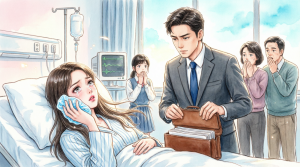
He asked the nurse for me by full name, stepped into the room, took one look at my face, and set his leather briefcase on the counter with measured care.
He asked me only two questions.
Had I signed anything? No.
Was the paper still with them? Yes.
Then he nodded, opened the case, and removed a document stamped with a red seal.
He asked the charge nurse, the hospital social worker, and the security guard to step closer.
When my parents saw that, they finally
stood up.
Lawrence held the document at chest height and said he was reading from Section Eleven of the Evelyn Mercer Irrevocable Trust and its companion letter of instruction.
His voice was calm, precise, almost gentle.
Then he read the sentence that stopped the room cold: Upon evidence of coercion, intimidation, or attempted diversion of trust assets from beneficiary Hannah Mercer by any family member, all distributions, housing privileges, and discretionary benefits to the offending parties shall cease immediately, and the trustee shall act at once to protect the beneficiary.
Ava laughed at first, a brittle little sound, because she thought it was theater.
My father smiled too.
Then Lawrence turned the page and began reading the names to whom that clause applied: Daniel Mercer, Caroline Mercer, and Ava Mercer.
He explained, still in that same even tone, that the monthly support payment my parents received from Grandma’s estate was suspended effective immediately.
The property tax support on the house would cease.
Ava’s yearly educational allowance was frozen.
Their occupancy rights in the house, which belonged not to them but to a separate Mercer family property trust, were now under formal review for termination because the named beneficiary had been endangered in that home.
The laughter vanished so quickly it almost made a sound.
My mother’s color drained first.
My father’s jaw tightened hard enough for a pulse to show near his ear.
Ava stared at him, then at Lawrence, and said, What does that mean? Her voice had gone flat with real fear.
Lawrence answered without looking away from the document.
It means your grandmother anticipated this exact behavior, and she instructed me to cut off every benefit the moment it happened.
My mother tried a softer tone then, the one she used on cashiers and neighbors.
This is a family misunderstanding, she said.
Lawrence extended his hand for the paper she had been trying to make me sign.
She hesitated.
The security guard stepped closer.
She gave it to him.
He scanned the first page and his expression changed just enough for me to understand how serious it was.
He asked whether this had been presented to me before or after I was injured.
I said both.
He handed the document to the social worker and said it appeared to be an attempted assignment of trust assets coupled with a false gift acknowledgment, and that it should be preserved.
Then, in front of everyone, he asked the doctor to note that my family had continued seeking my signature while I was under treatment for a facial injury.
The doctor looked at me again and asked the same question he had asked before.
Did I want to make a report?
That time I said yes.
Once I said the word, the scene moved quickly.
The charge nurse shut the room door.
Security separated my parents from me.
The social worker pulled a chair to my bedside and helped me slow my breathing enough to give a statement.
Mrs.
Talbot, who had refused to leave the waiting room until she knew I was safe, gave hers too.
She described the shouting she had heard through the wall, the crash, the look on my face when she came in, and my father’s rush to explain before anyone had accused him of

