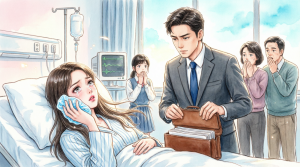
The emergency room smelled like antiseptic and melting ice.
I sat on the narrow exam bed with a paper gown over my clothes, an ice pack pressed against my jaw, while the skin beneath my left eye darkened from pink to violet in slow, ugly stages.
The doctor had just finished checking my pupils when he paused at the doorway and asked me, very carefully, whether I wanted to make a report.
I did not answer right away.
Instead, I looked through the wired glass toward the waiting area.
My mother sat upright with a navy folder on her lap.
My father paced once, then stopped and crossed his arms.
My sister Ava, still wearing the satin birthday sash she’d insisted on putting on at breakfast, dabbed under her eyes and stared at her phone.
They did not look worried.
They looked inconvenienced.
Then my cracked phone buzzed in my hand.
The message on the broken screen came through clearly anyway: On my way.
Do not sign anything.
Do not discuss trust matters until I arrive.
Lawrence Peton.
I read it three times, as if repetition could make the room feel less tilted.
My name is Hannah Mercer.
I was twenty-two that spring, finishing online coursework and working part-time at a tutoring center near campus.
My sister Ava had just turned twenty, and for as long as I could remember, she had been the axis around which my family rotated.
She learned early that being pretty, dramatic, and disappointed at the right moment could move everyone else around like furniture.
If Ava wanted my room because the afternoon light was better for selfies, I was told to be mature and switch.
If she wanted expensive dance classes, my violin lessons quietly disappeared from the budget.
If she broke something of mine, I was reminded that she was younger and more sensitive.
My parents called this compromise.
I called it my normal until I was old enough to understand compromise is supposed to involve two people giving something up, not one person vanishing on cue.
My grandmother Evelyn was the only person who ever named it plainly.
She never gave speeches.
She simply watched.
She noticed who cleared plates, who apologized first, who was expected to absorb every unfair thing in order to keep the peace.
One summer when I was sixteen, she took me to lunch and said, very softly, A family can love you and still train you to disappear.
Don’t mistake that training for your duty.
I did not fully understand her then.
I do now.
When Grandma died two years later, she did not leave me cash in an account my parents could reach.
She created an irrevocable trust.
It covered tuition, housing, health care, emergency expenses, and certain future needs if I finished school.
The trustee was Lawrence Peton, the attorney who had handled her affairs for nearly twenty years.
My parents hated that arrangement from the minute they heard about it.
They smiled in public and fumed in private because Grandma had done the one thing they could not reverse: she had placed a locked door between their wishes and my future.
They were not left with nothing.
Grandma’s estate also provided my parents with a modest monthly support distribution, help with property taxes on
the house they lived in, and a yearly educational allowance for Ava.
It was enough to keep their lives comfortable.
It was not enough to finance a luxury car for a birthday reveal on social media.
Ava, unfortunately, had turned social media into her entire definition of worth.
The morning she turned twenty, our kitchen looked like a sponsored post.
White balloons floated over the island.
A pink cake box sat on the counter.
A ring light stood near the window.
Ava wore a pale sash and kept twirling in front of her phone, talking to her followers about the start of her best year yet.
I stayed upstairs in my room with my laptop, trying to finish a discussion post before my shift.
At noon, my mother pushed my bedroom door open without knocking.
Downstairs.
Family meeting.
Her voice had that bright, clipped sound that meant the decision had already been made and my role was to cooperate.
The living room had been staged as neatly as the kitchen.
My father sat in his armchair like a judge.
My mother held a navy folder.
Ava stood between them, grinning at the image on her phone.
When she turned the screen toward me, I saw a spotless white BMW parked on a dealership lot, sunlight reflecting off the hood, temporary sticker in the window.
Isn’t it perfect? she asked.
My father did not bother with small talk.
You’re buying it for her, he said.
Forty-eight thousand.
Lawrence can release the funds if you sign today.
The word trust in his mouth made something go cold inside me.
That money had always meant survival.
Tuition bills.
Rent.
Dental work I had delayed for too long.
A future with locks on my own doors and no one demanding explanations for every dollar.
I said no.
The change in the room was immediate and frightening.
My mother’s face emptied.
Ava’s eyes filled so fast it looked practiced.
My father leaned forward and called me selfish.
Ava said every girl she followed drove something nice and she was tired of looking behind.
My mother said families invest in each other and after everything they had done for me, this was the least I could do.
That last line might have been funny if it hadn’t been a sentence I had heard in a hundred different forms since childhood.
Then my mother opened the folder and slid out a document.
It was not what she claimed it was.
It was not a harmless authorization request.
It was a polished, predatory piece of paperwork: an attempted direction to liquidate trust assets, identify the car purchase as a family gift, and create language that could later be pointed to as my voluntary approval of future discretionary transfers.
There were blank signature lines at the bottom waiting for me like open mouths.
I said I was calling Lawrence.
My father laughed and said Lawrence worked for the trust, which meant he worked for the family.
Ava started crying louder.
My mother picked up a pen and tried to place it in my hand.
When I stepped back, my father rose from the chair and moved in front of me.
What happened next took only a few seconds.
I backed away.
He moved closer.
My shoulder hit the edge