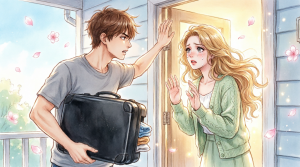
The first thing I saw when I came home was my life stacked by the front door in two large suitcases. One had burst open at the seam, and a silk blouse I loved was hanging out like a white flag. For a moment, I honestly thought there had been some kind of break-in.
Then I heard the soft clink of crystal from the staircase. I looked up and saw my husband, Curtis, descending slowly with a glass of champagne in one hand and a smile on his face that made my blood run cold. He didn’t look like a grieving son, and he certainly didn’t look like a man about to comfort his wife.
“Vanessa,” he said, almost lazily, as if he were discussing dinner reservations instead of destroying a marriage. “Good. You’re back. I was hoping to avoid making this any messier than it has to be.”
I stood there with my keys still in my hand, rain dripping from the hem of my coat onto the marble floor. “What is this?” I asked, even though some terrible part of me already knew. My voice sounded small in that grand foyer, swallowed by polished stone and expensive silence.
Curtis took a sip of champagne before answering. “This is the end,” he said. “My father is gone, and so is the arrangement. You were useful for a while, Vanessa, but now you’re just dead weight.”
If someone had slapped me, it would have hurt less. We had been married for ten years, and in all that time I had forgiven things I should never have forgiven. His selfishness, his vanity, his constant hunger to be admired—I had dressed those flaws up as ambition because I loved him.
Or maybe I loved the man I thought he could become. That was the real tragedy. I had spent a decade loving a possibility while ignoring the man standing right in front of me.
When I met Curtis, he was magnetic in the way certain dangerous people are. He knew exactly how to look at you, how to laugh at the right moment, how to make you feel as though being chosen by him meant something rare and glamorous. He spoke like life was a private club, and he had the key.
Back then, I mistook confidence for character. I thought his sharp edges came from pressure, from being the son of Arthur Hale, a real estate giant who had built a seventy-five-million-dollar empire with his own hands. I told myself that one day Curtis would soften, that one day he would become the man behind the polished smile.
Arthur once told me that buildings reveal their flaws under pressure. “A weak foundation can hide for years,” he said, “but sooner or later, the walls start talking.” At the time, I thought he was speaking about business. I did not understand that he was speaking about his son.
My father-in-law was not an easy man when I first met him. He was brilliant, demanding, proud, and had built his world out of steel instincts and sleepless nights. Even in his seventies, he had the presence of a man who could walk into a room and make everyone else feel underprepared.
But illness humbles even the strongest men. When cancer came for Arthur, it came without dignity and without mercy. Within months, the titan who had negotiated skyscrapers and land deals from memory was struggling to lift a spoon.
Curtis could not bear to witness the decline, or at least that was what he told everyone. He called it emotional self-protection. He said hospitals depressed him, medications made him anxious, and “negative energy” interfered with his focus.
At first, I defended him. I told Arthur that Curtis was overwhelmed, that people grieved in different ways, that not everyone knew how to face mortality. Arthur would listen without interrupting, and then he would give me one long, tired look that said he knew better.
So I became the one who stayed. I learned medication schedules, wound care, emergency numbers, and the difference between Arthur’s real pain and the kind of pain he hid because he hated appearing weak. I learned how to read the silence in a room and how to tell, from the sound of his breathing alone, whether it would be a difficult night.
Cancer strips away ceremony. It leaves you with harsh lights, stained sheets, trembling hands, and the kind of honesty most people spend their entire lives trying to avoid.
I cleaned Arthur when he was sick. I changed bedding in the middle of the night, rubbed his back when the nausea came in violent waves, and sat beside him through hallucinations brought on by morphine and fever. Sometimes he called me by his late wife’s name, and sometimes he spoke to people who had been dead for thirty years.
In the mornings, when the pain had eased a little, I read him the newspaper. He still liked financial pages best, though eventually he stopped pretending he cared about the markets and asked me to read the obituaries instead. “They’re the only honest section left,” he would mutter, and I would laugh even when I wanted to cry.
Little by little, something changed between us. The man who had once examined me like I was another variable in his son’s life began to trust me. He started asking for me when nurses came by, and if I stepped out for groceries, he would ask when I’d be back.
One evening, after a particularly brutal day, he reached for my hand with fingers that had gone thin and paper-dry. “You shouldn’t be doing this alone,” he said quietly. “Not when I have a son.”
I gave him the same answer I always gave. “You’re family,” I said. “And Curtis loves you. He just doesn’t handle this well.” Even as I said it, I hated how rehearsed it sounded.
Arthur’s laugh that night was bitter and soft. “Vanessa,” he said, “a man tells you who he is by what he does when there is nothing to gain. Don’t build a life on excuses.”
I did not know what to say. So I smoothed his blanket, adjusted the lamp, and pretended those words didn’t land somewhere deep enough to frighten me. Looking back, I think that was the moment the truth first knocked on the door, and I chose not to open it.
Curtis visited just often enough to be seen. He would arrive in tailored coats that smelled of cologne and city air, lean over Arthur’s bed, and put on the face of a devoted son. Then, when Arthur dozed off or the nurse stepped out, he would turn to me and ask in a lowered voice, “Did he mention the will?”
At first, I thought it was stress speaking. Then I realized it was hunger.
“Curtis,” I whispered once, appalled, “your father is still alive.” He just shrugged and adjusted his cufflinks as though I were the one being dramatic.
“That’s precisely why the timing matters,” he replied. “Men like Dad don’t leave loose ends unless someone pushes them.” Then he smiled at me as if the remark were clever, kissed my cheek, and went downstairs to take a business call while his father vomited blood into a basin I was holding.
I remember one terrible night in particular. The storm outside had knocked the power out for a few minutes, and Arthur was half-delirious, gripping my wrist so hard it hurt. He thought he was back in the early years of his business, sleeping in his office and praying the bank wouldn’t take everything.
When the lights came back on, he blinked at me and said, “Still here?” There was something almost childlike in his face then, something fragile and frightened. “Yes,” I told him. “I’m still here.”
He closed his eyes, and tears slipped out beneath his lashes. “That’s more than I can say for my son,” he whispered.
The last lucid conversation we had took place three days before he slipped into the coma. The afternoon light was thin and gray, and the room smelled faintly of antiseptic and cedar from the old furniture he had refused to replace. He asked me to open the curtains because he wanted to see the trees.
“You know he’ll throw you away if he thinks you’ve outlived your use,” Arthur said without looking at me. His voice was weak, but his mind was clear as glass. “I should have made a stronger man. Instead, I made an audience addict.”
My throat tightened, but I forced a smile. “You’re tired,” I said. “You shouldn’t be worrying about me right now.”
“That’s exactly why I’m worrying about you,” he replied. He turned his head then, and the old steel returned to his eyes for one brief, startling moment. “You are the only person in this house who has loved without calculation. Do not mistake kindness for weakness, Vanessa. The world does that enough on its own.”
I wanted to ask him what he meant. I wanted to ask why he sounded so certain, so grim, as though he had already seen the ending of a story I was still trying to survive. But a coughing fit took him, and by the time it passed, he was too exhausted to speak.
Three days later, Arthur died just before dawn. The room was dark except for the low amber glow from the hallway, and his hand was in mine when his breathing changed. I had never heard a room become so quiet so fast.
I called the doctor. I called the funeral home. Then I called Curtis, who answered on the fourth ring sounding irritated until I said the words, “Your father is gone.” There was a pause, and then his voice changed instantly, transformed by performance into grief.
By the funeral, Curtis had perfected his role. He stood in a black tailored suit, shoulders bowed just enough to suggest heartbreak, silk handkerchief in hand, speaking in a rich, broken voice to every investor, partner, and family friend who approached him. If sorrow could have won an award, he would have taken the stage twice.
I stood beside the casket feeling hollow. Arthur had not been my father by blood, but in his final years he had become something I had needed without even realizing it—a witness, a protector in spirit, a difficult, brilliant man who saw me clearly.
At the cemetery, the wind cut across the grass in sharp, cold sweeps. Curtis cried beautifully for the crowd and checked his phone when no one was looking. I saw him do it, and something inside me shifted, just slightly, like the first crack in frozen glass.
Two days after the burial, I spent the morning handling details Curtis declared “too draining.” I met with the cemetery office, signed floral invoices, and finalized a memorial donation Arthur had once mentioned wanting for a cancer care charity. By the time I returned home, I was exhausted clear through my bones.
And then I saw the suitcases.
Curtis reached the bottom of the stairs and stopped a few feet away from me. His shirt was crisp, his watch gleamed at his wrist, and his entire posture radiated relief rather than mourning. He looked like a man who believed a prison sentence had ended.
“What are you talking about?” I finally managed.
“I’m talking about freedom,” he said. “My father’s estate comes to me now, and I’m done pretending this marriage still makes sense. You were useful when he needed a caretaker, but that chapter is over.”
I stared at him as if language itself had broken. “I am your wife,” I said. “I cared for your father because he mattered to me. Because you mattered to me.”
“And I appreciate the service,” Curtis replied. Then he reached into his pocket, pulled out a check, and flicked it toward me. It drifted down and landed near my shoe.
Ten thousand dollars. Not a gift, not support, not remorse. Payment.
“Consider it compensation,” he said. “For the nursing, the errands, the emotional labor, whatever else you women like to count these days. Now take it and go before my attorney gets here. I have plans for the house.”
The humiliation hit me so hard it almost made me sway. “You can’t be serious.”
“Oh, I’m very serious,” he said, and his smile sharpened. “This house is about to become a place for a very different kind of life. Lighter. Better. More sophisticated. Frankly, Vanessa, it smells like old age in here. And you.”
I don’t remember deciding to cry. I only remember that suddenly my face was wet and I hated him for seeing it.
I tried to reason with him. I reminded him of ten years together, of anniversaries and losses and promises made in front of witnesses and God. He looked bored before I was halfway through.
“Don’t embarrass yourself,” Curtis said. “Sentiment is not a legal argument.” Then he glanced toward the hall and added, “Gentlemen, please.”
Two security guards stepped forward from where they had been waiting near the side entrance. I had seen both men dozens of times before; they had nodded politely to me at parties and opened car doors for guests. Now they would not meet my eyes.
“Mrs. Hale,” one of them said carefully, “we need you to come with us.”
The rain had started by the time they escorted me outside. It came down in cold sheets, soaking my hair, my coat, my dignity. I turned once, just once, and saw Curtis standing at the second-floor landing with his champagne, watching as if he had purchased front-row seats to my collapse.
That night I slept in my car in the parking lot of a twenty-four-hour supermarket on the edge of town. The fluorescent lights buzzed overhead, and every time someone pushed a shopping cart past, I woke with my heart hammering like I was being thrown out all over again.
I kept replaying the last three years in my mind. Arthur’s hand in mine, Curtis asking about the will, the check fluttering to the floor like an insult with a signature. By dawn, one truth had become impossible to avoid: the man I loved had never existed in the form I needed him to.
The weeks that followed were bleak and practical. I found a small apartment with peeling paint and a stubborn radiator, accepted the fact that half my wardrobe smelled like damp fabric and heartbreak, and began gathering documents because the divorce papers arrived with shocking speed. Curtis wanted everything erased cleanly, neatly, efficiently.
He wanted me gone before his new life began in earnest. He wanted to remove every trace of the woman who had seen him at his smallest. I think, more than anything, that was what frightened him—that I knew exactly what kind of man he was when no one important was watching.
On the third week, my phone rang while I was carrying groceries up the apartment stairs. The screen showed the name Sterling & Rowe, Attorneys at Law. My pulse jumped so hard I nearly dropped the bag.
“Mrs. Hale,” said a measured male voice when I answered. “This is Martin Sterling, executor of Arthur Hale’s estate. There will be an official reading of the will on Friday at ten a.m. Your presence is required.”
I stopped in the hallway, one hand gripping the railing. “Mine?” I asked. “Why would my presence be required?”
“That will be explained at the reading,” he said, in a tone that revealed nothing. “Please be there.”
An hour later, Curtis called. He didn’t ask how I was, and he didn’t pretend civility for more than three seconds.
“I don’t know why Sterling insists on dragging you into this,” he snapped. “Dad probably left you some trinket, maybe a bracelet or one of those sentimental notes old men think matter. Show up, sign whatever you need to sign, and don’t make a scene.”
His contempt no longer hurt the way it once had. Maybe pain has a threshold, and once you cross it, certain wounds go numb. “I’ll be there,” I said, and hung up before he could say anything else.
Friday morning came cold and bright. I put on the best outfit I still had—a navy dress, modest heels, and the pearl earrings Arthur once told me made me look “like someone with better judgment than my son.” It was the closest thing to armor I owned.
Sterling & Rowe occupied the top floor of a downtown building with dark glass and a lobby that smelled faintly of marble polish and money. When I stepped into the conference room, Curtis was already there at the head of a long mahogany table, flanked by two financial advisors who looked like men accustomed to circling large amounts of cash.
He looked me up and down with open disdain. “Sit in the back, Vanessa,” he said. “And for once in your life, don’t speak unless someone asks you a direct question.”
I said nothing. I took a seat near the end of the table and folded my hands in my lap so no one would see them shaking.
A minute later, the doors opened and Martin Sterling walked in carrying a thick leather folder. He was tall, silver-haired, severe, and so precise in his movements that he seemed carved rather than born. When his gaze met mine, it lingered for the briefest moment, unreadable and steady.
Then he sat, adjusted his glasses, and placed the folder on the table with quiet finality. “We will now proceed,” he said, opening the will, “with the last testament of Mr. Arthur Hale.”
And for the first time since Curtis threw me into the rain, I felt something stir beneath the ruin. It was not hope exactly, not yet. But it was enough to make me sit up straight and listen.
The air in the conference room felt heavier than it should have, as if the weight of impending decisions was pressing down on everyone. Curtis leaned back in his chair, tapping his fingers rhythmically on the tabletop, impatient. The financial advisors beside him exchanged polite but strained glances, clearly eager to see the numbers. Sterling adjusted his glasses, his eyes scanning the contents of the folder as if preparing for a performance.
Curtis shifted again, breaking the silence with a sharp laugh. “Alright, Sterling, we’ve all got better things to do than listen to some old legal ramblings. Just get to the part that matters. The money.”
I sat back, my fingers curled tightly into fists. His arrogance—it was as if he thought everything could be bought, including his father’s legacy, including me. I felt the sting of his disregard, the same sting I had fought against for years, but today was different. Today, something in me had changed.
Sterling, unfazed by Curtis’s impatience, flipped through a few more pages before speaking. His voice, calm and deliberate, filled the room. “As you know, Mr. Hale’s estate consists of several assets, including properties, a car collection, and liquid investments. But the distribution is not as straightforward as you might think.”
Curtis’s eyes narrowed. “Just say what it is, Sterling. We’re all busy people.”
Sterling met his gaze coolly, a small, knowing smile curling at the corner of his mouth. “The will stipulates that Mr. Hale’s assets are to be distributed according to specific conditions. These conditions were set forth clearly, two days before his final hospitalization.”
I watched Curtis’s expression falter for just a split second before he masked it with an impatient sigh. He tapped his fingers again, louder this time. “Conditions? What conditions? Just tell me I get the money.”
Sterling looked at me briefly before turning his attention back to the papers in front of him. “The first part of the will is simple. To my only son, Curtis Hale, I leave the family mansion, the car collection, and the sum of seventy-five million dollars.” He paused, letting the words sink in.
Curtis’s lips curled upward in a smug smile as he leaned back in his chair, clearly relishing the moment. “I knew it. All mine.”
But Sterling continued reading, his voice never wavering. “However, there are stipulations regarding this inheritance. Curtis, you must still be married to Vanessa, living together, and treating her with respect, as you did before Mr. Hale’s passing.”
I froze. Something inside me churned, a knot of disbelief rising in my throat. This couldn’t be real. The idea that Arthur had left a clause like this—one that questioned Curtis’s character, his treatment of me—was beyond anything I had ever expected.
Curtis’s smile faltered slightly, but he quickly regained his composure, his eyes darting between Sterling and me, his fingers tapping faster against the table. “What does that even mean?” he demanded. “I’ve always been respectful. This is just a formality, right?”
Sterling didn’t look up from the document. “Mr. Hale felt strongly that family and loyalty must come before wealth. If, at the time of his passing, Curtis has left Vanessa, evicted her from the home, or initiated divorce proceedings, it would prove that his worst fears were justified. That would result in a substantial reduction in the inheritance.”
Curtis went pale. I saw his fingers tremble slightly on the edge of the table, and for the first time, he looked less like a man in control and more like a person facing the consequences of something he hadn’t fully anticipated.
Sterling paused, looking at Curtis, allowing the silence to stretch just enough for the weight of the words to land. “And if the conditions are not met, Curtis’s inheritance will be reduced to a trust fund of $2,000 per month. That will be his sole access to funds for the rest of his life. He will not have access to the principal amount.”
Curtis opened his mouth to protest, but the words caught in his throat. His chest heaved as though he was trying to grasp for something solid in the room, something that would bring him back to the surface.
“That’s ridiculous!” he shouted, his voice louder than it had been all morning. “This is a joke. A sick joke. You can’t do this.”
But Sterling remained calm, unflinching in the face of Curtis’s outrage. “I am simply reading the will, Mr. Hale,” he replied quietly. “These are your father’s wishes.”
Curtis shot a glance at me then—sharp, venomous, and filled with a desperation I had never seen before. His usual confidence was gone, replaced by something far more terrifying: fear.
“What’s the point of all this?!” he yelled. “Just get to the end, Sterling. Tell me what happens if I don’t meet these ridiculous conditions. Tell me it doesn’t matter.”
Sterling’s gaze turned to me, his eyes briefly softening before he continued. “The last portion of the will contains a clause that will determine what happens next. If Curtis has fulfilled the requirements, he will inherit the full estate. If he has not, then the entire estate will be transferred to Mrs. Vanessa Hale.”
The words hit me like a punch. My head spun as I tried to process what had just been said. Everything I had suffered through, everything I had endured, suddenly felt like it was coming to fruition. But the clarity didn’t feel like victory—it felt like something else entirely. Something colder.
Sterling continued, his voice steady but with a hint of finality. “In the event that Curtis has failed to meet these conditions, Mrs. Hale will inherit everything—seventy-five million dollars, the mansion, the investments, and the car collection.”
I glanced at Curtis then, seeing his face twist in disbelief. He seemed paralyzed, as if his entire world had been pulled out from under him. His hands trembled on the table now, and his eyes darted back and forth, unable to settle.
“I…” he began, but the words didn’t come. His gaze moved frantically around the room, searching for something, anything, to stop this.
But there was nothing. There was only the cold, steady gaze of Sterling, who was calmly packing up the papers.
“You’re lying,” Curtis finally spat, his voice barely above a whisper. “This is all a lie. You can’t do this to me. I’m his son! I deserve this!”
But his protests were nothing more than a desperate attempt to hold onto the riches slipping through his fingers.
Sterling turned his eyes toward me then, a small, reassuring smile on his lips. “Mrs. Hale,” he said, his voice softening. “It seems that the conditions have been met. You are the rightful heir to this estate.”
For a moment, I couldn’t move. The air felt thick, suffocating. I could hear the thundering of my heart in my ears, and yet there was a strange calm that settled over me, as if the weight of what had just happened was still sinking in.
Curtis was staring at me now, his face a mixture of disbelief and horror. He opened his mouth to speak, but no words came out. His eyes searched mine, desperate for some sign that I would still save him, that I would somehow forgive him for everything he had done. But I couldn’t do it anymore. The man I had loved was gone, replaced by someone who had never truly seen me.
“You know, Curtis,” I said, my voice steady, “Arthur was right. Pain reveals the truth. And now I see everything very clearly.”
Sterling stood, collecting the documents in a neat pile. “If you’ll excuse me, Mrs. Hale,” he said quietly, “the transfers will be made immediately. The mansion, the assets—all will be yours.”
I nodded, feeling a sense of finality wash over me. Curtis had made his choice long ago. Today, the world would see exactly who he was. And now, so would I.
As I stood to leave, I glanced back at Curtis. He was still frozen in place, his face pale, his hands shaking. He had lost everything in a matter of minutes—his inheritance, his empire, and, most importantly, his chance at redemption.
But that was no longer my problem. I walked out of the room with my head held high, stepping into a future I had never imagined.
As I walked out of the law office, the sharp sting of the cool air hit my face, but it was the first time I had felt fully alive in months. The sun outside was piercingly bright, its rays cutting through the shadows of my old life. My fingers still trembled slightly, but it wasn’t from fear—it was from the relief of having a truth finally exposed.
I had expected this moment to feel like victory, but it didn’t. It didn’t feel like a fairy tale ending either. It felt like a weight, a heavy responsibility that I wasn’t sure I was ready to carry. The money, the mansion, the car collection—it was all mine now. But in some strange way, it felt as though it had been tainted by the process of getting it.
I stood there in the parking lot, my car sitting idly in front of me, and I tried to catch my breath. Curtis’s face, that combination of panic, disbelief, and desperation, replayed in my mind like a broken record. But it wasn’t just his face that haunted me. It was the realization that I had spent ten years of my life loving a man who had never truly cared for me. He had treated me like a tool, a means to an end, and I had let him.
That thought made my stomach turn. It wasn’t the money that had hurt me—it was the lies. The years of being with someone who had convinced me I was weak, someone who had taught me to believe I was invisible in the grand scheme of things. All of it had been a façade.
The drive back to the mansion was a blur. I didn’t remember the streets or the turns I took, but I remember the final moment when I stepped through the gates, the heavy iron doors slowly opening as if to welcome a new chapter, one that had been written in a way I never thought possible.
The mansion stood before me, majestic, cold, and entirely foreign. I had been here a thousand times, but it had always been his home. His space, his empire, his world. Now, it was mine.
I walked through the front door, a familiar but now alien feeling settling over me. I had been here as a guest, as a wife, but now, I was the one who would set the tone. This was no longer a space where I had lived in the shadows of his wealth and arrogance. It was mine, and with it came a responsibility I hadn’t asked for.
I let my fingers brush along the banister as I walked through the grand foyer, the marble floors echoing my every step. I was no longer just a bystander in this world. I was its master.
But I wasn’t ready for the moment when I heard the doorbell ring. My breath caught in my throat, and I stopped mid-step. Who could possibly be here at this hour?
I hesitated, my mind racing as I considered whether or not to answer. And then I heard the sound of footsteps—heavy, purposeful. Someone was coming up the stairs.
I moved instinctively, silently, as I stepped toward the door, my heart pounding in my chest. When I opened it, there stood Curtis, his suit disheveled, his eyes wide with desperation.
“Vanessa, please,” he said, his voice cracking. “You can’t do this. You can’t take everything from me.”
I stared at him for a moment, trying to process what was happening. He looked like a man who had just been stripped of everything he thought was his—everything that had made him who he believed he was. The man who had stood before me in that conference room, smug and victorious, was now just a broken shell of the person he once was.
“You’re right,” I said, my voice calm but firm. “I can’t do this. You did it for me. You made this happen.”
Curtis took a step forward, his eyes wild. “Vanessa, I—” He broke off, his breath coming fast. “I didn’t mean it. I didn’t mean any of it. I was under pressure. My father’s death… it got to me. Please, just give me a chance to make things right.”
I took a deep breath, steadying myself. “Curtis,” I began slowly, “you never wanted to make things right. If you had, you would have been here when your father needed you. You would have been here when I needed you.”
His face twisted with frustration. “You don’t understand. I thought I had it all figured out. The money, the power—it was all supposed to make sense, you know? But then he… he set all these rules. These conditions, and now everything’s falling apart. I just… I need you to fix it, Vanessa. We can make this work, I promise.”
The words burned in my throat as I shook my head. “No, Curtis. You’ve shown me who you are. I don’t need anything from you anymore. Not your money, not your promises. I’m not going back.”
His eyes searched mine, pleading now, as if there was still a chance to turn things around. “Please,” he whispered, his voice low and desperate. “I was wrong. I should have never let you go. I should have never thrown you out. You’re everything to me, Vanessa. Don’t do this.”
But in that moment, I saw the truth. The man who had once held my heart in his hands was now grasping at shadows, trying to salvage what he had lost. And I wasn’t there to help him pick up the pieces. Not anymore.
“You had your chance,” I said quietly, stepping back and closing the door between us. “And you threw it away.”
I leaned against the door for a moment, closing my eyes as the weight of the decision settled over me. The doorbell rang again, and I didn’t move this time. I knew what was on the other side. There was nothing left for me there.
As the sound of Curtis’s voice faded into the distance, I realized that something had finally shifted within me. I was free. Free from the man who had made me feel small. Free from a life I had outgrown.
The mansion was mine. And with it, I would build a life that was truly mine—without fear, without apology.
I turned away from the door, a soft smile tugging at the corner of my lips. It was a smile of peace, of clarity, and of a future that had just begun.
The days that followed were quieter than I had imagined. The mansion, now entirely mine, seemed to echo with possibilities I had never allowed myself to consider before. Everything about it felt different. It was no longer just a symbol of wealth or status; it was a place where I could reclaim myself, carve out a space where I could breathe freely, without the shadow of Curtis looming over me.
But peace, it seemed, was fleeting. Even in this house of polished marble and towering windows, the weight of my decision began to settle heavily on my chest. I had everything I thought I wanted, but I felt an unexpected emptiness.
I couldn’t help but think of Curtis. The desperation in his eyes haunted me. Had I been too harsh? Could I have given him one last chance to redeem himself?
No. The answer was clear. His cruelty had been a slow burn, not a fleeting mistake. And his words that day at the law firm had confirmed what I had long feared: he saw me as nothing more than an accessory to his ambition, a means to an end.
Yet, his sudden vulnerability had shaken something in me. It wasn’t love. It was regret. I regretted not seeing the truth earlier, not trusting myself enough to walk away sooner. But that was the past. And the past had no place in my future.
I stood in front of the mirror that morning, adjusting the dress I’d chosen for the day. It was simple, black with delicate lace. It was elegant, but most importantly, it was mine. The woman staring back at me was someone I hadn’t recognized in years. Strong, steady, unapologetic. I had not only taken back my independence—I had learned how to own it.
The phone on the counter buzzed, pulling me out of my thoughts. I glanced at the screen. It was a message from a lawyer I hadn’t yet met in person.
“Vanessa, I hope this message finds you well. I’ve attached some documents regarding the estate that require your immediate attention. Let me know when you can come by. Regards, Mark Thompson.”
The message was polite, professional, but there was an urgency in the words that made my heart skip a beat. I hadn’t expected more legal matters so soon. I had imagined settling in, adjusting to my new life, before facing the reality of running such a large estate.
I grabbed my coat and headed out to the office, not sure what to expect. As I drove, I couldn’t help but think about the state of things with Curtis. Despite everything, I still carried his memory with me, like a heavy, lingering weight. I couldn’t shake the feeling that there was something more—something else waiting to unfold.
When I arrived at the lawyer’s office, the tall, glass building gleamed in the sunlight. It was sleek, modern, and the perfect reflection of the man who had reached out to me. Mark Thompson. The name didn’t sound familiar, but that didn’t matter. The world I had stepped into was now full of new faces, new connections, and new demands.
I walked inside, greeted by a friendly receptionist who directed me to a waiting area. The space was minimalistic, designed with high-end finishes and muted colors. It was obvious that this law firm was as polished as the rest of my life had become. But I couldn’t shake the unease that had settled in my stomach.
A few moments later, Mark Thompson entered the room. He was a tall man with dark hair, sharp features, and an air of confidence that spoke of years of practice. He extended his hand with a warm smile, which I returned with a polite but cautious grip.
“Vanessa, it’s a pleasure to meet you. I’ve heard a lot about you from Mr. Sterling. Please, have a seat,” he said, gesturing toward the chair in front of his desk.
I sat down, my mind racing with questions. “What’s this about?” I asked, trying to keep my voice steady.
Mark took a seat across from me, flipping through a folder on his desk. “There are a few matters we need to discuss regarding your inheritance,” he began. “While the will was read and everything seems to be in order, there’s a clause in the will that we need to clarify. It’s not something I was fully aware of until recently, and I wanted to make sure you were informed.”
I raised an eyebrow. “A clause?”
He nodded, his expression serious. “Yes. It pertains to a provision that could affect how the estate is managed going forward. It’s important that you understand what’s at stake here.”
I leaned forward, my pulse quickening. “What does it say?”
Mark hesitated for a moment before pulling out a piece of paper from the folder and sliding it toward me. “It’s a provision that outlines certain conditions for the management of the estate, particularly the properties and liquid assets. Essentially, it gives you control over everything, but it comes with a heavy responsibility.”
I scanned the document quickly. The legal jargon was dense, but the key points were clear: I had control over the assets, but with one major condition. I needed to maintain the integrity of the family legacy, ensuring that the estate was not squandered or mismanaged.
I looked up at Mark, feeling the weight of the words settle on my shoulders. “So, what does this mean for me? What kind of responsibility am I looking at?”
Mark’s gaze softened slightly. “It means that, in exchange for the inheritance, you’ll need to make decisions that align with your father-in-law’s vision. This isn’t just about money, Vanessa. It’s about preserving the legacy of the Hale family, keeping the estate intact, and ensuring that future generations can benefit from it. You’ll need to be strategic, careful, and most of all, committed.”
The words felt like a heavy stone landing in my chest. “I’m not sure I’m ready for all of this,” I admitted, my voice betraying a hint of uncertainty.
Mark nodded, understanding. “I get it. It’s a lot to take in. But I’m here to guide you through it. You don’t have to do this alone.”
I stared at the document in front of me, the weight of my decision pressing down on me. The mansion, the money, the empire—it was all mine. But now it felt like more than just a gift. It was a burden.
“You need to understand, Vanessa,” Mark continued, “that this is more than just paperwork. The choices you make from here on out will determine the legacy of the Hale family. You’ll be responsible for making sure it endures.”
I nodded slowly, but inside, I felt the first stirrings of doubt. Could I really do this? Could I live up to the expectations that were now placed on my shoulders?
When I left the office, the air felt heavier than before. My car seemed like a refuge, a small space where I could try to make sense of everything. But no matter how hard I tried, the truth was unavoidable. The life I had stepped into wasn’t just one of wealth and comfort. It was a life of constant scrutiny, of pressure, and of choices that would echo through time.
And somewhere in the back of my mind, a nagging question persisted: Could I ever truly escape the shadow of Curtis? Would the man I had loved ever let me go, or would he continue to haunt me in ways I had yet to understand?
I drove back to the mansion, the familiar landscape now feeling foreign. The mansion stood before me, a towering structure of stone and glass. It was mine now. But what did that really mean?
As I parked the car and walked up the steps, I knew one thing for certain: my life had changed forever. And the journey ahead would demand more from me than I ever thought possible.
The days that followed were filled with long hours of decisions and meetings, paperwork and legal formalities. The mansion, once a place of dreams and illusions, had become the center of my life. But now it was more than just a house. It was a monument to the legacy of a family, to the past I could no longer ignore, and to a future I had yet to build.
I spent hours with the legal team, going through every document and clause. It was overwhelming. Each signature felt like another piece of my old life being erased, replaced by something new and uncharted. Mark Thompson, the lawyer who had been guiding me, remained patient, but his words were beginning to echo in my mind with a sense of finality: The choices you make from here on out will determine the legacy of the Hale family.
At night, I would sit in the grand, empty living room, staring out over the sprawling estate. The silence was deafening. I should have felt accomplished, victorious even, but the weight of the responsibility was crushing.
I thought of Curtis. Not with love, not with anger, but with something far colder—indifference. He had left me, discarded me when I was at my most vulnerable, and in the end, his greed had led to his downfall. I had made my peace with that, but the reality was still stark. He would never understand why I had chosen to leave him behind. He would never understand that I had walked away not because of the money, but because of the person he had become.
A few days later, I received an unexpected call. It was from one of Curtis’s old associates—someone who had been a part of his business dealings, someone who, in a way, had been in my life even before the divorce. His name was Richard Cole, and he had been Curtis’s right-hand man. He had always seemed polite enough, but I had never really paid much attention to him before. Now, his voice on the other end of the phone was full of urgency.
“Vanessa, I need to meet with you,” he said. “It’s about Curtis. He’s… he’s not handling this well. He’s… spiraling.”
I felt a pang of something. Sympathy? Guilt? I wasn’t sure. But I agreed to meet him the following afternoon.
When Richard arrived at the mansion, his presence seemed to fill the entire space. He was tall, well-dressed, and carried the air of someone who had always been on the inside. He greeted me with a slight nod and a handshake, his face serious.
“Thank you for meeting with me,” he said, his voice steady but concerned. “I don’t know what’s going on with Curtis. He’s… he’s lost it. He’s running through his savings, making reckless decisions. And he’s asking for you. He thinks—well, he thinks that if he can just talk to you, he can fix things. I don’t know if it’s guilt or just desperation, but I think he’s going to implode if someone doesn’t step in.”
I took a deep breath, trying to steady myself. Part of me had expected this. Curtis had never been one to accept defeat quietly. But this? This was different. His fall from grace had been swift and brutal, and now he was grasping at anything to keep himself from sinking further.
“Richard,” I said, my voice calm, “I’ve already given Curtis everything I had. My time, my energy, my love. He’s not going to change. You’re right—he’s spiraling. And there’s nothing I can do to stop it.”
Richard looked at me, his brow furrowing slightly. “I’m not asking you to save him, Vanessa. I’m asking you to make him see that it’s over. That the life he’s been living is gone. That it’s time for him to face reality. He doesn’t want to, but I think if you—”
“No,” I interrupted, my voice sharper than I intended. “Curtis needs to face his own consequences. I’m done. I don’t want to be part of his life anymore. I don’t want to be part of his mess. I’m moving forward, Richard. I’m going to build a future for myself. One that’s not tied to him, to his empire, or to his mistakes.”
There was a long pause, and for the first time, I saw something in Richard’s eyes—a flicker of understanding. It was brief, but it was there.
“I respect that,” he said quietly. “But Vanessa… just know that Curtis is… broken. He’s going to try to contact you again. He’s not giving up easily.”
“I don’t care,” I replied, my voice firm. “Let him try. He doesn’t have a hold on me anymore.”
Richard nodded, his expression unreadable. He stood up, offering me a brief but respectful nod. “I just wanted to warn you. I’ll let you know if anything changes.”
I watched him leave the mansion, his footsteps echoing in the hallway as he exited. When the door closed behind him, I exhaled deeply, a strange sense of relief washing over me. For the first time, I felt in control. The power to shape my own future was now completely in my hands, and nothing—nothing—could take that away.
But even as I stood there, feeling the weight of my decisions, I couldn’t deny the nagging feeling that Curtis was still there, lurking in the background of my life, like a shadow I couldn’t quite escape. Would he ever truly let me go?
That evening, after dinner, I received a message. It was from Curtis.
“I was wrong, Vanessa. I never understood what you meant to me. But I know now. Please, don’t turn your back on me. We can fix this. We can start over. I’ll do whatever it takes. Please.”
I stared at the message, my finger hovering over the screen. There was a time when those words would have broken me. When I would have believed that he was finally seeing the light. But now, it was different. His words felt empty, rehearsed, and desperate.
I didn’t reply. I didn’t need to.
I put my phone down, standing up and walking toward the window. The mansion stretched out before me, its lights gleaming in the distance. For the first time in a long time, I felt a sense of peace.
I was no longer defined by Curtis, by his family, or by the empire he had tried to build on the backs of others. I was free. And in that freedom, I found strength. The strength to move forward, to build my own life, to be the woman I had always been destined to become.
As I turned away from the window, a soft smile curved my lips. The future was mine to create, and I would do it on my terms.

