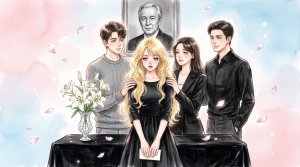
Long enough to know which staff members rise before dawn, which dogs belong to nobody and everybody, which windows catch the orange edge of evening first. Long enough to begin meeting with the foundation director about the education fund. Long enough to learn that Tadeo kept a little workshop behind the main house where he repaired tools badly and played old records loudly.
Long enough, maybe, to begin understanding that inheritance is not only about money. Sometimes it is about where grief is allowed to become useful.
That understanding sharpens one afternoon when Marisol’s granddaughter arrives to thank you for renewing the scholarship program Roberto and Tadeo started.
She is seventeen. Thin, serious, bright-eyed. She wants to study environmental engineering. She speaks to you in careful English because she is practicing and because somebody somewhere taught her that old women in black deserve extra gentleness.
When she leaves, you sit on the veranda holding the tea she brought and think about your own children.
The comparison is not fair, you tell yourself.
Then you reject that thought completely.
Fairness has already had more than enough room in this story to hide behind.
You finally write to Rebeca and Diego the next morning.
The email is short.
I will not discuss money by phone. If you wish to speak to me as your mother rather than as a possible solution, you may write. If you wish to ask for help with the debts, you may begin by telling the truth about the funeral and about how you treated me before and after it. I am done responding to performance.
You send it before you can soften it.
Three hours later, Diego replies with one sentence.
I didn’t think you’d actually leave us to handle this alone.
You stare at the words until your vision blurs.
There it is again. The architecture beneath everything. He did not think you would leave. Not because you were safe. Because you were useful. Your son had assumed, even after the funeral, even after Costa Rica, even after the office in San José and the documents and the legal humiliation, that somewhere under your pain there would still be the old automatic instinct to clean up after him.
You do not reply.
Rebeca takes longer.
Her message comes just after midnight and begins with, I was cruel. The rest is not perfect, but it is real enough to hurt. She says she thought your plane ticket meant you had been dismissed, and a part of her enjoyed that because she was tired of feeling like your life had become a burden her father expected her to carry someday. She admits she liked the feeling of being chosen publicly. She admits she never once asked how you would survive because she assumed you always did.
You read that last line several times.
I assumed you always did.
It is, in its own awful way, the family credo.
You survive. You make do. You stretch things. You soften blows. You sew in the dark. You absorb insult and call it weather because mothers are not supposed to demand climate control.
You write back only this:
Yes. I always did. That is not the same as being treated justly.
The next call you answer is from Diego.
Not because he deserves it. Because something in Rebeca’s email told you the hour of performance may finally be cracking.
He sounds tired.
Not theatrically tired. Not sorry in the polished way people perform on panels or at funerals. He sounds like a man who has been standing in the debris of his own expectations and discovering that resentment is no substitute for competence.
“I was awful,” he says.
You say nothing.
“You were right about the funeral.”
Still nothing.
“I smiled,” he says again, and now his voice breaks on the word.
There are silences that manipulate. This one does not.
You let it breathe.
Then Diego says something you did not expect to hear from him even once in your life.
“I think Dad knew I would.”
That sentence shifts the room inside you.
Because beneath the apology is something darker and truer. Your husband did not just know his children were greedy. He knew they had rehearsed treating you as an afterthought so thoroughly that when handed evidence of your possible humiliation, they chose delight first and curiosity never.
“Why did you?” you ask.
The question is calm. That seems to hurt him more.
On the line, your son exhales slowly.
“Because I thought if Dad didn’t choose you, then maybe all those years watching you take care of him didn’t matter as much as they made me feel guilty for not helping.”
You close your eyes.
There it is. Not just greed. Relief. Your children had learned to protect themselves from shame by devaluing the labor that should have shamed them. If your suffering mattered less, then their neglect cost less. If the envelope proved you were disposable, then the whole ugly imbalance of the last eight years could be rewritten as normal.
You thank him for telling the truth.
Then you tell him the rest.
“I am not rescuing you from the debts your father tied to those assets,” you say. “Not because I want you ruined. Because some lessons arrive too late unless they are expensive.”
He makes a broken sound that could be anger or grief. Maybe both.
“You’re really going to leave us with this?”
You stand from the veranda chair and look out over the valley.
“No,” you say. “Your father did.”
After you hang up, you cry for a long time.
Not because you regret the answer.
Because somewhere inside every hard-won boundary is the ghost of the woman you used to be, the one who would have sold her own safe future to make sure her children slept easier. Every time you refuse now, you are grieving her a little too.
A week later, Ana Lucía takes you to Tadeo’s grave.
It lies on a rise above the far coffee fields under a jacaranda tree that drops violet petals onto the stone when the wind turns. Beside it is an empty space already marked with Roberto’s name and the year of his birth, waiting for the date that closed his life. Moisés tells you Roberto arranged it that way a decade ago, after one of Tadeo’s surgeries went badly and both men decided it was easier to plan for death than admit fear.
You kneel more slowly than you used to.
The mountain air is cool. The valley below rustles with work continuing. Nothing stops for grief here. That feels strangely merciful.
On Tadeo’s stone is a line in Spanish you have to read twice.
He knew how to keep what mattered alive.
You sit back on your heels and laugh softly through tears.
Because of course that is what Roberto loved in him. Not just a brother he was denied. A man who knew the difference between value and display. A man who built patiently and hid wisely. A man who, in the end, trusted you more than the children he had never met.
That night you make a decision.
Not about the money exactly. About the shape of your life.
You do not want to flee back home the minute the first legal storm passes. You do not want to sit in the old house sewing memory into silence while Diego and Rebeca learn nothing except that your dignity eventually folds under enough pressure. But you do not want to vanish into the mountains forever either. The truth is more complicated.
So you begin planning a split life.
Part of the year in Costa Rica. Part back in the States. Enough time here to learn the business, the land, the people, the history Roberto hid. Enough time there to stand in your own name on the soil where your children once assumed you could be quietly displaced.
When you tell Moisés, he nods like a man who has been waiting for you to catch up to your own outline.
“Good,” he says. “That sounds like ownership.”
Six weeks after the funeral, you return home.
Not to the old house. That one has already become a battlefield of locks, paperwork, and your children’s increasingly desperate negotiations with banks and contractors. You book a suite at a quiet hotel downtown instead. Moisés arranged secure financial access. Denise, a probate attorney he put you in touch with stateside, arranged private transport. For the first time in your life, arriving home does not mean walking back into somebody else’s version of your place.
The news of your return spreads quickly.
Rebeca asks to see you first. Alone.
You agree.
She arrives at the hotel lounge looking less polished than you have ever seen her. No television makeup. No glossy coat. No practiced sorrow. Just your daughter in a navy dress with bitten-down nails and the stiffness of someone walking toward her own reflection after years of avoiding mirrors.
She sits and says, “I hated you a little.”
The bluntness almost startles a laugh out of you.
“I know,” you say.
Her eyes fill immediately.
“Not because of you,” she says. “Because you stayed. Because you did the ugly work. Because Dad always assumed you would. And because some part of me knew I was letting you do it and got meaner every time I had to see that.”
It is such a terrible, honest sentence that it clears the room of pretense all at once.
You nod slowly.
“Go on.”
She does.
She tells you about resenting the calls from you when Roberto got worse because every update sounded like a summons she was too selfish to answer. She tells you Elvira encouraged distance, calling you dramatic and your caregiving “martyr behavior.” She tells you she stopped visiting because the house smelled like medicine and fear and because each time you opened the door looking tired but kind, she felt smaller than she could bear.
“And at the funeral,” she whispers, “when I saw that ticket, I let myself feel relieved. Like if he’d dismissed you too, maybe I didn’t have to feel guilty anymore.”
You do not rescue her from that either.
Some confessions deserve to stand in full light.
After a long silence, you ask, “Why are you here?”
She wipes her eyes roughly.
“Because I don’t want the last true thing between us to be that smile.”
That one lands.
Not perfectly. Not all at once. But somewhere inside your anger, something old and maternal shifts. Not forgiveness yet. Perhaps not even mercy. Just recognition that shame, when honest enough, can become the first real thing a person has ever offered you.
You tell her the boundary clearly.
“I’m not paying your debts,” you say. “I’m not undoing your father’s lessons for you. But if you want a relationship with me, it starts with truth. Not once. Repeatedly.”
She nods so hard it almost looks painful.
“Yes.”
Then, after a breath, she says, “I’d like to earn that.”
Earn. Not assume. Not inherit. Not charm. Earn.
It is the first useful word you have heard from her in years.
Diego comes the next day.
He is less eloquent and more broken-open than his sister. There is something almost adolescent in the way he hovers before sitting down, as if he still hopes somebody will tell him where to put his hands so he does not look guilty. When he finally speaks, it is not about money.
“I keep hearing you at night in the sewing room,” he says.
The sentence is so strange it takes a moment to understand.
He means memory.
He means the sound of the machine running while he slept or scrolled or flew out early or called once and decided it was enough. He means the life he let blur into background noise until the will turned it into a verdict.
“I was cruel because I thought if I needed you less, I’d owe you less,” he says.
That, too, is a terrible and useful truth.
You do not hug him.
But you do not turn away either.
“I’m still your mother,” you say. “That does not mean I’m your hiding place.”
He nods with tears standing in his eyes.
It is the closest thing to a beginning you can offer.
Part 5
The visible estate collapses faster than anyone expected.
Not into ruin exactly. Into reality. The farm has to be sold to satisfy liens and tax obligations. Two of the apartments go to settle debts. One vehicle is surrendered. Another is sold. The “fortune” everyone heard read aloud at the will turns out to have been gross value, not net freedom, and freedom was what your children thought they were inheriting.
They learn the difference the way many people do: through invoices.
You do not gloat.
That surprises even you.
At first you think you will. That you will savor each hard lesson, each dismantled illusion, each expensive consequence. But by the time the second property appraisal comes in and Diego sends a short email saying Sold the truck today, for less than Dad paid, all you feel is a tired kind of justice. Not joy. Just correction.
Meanwhile, your own life begins to widen.
You rent out a small office in Raleigh for the U.S. side of the foundation Ana Lucía helped you create. You name it the Tadeo-Roberto Education Fund, though privately you think of it as the place where hidden men finally became useful in the open. The mission is simple and very close to your heart: grants for caregivers, seamstresses, widows, and working women over fifty who have spent too many years keeping other lives intact at the expense of their own.
The first six recipients make you cry.
One woman wants to finish her nursing license after spending twelve years caring for an ill husband. Another needs seed money for a sewing studio after losing her home in a divorce. A third wants legal training to advocate for older women pressured out of property by their children. You read every application yourself. You know what it sounds like when a person has spent years being mistaken for infrastructure.
When the local paper profiles the foundation, Rebeca asks before sharing the article.
You notice that.
Before.
The word matters.
Diego starts calling once a week, not to ask for money, not to angle for rescue, just to tell you ordinary things. A dentist appointment. A job interview. A weird dream about Roberto fishing in a suit. At first the calls are awkward. Then they become almost human. Grief, you are learning, can mature people only if they stop using it as decoration.
Elvira never really changes.
Some people do not. That is also useful to know.
She makes one last attempt at intervention during Christmas, pulling you aside at a family gathering and saying, with a martyr’s sigh, that the children “have been through so much” and “surely now that the lessons have been learned” there might be room for more generosity. You look at her long enough for the mask to slip.
“The lesson you keep missing,” you say pleasantly, “is that generosity is not the same thing as access.”
She does not try again.
A year after the funeral, you return to Costa Rica for the harvest.
This time you do not arrive as a bewildered widow with a folded plane ticket and a stranger waiting in arrivals. You arrive with boots packed in your suitcase, your name known at the gate, and a stack of scholarship reports in your carry-on. The mountains greet you with the same mist and green abundance, but you are not the same woman stepping into them.
You know where the kitchen towels go now.
You know which dog sleeps under the veranda table and steals mango when no one is looking. You know that the old processing equipment in Building Three needs replacing before next rainy season. You know that Ana Lucía cries at bolero music and pretends she doesn’t. You know that grief can stop being a room you are trapped in and become a country you learn to travel through.
One evening, after a long day meeting with cooperative leaders, you sit alone on the veranda with Roberto’s final letter beside you.
You have read it enough times to know every curve of the handwriting. Enough to stop needing answers from it and start hearing the silences around it too. What he said. What he never said. What he hid to protect you. What he hid to protect himself from having to be fully known while still alive.
At seventy-three, you understand something younger women are rarely told.
A person can love you sincerely and still fail you structurally.
Roberto loved you. There is too much evidence otherwise to deny it. He also let you carry too much, know too little, and bleed in the dark while he called secrecy protection. Love did not erase that. Wealth did not erase that. The mountain house with its views and letters and hidden empire did not erase that.
And yet.
He also saw the children more clearly than you had let yourself. He did one last thing right, though he did it in the most maddening way available to him. He made sure the final safe place could not be smiled away from you in a courtroom.
That matters.
Not enough to sanctify him.
Enough to let you set the letter down without hatred.
Later that week, Moisés brings you a small package no bigger than a Bible.
“No return address,” he says. “From the States.”
You open it on the veranda with Ana Lucía watching.
Inside is an old metal tin, scratched at the corners. Within it are sewing needles, a tiny spool of blue thread, and a note in Diego’s handwriting.
Found this in the back of Dad’s closet. It was your emergency kit. I used to hear it rattle in your purse when I was a kid. I think I stole the blue thread once for a school project and blamed Rebeca. Sorry for that too.
The note continues.
I used to think you were just always there. Like light switches or walls. Something permanent and useful. I know now what a violent way that is to see a person. I’m trying to become someone who notices before losing.
You hold the note in both hands until the valley blurs.
Ana Lucía says nothing.
She simply pours more coffee and leaves you to your tears.
By the second anniversary of Roberto’s death, your life has a shape nobody in that will-reading room could have imagined.
Part of the year in Raleigh. Part in Costa Rica. A foundation under your name and Tadeo’s and Roberto’s. Two children no longer rich, but more honest than they used to be. A hotel no longer necessary. A wardrobe no longer all black. A bank balance large enough to calm every fear you were once trained to carry in silence. A sewing machine on your veranda, not because you need the money, but because your hands still like the language of fabric and thread.
Sometimes people ask why you still sew.
You tell them the truth.
Because survival taught your hands something wealth doesn’t erase.
One warm evening at Monteverde Azul, after the workers have finished for the day and the valley is turning gold, Rebeca calls.
Not to ask for anything.
To tell you Mason, your grandson, got into a summer science program and wants to write you a thank-you note because the foundation helped cover it. To ask whether you remember Roberto ever making mango jam. To confess that she still thinks about the envelope and hates the woman she was when she smiled. To say she hopes, someday, when the memory no longer burns so hard, you might tell her more about who her father was here.
You listen.
Then you say yes.
Not immediately to everything. Not all at once. But yes, you will tell her. Yes, she can come visit when the harvest is done. Yes, there are some stories children should hear only after their parents stop using inheritance like a mirror.
When the call ends, you set the phone beside Roberto’s letter and look out over the valley.
The cloud mist is rising again, wrapping the distant rows of coffee in silver-gray softness. Down below, a truck bumps along the service road. Someone laughs near the workers’ kitchen. A dog barks twice. Life keeps moving, sturdy and unsentimental, whether people deserve its mercy or not.
You think back to the funeral.
The folded envelope. The smiles. Costa Rica is perfect for someone your age. The way your fingers shook around the ticket while grief and humiliation tried to become the same thing. At the time, you thought you were being reduced to a small package. Sent away. Made easy to dismiss.
You understand now how wrong that room was.
The children saw the size of the envelope and assumed the size of its worth. They saw what they wanted to see because greed makes people lazy. But the smallest package was never an insult. It was a gate. And you, old enough to know pain but not yet too old to walk through it, were the only one it was meant to open for.
You fold Roberto’s letter one more time and slip it back into its envelope.
Then you pick up your sewing, thread the needle with the blue spool Diego sent, and watch the light settle over the mountains your husband kept hidden until the end. Not because secrets were noble. Not because pain was necessary. But because the truest things in your life, you have finally learned, do not always arrive dressed like wealth.
Sometimes they arrive as a folded ticket.
Sometimes as a key.
Sometimes as a terrible truth.
And sometimes, after a lifetime of being treated like the woman who would make do with less, they arrive as the first thing that is finally, unmistakably yours.
THE END

