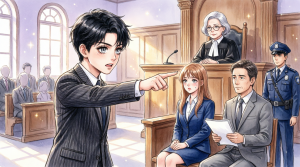
For a man who built himself around reputation, the license hurt most.
I wish I could say that was the moment I felt peace.
It wasn’t.
Peace arrived slower than that.
Ending the discretionary support was not dramatic.
It was paperwork.
Notices went out.
Authorizations were revoked.
The trust administrator did what institutions do best: it converted years of emotional distortion into dates, amounts, and status changes.
Without the invisible support, the Caldwell house had to be sold within eight months.
My father downsized to a rental he described to old acquaintances as temporary.
Tyler disappeared into one new venture after another somewhere in Florida, then Arizona, then silence.
The old office closed.
The staff who had actually done the work found other jobs.
My father wrote twice.
The first letter was angry.
He said I had destroyed the family, betrayed my mother’s memory, embarrassed him publicly, and mistaken independence for cruelty.
The second was different.
Not good, not honest enough to be called transformed, but quieter.
He wrote that perhaps he had not understood me.
He wrote that perhaps he had relied on assumptions.
He wrote that if I wished, we might have coffee one day.
I did not answer either letter.
Not because I needed revenge.
Because silence, for once, belonged to me.
The thing about surviving a parent like that is that people expect the story to end when the parent loses.
It does not.
Their voice lingers.
It lives in your nervous system.
It stands beside you in fitting rooms and budget meetings and empty kitchens.
It asks whether your life looks impressive enough to count.
Whether choosing peace over display is secretly failure.
Whether living alone means being alone.
I had to learn, deliberately, that a modest life chosen on purpose is not a small life.
So I kept mine.
I stayed in my one-bedroom apartment in Unit 4B.
I kept the scuffed shoes.
I expanded the property company slowly, buying neglected buildings with good bones and bad management, renovating them into mixed-income housing.
I shifted part of my practice toward representing women in coercive financial-control cases, because once you see how often money is used as a leash, you stop pretending it is only numbers.
A year after the conservatorship hearing, we opened a renovated building on the west side of the city.
It had once been a decaying office block everyone said was too tired to save.
We turned it into transitional housing and small business space for women leaving financially abusive households.
On the first floor there was a legal clinic.
On the second, furnished apartments.
On the roof, a small garden with stubborn herbs and a skyline view that made the whole city look newly possible.
I named it Margaret House.
Not Caldwell House.
Not Avery Center.
Margaret House.
The opening was small by design.
No orchestra.
No giant donor wall.
Just city staff, tenants, contractors, clinic partners, and a few people who had seen the worst parts of my life without trying to turn them into lessons about themselves.
Lydia came.
So did Judge Sullivan, not in any official capacity, just as a guest who liked seeing a building used well.
At 10:02 that morning, as the ribbon was being cut, I glanced at my watch out of habit.
For
one strange second I was back in that courtroom, hearing my father say incompetent with all the certainty of a man who had never once bothered to know me.
Then someone laughed nearby.
A tenant’s little girl tugged her mother toward the clinic door.
Sun hit the bricks at the exact angle I had hoped it would when we approved the final exterior finish.
The watch on my wrist marked the minute and moved on.
So did I.
I do not know whether my father ever truly understood what he did.
I suspect he understood the cost before he understood the harm.
For some people, consequence is the first language they become willing to hear.
That may have been true for him.
But understanding him stopped being my work.
My work became this: building things that could not be taken by shouting, by shame, by legal intimidation disguised as love.
The last time I saw Richard Caldwell was by accident, nearly two years after the hearing.
I was leaving a coffee shop near the courthouse when he came in through the side door.
He looked older in the way men do when status no longer performs youth for them.
Smaller, too, though perhaps that was only the absence of an audience.
He stopped.
So did I.
For a moment neither of us spoke.
Then he said, “You still wear those same shoes.”
I looked down at them and smiled a little.
“Yes,” I said.
“They hold up well.”
He almost smiled back, but whatever fragile honesty had entered the moment did not stay long enough to become anything useful.
He nodded once.
I nodded once.
Then I walked past him and into the afternoon.
That was enough.
He had once stood in court and tried to reduce me to a cautionary tale: a lonely woman, poorly dressed, living in a small apartment, needing a stronger hand to rescue her from herself.
What he never understood was that every detail he mocked had been earned, chosen, and paid for.
The apartment was mine.
The career was mine.
The quiet was mine.
Even the money that had kept his world upright for a little while longer had been mine to give.
And mine to stop.
The paper he read that day did not just show him where his life had come from.
It showed me, finally and beyond appeal, that I no longer needed him to recognize me for my life to be real.
That was the true ending.
Not his disgrace.
My freedom.
THE END