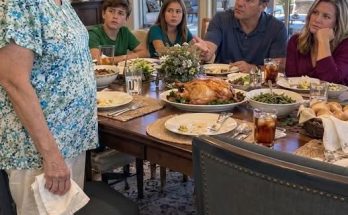
I looked at Daniel. He was waiting for an answer. Not an explanation. Not a discussion. An answer. I glanced at Renee, who sat beside him with her hands folded neatly near her plate. She had put considerable effort into looking uncomfortable, but there was something else in her expression that I recognized. Relief. She wanted me gone, and she wanted the unpleasant task of making it happen to be over as quickly as possible.

I slowly placed my fork beside my plate. “Daniel,” I said quietly, “is this something you’ve both been discussing?” He shifted in his chair. “Mom, we’ve talked about it a few times.” “A few times?” Renee interrupted before he could respond. “Margaret, please don’t make this more difficult than it needs to be. We love you, but we’re a young family. We need our space, and the children need their own routines.”
I looked at my grandchildren. My granddaughter, Emily, was eleven. My grandson, Lucas, was eight. I had packed their lunches, driven them to school, sat beside them through fevers, and read bedtime stories when their parents were too exhausted to manage another thing. I knew Emily hated the crust on her sandwiches. I knew Lucas became nervous before soccer matches and pretended he wasn’t. I knew these things because I had paid attention. Apparently, paying attention had become another way of making myself useful.
“Of course,” I replied. Daniel looked surprised. “Of course?” “I understand.” Renee visibly relaxed. Daniel rubbed the back of his neck. “We’re not saying you have to leave tomorrow. We just think it’s time you started looking at some options.” “Options,” I repeated.
“Maybe one of those retirement communities,” Renee suggested. “Some of them are really lovely. They have activities, other people your age, and everything is taken care of.”
Other people my age.
As if seventy-one meant I had suddenly stopped being a person who could make her own decisions.
As if I hadn’t managed a household for decades, balanced a budget, raised a child, and stood beside my husband through every difficult season of our lives.
I could have told them about the lottery ticket.
I could have explained that, at that very moment, I possessed more money than they could reasonably imagine.
I could have watched their expressions change.
But I didn’t.
Instead, I picked up my napkin, folded it carefully, and placed it beside my plate.
“How much time do you think I have?” I asked.
Daniel glanced at Renee.
“Maybe a month or two?”
“A month or two,” I repeated.
“That should be enough time to find somewhere suitable,” Renee said.
I nodded.
“Then I’ll make arrangements.”
The silence that followed was almost comical.
They had prepared themselves for tears, arguments, perhaps accusations. They had expected me to remind Daniel that I was his mother, that I had sold my own house to help him, and that I had spent the last two years trying to make their lives easier.
They had not expected me to agree.
Daniel cleared his throat.
“Thank you for understanding, Mom.”
I smiled at him.
It was a small smile, the kind I had used for years whenever I wanted to hide that something hurt.
“You’re welcome, Daniel.”
Then I excused myself from the table.
I went upstairs to the little bedroom they had given me when I first arrived.
It was the smallest room in the house, tucked between the laundry room and the children’s bathroom. My belongings occupied two suitcases, a dresser drawer, and a small section of closet space.
I had sold a house filled with thirty-eight years of memories and reduced my life to a few possessions because I thought my son needed me.
I sat on the edge of the bed.
For the first time since Harold’s death, I allowed myself to cry without trying to stop.
I didn’t cry because I was afraid of having nowhere to go.
I cried because I finally understood that I had mistaken being needed for being loved.
And there is a terrible loneliness in discovering that difference inside your own family.
After a while, I wiped my face and opened the bottom drawer of my dresser.
Inside was a small photograph of Harold and me on our wedding anniversary. He was wearing his favorite blue shirt, and I was laughing at something he had said.
I held the photograph in both hands.
“What would you do?” I whispered.
Of course, the room remained silent.
But I could almost hear Harold’s voice.
He had never been a man who raised his voice when he was angry. He believed that the strongest decisions were often made quietly.
He used to tell me, “Maggie, don’t confuse keeping the peace with doing what’s right.”
That night, I finally understood what he meant.
I placed the photograph in my handbag, opened my laptop, and sent a message to my attorney.
I’m ready to move forward with the Willow Creek property.
His reply arrived less than ten minutes later.
Understood. I’ll have the team finalize the acquisition arrangements tomorrow morning. We will continue to protect your identity as agreed.
I read the message twice.
Then I closed the laptop.
For the first time in months, I slept peacefully.
The following morning, I woke before everyone else.
I made coffee, prepared the children’s lunches, and left a note reminding Emily that her science project was due on Friday.
Habit is a curious thing.
Even after someone wounds you, your hands may continue performing the little acts of love they have practiced for years.
At breakfast, Daniel seemed almost cheerful.
“Mom, I was thinking we could help you look at some places this weekend.”
“That’s thoughtful,” I said.
“We can check a few retirement communities online first.”
“I’ll see what I can arrange.”
Renee smiled.
“I’m glad we’re all being reasonable about this.”
Reasonable.
The word stayed with me as I drove Lucas to school.
I wondered how many times women had been called unreasonable for expecting consideration from people they loved.
That afternoon, while Daniel and Renee were at work, I met my attorney through a secure video call.
His name was Thomas Bennett. He was a careful man who spoke slowly, listened closely, and never made promises he couldn’t keep.
He had been helping me structure my lottery winnings through a combination of trusts and legally compliant entities designed to protect my privacy and manage the money responsibly.
The first thing he asked was whether I was certain about the house.
“Absolutely,” I replied.
“The sellers have indicated that the cash offer is attractive, but we need to make sure the purchase is completed through the appropriate entity and that the documentation is entirely in order.”
“I understand.”
“One other question, Margaret. Are you buying this property for yourself?”
I looked out the window at the Arizona sunlight falling across the backyard.
“Yes,” I said. “But I have another reason.”
He waited.
“I want to know what it feels like to own a home again without having to ask anyone’s permission to exist inside it.”
Thomas said nothing for a moment.
Then he answered, “I think that’s a very good reason.”
We reviewed the paperwork.
The property on Willow Creek Lane had been placed back on the market after the previous prospective buyer’s financing arrangements changed. The sellers were now considering offers, and the house was available for a prompt cash purchase.
My advisers had already established an acquisition company as part of my broader financial arrangements.
Its name was MHB Heritage Holdings.
The initials came from Harold’s full name: Matthew Harold Briggs.
Daniel had seen those initials hundreds of times.
For years, he had watched his father use them on business documents, old invoices, and the paperwork associated with the small contracting business Harold once operated.
To Daniel, MHB was simply a familiar family abbreviation.
He had no idea that it would one day become the name associated with the most consequential purchase of his life.
I signed the documents electronically.
The offer went in that afternoon.
By Thursday, the sellers had accepted.
By Friday morning, the title company was preparing the closing documents.
And on Saturday, six days after my son had asked when I intended to leave his house, I became the owner of the property he and Renee had dreamed of buying.
I didn’t tell Daniel.
I didn’t tell Renee.
I didn’t even tell my grandchildren.
Instead, I continued making breakfast and folding laundry.
But something inside me had changed.
I was no longer waiting for someone to decide whether I belonged.
I was preparing to open a door of my own.
And I had no idea how quickly the truth would begin to unravel everything my son thought he knew about me.
PART 3: The Day My Son Discovered Who Owned His Dream House
The first thing I bought for my new home was not a sofa.
It wasn’t a television, a dining table, or even a bed.
It was a rosebush.
A small, healthy rosebush with deep red flowers, purchased from a nursery on the edge of Scottsdale.
The young man who helped me load it into the car asked whether I was planting it for a special occasion.
“Yes,” I told him. “I’m planting it for someone I miss.”
He smiled politely, unaware that he had just helped me bring a little piece of my old life into my new one.
The house on Willow Creek Lane was everything I remembered.
The broad front porch stretched across the front of the Craftsman-style home. Sunlight passed through the tall trees, leaving shifting patterns on the wooden steps. The original hardwood floors creaked softly beneath my feet, and the windows in the dining room overlooked a garden that needed attention.
The house wasn’t perfect.
The kitchen cabinets needed refinishing. One bathroom required repairs, and the back fence leaned slightly to one side.
But I loved it.
It had character.
It had warmth.
Most importantly, it was mine.
Thomas had arranged for the closing to be completed through MHB Heritage Holdings, and the property records reflected the purchasing entity rather than my personal name.
Everything was handled lawfully, with the appropriate disclosures and documentation.
I had no intention of deceiving anyone about ownership if the truth became relevant. I simply wasn’t ready to turn my private financial circumstances into a family discussion.
For years, I had been Margaret Briggs, the wife who supported her husband, the mother who raised her son, and the widow who accepted help because she believed she had no better alternative.
Now I wanted to discover who Margaret Briggs could be when she no longer had to explain herself.
I hired a local contractor to begin the repairs.
I ordered a bed, a comfortable armchair, and a dining table large enough for family dinners.
I chose curtains in a soft cream color and bought new dishes decorated with tiny blue flowers.
I also arranged for a gardener to help restore the flower beds.
The rosebush went near the front porch.
I wanted it to grow where the morning sun could reach it.
For the first time in two years, I was making decisions about a home without wondering whether someone else would approve.
And then, on Monday morning, Daniel received a phone call.
I was in the kitchen at his house, slicing strawberries for Lucas’s lunch, when I heard him answer his phone in the living room.
“Hello?”
A pause.
“Yes, this is Daniel Briggs.”
Another pause.
Then I heard his tone change.
“I’m sorry. Which property?”
He walked toward the window.
“Willow Creek Lane?”
I kept slicing.
He was silent for several seconds.
Then he said, “No, that can’t be right. We made an offer on that house months ago.”
A longer silence followed.
“You’re telling me it’s already sold?”
I placed the knife on the cutting board.
Daniel listened, his expression growing increasingly confused.
“Who bought it?”
Another pause.
“MHB Heritage Holdings?”
The knife remained on the board.
I didn’t turn around.
I didn’t need to see his face to know that the name had caught his attention.
“All right,” he said finally. “Thank you for letting me know.”
He ended the call and stood motionless.
When I turned, he was staring at his phone.
“Everything all right?” I asked.
He looked up quickly.
“Yes. It’s just that house we wanted.”
“The one on Willow Creek Lane?”
He nodded.
“Apparently someone bought it.”
“I’m sorry to hear that.”
He frowned.
“Do you know anything about MHB Heritage Holdings?”
I shook my head.
“Should I?”
“I don’t know. The name sounds familiar.”
I picked up the strawberries and placed them into a container.
“Perhaps you’ve seen it somewhere.”
He studied me for a moment, as though he expected me to say something else.
Then he shook his head.
“Probably.”
He walked away.
That evening, Renee was furious.
She had apparently been researching the purchase and discovered that the new owner had paid cash through a company with no publicly obvious connection to an individual buyer.
“They must have more money than they know what to do with,” she said, pacing the living room.
Daniel sat on the sofa, scrolling through his phone.
“Maybe it’s an investment company.”
“An investment company bought the exact house we wanted, and nobody even gave us a chance to match the offer?”
“They probably wanted to close quickly.”
Renee stopped pacing.
“Do you know how much we would have had to save to afford that place? We spent months planning everything.”
I was folding towels at the dining table, listening without looking up.
“I know,” Daniel replied.
“Four bedrooms, a proper garden, room for the children. We could have finally had somewhere that felt permanent.”
He sighed.
“I know, Renee.”
She lowered herself onto the sofa.
Then she said something that made me pause.
“Well, at least once your mother moves out, we’ll have more room here.”
Daniel didn’t answer.
For the first time, I wondered whether he had begun to understand the connection between the things he wanted and the things he was willing to sacrifice.
I hoped he had.
But hope is not evidence of change.
So I kept my plans to myself.
Over the next two weeks, I made quiet preparations to leave.
I arranged for a moving company to collect my belongings. I donated the clothes I no longer wore and packed my photographs, Harold’s watch, my books, and the small collection of recipes I had handwritten over the years.
I also set aside something for Emily and Lucas.
For Emily, I bought a notebook with a blue cloth cover. She loved writing stories, and I wanted her to have a place to keep them.
For Lucas, I bought a small wooden box for his soccer medals and the other treasures eight-year-old boys collect.
I wrote a letter to each of them.
Not a goodbye forever.
Just a reminder that they could always speak to me honestly, that they were loved, and that growing older did not mean losing the right to choose their own lives.
I didn’t know whether Daniel and Renee would encourage the children to visit me.
I hoped they would.
But I was no longer willing to make my entire life depend on someone else’s willingness to include me.
One Friday evening, Daniel found me packing a box in my bedroom.
“You’re really doing this, then?” he asked.
I folded a sweater and placed it inside.
“Yes.”
He leaned against the doorframe.
“Have you found somewhere?”
“I have.”
“Where?”
“A house.”
He laughed nervously.
“A house? Mom, those places are expensive.”
“I know.”
“Have you thought about the maintenance? Property taxes? Insurance? All the things that come with owning a home?”
I looked at him.
“I have.”
He shook his head.
“I just don’t want you making a decision you’ll regret.”
For a moment, I almost laughed.
Not because his concern was amusing, but because it was so late in coming.
When I had sold my previous house, he hadn’t asked whether I might regret it.
When I had moved into the smallest bedroom in his home, he hadn’t asked whether I was comfortable.
When he had asked me to leave, he hadn’t asked whether I had somewhere safe to go.
Yet now, suddenly, he was concerned about my future.
“Thank you, Daniel,” I said. “I’ll be careful.”
He seemed relieved that I wasn’t arguing.
“Good. We can help you move next weekend.”
“That’s kind of you.”
He hesitated.
Then he asked, “Mom, you haven’t been hiding anything from us, have you?”
My hands went still.
“What do you mean?”
“I don’t know. You’ve seemed different lately.”
I looked directly at him.
“Perhaps I am different.”
He waited, but I offered no explanation.
Finally, he shrugged.
“Well, as long as you’re all right.”
He walked away.
I sat on the bed after he left, listening to his footsteps fade down the hall.
There had been a time when I would have chased after him.
I would have asked whether he was worried about me, whether he was angry, whether he needed something.
I would have done anything to keep him from walking away with an unanswered question.
But that night, I returned to packing.
Some questions deserve to remain unanswered until the person asking them is ready to hear the truth.
Moving day arrived on a clear Saturday morning.
A truck pulled into the driveway just after eight.
Daniel came downstairs wearing jeans and a gray T-shirt. Renee followed, holding a mug of coffee.
“Looks like you’ve got everything organized,” he said.
“I’ve tried.”
The movers carried my suitcases downstairs first, followed by my boxes and the few pieces of furniture I had decided to keep.
My old armchair was the last item loaded.
I had sat in that chair nearly every evening since Harold died, holding a book I rarely read and trying to become accustomed to a life that had changed beyond recognition.
As the movers carried it away, I felt a small, unexpected pang of sadness.
Then I remembered the chair waiting for me in my new home.
I didn’t need to cling to every object that had witnessed my grief.
I could take the memories and leave the sorrow behind.
Emily came running down the stairs.
“Grandma, are you leaving now?”
I knelt to hug her.
“Yes, sweetheart.”
“Can I visit your new house?”
“Of course you can.”
She looked worried.
“Promise?”
I brushed a strand of hair away from her face.
“I promise that my door will always be open to you.”
Lucas wrapped his arms around my waist.
“Will you still make your pancakes?”
I smiled.
“Every time you ask.”
Renee called the children toward the kitchen.
Daniel stood near the front door, watching me.
For one brief moment, I thought he might apologize.
He didn’t.
Instead, he said, “I hope everything works out for you, Mom.”
I looked at my son.
“I hope it works out for you, too.”
Then I climbed into the car.
As we pulled away, I watched the house disappear behind us.
I had arrived there believing that family meant never having to stand alone.
I left understanding that family should never require you to abandon yourself.
When we arrived at Willow Creek Lane, the front door stood open.
The contractor had finished the most urgent repairs, and the house smelled faintly of fresh paint and clean wood.
Sunlight poured across the floorboards.
I walked into the living room and stood in the center of the space.
For several seconds, I couldn’t speak.
It wasn’t because the house was magnificent.
It was because nobody could tell me that I was taking up too much space.
Nobody could make me feel guilty for sitting down.
Nobody could turn my presence into an unpaid obligation.
I walked into the kitchen and placed Harold’s photograph on the counter.
Then I went outside and planted the rosebush near the porch.
The soil was soft from the gardener’s work. I dug a small hole, lowered the roots into place, and covered them carefully.
When I finished, I sat on the porch steps.
“Well, Harold,” I whispered, “I finally have a place of my own again.”
A gentle breeze moved through the trees.
I smiled.
For the first time in years, the future felt like something waiting to be discovered rather than something I had to endure.
I thought that would be the end of the story.
I was wrong.
Because the following Tuesday, my phone rang.
It was Daniel.
“Mom,” he said, “I need to ask you something.”
I was standing in my new kitchen, preparing tea.
“All right.”
“Do you remember the company that bought the Willow Creek house?”
I set the kettle down.
“Yes.”
“Well, I found something strange.”
I waited.
He continued, speaking more quickly now.
“I was looking through some old documents Dad kept. I found a business record with the initials MHB. It was from years ago, and it had his full name on it.”
I said nothing.
“Mom, I know this sounds ridiculous, but the company that bought the house has the same initials.”
I watched steam rise from the kettle.
“That is interesting,” I replied.
“Interesting? Mom, what if it’s connected to Dad’s old business?”
“Perhaps it is.”
He exhaled sharply.
“I called the property agent. They wouldn’t tell me anything about the buyer. They said I would need to contact the company through the proper channels.”
“That sounds reasonable.”
“Mom, why are you being so calm?”
I looked through the kitchen window at the red roses near the porch.
“Because, Daniel, not every mystery needs to be solved immediately.”
He was silent.
Then he asked the question I had been waiting for.
“Mom, where exactly are you living now?”
I could have told him.
I could have ended the uncertainty with a single sentence.
Instead, I gave him the address.
There was a long pause.
Then I heard him say, very softly, “Willow Creek Lane?”
“Yes.”
He didn’t speak.
I waited.
Finally, he whispered, “Mom, that’s the house.”
“Yes, Daniel.”
“But how?”
I took a slow breath.
“Why don’t you come over and see me?”
He arrived forty minutes later.
I heard his car pull into the driveway before I saw him through the front window.
He got out slowly and stared at the house.
He looked at the porch, the tall trees, the freshly painted trim, and the flower beds.
Then he looked at the number beside the front door.
He checked his phone.
Then he looked at the house again.
When I opened the door, he appeared unable to decide whether to speak or ask a question.
“Come in,” I said.
He stepped across the threshold.
His eyes moved from the hardwood floors to the dining room, then to the kitchen, where Harold’s photograph sat beside a vase of roses.
“This is really the house?”
“Yes.”
“But the company—”
“Come sit down, Daniel.”
He followed me into the living room.
For a few seconds, neither of us spoke.
Then he looked at me with an expression I had never seen on his face before.
Not anger.
Not irritation.
Something closer to fear.
“Mom,” he said, “who owns this house?”
I looked at my son.
And for the first time in months, I decided I would no longer make the truth smaller to protect his comfort.
“I do.”
He stared at me.
“What?”
“I purchased it through MHB Heritage Holdings.”
He slowly lowered himself into the chair opposite mine.
“But how could you afford—”
He stopped.
His eyes moved toward the photograph of his father.
Then back to me.
“Mom, where did you get that kind of money?”
I reached into my handbag and removed a small folder.
Inside was a copy of the letter my attorney had prepared confirming the lottery claim and the arrangements that followed it.
I placed it on the coffee table.
Daniel looked down.
He read the first page.
Then he read it again.
His face drained of color.
Finally, he raised his eyes.
“You’re a millionaire?”
I shook my head gently.
“More than that.”
He looked at the document again.
Then he whispered, “How much?”