Two days later, the medical team approved a short visit for Ethan. We explained beforehand that his mother was still recovering and might not be able to speak much. He listened carefully. “Will she know it’s me?” “The doctors believe she’s beginning to respond to people,” I said. “But she may be tired, and we need to let her rest.” He nodded. “I can be quiet.” When we entered the room, Laura was awake.
Her eyes were open, and she was looking toward the window. A nurse stood beside the bed. When she saw us, she smiled gently and told Laura that her family had arrived. Ethan froze in the doorway. For a moment, he didn’t move. Then Laura turned her head. Her gaze settled on him. Ethan’s mouth fell open. “Mommy?” Laura’s eyes filled with tears. Her lips moved. It took her several attempts to form the word. “Ethan.”
Our son ran two steps forward before remembering the nurse’s instructions. He stopped beside the bed. “I’m here, Mommy.” Laura lifted her fingers slightly. The nurse helped position her hand so Ethan could touch it safely. He placed his small hand against hers. Then he began crying. “I knew you were still there.” Laura’s eyes remained fixed on him. She couldn’t say much, but her fingers moved gently against his. Ethan leaned close. “I told Daddy to check on you. I told him you were calling me.” Laura blinked slowly.
A tear slipped down her cheek.
I stood beside them, unable to speak.
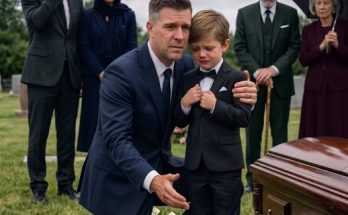
For seven days, I had carried the image of my son standing beside his mother’s grave, begging me not to leave her behind.
Now he was standing beside her hospital bed.
She was alive.
She was awake enough to recognize him.
And he was holding her hand.
The nurse eventually reminded us that Laura needed rest.
Ethan nodded, although he clearly didn’t want to leave.
Before we went, he leaned close to his mother.
“I love you, Mommy.”
Laura’s lips moved.
“I… love… you.”
The words were faint and slow.
But Ethan heard them.
He looked at me with an expression I would never forget.
“She said it, Daddy.”
I wrapped my arms around him.
“Yes, buddy. She did.”
We left the room together.
In the corridor, Ethan jumped up and down with the energy of a child who had been carrying too much sorrow for too long.
“Can we tell Grandma? Can we tell Aunt Margaret? Can we tell my teacher?”
I laughed through my tears.
“We can tell Grandma and Aunt Margaret. We’ll wait until Mommy’s doctors say she’s ready for more visitors before we make other plans.”
He nodded.
Then he took my hand.
“Daddy?”
“Yes?”
“Now we can go home and wait for her.”
I knelt beside him.
“Yes, buddy. Now we can wait for her.”
For the first time since Laura died—or since we believed she had died—I could say those words without feeling that they were a farewell.
They were a promise of patience.
A promise of hope.
A promise that our family still had a chance.
Chapter 14: What the Investigation Revealed
The medical and procedural review continued after Laura regained consciousness.
The authorities examined the original emergency response, the records documenting her condition, and the procedures followed before the funeral.
The findings were serious.
The review determined that the original assessment had not adequately resolved certain signs of uncertainty before the final declaration was made.
Some observations had been interpreted as consistent with death, but the later examination demonstrated that the situation required a more complete explanation.
The officials did not present the case as evidence that people commonly return from death.
They emphasized that Laura’s circumstances were exceptionally unusual and that the review was intended to establish exactly what had gone wrong.
The relevant organizations were instructed to examine their procedures, and the medical professionals involved cooperated with the review.
For our family, the investigation was painful.
Every interview forced me to revisit the morning I found Laura.
Every question brought back the funeral, the grave, and Ethan’s desperate voice.
I answered honestly.
I did not accuse people of intentional wrongdoing without evidence.
I did not pretend to understand the medical details.
I told the investigators what I had seen, what I had heard, and what I had been told.
At the conclusion of one meeting, an official thanked me for providing a detailed timeline.
“Your son’s report helped prompt a further assessment,” she said. “We cannot determine exactly what he heard at the cemetery, but your decision to seek help allowed the circumstances to be reviewed.”
I nodded.
“I’m grateful someone listened.”
She paused.
“So are we.”
The review led to changes in how uncertain cases were documented and escalated within the relevant organization.
The specific medical circumstances remained rare, but the lesson was clear: when uncertainty exists, it must be addressed carefully, and the proper safeguards must be followed.
I didn’t need a public scandal.
I didn’t need someone to be humiliated.
I wanted to know what had happened to my wife, and I wanted to know that the people responsible had learned from it.
That was the only outcome that could make any sense of the experience.
Chapter 15: The Long Road Back
Laura did not come home the following week.
Or the week after that.
Her recovery was slow.
She needed continued medical treatment, rehabilitation, and careful monitoring. There were days when she was alert and able to speak for several minutes, followed by hours when exhaustion overwhelmed her.
Some memories came back easily.
Others seemed distant.
She remembered Ethan’s birth.
She remembered our first apartment.
She remembered the little house we bought when Ethan was two.
But she had no clear memory of the night she became unresponsive.
When she asked me what had happened, I explained as much as I could without overwhelming her.
“You were very ill,” I told her. “We thought you had died. The doctors are still reviewing exactly what happened.”
She looked frightened.
I took her hand.
“You’re safe now. They’re taking care of you.”
She closed her eyes.
“I don’t remember.”
“That’s all right. You don’t have to remember everything right now.”
She swallowed.
“Ethan?”
“He’s safe. He’s been visiting whenever the doctors say it’s okay.”
Tears gathered in her eyes.
“Did he see…?”
“He saw you in the hospital. He’s been very brave.”
She squeezed my hand weakly.
“I want to see him.”
“You will.”
The first time she was strong enough to sit upright for a longer visit, Ethan brought her a stack of drawings.
He had made one for every day she had been away.
There were pictures of our house, our dog, the garden, and the three of us standing beneath a yellow sun.
On the last page, he had drawn a hospital with a little figure waving from the window.
Above it, he had written:
MOMMY IS COMING HOME.
Laura cried when she saw it.
She pressed the paper to her chest.
“I love you,” she whispered.
Ethan climbed carefully onto the chair beside her.
“I love you too.”
For several minutes, they sat together holding hands.
I stood by the window and watched them.
I had once believed that the hardest part of this story would be the moment we discovered Laura was alive.
I was wrong.
The hardest part was learning how to live with uncertainty again.
We had no guarantee that Laura would recover completely.
We had no way to erase the fear Ethan had experienced.
We couldn’t return to the family we had been before that terrible week.
But we could begin building a new version of our life.
One day at a time.
One medical appointment at a time.
One small improvement at a time.
And each evening, when I helped Ethan get ready for bed, I reminded him that his mother loved him.
Not because I wanted him to forget what had happened.
Because I wanted him to understand that he had never been responsible for saving her.
He had been a frightened child who told his father something important.
The adults had been responsible for deciding how to respond.
And when the situation became uncertain, the right thing had been to seek professional help.
Chapter 16: The First Night Home
Laura returned home several months later.
The doctors had cleared her for discharge with a rehabilitation plan, follow-up appointments, and clear instructions about the care she would need.
I had prepared the house carefully.
I moved furniture to make it easier for her to get around.
I installed safety rails where recommended.
I arranged her medications and appointments with the help of the medical team.
Ethan insisted on helping me decorate the living room.
He placed his drawings on the refrigerator and made a sign for the front door.
WELCOME HOME, MOMMY.
When Laura stepped inside, she stopped.
Her eyes moved slowly around the room.
The sofa.
The family photographs.
The little table beside the window.
The yellow curtains she had chosen years earlier.
She began to cry.
I took her hand.
“It’s still home,” I whispered.
She looked at me.
“I thought I’d never see it again.”
I held her gently.
“Neither did I.”
Ethan hurried over and wrapped his arms around her waist.
Laura bent carefully and kissed the top of his head.
“My baby.”
He held her tightly.
“I saved your picture.”
She looked at the drawings in his hands.
“You did?”
He nodded.
“All of them.”
Laura smiled through her tears.
“Then I think we should put them somewhere special.”
That evening, we ate dinner together at the kitchen table.
Laura was tired, so we kept the meal simple.
Soup.
Bread.
A little fruit.
Ethan talked almost nonstop about school.
He told her about his friends, his teacher, and the time he had accidentally dropped his lunchbox in a puddle.
Laura listened, occasionally asking a question.
Sometimes she seemed overwhelmed by the conversation and needed to rest.
We learned to slow down.
After dinner, I helped her settle into bed.
Ethan stood beside the doorway, holding his favorite stuffed dog.
“Mommy?”
“Yes, sweetheart?”
“Can I sleep in your room tonight?”
Laura looked at me.
I smiled.
“If the doctors’ instructions allow it, we can make him a little bed nearby.”
She nodded.
“Of course.”
We arranged a small mattress on the floor.
Ethan climbed beneath his blanket and turned toward his mother.
“Mommy?”
“Yes?”
“Do you remember calling me?”
Laura grew quiet.
I sat on the edge of her bed.
She looked at Ethan carefully.
“I don’t remember what happened when I was sick,” she said. “I know you heard something that frightened you, and I’m so glad you told Daddy.”
He frowned.
“But did you call me?”
Laura reached toward him.
“I can’t tell you something I don’t remember, sweetheart. But I know you love me, and I know you wanted me to be safe.”
Ethan considered that.
Then he nodded.
“Okay.”
Laura stroked his hair.
“You never have to prove how much you love me. You can always tell us when you’re frightened or worried. We’ll listen.”
He smiled faintly.
“Even if it’s weird?”
“Especially then,” she whispered.
I looked away, overcome.
When Ethan finally fell asleep, Laura took my hand.
“Michael?”
“I’m here.”
She studied my face.
“I’m sorry.”
I shook my head.
“You don’t have to apologize.”
“I was frightened before I got sick. I knew something was wrong, but I didn’t want to worry you.”
I squeezed her hand.
“We’ll talk about it when you’re stronger.”
She nodded.
Then she whispered, “Thank you for listening to Ethan.”
I looked toward our son, asleep on the mattress beside the bed.
“I almost didn’t.”
“But you did.”
I swallowed.
“Yes.”
She closed her eyes.
I sat beside her until I was certain she was comfortable.
For the first time in months, our house was quiet in a way that didn’t feel empty.
It felt peaceful.
Chapter 17: The Promise We Made
A year later, we returned to the cemetery.
Not to visit Laura’s grave.
To visit the place where our family had faced the most frightening day of our lives.
Laura came with us, walking slowly but steadily.
Ethan held her hand on one side and mine on the other.
We stood beneath the maple trees while the wind moved softly through the branches.
For a long time, nobody spoke.
Then Ethan looked up at his mother.
“Do you remember when I told Daddy you were calling me?”
Laura nodded.
“I remember what you’ve told me.”
“Everyone thought I was wrong.”
She knelt carefully in front of him.
“Sometimes grown-ups don’t understand something right away. That doesn’t mean you should be afraid to speak. It means we should listen, ask questions, and find the right people to help.”
Ethan thought about that.
“Even if they’re doctors?”
“Even if they’re doctors,” Laura said gently. “Doctors know a great deal, but they still need accurate information. If something worries you, it’s okay to tell them. They can investigate it.”
He nodded.
Then he hugged her.
I watched them beneath the trees and remembered the little boy who had stood beside his mother’s grave, crying and begging me to believe him.
He had not understood medical procedures.
He had not known what was happening to his mother.
He had simply known that something felt wrong.
And he had been brave enough to say so.
I took Laura’s hand.
“I almost walked away that day,” I admitted.
She looked at me.
“But you didn’t.”
“No.”
“That’s what matters.”
We stood together for a few more minutes.
Then Ethan pointed toward the path.
“Can we get ice cream?”
Laura laughed.
“Yes, sweetheart. We can get ice cream.”
He took off running toward the parking lot before remembering that he was supposed to walk beside us.
“Slow down!” I called.
He turned around, grinning.
For the first time in a very long time, his laughter sounded uncomplicated.
Laura leaned against me.
“I never want to forget what we learned,” she said.
“Neither do I.”
“What did you learn?”
I looked toward Ethan.
“That love isn’t just about protecting someone from danger. Sometimes it’s about listening when they tell you something you don’t understand.”
Laura nodded.
“And I learned that I shouldn’t hide when I’m frightened.”
I kissed her forehead.
“We’re going to do better.”
She squeezed my hand.
“Yes,” she whispered. “We are.”
Epilogue: The Voice We Almost Ignored
Two years after the day of Laura’s funeral, I still remembered the sound of the rain.
I remembered the flowers beside the grave.
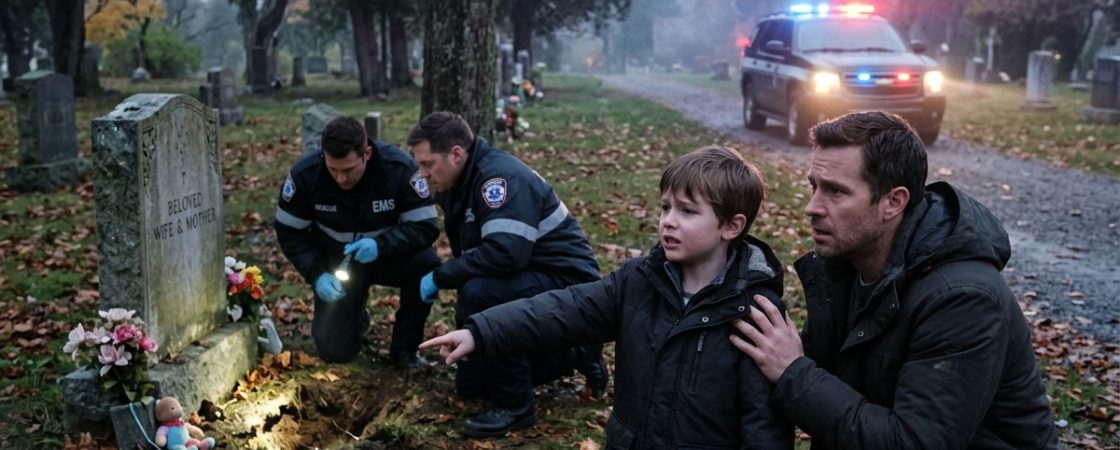
I remembered the way Ethan had tugged at my jacket and whispered, “Daddy, please check on Mommy.”
Sometimes, I wondered what would have happened if I had told him to stop imagining things.
What if I had dismissed his words as grief?
What if I had walked to the car and driven home?
I could not know.
The medical review had established that Laura’s original assessment had required further scrutiny, but it had not turned her survival into a simple miracle or proved that Ethan possessed some extraordinary ability.
We never claimed that it had.
We understood that his experience could not explain the medical event on its own.
What mattered was that he had spoken up, I had taken his concern seriously, and qualified professionals had been asked to review the situation.
That decision had opened the door to an urgent assessment.
And that assessment had given Laura a chance to receive treatment.
Today, Laura still attends follow-up appointments.
Some memories of that period remain unclear to her.
Our family has had to learn patience, accept uncertainty, and appreciate ordinary days in a way we never did before.
Ethan is older now.
He still draws pictures of the three of us beneath a yellow sun.
The first picture—the one he placed beside Laura’s grave—hangs in a frame above his desk.
He refuses to throw it away.
One evening, I asked him why.
He shrugged.
“Because it reminds me that I should tell people when something feels wrong.”
I sat beside him.
“That is a good reason.”
He looked at me.
“Daddy?”
“Yes?”
“Do you think Mommy would be here if I hadn’t said anything?”
I took a breath.
“I don’t know exactly what would have happened. But I know that telling me what you experienced helped us ask the right people to check. And I’m very glad you told me.”
He nodded.
Then he leaned against my shoulder.
I wrapped my arm around him.
Across the room, Laura was reading a book beneath the warm light of the lamp.
She looked up and smiled at us.
For a moment, I remembered the hospital room, the machines, and the first faint movement of her fingers beneath mine.
I remembered how close we had come to saying goodbye forever.
Then Laura closed her book.
“Are you two coming to bed soon?”
Ethan grinned.
“In a minute, Mommy!”
She shook her head with a smile.
“That’s what you always say.”
I laughed.
And in that ordinary moment, surrounded by the people I loved, I understood something I had struggled to learn during the darkest days of my life.
We cannot always control what happens to the people we love.
We cannot always understand every warning sign.
And we cannot always find the right words when grief or fear makes everything feel impossible.
But we can listen.
We can ask questions.
We can seek help from people qualified to provide it.
And we can refuse to let embarrassment or fear keep us silent when something important needs attention.
Ethan had not saved his mother through magic.
He had done something simpler, and perhaps more important.
He had told the truth about what he experienced.
And I had finally listened.
Sometimes, that is where the most extraordinary changes begin.
Not with certainty.
Not with a miracle we can explain.
But with one small voice asking us not to walk away.