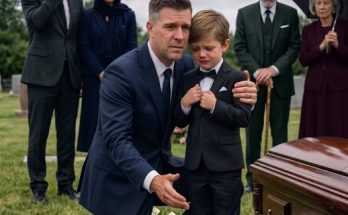
We were finally allowed to see Laura shortly after seven that evening, once the medical team had determined that a brief family visit would be appropriate. Ethan held my hand so tightly that his fingers hurt. A nurse led us through a corridor into a private room. The lights were dim. Machines stood beside the bed, and monitors displayed information I didn’t understand. Laura lay beneath a white blanket. Her face was pale.
A breathing tube and other medical equipment surrounded her, and several lines ran beneath the blanket toward the monitors. For a moment, I couldn’t move. It was Laura. My wife. The woman who used to sing badly while making pancakes. The woman who left little notes in my lunch bag when I worked long shifts. The woman who had sat beside Ethan for hours when he was frightened of thunderstorms. She looked impossibly fragile. Ethan made a small sound. “Mommy?”
He moved toward the bed, but the nurse gently stopped him and explained that he could stand beside me and speak to her without touching the equipment. I knelt beside him. “Mommy’s receiving treatment,” I whispered. “We need to be gentle.” He nodded. Then he leaned toward the bed. “Hi, Mommy. It’s me.” His voice trembled. “I made you a picture.” He held up his drawing.
“I put a heart beside your name because I love you.”
I covered my mouth.
For a long moment, the room was filled only with the soft sounds of the machines.
Then Ethan whispered, “You don’t have to be scared. Daddy’s here.”
I looked at Laura’s face.
I had no idea whether she could hear him.
I had no idea whether she could understand anything happening around her.
But I stood beside my son and let him speak.
He told her about school.
He told her that his teacher had given him a sticker for helping another child.
He told her that he had fed the dog, although he had forgotten to put the lid back on the food container.
Then he leaned closer.
“I knew you were still here, Mommy.”
A nurse looked away, visibly moved.
I gently placed my hand on Ethan’s shoulder.
“We should let Mommy rest now.”
He nodded reluctantly.
Before leaving, he placed his drawing on a small table near the door.
Then he turned toward Laura.
“I love you.”
I stood beside him.
“I love you too, Laura,” I whispered.
We left the room.
In the corridor, I leaned against the wall and finally broke down.
I cried so hard that I could barely breathe.
Not because I knew Laura would recover.
I didn’t.
I cried because I had seen her alive.
Because I had heard the doctor confirm that she was receiving treatment.
Because my son had been able to speak to his mother again.
And because I had come within hours of accepting a goodbye that might not have been the end.
Daniel put a hand on my shoulder.
“Michael.”
I shook my head.
“I don’t know what to do.”
“You don’t have to know everything tonight.”
He was right.
For the first time in three days, I didn’t need to arrange a funeral, answer condolences, or explain to Ethan why his mother would never come home.
I needed to wait.
To listen.
To let the doctors work.
And to hope.
Chapter 6: The Questions Nobody Could Ignore
The next morning, a hospital administrator and two officials involved in the review asked to speak with me.
They explained that the circumstances required a formal investigation into the initial pronouncement, the handling of Laura’s body, and the procedures that followed.
I was asked to provide a detailed timeline.
I described finding Laura unresponsive.
I described calling emergency services.
I explained what the paramedics had done and what the physician had told me.
I provided the names of the people who had been present and the times I could remember.
Then I described the funeral home.
The warmth of Laura’s hand.
Ethan’s question.
The way he had insisted that he heard his mother calling his name.
I made it clear that I could not prove what Ethan had heard.
I could only report his words and the events that followed.
The officials thanked me.
They explained that they would review the medical records, speak with the professionals involved, and determine whether any procedures had been improperly performed or any warning signs overlooked.
They also asked whether I had noticed anything unusual in Laura’s health before her death.
I told them about the headaches and fatigue.
I told them about the occasional dizziness.
I told them that she had been sleeping poorly and had mentioned feeling unusually weak in the days before she died.
They wrote everything down.
When the meeting ended, one of the officials paused at the door.
“Mr. Walker, I know this is an extraordinarily difficult situation. Please remember that the purpose of the review is to establish what happened. You do not need to determine that yourself.”
I thanked him.
After they left, I went to the hospital cafeteria and bought a cup of coffee I barely touched.
I sat by the window and watched people crossing the parking lot.
Some were carrying flowers.
Some were talking on their phones.
Some were simply walking toward their cars, returning to ordinary lives that had not been turned upside down.
I wondered how many people had passed through those doors believing that a loved one was gone.
I wondered how much trust we placed in medical systems because we had no choice but to trust the people who understood what we could not.
And I wondered how we would ever understand what had happened to Laura.
My phone vibrated.
It was a message from my supervisor at work.
Take whatever time you need. Don’t worry about the job.
I stared at it.
For years, I had measured my life in shifts, deadlines, and projects.
I had believed that if I worked hard enough, I could protect my family from almost anything.
But I couldn’t build a wall strong enough to keep death away.
I couldn’t calculate my way out of grief.
And I couldn’t force the world to make sense simply because I needed it to.
All I could do was show up.
So I finished my coffee, returned to the ward, and sat beside Ethan while we waited for another update.
Chapter 7: The First Sign of Hope
For two days, Laura remained critically ill.
The medical team provided treatment and monitored her condition closely.
The doctors explained that the initial findings were unusual and that the full explanation might take time to establish.
They were also cautious about making promises.
Laura’s survival was only the first hurdle.
They needed to understand the extent of her condition and whether she had suffered any lasting injury.
I slept in a chair beside Ethan in a family waiting room.
Margaret brought us clean clothes.
Daniel arranged meals.
Friends sent messages and flowers, though I barely had the energy to read them.
Every time a doctor approached, I stood.
Every time a nurse opened the door, my heart jumped.
On the third morning, Dr. Carter asked to speak with me.
I followed her into the consultation room.
“Your wife is stable enough that we’re cautiously encouraged,” she said. “She remains seriously ill, and there are still important questions about her condition. But she has responded to treatment.”
I pressed my hands together.
“Can she hear us?”
“We can’t be certain. Some patients may have periods of awareness, but we need to assess her neurological condition as she stabilizes.”
“Can I talk to her?”
“Yes, as long as you follow the team’s instructions and understand that we cannot predict how she will respond.”
I nodded.
When I returned to the room, Ethan was sitting on the floor drawing.
“Buddy,” I said, “the doctor says Mommy is responding to treatment.”
He looked up.
“Does that mean she’s getting better?”
“It means we’re seeing some encouraging signs.”
He sprang to his feet.
“Can I tell her about my sticker?”
I smiled for the first time in days.
“Yes. We’ll ask the nurse when we can visit.”
That afternoon, we were allowed to sit beside Laura for a few minutes.
Ethan told her about the sticker.
He told her that his teacher had asked him to explain why he had been absent.
He told her that he had said his mother was sick.
Then he leaned close.
“Mommy, if you can hear me, squeeze my hand.”
I stood still.
A nurse watched the monitor.
Nothing happened.
Ethan waited.
Then he looked at me.
“Maybe she’s tired.”
I crouched beside him.
“Maybe.”
He nodded, accepting the answer.
We stayed a few more minutes before leaving.
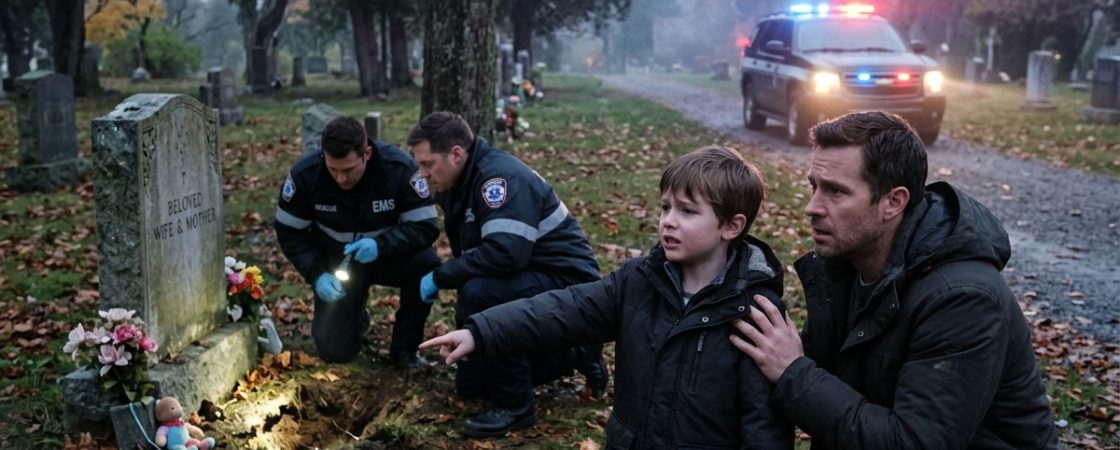
That evening, as I sat alone beside the window, I thought about the moment at the cemetery when Ethan had asked me to check on his mother.
I had almost dismissed him.
I had almost told him that grief was making him imagine things.
And perhaps, in part, grief had shaped what he experienced.
I still didn’t know.
But I was grateful that I had listened.
Not because a child could diagnose a medical condition.
Not because every unusual feeling or dream should be treated as proof of a miracle.
But because when something didn’t make sense, the responsible choice had been to ask qualified people to review it.
That decision had changed everything.
Chapter 8: The Hand That Moved
On the fifth day, I was sitting beside Laura’s bed when the nurse adjusted one of the monitors.
Ethan was at school with Margaret, who had insisted that he needed a few hours of routine.
I had been talking to Laura about ordinary things.
The weather.
The garden.
The way our neighbor had accidentally sent a birthday card to the wrong house.
I had no idea whether she could hear me.
But speaking to her made the room feel less empty.
“Ethan misses you,” I whispered. “He keeps asking whether you’re going to come home.”
I swallowed.
“I miss you too.”
I sat back.
For a moment, I watched the steady movement of the monitor.
Then I reached for Laura’s hand.
It was warm.
Not the uncertain warmth I had noticed at the funeral home.
Real warmth.
I held it gently.
“Laura, if you can hear me, you don’t have to fight alone.”
I waited.
Nothing happened.
I was about to release her hand when I felt a faint movement beneath my fingers.
I froze.
It was so slight that I wondered whether I had imagined it.
I leaned forward.
“Laura?”
I watched her hand.
Then it moved again.
Only a fraction.
But enough.
I pressed the call button.
A nurse entered immediately.
“What’s wrong?”
“I think she moved her hand.”
The nurse checked Laura’s condition and called for the doctor.
Within minutes, Dr. Carter was in the room.
She examined Laura, asked me to describe exactly what I had seen, and began a series of assessments.
I stepped back, trembling.
The team spoke in quiet, precise voices.
They checked Laura’s responses and reviewed the monitors.
Then Dr. Carter looked at me.
“We’ve observed a response that warrants further neurological assessment.”
I gripped the bedrail.
“What does that mean?”
“It may indicate a response to stimulation, but we need to determine what kind of response it is and whether it is consistent.”
I nodded quickly.
“Please do whatever you need to do.”
The doctors continued their assessment.
I waited in the corridor.
Twenty minutes later, Dr. Carter returned.
“We’ve observed another response. We’re arranging additional testing to assess her neurological function.”
I covered my mouth.
“Is she waking up?”
“Not yet. We need to be cautious. A response does not necessarily mean that someone is conscious or able to understand what is happening.”
I understood.
But hope had already begun growing inside me.
That evening, I called Margaret and asked her to bring Ethan to the hospital the following morning if the medical team permitted a visit.
I wanted him to see his mother.
I wanted him to know that she was receiving care.
And I wanted him to understand that his words at the cemetery had been heard.
Not because they had magically solved a medical mystery.
Because he had spoken up, and the adults around him had finally taken his concern seriously enough to seek a proper assessment.