It was a Sunday afternoon in April, the kind of quiet Easter I had grown used to since retirement. The house was still, almost too still, filled with the warm smell of slow-roasted ham and black coffee, with sunlight falling in soft rectangles across the kitchen floor. Outside my window, the daffodils had started to bloom, and for a little while that morning, everything had looked ordinary enough to fool a man into believing life had softened.
I was sitting alone at my small dining table, one hand wrapped around a coffee mug gone lukewarm, waiting for my daughter Lily to call later in the day.
She always called on holidays.
Always.
Even after she married Richard Vance and moved into that giant stone mansion on the hill. Even after her voice slowly changed over the last five years from bright and easy to careful and measured, like every sentence had to pass through someone else’s permission before it reached me. She still called.
That was why, when my phone rang at exactly 1:04 PM and her name appeared on the screen, a small smile touched my face before I even answered.
“Happy Easter, sweetheart,” I said.
What came through the line was not a greeting.
It wasn’t laughter, or a teasing complaint, or her soft little “Hi, Dad” that still had traces of the girl who used to race barefoot across my backyard with popsicle juice dripping down her wrist.
It was terror.
“Dad… oh my God… please…”
Her voice was shattered. Wet with tears. So broken I almost didn’t recognize it.
I straightened so fast my chair legs scraped hard against the floor.
“Lily?” I said. “What’s wrong? Talk to me.”
“Please come get me,” she choked out. “He… he hit me again, Dad. It’s bad this time…”
Again.
That word hit harder than the panic in her voice.
Because fathers know things they pretend not to know until the truth says itself out loud. I had seen the long sleeves in summer. The careful makeup. The explanations given too quickly. The way she stopped hugging with her whole body and started leaning in like someone bracing for impact.
I had known.
Or at least I had known enough to fear it.
Before I could say another word, before I could tell her to run, to lock herself in a room, to stay on the phone with me no matter what happened, I heard a scream on her end.
Not a startled scream.
Not anger.
Pain.
Raw, sharp, gut-deep agony.
Then a violent crash. Something metallic hitting something hard. A thud. Another impact. The sound of a phone skidding or being thrown.
Then nothing.
Dead silence.
“Lily?”
No answer.
“Lily!”
The line had gone dead.
My coffee cup slipped from my hand and shattered on the linoleum, but I didn’t even look down. I didn’t register the sound, the mess, the hot liquid spreading across the floor. Every ordinary piece of that quiet Easter afternoon vanished in an instant.
The retired man my neighbors knew—the one who waved from his rusted pickup, mowed his lawn on Saturdays, and kept mostly to himself—was gone.
In his place, something older woke up.
Something I had spent fifteen years burying under routines, silence, and the desperate hope that I would never again need to become the man I once was.
Twenty minutes later, my beat-up pickup truck screeched to a stop in front of the Vance estate.
The place sat behind wrought-iron gates and stone walls like it had been designed by a man who needed the world to understand he was untouchable. Richard’s family had money that went back three generations and arrogance that felt even older. Their house wasn’t a home. It was a monument. A sprawling, manicured, high-dollar fortress with imported marble, trimmed hedges, and the kind of silence wealth tries to buy for itself.
I punched the security code Lily had once given me “just in case.”
At the time, she had laughed lightly and said it was for emergencies.
Her fingers had trembled when she wrote it down.
The gates opened.
I drove through.
What I saw on the lawn made the rage settle deeper, colder.
Children were running through the grass hunting bright plastic Easter eggs. Music drifted from hidden outdoor speakers. Guests in expensive spring clothes laughed with champagne glasses in their hands while soft sunlight poured over the entire scene like it belonged on a postcard.
A perfect holiday.
A perfect family.
A perfect lie.
I slammed the truck into park near the front steps and got out so fast I barely shut the door. My boots hit the marble porch hard enough to echo. The front doors stood partly open, as if the house itself had grown careless under the protection of money.
Before I could reach the handle, one of the doors opened wider from the inside.
Eleanor Vance stood there.
Richard’s mother.
She looked exactly like she always did—silk blouse, sharp jewelry, expensive hair, and a face so carefully arranged it barely seemed human. In one hand she held a thin glass of mimosa. Her expression started as polite surprise and hardened the second she saw mine.
“Oh, Arthur,” she said, like I had arrived uninvited to a brunch instead of in answer to my daughter’s screams. “What a surprise.”
“I’m here for Lily,” I said.
“She isn’t feeling well,” Eleanor replied smoothly, shifting her body to block the doorway. “She’s resting upstairs. You don’t need to come in here and ruin the holiday with all this drama.”
“Move.”
It came out low. Flat. More dangerous than loud.
She didn’t move.
Instead, she sighed through her nose and gave me the kind of look rich women reserve for things they consider embarrassing but beneath them.
“I really think you should leave,” she said. “We have important guests here. Go back to your lonely little house and wait for her to call when she’s ready.”
Then she put one manicured hand directly on my chest and shoved.
It wasn’t a timid gesture.
It was possession. Dismissal. A final insult delivered with all the confidence of someone who had spent her life pushing people aside and watching them step back.
I did not step back.
I caught her wrist.
Her eyes widened for the first time.
I swatted her arm aside so hard the mimosa sloshed over the rim of her glass. Then I threw the heavy oak door open with enough force that it slammed into the interior wall and echoed through the foyer like a gunshot.
The room beyond was cathedral-sized and sickeningly elegant. High ceilings. White walls. Antique mirrors. A massive Persian rug spread across the center of the room beneath a crystal chandelier.
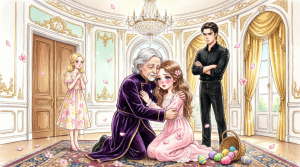
And there, on that rug, lay my daughter.
For a second my mind refused to understand what I was seeing.
She was curled on her side in a broken, unnatural shape. Blood from a wound at her temple had spread into the white wool in a dark, ugly pool. One of her shoes was missing. Green plastic Easter grass and torn basket wrapping had been scattered around her like some obscene decoration.
I ran to her.
Dropped to my knees.
Her face—
God.
Her face was swollen, already bruising, the left eye nearly closed. There were marks on her neck, angry finger-shaped bruises darkening by the second. Her lip was split. Her breathing was shallow and ragged, but it was there.
She was alive.
“Lily,” I whispered, gathering her head gently into my hands. “Baby, I’m here. I’m here.”
Her eyes fluttered open just enough to find me. Her fingers closed weakly around my flannel shirt like she was reaching for the last solid thing in a collapsing world.
Then I heard the soft clink of glass behind me.
I turned.
Richard stood at the wet bar pouring himself a drink.
Not pacing. Not panicked. Not pretending to help.
Pouring Scotch.
He wore a silk shirt with French cuffs, and there was a bored little smile on his face that made something in me go still and deadly.
“Old man,” he said, “you need to calm down.”
I looked back at Lily’s neck. Then at him.
“She’s being dramatic,” he said with a shrug. “She tripped. Hit her head on the fireplace.”
The room seemed to constrict around the sound of his voice.
“She tripped,” I repeated.
I did not raise my voice.
I didn’t need to.
I looked down at the bruises shaped exactly like a hand around my daughter’s throat. Then back at the man holding a crystal glass like he was inconvenienced by my presence.
Eleanor swept into the room behind me, still clutching her mimosa. Her gaze dropped to the spreading bloodstain on the rug, and she clicked her tongue.
“Oh, for heaven’s sake,” she sighed. “Look at the mess. Richard, I told you to call the maid before the guests came back in.”
The mess.
Not Lily.
Not the blood.
Not the body on the floor.
The rug.
That was the exact moment I understood what kind of people they really were—not just cruel, not just abusive, but hollow. The kind of people for whom another human being existed only in relation to inconvenience, reputation, or control.
“You think you can do this?” I asked Richard.
He took a slow sip of Scotch.
“You think you can beat my daughter half to death and just keep breathing like nothing happened?”
He smiled.
Actually smiled.
Then he set the glass down and strolled a little closer, all smooth confidence and inherited power.
“Arthur,” he said, “let me save you some time. The world doesn’t work the way you think it does.”
He leaned in slightly, voice dropping into that smug conspiratorial tone rich men use when they’re about to explain why consequences are for other people.
“My grandfather built this town,” he said. “My family owns half of Main Street. The police chief is outside right now eating barbecue in my backyard. I fund his campaigns. His son’s college tuition comes from one of our foundations.”
He spread his hands as if offering me a lesson in gravity.
“So go ahead. Call the cops. Call the hospital. Call whoever makes you feel like you’re doing something. Let’s see if they arrest me—or if they put you in cuffs for trespassing and laying hands on my mother.”
He believed every word.
That was the most dangerous part.
Not the violence. Not even the cruelty.
The certainty.
The certainty that systems bend toward men like him. That money scrubs blood clean. That power rewrites truth before truth can get dressed.
I looked into his eyes and understood something with perfect clarity:
Conventional law would not save my daughter.
Not here.
Not in this town.
Not against this family.
So I would not use conventional law.
I slid one arm beneath Lily’s knees and the other around her back. She cried out softly when I lifted her, and the sound nearly tore the skin off my bones, but I held her as carefully as I could and rose to my feet.
Richard laughed.
Actually laughed.
Behind me, I could hear the muted sounds of the party continuing somewhere deeper in the estate—glasses clinking, children shouting on the lawn, doors opening and closing as if a woman hadn’t just bled all over a five-thousand-dollar rug.
“You should leave,” Eleanor said coldly. “Before you embarrass yourself any further.”
I looked at Richard over my daughter’s bruised face.
“You are going to regret what you just said,” I told him.
My voice was quiet now. Devoid of heat. That was what made it true.
He mistook it for surrender.
That, too, was a mistake.
I turned and carried Lily out through the open doors, across the marble porch, and down the steps toward my truck. No one stopped me. Why would they? In their world, I was just an old man in worn boots and a faded flannel shirt carrying away a problem they assumed had already been contained.
I laid her carefully in the passenger seat and buckled her in, ignoring the blood soaking into the cracked vinyl. She whimpered once, then turned her face weakly toward me.
“Dad…”
“I’ve got you,” I said. “I’ve got you now.”
Then I reached into the glove compartment.
And pulled out the second phone.
It was old. Heavier than any modern phone had a right to be. Military-grade. Satellite encrypted. A relic from a life no one in Oakwood Hills would have imagined for the lonely retired man in the rusted pickup.
I had not touched it in fifteen years.
Not once.
I opened it anyway.
The screen glowed faint green.
There was only one contact stored.
No name. No label.
I hit dial.
The line did not ring.
There was a short burst of static, then a voice answered. Deep. Gritty. Instantly familiar.
“Report, Commander.”
That title hit like an electric current straight through my spine.
Commander.
I had not heard it spoken aloud in over a decade.
Not since I stepped away from the world that required it.
But titles like that do not disappear. They wait. Buried under ordinary lives, under lawn mowers and retirement checks and coffee on Easter Sundays, until blood calls them back.
“Ghost,” I said.
And as soon as I heard my own voice, I knew the last fifteen years had fallen away. The softness was gone. In its place was the cold, clipped cadence of the man I used to be—the one men followed into places from which not all of them returned.
“We have a Code Black.”
Silence.
Heavy silence.
A Code Black was not a phrase used lightly. It was the highest-level distress call we had ever agreed on, reserved for only one kind of situation: immediate family. Life or death. No questions. No hesitation.
It had only existed on paper.
Until now.
When Ghost spoke again, there was no trace of warmth left in his voice.
“Location?”
“The Vance estate. Oakwood Hills.” I started the truck with one hand, my eyes fixed on the gates ahead. “My daughter has been severely assaulted. High probability of law enforcement compromise and active cover-up. I need a clean sweep.”
Another beat of silence.
Then I heard a metallic click on the other end of the line.
A weapon being readied.
“Understood, Commander.”
His voice was lower now. Colder.
“We are fifteen minutes out.”
I pulled the truck into gear.
Lily breathed weakly beside me.
Behind us, the Vance estate gleamed in the spring sunlight, still full of guests who believed the worst thing that could happen on Easter Sunday was spilled wine on linen.
Richard and Eleanor were probably still inside laughing about the pathetic old man they had dismissed.
The police chief was probably still in the backyard with barbecue sauce on his fingers, ready to write up another convenient lie.
None of them knew what that phone call meant.
None of them knew what name they had just activated.
None of them knew that somewhere, in places far outside their gated imagination, men who had once operated in silence had just received a summons they would not ignore.
I tightened my hand around the wheel.
Ghost’s last words echoed in my ear.
We are fifteen minutes out.

