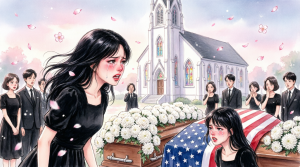
I found the screenshot of my mother’s text message about the “dreary” funeral and the “cheap” lilies. I found the timestamped Hawaii post. I found older messages too—subtle ones, ugly in hindsight. My mother complaining that David had “taken me away.” My father once texting that I should “remember who your real family is” when I missed Thanksgiving because Sophia had the flu. Leo asking for money three separate times over the years with increasingly creative reasons and increasing resentment when I said no.
Each item I pulled from that folder made the room feel colder.
I printed the most relevant pieces on crisp white paper and slid them into sheet protectors. Not because I needed the theatrics, but because presentation matters. The truth should look as disciplined as the lie looks polished.
Third: build support.
That part I didn’t do alone.
I drove out to Uncle Hector’s ranch on a Thursday afternoon with a black leather briefcase buckled into the passenger seat like a second person. The road dipped and stretched through dry grass and barbed-wire fences. The sky was huge, a flat blue bowl with hawks circling so high they looked like flecks of ash.
His ranch house sat back from the road behind a stand of scrub oak, wide porch, rusted wind chime, dog asleep under an old farm table. The place smelled like mesquite smoke, leather, and coffee that had been sitting on the burner long enough to become a new substance.
We spread everything out on his kitchen table.
He read each page slowly, eyes narrowing at the financials, jaw hardening at my mother’s messages. When he got to the Facebook post about me “remembering before she was a captain, she was a daughter,” he actually took his reading glasses off and set them down with a little click.
“Well,” he said at last, “that’s low even for them.”
“I’m not doing this to humiliate them,” I said.
He looked at me over the table. “Good. Humiliation is cheap. Truth costs more.”
That was exactly why I had come to him.
We went through the likely scenarios. Aunt Martha opening with a speech about family unity. My mother trying to cry. Leo trying anger. My father trying intimidation. Side chatter from relatives who hated conflict but loved conclusions.
“Don’t defend yourself emotionally,” Hector said. “That lets them drag you into feelings. You stick to sequence. Date. Fact. Document. Let the room connect the dots.”
“What if they say it’s fake?”
He grunted. “Then I stand up.”
That simple.
He had also called two cousins—John and Michael—men in their forties who had always kept some distance from my father’s branch of the family. They were willing to be there, watch closely, and speak if needed. Not because they adored me. Because they respected Hector, and because even gossip-lovers can smell when a story has been over-perfumed.
The day before the reunion, I stayed late at the office and built a short presentation.
No dramatic music. No transitions. Just slides.
Timeline of the funeral date and the Hawaii post. Screenshot of the accidental text. Public records showing Leo’s debt and defaults. Company incorporation documents and loan records for Pina Secure Solutions proving I had built it with my own capital and a small business loan, not some giant insurance windfall. Every slide had dates in the bottom corner and source notes in small font because old habits die hard and I believe in citing my work.
Around nine that night, the office had gone quiet except for the low buzz of the HVAC. The city outside was all gold windows and red taillights. I stood in the restroom under harsh lights and looked at myself in the mirror.
I chose not to wear my uniform.
That mattered.
The uniform was earned, honorable, and deeply mine. I refused to let them turn it into stage dressing for their family melodrama. I would go as Olivia Pina, founder and CEO, widow and mother, woman they had underestimated for thirty-four years.
So the next evening I put on black trousers, a white button-down, low heels, and simple gold studs. I pulled my hair back into a smooth knot. No flashy makeup. No armor except composure.
Before I left, I opened the memory box where I kept the funeral flag and the pumpkin-patch photo. I looked at David’s grin, at Sophia’s missing tooth and sticky cheeks, and let myself feel the full weight of why I was doing this.
Not to win a family argument.
To stop them from staining what was left of the people I loved.
When I pulled into the steakhouse parking lot, the giant neon sign buzzed red against the dark. Through the front windows I could see clusters of people moving under warm amber lights. The air outside smelled like grilled meat, gasoline, and rain trapped in the pavement from an earlier shower.
Uncle Hector was waiting near the entrance in a dark blazer and boots polished enough to catch the light. He didn’t ask if I was ready. He just took one look at my face and nodded.
I picked up the leather briefcase from the passenger seat.
It felt solid in my hand. Balanced. Final.
Inside it were dates, lies, debts, screenshots, and the last clean version of my name.
Then Hector opened the restaurant door, and the sound of cutlery, voices, and old family history came spilling out.
Part 8
The private banquet room at the steakhouse smelled like seared beef, butter, expensive perfume, and old resentment.
Round tables filled the room, covered in white cloths that glowed softly under yellow chandelier light. Water glasses sweated onto folded napkins. Someone had put tiny vases of white roses in the center of each table, which would have been funny if anything about the evening had left room for humor. Along the back wall stood a projector screen I had requested through the reunion organizer with the excuse that I “wanted to share a tribute to family milestones.”
That part, at least, was true.
Conversations softened as Hector and I walked in. Forks paused halfway to mouths. People did that quick church-lobby scan—look, register, pretend not to stare. I saw pity on a few faces, curiosity on more, and naked accusation on at least three.
My parents were at the center table.
Of course they were.
My mother wore black, which was rich coming from someone who had called my husband and daughter’s funeral dreary. Pearls again. Soft makeup. Tragic widow-adjacent styling. My father sat beside her in a navy blazer, broad hands resting on the table as if he chaired a board instead of a lie. Leo was on her other side, beard trimmed, expensive watch gleaming, his posture slouched into fake confidence.
Aunt Martha spotted me first and put on her public smile.
“Olivia, sweetheart,” she called. “You made it.”
The room relaxed a little, sensing a script. Maybe there would be tears. Maybe reconciliation over bread rolls. Maybe the scandal would be smoothed over with enough casserole-coded language and strategic prayer.
Hector and I took seats near the back, at a table with John and Michael, both of whom greeted me with the careful courtesy men use when they know pain is in the room but don’t know what shape it takes. I appreciated that more than anybody’s hug.
For the first twenty minutes I said almost nothing. I drank ice water and listened.
That was useful.
My mother moved through the room like a campaigner. Touching elbows. Lowering her voice for intimate side comments. Receiving sympathy she had grown quite skilled at harvesting. Leo laughed too loudly at something near the bar service station. My father clasped shoulders, nodded gravely, played the role of stoic patriarch weathering an ungrateful child.
Then Aunt Martha stood and tapped her water glass with a spoon.
The little chime cut through the room. Chairs shifted. Conversations died.
“Well,” she said, smiling at everybody like she owned the oxygen. “It means the world to see family together, especially after such a painful season for all of us.”
Painful season.
Like a drought. Like allergies. Like my husband and daughter had been a weather pattern.
She went on about togetherness, healing, roots, how “family is all we really have.” I saw heads nodding. I saw my mother dabbing at the corners of her eyes with a napkin. I saw Leo practicing humility like it was an optional sport.
Then Martha’s gaze found me.
“And Olivia, dear,” she said in a voice sugared enough to crack teeth, “I think we all hope tonight can be a step toward mending what’s broken. Your parents love you very much.”
That was my cue. The one they thought they had written.
I stood up.
My chair made a small scrape against the carpet. Forty-some heads turned.
I walked to the front of the room carrying the briefcase. My heels sounded steady on the floor, which felt like a mercy. I set the case on the small lectern beside the projector controls and took a breath that tasted faintly of rosemary and steak smoke.
“Thank you, Aunt Martha,” I said.
My voice carried without effort. Years of command presence are useful in places other than parade fields.
“You’re right about one thing. Family matters. Which is exactly why truth matters.”
The room stilled again, differently this time.
I opened the briefcase, took out the clicker, and turned on the projector.
The first slide lit the screen behind me: a simple timeline. Funeral service, Fort Sill, 10:00 a.m. Hawaii post timestamped during the service. Image included.
A murmur went through the room before I even spoke.
“Some of you have heard,” I said, “that I abandoned my family after receiving a large insurance payout and refused to help them in their time of need.”
Across the room, my father shifted.
“I’d like to be very precise tonight.”
Click.
The Hawaii photo filled the screen. My mother in her sundress. My father with a beer. Leo throwing two thumbs up beside a turquoise pool bright enough to hurt.
I didn’t need to say much. The timestamp did most of the work.
“This photo,” I said, “was posted publicly while my husband and daughter were being buried.”
No one interrupted. Even the waitstaff froze by the side station.
Click.
The screenshot of my mother’s accidental text appeared next. I had enlarged only the relevant lines.
Finally escaped that dreary atmosphere. Those white lilies looked so cheap anyway. Leo really needed this vacation after having to endure the news about Olivia.
Somebody gasped. Not a polite little inhale. A real one.
I didn’t look at my mother. I kept my eyes on the room.
“After the funeral, my parents and brother came to my home,” I said, “and asked me for forty thousand dollars to fund Leo’s sports bar. They specifically referenced my salary and my husband’s life insurance as reasons I could afford to help.”
“Liar,” Leo barked.
I turned to him. “Do you want me to keep going?”
The room turned with me. The question wasn’t angry. That made it worse for him.
He sat back down.
Click.
Now the financial records. Leo’s LLC filing. Default notices. A simple summary Andrea had helped me build showing unpaid vendors, loan amounts, missed payments, and the total debt load tied to the failed venture.
“This,” I said, “is the reason my parents are in financial trouble. It is not because I refused support. It is because Leo’s business was mismanaged and debt was taken on recklessly.”
My father half-rose. “That’s private family business.”
“It became public when you made it public,” I said.
Another murmur. Not sympathetic this time.
Click.
The next slides were my own. State incorporation records for Pina Secure Solutions. My small business loan paperwork. Early capital contributions from my savings. Dates. Signatures. Sources.
“My company,” I said, “was not built with a windfall from tragedy. It was built the old-fashioned way. With a loan, my savings, and eighteen-hour days.”
I saw John at the back table fold his arms and lean back, face unreadable. Michael was staring at my father like he was seeing him for the first time. Aunt Martha’s mouth had lost all color.
Then I pulled out the printed copy of my mother’s neighborhood-group post and read the final line aloud.
“We only pray Olivia remembers that before she was a captain, she was a daughter.”
This time I did look directly at my mother.
“Before I was a captain,” I said, “I was a daughter who learned very early that love in my family came with ranking. Before I was a captain, I was the girl whose dog disappeared because my brother lied. The girl left in a hospital room while everyone drove to support Leo’s latest dream. The girl whose achievements were tolerated at best and ignored at worst.”
My mother stood up, hands shaking. “This is disgusting.”
“No,” I said. “This is documentation.”
She looked around the room for rescue and found none.
Then Uncle Hector stood.
If I live to be a hundred, I will never forget the sound the room made when he rose. It wasn’t a noise exactly. More like the collective understanding that weight had just shifted.
He didn’t hurry. He put both palms on the table first and then straightened to his full height, weathered face stern, voice low and carrying like distant thunder.
“I was at the funeral,” he said. “I saw the empty chairs where Norman, Ashley, and Leo should have been. I watched Olivia stand there with that folded flag and no blood family beside her. And I know for a fact my brother asked her for money after choosing a vacation over burial.”
He turned his head slightly toward my father.
“You have disgraced your own name,” he said.
Nobody moved.
Aunt Martha slowly sat down in her chair as though her knees had stopped working correctly. One of my second cousins whispered, “Oh my God,” to no one in particular. My mother’s mouth opened and closed once without sound. Leo looked ready to bolt. My father had gone the color of old paper.
That was it.
No yelling. No overturned tables. No cinematic slap.
Just the truth entering a room where lies had gotten too comfortable.
My parents left first. My mother snatched up her purse with hands that no longer looked elegant. My father shoved his chair back so hard it nearly tipped. Leo muttered, “This is insane,” as if the problem were lighting, not content. They pushed past clusters of relatives who had stopped pretending not to judge them.
Nobody tried to stop them.
Nobody called after them.
The door closed behind their retreat with a soft padded thud, and the whole room seemed to exhale.
I stood at the front with the clicker still in my hand, heart hammering so hard I could feel it in my throat.
I had imagined this moment so many times in the days leading up to it. In some versions I felt vindicated. In others, powerful. In none of them did I expect the first thing I’d feel to be sadness.
Not for them.
For the years.
For every younger version of me who had thought if she just worked harder, stayed calmer, achieved more, loved better, she might finally become undeniable.
I looked out at the room full of people who now understood the truth and realized that understanding changes almost nothing about what it cost to get there.
Then Aunt Martha started crying.
And I knew the night was not over yet.
Part 9
Aunt Martha did not cry prettily.
That sounds mean, but it’s true. Her mascara ran in two dark tracks and her nose turned pink and she made these small, outraged choking sounds like her own emotions had betrayed her. She stood up halfway, sat back down, then finally rose and crossed the room toward me with both hands out as though approaching a skittish horse.
“Olivia,” she said, voice cracking, “I had no idea.”
I believed that part.
What I did not have the energy for was letting her ignorance become the center of my evening.
“I know,” I said.
She flinched anyway.
One by one, other relatives approached. Some apologized directly. Some circled the idea of apology like it was hot to touch. John shook my hand and said, “You were right to set the record straight,” in the tone of a man acknowledging weather damage after a tornado. Michael offered to walk me to my car if I needed it. A cousin I had barely spoken to in ten years squeezed my shoulder and whispered, “I’m so sorry about Sophia.” That one almost did me in.
I left before dessert.
The drive back to Lawton took hours and passed mostly in silence. Hector was in the passenger seat of my SUV because he’d ridden with me in and left his truck at the ranch to make the return easier if I needed company. The road unspooled in front of us under a black sky pricked with sparse stars. On the highway, truck lights swept by in white and red ribbons. The inside of the car smelled like leather, stale coffee from the cup holder, and the faint smoke scent Hector always carried home from his wood stove.
“You did good,” he said finally.
I kept my eyes on the road. “I feel awful.”
“That tracks too.”
I let out a breath that sounded almost like a laugh. “I thought I’d feel lighter.”
He was quiet for a moment. “You probably will. Later. Tonight you just amputated something.”
That was the exact word for it.
Not liberation. Amputation.
Necessary, bloody, and strangely clean.
The next morning I woke with that empty, over-bright feeling that follows a battle when your body hasn’t gotten the memo that the fight is over. Sunlight cut through the blinds in hard white lines. My phone was face down on the nightstand, vibrating.
Voicemail. Unknown number.
Then another.
Then a text from Leo.
Please answer. This has gone too far.
I made coffee before listening to anything because I wanted something hot in my hands. The kitchen smelled like grounds and toast and the lemon dish soap Sophia used to insist on squirting herself even though she always used too much. I stood at the counter barefoot and hit play.
Leo’s voice came through ragged and dramatic, full of tears he absolutely expected to work.
“Liv, please call me back. Mom’s a wreck. Dad won’t talk. Everybody’s turning on us. You made your point, okay? You don’t have to keep punishing us.”
Punishing.
As if truth were punishment and not consequence.
I deleted the message.
The second voicemail was from my mother.
There were no tears in hers. Just fury squeezed thin.
“I hope you’re satisfied,” she said. “Your father’s blood pressure is through the roof. You humiliated us. Whatever you think happened, family does not do this to family.”
I listened to the whole thing without moving. At the end she said, “You will regret this one day,” and I nearly smiled because it was such a perfect final offering from her. Not remorse. Not responsibility. Just prophecy-as-control.
I deleted that one too.
Then I blocked all three numbers.
I wish I could tell you that was the end.
It wasn’t.
People like my parents don’t surrender when the room turns on them. They regroup. For the next two weeks they used every route not yet blocked. Emails from throwaway addresses. A card from my father with nothing in it but a Bible verse about honoring mother and father. A long message sent through a cousin claiming my mother had “collapsed from stress.” Leo tried LinkedIn, which almost impressed me with its audacity. My office receptionist got a call from a woman identifying herself as “family” and demanding to know my schedule.
That one ended the experiment.
I hired an attorney.
Not Andrea—she was delighted but two hours away and had enough sense to tell me I needed someone local and mean. I found a woman in Tulsa named Renee Calder who wore immaculate navy suits and spoke in complete sentences that made men sweat. Her office smelled like paper, peppermint tea, and expensive carpet. I brought the screenshots, emails, voicemails, and a typed log of contact attempts.
Renee read everything in silence, then looked up and said, “How much access do you want them to have to your life?”
“None.”
“Good,” she said. “That’s the clearest answer I’ve heard all week.”
She sent formal cease-and-desist letters regarding harassment, false claims affecting my business reputation, and unwanted workplace contact. She also drafted a separate notice making it clear that any future attempt to obtain money from me, directly or indirectly, would be documented and answered through counsel.
When I left her office, I sat in my car and stared at the steering wheel for a long time.
There is something uniquely brutal about putting legal language around family. The paper doesn’t care who taught you to tie your shoes or who forgot your science fair. It just lays out behavior, boundaries, consequence. Clean. Necessary. Devastating.
That afternoon I drove to the cemetery.
The grass was bright from recent rain, green enough to hurt. Crickets had started up in the ditch beyond the fence, and a mower hummed somewhere far off. David’s headstone still looked too new, the engraved letters too sharp. Sophia’s was smaller, which I hated with a physical intensity.
I brought sunflowers because she used to call them “happy-faced flowers.”
I knelt between the graves and set the stems down carefully. The dirt smelled warm and alive under the sun. Ants moved along a crack in the path. Somewhere nearby a mourning dove made its hollow, lonely call.
“I did it,” I said aloud.
My voice didn’t break.
“I told the truth.”
Then, because the next part mattered too, I said, “And I’m not letting them back in.”
The breeze shifted. The cemetery trees whispered overhead.
I thought about forgiveness for maybe half a second. Not as an emotional urge. As a concept. A word other people love to hand out when they aren’t the ones bleeding. I knew what relatives and pastors and strangers in grocery store lines would say if they knew the whole story. Don’t let bitterness poison you. Grace heals. Family is family.
Here’s what I knew instead:
Forgiveness is not the same as access.
And some betrayals don’t deserve the dignity of being framed as a misunderstanding.
I did not hate my parents anymore. Hate is hot and living and expensive. What I felt was colder than that and much more useful. I was done. They had burned through every version of grace I ever had for them, and I would not invent more just because they had finally been embarrassed in public.
I sat there until the shadows lengthened and the headstones turned honey-colored in the lowering light.
By the time I stood up, my knees ached and my blouse had grass stains at the hem. But something inside me felt steadier. Not happy. Not healed. Anchored.
The next week, I filed paperwork for a nonprofit I’d been sketching in the margins of legal pads for months.
I named it Sophia’s Sunshine Project.
If my family of origin was determined to keep taking, then the rest of my life was going to be built around giving where it mattered.
And that decision, more than the showdown, was the first real step toward peace.
Part 10
Two years later, my mother showed up at my office.
By then Pina Secure Solutions occupied an entire floor in a downtown Tulsa building with real glass walls, a training room, and a break room big enough for my team to argue over chili recipes in comfort. The lobby smelled faintly of polished stone and whatever citrus cleaner the janitorial crew used at night. My assistant kept a bowl of peppermints on the reception desk and changed them out every Monday because she believed stale candy damaged morale.
Sophia’s Sunshine Project had become real in the best possible way. Not a grief hobby. A working nonprofit with summer programs for kids from military and first-responder families touched by loss, mentorship weekends, therapy partnerships, and an annual campout where we handed out yellow bandanas and let children who had already seen too much laugh until they fell asleep in lawn chairs. My calendar was full, my team was strong, and on Sundays I still drove out to Hector’s ranch where we fished, drank beer, and let silence do the talking.
The family noise had mostly died.
The cease-and-desist letters helped. So did public shame. My parents sold their Tulsa house sometime in the second year after the reunion. Leo drifted through rumors the way he had drifted through every phase of his life—Phoenix, then Amarillo, then maybe Missouri. I didn’t track it. I didn’t ask.
That morning I had a board meeting at noon and a site visit at three. I was reviewing a proposal when my assistant, Marcy, tapped lightly on my open door.
“There’s a woman here asking to see you,” she said.
“Name?”
She hesitated. “Ashley Ramos.”
The room seemed to lose a degree of warmth.
Outside my office window the sky was bright and clear, traffic moving in toy-car lines below. On the credenza behind me sat three framed photos: David and Sophia at the pumpkin patch, my executive team at last year’s retreat, Hector holding up a bass so small we laughed for ten straight minutes. The air conditioner clicked on overhead. Somewhere down the hall a copier started humming.
I set down my pen.
“Did she make an appointment?”
“No.”
“Did you tell her that matters?”
Marcy’s mouth twitched. “Yes. She said this was family.”
Of course she did.
I stood up slowly. “Thank you. I’ll handle it.”
She nodded once and stepped back.
My mother was waiting in the lobby in a beige dress and a cardigan too warm for the weather. She looked older. Not in a dramatic way. Just smaller around the eyes, the careful upkeep a little more strained. Her hair was cut shorter than I remembered. She carried a large handbag in both hands like she needed something to hold onto.
When she saw me, her face changed into what she probably believed was tenderness.
“Olivia.”
I stopped ten feet away.
“Why are you here?”
Her eyes flicked toward the reception desk, then back to me. “I was hoping we could talk somewhere private.”
“No.”
That unsettled her more than yelling would have.
“I came a long way,” she said. “The least you can do is hear me out.”
“The least I can do,” I said, “is protect my peace.”
A flush rose in her cheeks. “I’m still your mother.”
“No,” I said. “You are the woman who gave birth to me. Those are not the same thing.”
That landed. Good.
She tried again, reshuffling herself into a new tone. Sorrowful this time. “Your father’s not well.”
I felt nothing.
Not because I’m made of stone. Because I had spent years training myself to stop treating every crisis in that family as a summons.
“I’m sorry to hear that,” I said.
She stared, waiting for the rest.
There was no rest.
She licked her lips. “Leo is in trouble too.”
Of course he was.
I folded my arms. “What kind of trouble?”
She looked down. “Substance issues. Debt. Some bad people.”
There it was. The real appointment request hidden under all the maternal fog.
“And what do you want from me?”
Tears sprang to her eyes with suspicious speed. “I want my daughter back.”
“No,” I said quietly. “You want access to the person you think can fix your life.”
“Olivia, please.”
People in the lobby had begun pretending not to listen. Marcy was suddenly very interested in alphabetizing a stack of folders. The peppermint bowl shone under the recessed lights like a small, absurd moon.
My mother took one step forward. “I know we made mistakes.”
Mistakes.
That word again. As if they had overcooked dinner. As if they had mailed a birthday card late. As if skipping a funeral, demanding money from the dead, and slandering me publicly belonged in the same category as bad parking.
“No,” I said. “You made choices. Repeatedly. For decades.”
She started crying in earnest now. The sound bounced thinly in the polished lobby.
“I said I was sorry,” she whispered.
I tilted my head. “When?”
Her mouth parted. No answer came.
Exactly.
Apology requires specifics. Accountability. Ownership without excuses. She had brought none of those. She had brought fatigue, panic, and an old assumption that if she stood close enough to me and used the right blood-language, I would resume my assigned function.
I stepped closer, not to comfort her, but to make sure she heard me clearly.
“You missed David and Sophia’s funeral,” I said. “You called it dreary. You called the lilies cheap. You came into my house and treated their deaths like an investment opportunity. You lied about me for money and status. Then when the truth came out, you never apologized. Not once. You just kept trying new doors.”
She shook her head, crying harder. “I was hurting too.”
“Yes,” I said. “But hurt people are still responsible for what they do with their hurt.”
That line came from years of therapy and one very wise counselor I’d started seeing after the funeral. It fit here perfectly.
My mother looked around the lobby again, maybe hoping shame would soften me. It didn’t.
“I don’t forgive you,” I said.
The sentence surprised even me with how calm it sounded.
Her crying stopped abruptly, like a faucet turned off.
I kept going. “Not because I’m bitter. Not because I’m cruel. Because forgiveness is not something I owe to people who would use it as a door handle. I have a good life now, and none of it has room for you.”
The silence after that was almost gentle.
She stared at me as though she had expected pain and gotten math instead.
“I came all this way,” she said again, weaker this time.
“And you need to leave all this way too.”
Marcy, who was a better employee than I deserved, appeared at my shoulder as if summoned by God or training or both.
“Ma’am,” she said to my mother with professional brightness, “I can walk you out.”
Ashley looked at me one last time.
For years I had imagined some future scene where my parents finally saw me clearly and I felt something big and cleansing. Triumph. Grief. Closure dropping like rain after drought.
What I felt was smaller and steadier.
Relief.
My mother picked up her bag, turned, and followed Marcy to the elevators.
She never looked back.
That evening, after the board meeting and the site visit and the ordinary business of a life I had earned, I drove to the cemetery with a bunch of sunflowers in the back seat. The western sky was all orange fire and lavender haze. Grasshoppers knocked against the weeds near the fence. The air smelled like warm earth and cut grass and summer going soft around the edges.
I set the flowers down between David and Sophia and sat in the fading light.
“I told her no,” I said.
The breeze moved through the cemetery in a long, quiet sweep.
I looked at their names. At the dates. At the distance between us and the years that had passed anyway.
Then I looked up at the sky and thought about my office lobby, about Marcy’s peppermint bowl, about Hector’s porch, about kids at Sunshine camp roasting marshmallows and laughing with sticky fingers, about my team arguing over chili, about the life I had built out of wreckage and discipline and love that still had somewhere to go.
My parents had spent my whole childhood teaching me that blood was permission.
David and Sophia taught me something better.
Love is a verb. Respect is a choice. Family is built, not claimed.
I rose, brushed the grass from my slacks, and stood a moment longer with my hand resting on the top of Sophia’s stone.
“I’m okay,” I told her. “More than okay.”
And for the first time in my life, when I turned away from the graves and walked back to my car, there was no part of me still listening for my family to call me home.
I was already there.
THE END!