I was seventeen the summer everything collapsed, and we lived in a quiet suburb outside Boise, Idaho, where neighbors waved politely and kids rode their bikes through looping streets without worry. My family had adopted a shy dark haired girl named Natalia Greene from overseas when she was ten, and I was twelve at the time, so we coexisted peacefully without ever imagining how badly things would break.
Nothing in our shared history hinted at the storm that was coming, and our lives moved along with ordinary routines that felt safe and predictable.
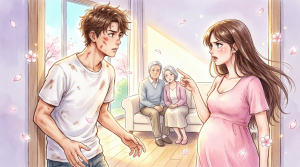
That illusion shattered on a Wednesday afternoon when I came home from baseball practice and saw my parents sitting stiffly at the dining table with pale faces and eyes fixed on me like I did not belong there.
Before I could even ask what was wrong, my father slid his phone across the table toward me and said, “Explain this right now.”
On the screen was a message Natalia had sent to a friend that had been captured and forwarded to my mother, and it read that she was pregnant and that I was the father.
I froze in place because my own name stared back at me like a permanent accusation that I could not erase no matter how loudly I denied it.
I laughed at first because it seemed impossible, but my parents did not laugh and instead demanded answers, explanations, and a confession that I could not give.
My voice cracked as panic spread through me and I kept repeating that I had nothing to do with it, but they had already decided what they believed.
My mother whispered with a trembling voice, “How could you do this to her,” while my father shouted, “You are finished in this house,” as if a verdict had already been signed.
Within hours everything began to collapse around me, and my girlfriend Abigail Stone called me crying and accusing me of being someone she never wanted to see again.
Her parents banned me from their home, and by the end of the school week rumors spread so quickly that I became the villain in every whispered conversation.
Natalia barely looked at me during those days, and when she did there was fear in her eyes mixed with something colder that felt like determination. She repeated the lie every time someone asked her, and my parents believed her without hesitation as if her words were unquestionable truth.
Three days later I packed a single bag, walked out of the house, and refused to look back at anything I was leaving behind.
The last image burned into my memory was my mother crying against my father while he stared at me like I was something he wanted erased completely.
I moved to another state, changed schools, worked part time jobs, and built a life from nothing because I had been pushed out before I even understood what was happening.
At seventeen I disappeared from everything I once knew because my family had already erased me first.
The first years after leaving felt like wandering through a cold fog that had no shape and offered no direction for where I should go next.
I settled in Spokane, Washington because it was a place where nobody knew my name, and anonymity felt safer than any familiar face.
I lived in a small apartment above a laundromat, worked night shifts stocking shelves at a grocery store, and finished high school through online classes while trying to stay invisible.
Every birthday and holiday passed without a single message from home, and not even a generic greeting arrived to remind me that I once belonged somewhere.
At the time I believed I deserved that silence because I had been told I was guilty, and it reshaped how I saw myself without me realizing it.
Years later a therapist would explain how that kind of rejection changes a person, but back then I only knew that I kept moving forward because I had no other choice.
At nineteen I started rebuilding my life with purpose, enrolling in community college and discovering that I had a natural talent for automotive engineering.
Machines made sense in ways people never did, because they followed rules and never lied or twisted the truth for convenience.
After transferring to Washington State University, I completed my degree while working at a small auto shop run by an older mechanic named George Miller who treated me with quiet respect.
He never pushed me to talk about my past, and instead focused on teaching me skills that helped me build a future I could rely on.
Meanwhile the lie that destroyed my life remained buried, and I avoided searching for anything related to my family because I feared reopening wounds that had barely begun to heal. In my mind they had chosen their version of the story, and I had learned to exist without them.
By the time I turned twenty five, I owned a small but steady repair business, bought a modest townhouse in a calm neighborhood, and adopted a German shepherd named Rusty who became my closest companion.
I tried to believe that I had truly moved on, but deep down I avoided relationships because trust felt dangerous after everything I had lost.
Everything changed during my twenty seventh year when a letter arrived in my mailbox without any return address.
Inside there was only a single sheet of paper with shaky handwriting that said, “Connor, I am so sorry, the truth is finally out, please let us explain,” followed by my mother’s signature.
I sat on my couch for a long time with Rusty resting his head on my knee while memories flooded back without warning. I recognized her handwriting immediately, and the past I had buried began pushing its way back into my present.
Two weeks later, while closing my shop for the night, my phone rang from an unknown number that I chose not to answer at first.
Moments later a voicemail appeared, and when I listened I heard my father’s voice sounding older and fragile as he said, “Son, we need to see you, we owe you the truth.”
That night I could not sleep because for ten years I had imagined different versions of this moment without knowing how I would react. I realized that I was not prepared for the mix of anger and uncertainty that came with hearing their voices again.
Three days later there was a soft knock at my front door, and Rusty gave a single bark before going quiet while staying alert beside me.
When I looked through the peephole, I saw my parents standing there looking worn down by time, and between them stood Natalia with hollow eyes.
I did not open the door even when my father knocked again and said with a breaking voice, “Connor, please.”
I leaned my forehead against the door while Rusty pressed against my leg, sensing everything I was trying to hold inside.
My mother spoke next from the other side, saying, “We know you do not owe us anything, but you deserve to hear the truth.”
Silence stretched between us until Natalia finally spoke, her voice softer but steady as she said, “Connor, I lied.”
Those words cut through everything I had built over the years and reopened wounds I thought were sealed. Through the closed door she explained that she had been fifteen when she became pregnant, and the real father was a boy named Evan Drake who pressured her and then disappeared.
She said she panicked and told a friend my name because it felt like the safest option at the time, never imagining that my parents would react so strongly.
By the time everything spiraled out of control, she was too afraid to admit the truth and allowed the lie to grow until it destroyed me.
She also admitted that she did not come forward on her own because years later Evan resurfaced and bragged about what happened while intoxicated, which eventually reached her.
The guilt consumed her, and she finally told my parents everything, leading them to confront him and confirm the truth they had ignored.
My mother cried as she explained how they had tried to find me for years, sending messages and searching for any trace of where I had gone.
My father admitted that his pride and anger had blinded him, and he said quietly, “We destroyed you when you were just a child.”
I stood there with my hand near the door handle, torn between opening it and showing them who I had become or walking away again.
In the end I stepped back and sat on the floor beside Rusty, choosing silence while they continued apologizing outside.
They stayed there for nearly twenty minutes, crying and begging for forgiveness that I was not ready to give. Eventually their voices faded as they walked away, leaving me alone with the weight of everything that had finally come to light.
Maybe one day I will open that door and face them properly, or maybe I will choose to keep my distance and protect what I have built. For the first time in ten years, I realized that the choice belonged to me, and that alone felt like something I had never truly had before.

