President Donald Trump announced on Tuesday night that he is launching an investigation into alleged price gouging after accusing big oil companies of not dropping gas prices. “The big Oil Companies are not dropping their price at the pump commensurate with the sharply lower prices they are paying for Oil. Those prices are dropping like a rock!” he wrote on his social media platform, Truth Social. “In other words, customers are being ‘gouged,'” he said, adding that he had instructed the Department of Justice to “immediately” begin looking into the matter.
Price gouging occurs when a business takes advantage of a sudden supply shock to raise prices significantly. The president did not name any specific oil companies in his late night social media post. Newsweek contacted the Department of Justice for comment by email on Wednesday outside standard working hours.
The American Petroleum Institute, the national trade association representing the U.S. oil and natural gas industry, rebuffed Trump’s accusations of price gouging.
“Our industry shares the goal of delivering relief at the pump and restoring stability to global energy markets. Gasoline prices don’t move in lockstep with crude oil, especially during a major global disruption that is still affecting supply, refining and inventories,” API spokesperson Bethany Williams told Newsweek.
“Our focus remains on supporting market stability and delivering the energy consumers need,” she added.
White House spokesperson Taylor Rogers told Newsweek: “President Trump was clear all along that there would be short-term, temporary disruptions to energy markets, and that oil and gas prices will quickly fall as soon as the Iran situation is resolved. President Trump has a proven track record of bringing gas prices to historic lows, and the Administration continues to be laser-focused on delivering economic relief for the American people.”
As of Wednesday morning, Brent crude, the global benchmark for oil, was roughly $75 per barrel, down from the peaks of more than $100 reached after the U.S. and Israel launched strikes against Iran on February 28 and from roughly $86 a month ago.
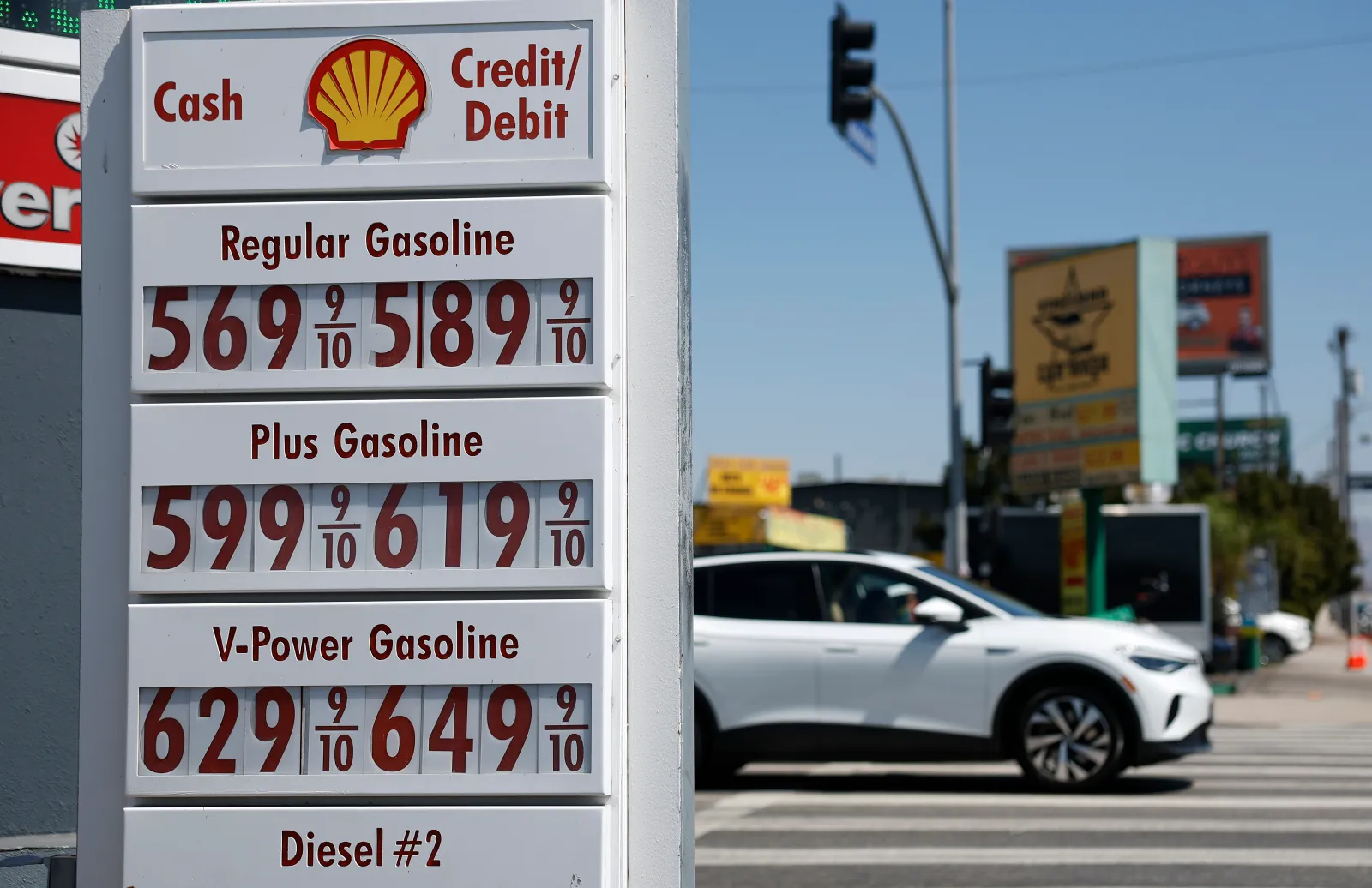
On the same day, the U.S. national average gas price was just below $4, at $3.926 per gallon, having fallen from $4.529 a month ago, according to data from AAA. In California, where drivers paid the highest price at the pump, a gallon of gas went for $5.56. In Indiana, where drivers paid the lowest price, it went for $3.32.
“Gasoline prices better start going down a lot faster than what I’m seeing!” Trump wrote.
These are the 10 states with the highest gas prices as of Wednesday morning, according to AAA:
- California —$5.56
- Hawaii—$5.54
- Washington —$5.32
- Alaska—$4.98
- Oregon—$4.83
- Nevada —$4.75
- Idaho —$4.22
- New York—$4.22
- Illinois—$4.19
- Arizona —$4.16
Why Prices May Fall Slowly
According to Patrick De Haan, the head of petroleum analysis at GasBuddy, gas prices will likely fall slowly, as concerns remain over the Strait of Hormuz and markets.
“Retail gas price behaviors haven’t changed—prices continue to fall at the national level, the lag time remains consistent,” he told Newsweek.
“However, some c-store operators, given how high prices went and now how oil has dropped, are reporting very healthy margins—but the pace of decline is typical,” he continued.
De Haan believes prices will fall in time, adding that “nothing is really new with how this is all happening,” and that Trump’s accusations against U.S. oil companies appear to be misplaced, as they rarely own retail outlets.
“‘Big oil’ isn’t gouging, it’s just that retailers drop prices slower to make up for their inability to earn a livable income during March and April when prices were white hot,” he said.
The analyst estimated that by July 4, the national average could fall to $3.70 per gallon, and that it could drop to $3.35 per gallon by the end of summer, “barring hurricanes or re-escalations.”
An Economist Weighs In: ‘Not Surprised’
Despite Trump’s eagerness to see gas prices plunge, as he had promised Americans, their slow fall is in line with what economists would normally expect to happen under the current circumstances.
“While oil companies have certainly profited from elevated prices, much of the recent easing in gasoline prices reflects falling crude oil prices from weeks ago,” Tyler Schipper, an associate professor in the Department of Economics at the University of St. Thomas, told Newsweek.
“There is always a delayed response at the pump: Gas prices follow oil prices, but they do not move in lockstep with today’s headlines. Markets seem to be responding as most experts would predict, with gasoline prices coming down as oil prices fall, but taking time to return to pre-conflict levels,” he said.
Schipper added: “Bottom line: As a driver, I’d love gas prices to be lower. As an economist, I’m not at all surprised they are not.”
Why Gas Prices Went Up
Gas prices rose in every U.S. state in the weeks following the start of the war in Iran, as the conflict effectively put a chokehold on the Strait of Hormuz, a narrow waterway where one-fifth of the world’s oil normally transits, and sent global oil prices skyrocketing.
However, a recent encouraging turn in the negotiations between the U.S. and Iran to end the conflict has brought down both oil and gas prices over the past few weeks. According to GasBuddy data, the national average gas price in the U.S. was 14 percent lower on Wednesday than their May peak after the two countries agreed to an interim peace deal and the reopening of the Strait of Hormuz.
By comparison, crude oil prices were down 23 percent over the same period. From their peak in March, when Brent crude was roughly $118 per barrel, they have fallen by an even steeper 40 percent.
While gas prices have been falling for six weeks straight, they remain much higher than the average of $2.76 per gallon recorded in January, when the White House boasted about the Trump administration delivering big wins for American families.
Schipper expects gas prices to continue trending downward as oil prices ease, but he warns that progress will eventually slow.
“Factors like countries replenishing their reserves, higher transport costs through the Strait of Hormuz and a return to normal energy consumption will offset some of the recent supply-side gains,” Schipper said.
“Any forecast depends on continued progress toward peace with Iran,” he continued. “If conflict flares up again, all predictions go out the window. Ultimately, I don’t expect to see gasoline prices return to their 2025 levels until 2027.”
What This Means for Consumers
Americans have paid an extra $59 billion in inflated fuel prices since the start of the war in Iran, or almost $450 a month per household, according to an analysis by Moody’s Analytics first shared with CNBC in late May. These additional costs, according to Moody’s chief economist Mark Zandi, were “made up mostly of gasoline, then there’s a diesel cost and an implied jet fuel cost in those higher airline fees.”
The extra costs have eaten up the federal income tax refunds pushed forward by the Trump administration, which initially offset the unexpected additional financial burden. By the end of May, the costs were higher than the refunds.
Trump has promised that gas prices will plummet once the conflict in the Middle East is over. But “unless the war ends soon, financially pressed consumers will have no option but to turn more cautious in their spending, threatening the already soft economy,” Zandi told CNBC.
Why Strait of Hormuz Disruption Continues
At least 172 vessels have crossed the Strait of Hormuz since Washington and Tehran signed a deal to end the war on June 17, which included lifting the U.S. naval blockade, according to data from the maritime intelligence firm Kpler cited by the BBC.
While it is a clear improvement from a few weeks ago, total crossings remain well below the average of 138 a day reported before the war began.
Navigating the strait, even without the U.S. blockade, remains more difficult than before the start of the conflict as the once-popular central route is laden with mines. Vessels, as reported by The New York Times, are now preferring to take the southern route close to the coast of Oman or the northern route close to the coast of Iran.
The Joint Maritime Information Center, which is monitoring security threat levels in the Strait of Hormuz, said mariners should remain wary of mines and should also “expect congestion through transit routes and potential VHF hailing from naval forces to support free flow.”
How US-Iran Talks Are Progressing
Talks between the U.S. and Iran continue as major gaps in the negotiations remain. On Monday, Vice President JD Vance announced that Iranian officials had agreed to let United Nations inspectors back into the country’s nuclear sites. On Tuesday, however, Iranian officials denied making such a commitment.
Meanwhile, Trump is facing backlash from the Senate, which gave final approval on Tuesday to a resolution instructing him to end the war in Iran or seek congressional authorization to continue it. The resolution does not have the force of law, but it is a strong rebuke from lawmakers—including four Senate Republicans who joined their Democratic colleagues in supporting the war powers resolution.

