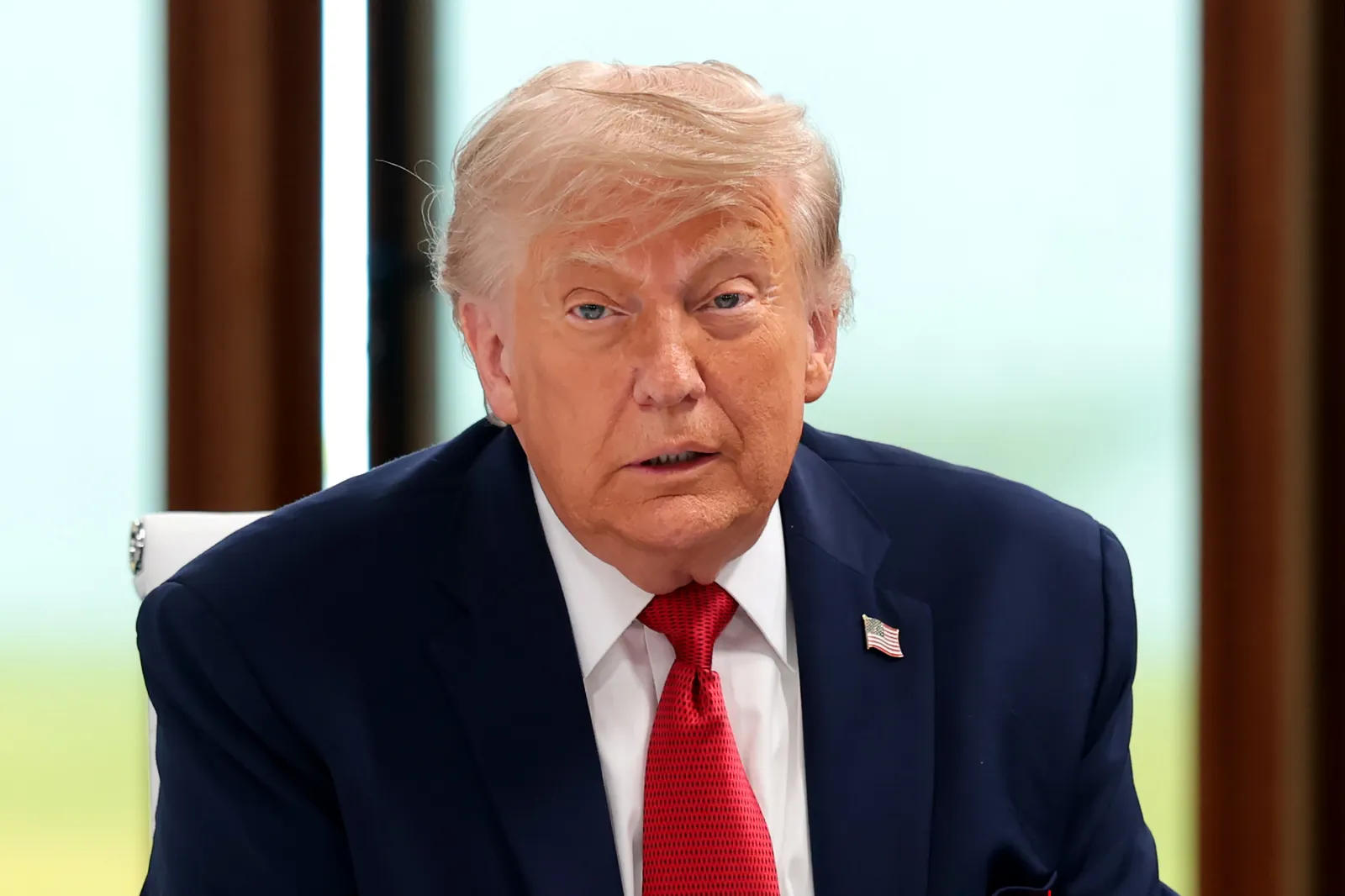
President Donald Trump called reporting by The New York Times on the war against Iran “treasonous” and said he would add the report to his lawsuit against the newspaper. “The way the Corrupt and Failing New York Times is covering stories on a very battered and beat up Iran, through FAKE & MADE UP ‘FACTS’ is, in my opinion, ‘TREASONOUS,’” Trump wrote on his Truth Social platform on Sunday night. “I will be adding all of their false and ridiculous reporting to my multi Billion Dollar lawsuit against them. They are Criminals!”
Trump filed a $15 billion lawsuit, alleging defamation, against the Times in September last year, but a judge tossed it out days later, saying the 85-page complaint was full of “tedious and burdensome” language that had no bearing on the legal case.
He then filed an amended 40-page complaint with the U.S. District Court for the Middle District of Florida in October, which named the newspaper, publisher Penguin Random House, investigative reporters Suzanne Craig and Russ Buettner and the newspaper’s chief White House correspondent, Peter Baker, as defendants.
Why Trump Is Targeting the Times‘ Iran Coverage
Trump’s new remarks came after he criticized a Times analysis suggesting months of conflict had changed little strategically, while Trump claimed Iran’s military and economy had been severely damaged. The Times has previously said Trump’s lawsuit is without merit and an attempt to stifle independent reporting.
In another post earlier on Sunday, Trump criticized a Times article published that day under the headline “What Changed After Almost 4 Months of War? Analysts Say Not Much.”
He rejected the analysis, claiming Iran’s military and economy had been severely damaged, the Strait of Hormuz remained open and U.S. markets and jobs were at “record HIGHS.” He also accused the newspaper of being “corrupt and unethical.”
Newsweek contacted attorneys for Trump and the New York Times via email outside of regular office hours on Monday.
Trump has repeatedly clashed with reporters and news outlets since returning to office last year.
He previously filed suits against ABC News and CBS News’ 60 Minutes, both of which were settled out of court by the news organizations’ parent companies.
Trump also filed a lawsuit against The Wall Street Journal and its owner, Rupert Murdoch, after the newspaper published a story reporting on his ties to the late convicted sex offender Jeffrey Epstein.
Last week, Trump signed a memorandum of understanding with Iran to end the war. The interim agreement calls for a permanent end to hostilities and starts a 60-day negotiating clock to reach a final deal on the future of Iran’s nuclear program.
Legal Experts Weigh In
Trump could seek permission from the court to amend his complaint, but any new claim would still have to meet the requirements for defamation, said Jane Kirtley, a professor of media ethics and law at the University of Minnesota’s Hubbard School of Journalism and Mass Communication.
“To be libelous, a statement must be false and defamatory,” Kirtley told Newsweek. “Even taking his allegations at face value, the Times’ analysis is simply that—an analysis based on stated facts, which is a statement of opinion.”
Kirtley said the omission of certain facts can, in some cases, be relevant to actual malice—the standard requiring knowledge of falsity or reckless disregard for the truth. But she said the Times appeared to have provided sufficient facts, both supporting and challenging its analysis, to withstand such a claim.
Kirtley said Trump’s own assertion that the Times story was “treasonous” was legally notable, although she said it would also likely be protected by the First Amendment.
“Although he’s used the term ‘treasonous’ in the past, in this context I would argue that it is Trump’s rhetorical hyperbole, which, as political speech, would enjoy a very high level of First Amendment protection,” said Kirtley. “In other words, ironically, President Trump is benefiting from the New York Times v. Sullivan standard (and its progeny) that he has vowed to destroy.”
Trump has criticized and legally challenged the landmark 1964 Supreme Court decision, which established that public officials who sue for defamation must prove that the challenged statements were made with “actual malice”—meaning knowledge of falsity or reckless disregard for the truth. The standard was later extended to public figures.
Trump’s attorneys have not yet said in court how, or whether, they would seek to add the Iran coverage to the existing complaint.
Lyrissa Barnett Lidsky, a law professor at the University of Florida whose research focuses on tort law and the First Amendment, said it appeared that the president is “using the threat and reality of defamation lawsuits as a strategic tool of governance.”
She told Newsweek: “He’s trying to intimidate critics into silence, and he’s successfully extracted settlements against a number of media critics. The President may now also be using defamation law to try to dictate how history will be written.”
What’s In Trump’s MOU With Iran?
The MOU sets out a 60-day interim framework aimed at ending the war and opening negotiations on a final nuclear deal. Its key provisions include:
- An immediate halt to military operations, including in Lebanon
- A commitment by Iran to keep the Strait of Hormuz open to shipping for 60 days, with no charge for vessel passage
- A pledge by Iran not to develop nuclear weapons and to dispose of its enriched uranium stockpile through a mutually agreed mechanism under International Atomic Energy Agency supervision
- A U.S. commitment to lift its naval blockade of Iranian ports within 30 days
- U.S. waivers for Iranian oil exports and related banking, insurance and transportation services
- The unfreezing of some Iranian assets and a proposed reconstruction and economic development package worth at least $300 billion
- A mechanism to monitor compliance while the two sides negotiate a final deal, which would be backed by a binding United Nations Security Council resolution
The deal appears designed to exchange immediate de-escalation and protection of a critical global shipping lane for major economic relief to Tehran.
Supporters are likely to argue that the Hormuz and uranium provisions reduce the risk of a wider war and create a path toward a verifiable nuclear settlement.
Critics, however, are likely to focus on the scale of the proposed reconstruction fund and sanctions relief, arguing that the U.S. would be offering Iran substantial concessions before a final deal is secured.
The interim deal was thrown into doubt on Saturday, when the Iranian military said it had again closed the strait in response to Israeli air strikes in Lebanon. Hours earlier Iranian state media reported that a spokesperson for the Iranian Foreign Ministry denied claims the strait was to be closed, and minutes before U.S. Vice President JD Vance told Fox News during a live TV interview that the lane remained open.