“What did they do to my son?” she asked without even looking at me. “Raul called me saying he’s being accused.” The doctor turned toward her, her eyes blazing with a protective fire. “Your daughter-in-law has serious injuries,” the doctor stated flatly. “And she is pregnant.” Mrs. Eulalia went still. It wasn’t surprise I saw on her face. It was calculation. Her eyes went from my womb to the folded X-ray in Raul’s hand, then to the door, as if searching for an exit. “That can’t be,” she murmured. My blood turned to ice. She didn’t say “how wonderful.” She didn’t say “God bless her.” She said: “That can’t be.”
Raul heard her, too. He looked at her with a different kind of rage, a flicker of doubt crossing his features. “Why can’t it be, Mom?” he demanded. Mrs. Eulalia swallowed hard, her eyes darting around the room. “Because… because this woman is devious,” she stammered. “Who knows whose kid that is.” I tried to sit up, but the pain pierced through my ribs like hot knives. Still, I found the strength to speak. “I have never been with another man,” I said, my voice trembling but clear. “Shut up!” Raul yelled at me, raising his hand. The doctor took a step forward, placing herself directly between us. “Lower your voice or I’ll call security,” she warned, her tone leaving no room for argument. But Raul wasn’t looking at me anymore.
He was looking at his mother, his eyes narrowing with sudden, dawning suspicion. “Why did you say that?” he asked, his voice dropping to a dangerous whisper. Mrs. Eulalia squeezed the rosary between her fingers, her knuckles turning white. “Because a mother knows things,” she replied, though her voice lacked its usual conviction. At that moment, a social worker named Mariana entered the room. She came with a blue folder and a serene gaze, the kind that doesn’t need to raise a voice to hold you up. “Mrs. Lucia,” she said gently, “your daughters are here.” “A neighbor brought them.” “They are scared, but they are fine.” My soul returned to my body. “Camila? Renata?” I choked out, tears spilling over. “They are with nursing,” Mariana assured me. “They ate some Jell-O and are asking for you.” I cried, unable to help it. Not for myself. For them. Because they had seen too much. Because I had confused silence with protection and obedience with love. Raul tried to push past Mariana. “I’m going to get my daughters,” he declared. Mariana stepped squarely in his way, her posture unyielding. “No,” she said firmly. “The girls are not going with you.” “They are my daughters!” he shouted. “For now, they are in protective custody while the situation is evaluated,” Mariana replied, her voice echoing with legal authority. Raul raised his hand, and for the first time, he didn’t find my face in front of him. Instead, he found two security guards who appeared at the door, their hands resting near their belts.
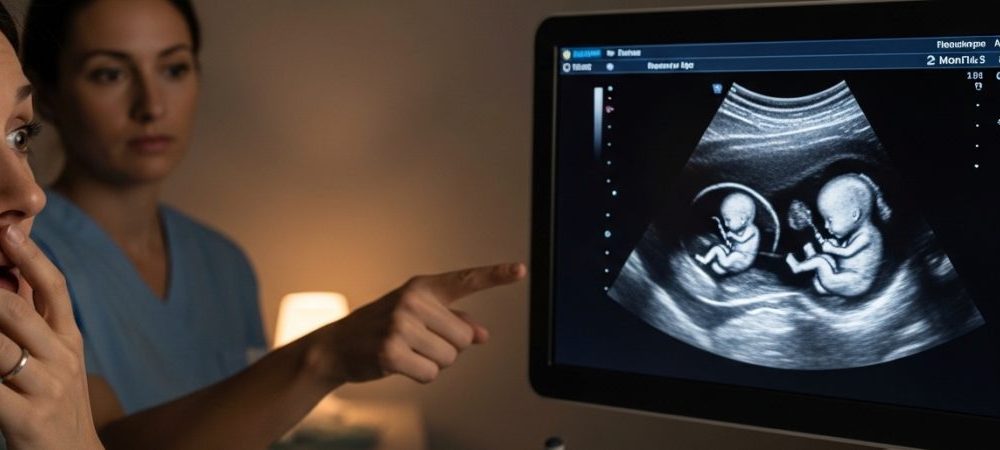
Mrs. Eulalia put her hand to her chest, feigning a heart attack. “What a shame!” she wailed. “Look what you caused, Lucia!” The shame, I thought, had been sleeping in my bed for years. It wasn’t mine anymore. The doctor asked for another ultrasound to check on the baby, ensuring the trauma hadn’t caused a miscarriage. They took me down a long hallway. The ceiling lights passed one after another like memories. My wedding in a borrowed dress. Raul promising to take care of me. Mrs. Eulalia touching my belly when Camila was born and saying, “Oh well, maybe next time.” Renata crying in my arms while her grandmother refused to hold her because “another female in the family wasn’t needed.” When the doctor put the cold gel on my belly, I closed my eyes. I was terrified that the blows had harmed the baby. Then I heard that sound. Fast, small, stubborn. Thump-thump-thump-thump. “There is your baby,” the doctor said softly. “The heartbeat is strong.” I covered my mouth with my hand. I don’t know if it was instinct or a miracle, but for the first time in a long time, I didn’t feel like my body was a battered house. I felt that it still held life. The doctor moved the device slowly, her eyes fixed on the monitor. Suddenly, she frowned. “Did you have another birth before your two girls?” she asked, her tone shifting. I opened my eyes, confused. “No,” I said. “Only Camila and Renata.” “Are you sure?” she pressed, looking deeply into my eyes. I froze. “Yes,” I whispered. She looked at the screen, then at my charts, her brow furrowed in deep concentration. “There are signs here of an old C-section,” she said slowly. “And it’s not from your daughters, because according to the file, both were natural births.” I felt the room tilt. “That can’t be,” I breathed. The doctor called the previous physician into the room. They checked papers, talking in low, urgent voices.
I barely understood scattered words: internal scar, previous procedure, old file, records. An hour later, the doctor returned with a yellowed, dust-covered folder. He wasn’t alone. Mariana was with him, her expression grave. “Mrs. Lucia,” he said gently, “we found a record from seven years ago.” “You were admitted to this same hospital with a complicated labor.” “Yes,” I whispered, my heart pounding against my ribs. “When Camila was born.” The doctor opened the folder, his eyes filled with a profound, sorrowful pity. “It says here that you had a twin pregnancy that day,” he said. I ran out of air. “No,” I gasped. Mariana stepped closer to my bed, placing a comforting hand on my shoulder. “Lucia…” she began. “No,” I repeated, but my voice broke into a sob. “I had Camila.” “They told me it was only her.” “They told me I fainted because I lost blood.” The doctor turned a page, the sound of the paper tearing through the silence like a gunshot. “According to this record, two babies were born,” he said, his voice heavy. “A girl and a boy.” The world stopped making noise. I only heard my own heart, hammering a frantic rhythm against my chest. A boy. My son. The son Raul had demanded of me for years, the son he had beaten me for not giving him. “Where is he?” I asked, though the answer terrified me to my very core. “Where is my baby?” Mariana took a deep breath, bracing herself. “The file says the boy was declared deceased hours later,” she explained carefully. “But there are irregularities.” “There is no death certificate.” “No record of the body being released.” “No signature from you.” “Because I was asleep,” I said, trembling violently. “They drugged me.” “Mrs. Eulalia said it had been necessary.” “She signed everything.” The doctor looked at Mariana, confirming the horror of the situation. “There is an authorization signature,” the doctor confirmed. “From Eulalia Mendoza.” I put my hands on my belly, but I wasn’t protecting the baby that was coming. I was searching for the one they had stolen from me. The door burst open. Raul had been listening outside.
“What are you saying?” he demanded, his face pale. Mrs. Eulalia was right behind him, white as a sheet, her eyes wide with panic. “Don’t believe them, son,” she shrieked. “It’s all lies!” Raul snatched the folder from the doctor’s hands. He read one, two, three lines. His hands began to shake, the paper rattling in his grip. “It says ‘male’ here,” he whispered, the color draining from his face. No one spoke. The silence was deafening. “Mom,” he said, turning to her, in a voice I had never heard from him before. “I had a son?” Mrs. Eulalia pressed her lips together, her facade finally cracking. “That boy was born wrong,” she spat. “What did you do to him?” Raul yelled, stepping toward her. “I saved him from a miserable life!” she screamed, and her scream was a confession that echoed off the sterile walls. “He was born weak! Small! He was going to bring misfortune to this family!” “Where is he?” Raul asked, his voice breaking. She started to cry, but her tears gave me no pity. They were the tears of a cornered rat, caught in the trap of her own making. “Your cousin Maribel couldn’t have children,” she sobbed. “Her husband was going to leave her.” “I only did what was best for the family.” “The boy is alive.” “He is with her, in Charleston.” I felt something inside me break and ignite at the same time. A fire, hot and pure, erupted in my chest. “She stole my son,” I said, my voice steady and cold. Mrs. Eulalia looked at me with pure, unadulterated hate. “You didn’t deserve him,” she sneered.
“You were poor, weak, a whiner.” “And then you brought another girl.” “What were people going to think?” Raul slumped into a chair, the fight completely drained from him. For years he had beaten me for not giving him a son, while his own mother had hidden the son I did give birth to. The irony was a bitter poison in his mouth. But I wasn’t looking at Raul anymore. I didn’t care about his surprise, his guilt, or his late, useless tears. My pain had another name. “I want to see him,” I said, my voice ringing with a new, unbreakable authority. “I want my son.” Mariana nodded, her eyes shining with respect. “We are going to file a report,” she said firmly. “This is kidnapping, falsification of documents, and domestic abuse.” “But we have to do it the right way.” Raul stood up, a desperate look in his eyes. “I’m going with you,” he offered. I looked at him, and for the first time, he lowered his eyes, unable to meet my gaze. “You aren’t going anywhere with me,” I told him, my voice devoid of any emotion. “You broke my ribs.” “You broke my years.” “You broke me in front of my daughters.” “Lucia, I didn’t know…” he pleaded. “But you did hit me,” I cut him off. He opened his mouth but found no defense. “I’ll spend my whole life asking for your forgiveness,” he whispered. “I don’t want your life,” I replied, turning my head away. “I want mine back.” That night, I gave my statement. It hurt more to talk than to breathe. I recounted every blow I remembered. Every threat. Every time Mrs. Eulalia called me useless. Every time Raul locked me in the bathroom. Every one of my daughters’ birthdays that ended in tears because they weren’t “the heir.” Camila came to see me the next day. She walked slowly, as if the hospital were a church, her small face pale with worry. Renata followed behind with a teddy bear a nurse had given her, her eyes wide and questioning. “Mommy,” Camila said, her voice trembling. “Are we not going back to the house?”
I hugged her carefully, mindful of my ribs. “No, my love,” I whispered. “Promise?” she asked. That question broke me more than any kick Raul had ever delivered. “Promise,” I said, kissing the top of her head. Renata touched my belly, her small fingers tracing the curve. “Is a baby living in there?” she asked. I nodded. “Yes.” “Is Daddy going to yell at it?” she whispered, fear creeping into her voice. I pulled her to my chest, holding both my girls as tightly as I could. “No one is ever going to yell at a baby for being born again,” I vowed. Three days later, with the support of the District Attorney’s office and a court order, we went to Charleston. I still walked slowly, my body aching with every step. I wore dark sunglasses to hide the bruises and a medical brace that held my ribs together. Mariana was by my side, a pillar of strength. So were a prosecutor and two police officers, their presence a shield against the past. Maribel’s house was large, painted a cheerful yellow, with pots of geraniums and a new truck outside. It was a pretty house, designed to hide a horrible, unforgivable lie. Maribel opened the door. When she saw me, she dropped the cup she was holding, the ceramic shattering on the porch. “Lucia…” she gasped. She didn’t ask what I was doing there. She knew. “Where is my son?” I demanded, my voice shaking with a mixture of rage and desperation. She put her hands to her chest, stepping back. “Please, don’t do this,” she begged. “Where is he?” I repeated, stepping forward. A boy appeared at the end of the hallway. He was seven years old. He had black hair and large, expressive eyes. My eyes. On his left cheek, he had a small mole, just like Camila’s. He looked at me with curiosity, tilting his head. “Mom, who is she?” he asked. The word pierced through me like a physical blow. Mom. He was saying it to someone else. Maribel started to cry, her shoulders shaking. “I raised him,” she sobbed. “I love him.” “You took him from me,” I said, unable to look away from him, my heart shattering into a million pieces. The boy took a step back, sensing the tension. “What’s happening?” he asked, his voice small. I knelt as best as I could, though the pain made me break into a cold sweat. “Hi, sweetheart,” I said, forcing a gentle smile. “My name is Lucia.” He watched me, his eyes searching mine. “I’m Matthew,” he replied. Matthew. My son had a name. Not the one I would have chosen, but it was his. He was alive. He was breathing. He was looking at me. And in that instant, I understood that recovering a son wasn’t about snatching him suddenly from the only arms he knew. It was about telling him the truth without destroying him. Maribel confessed a short time later, sitting on her porch, weeping uncontrollably.
Mrs. Eulalia had handed the newborn to her with false papers and the promise that no one would know. They told her I had agreed because I couldn’t support two babies. They told her I was a bad mother who didn’t want him. “I wanted to believe it,” she sobbed. “Because I needed to believe it.” I didn’t forgive her that day. Maybe I never fully will. But I didn’t scream in front of Matthew either. There were already too many adults breaking children, and I refused to be one of them. The judge ordered tests, interviews, and psychological support. Matthew didn’t fall into my arms like in the movies, running and saying “Mom.” He arrived with fear, with doubts, with two drawings in his backpack and a life he didn’t know was borrowed. For weeks, I saw him at a family center, under the watchful eye of a therapist. At first, he spoke to me formally, calling me “Mrs. Lucia.” Camila gave him a blue marble, a peace offering from a sister he never knew he had. Renata asked him if he knew how to make paper airplanes, her innocence bridging the gap. He barely smiled. The first time he called me “Lucia,” I felt sadness and hope at the same time. The first time he took my hand to cross the street, I cried silently, letting the tears fall where he couldn’t see them. The first time he asked if I had looked for him, I told him the absolute truth. “I didn’t know you existed, my love,” I said, looking deeply into his eyes. “But from the moment I knew, I haven’t stopped looking for you for a single second.” He looked down, his small shoulders slumping. “So you didn’t give me away?” he asked, his voice barely a whisper. “Never,” I said fiercely. Matthew hugged my waist tightly. I endured the pain in my ribs because that hug was putting my soul back in place. Raul was arrested for domestic violence shortly after. Mrs. Eulalia also faced charges for kidnapping and forgery, her empire of lies finally crumbling.
At first, in our small town, people said everything. They whispered that I had exaggerated. They said a mother shouldn’t put the father of her children in jail. They claimed that family problems are settled at home, behind closed doors. But one afternoon, while I was selling snacks outside a school to make rent, a neighbor who used to close her window when I walked by approached me with red eyes. “Forgive me, Lucia,” she told me, her voice thick with guilt. “I used to hear it.” “I used to hear him yelling.” “I didn’t know what to do.” I didn’t know what to say. Then another neighbor came. And another. Some didn’t ask for forgiveness; they just bought extra snacks, leaving large tips. Others gave me clothes for the kids. One offered me a job cleaning medical offices, giving me a safe, stable income. Life didn’t get fixed all at once, but it stopped hitting me. My baby was born on a rainy dawn, healthy and strong. It was a girl. When the doctor put her on my chest, I laughed through my tears, a sound of pure, unadulterated joy. Camila clapped when she saw her, her face beaming with pride. Renata said she looked like a little bundle of sunshine. Matthew, serious like a little old man, tucked her blanket in with gentle, careful hands. “What’s her name going to be?” he asked, looking at the tiny, perfect face. I looked at my four children, my heart swelling with a love so vast it threatened to consume me. “Hope,” I said. No one asked for a boy. No one sighed in disappointment. No one said “maybe next time.” Raul asked to see me months later from the detention center. I agreed only once, accompanied by my lawyer, needing closure more than anything else. I found him thinner, with hollow eyes and a defeated posture. “Lucia,” he said, his voice raspy. “I lost everything.” I looked at him through the thick glass, feeling nothing but a distant, cold pity. “No,” I corrected him. “You threw it away.” He cried, the tears flowing freely down his cheeks. “My mother made me believe…” he started. “Your mother lied,” I cut him off sharply. “But your hands were your own.” He went silent, the weight of his actions finally crushing him. “Does Matthew ask about me?” he asked, a flicker of hope in his eyes. “He asks about the truth,” I replied. “That’s different.” “And what do you tell him?” he pressed.
“That his father had the opportunity to love,” I said, my voice steady and clear. “And he chose to hurt.” Raul closed his eyes, a single tear escaping. “Will you ever forgive me?” he whispered. I thought of my daughters covering their ears. Of Matthew growing up far away from me, robbed of seven years. Of Hope moving inside my womb while he accused me of betrayal. I thought of my body, full of maps I hadn’t chosen, scars I had to heal. “I don’t live to hate you,” I told him, standing up. “But I wasn’t born to forgive you either.” I turned and walked away. “Lucia…” he called out, but I didn’t turn back. Outside, the sky was clear, a brilliant, endless blue. I bought four popsicles before going home. Camila chose lime, Renata strawberry, Matthew coconut, and I took a small one for when Hope grew up, even if it melted on the way. That silliness made me laugh, a genuine, belly-deep laugh. Before, I didn’t allow myself silliness. Before, I was too busy surviving. That night we had noodle soup at a used table that wobbled on one leg. Matthew said they asked him to draw his family at school. He showed me the paper, his face a mix of pride and vulnerability. We were all there. Camila with massive braids. Renata in a purple dress. Hope as a little pink ball in my arms. Him by my side. And me. I was drawn taller than a house. “I drew you big,” he said, looking up at me. “Why?” I asked, my throat tight. He shrugged, a small, genuine smile playing on his lips. “Because you’re really there.”
I went to the bathroom to cry so he wouldn’t get scared. But Camila followed me, peeking through the door. “Are you sad, Mommy?” she asked, her eyes wide with concern. I wiped my face, taking a deep, shuddering breath. “No,” I said, looking at my reflection, seeing not a victim, but a survivor. “I’m breathing.” She didn’t understand, but she hugged me, and that was enough. With time, my story stopped being gossip and became a warning. In the market, women who used to look down started speaking to me in low voices. One showed me a bruise on her arm. Another asked for Mariana’s number. Another told me her husband also blamed her for only having girls. I would repeat to them what a doctor told me when I was broken on a gurney, a truth that became my mantra. “The sex of the baby is determined by the father,” I would tell them. “But the value of a woman is determined by no one.” Sometimes I still dream of the courtyard of that house. I dream I’m on the ground and I can’t get up. Then I wake up startled, looking for blows that no longer come. And the same thing always happens. I hear my children’s breathing in the small rooms. I hear Hope moving in her crib. I see the dawn over the city through the window, soft and clean, as if the world were giving me another chance. So I get up. I make coffee. I braid hair. And when my children wake up, I tell them the same thing every day, so they never forget. “In this house, no one is worth less for being born a girl.” “No one is worth more for being born a boy.” “In this house, we were all born to be loved.” Matthew was the last one to leave for school that morning. He came running back from the door and hugged me hard, his arms wrapping around my waist. “Mom,” he said. It was a small word. But it gave me back seven years. I hugged him with all the care in the world, the way you hug what was lost when it finally returns. Looking at the sun coming through the window, I understood that Raul hadn’t taken my life. He had only delayed the moment I could start living it. And now, finally, I was alive.

