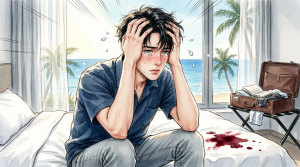
You freeze with one foot still on the carpet and one hand gripping the edge of the mattress.
The red stain isn’t large. It doesn’t look like a crime scene, not even close. But it sits there on the white hotel sheet with the kind of quiet certainty that can stop a man’s breath. A small, dark bloom in the middle of a morning that, five seconds ago, had still felt almost tender.
Your ex-wife is standing by the window in your white dress shirt, the ocean behind her turning silver in the Cancún sun.
For one strange second, your mind goes somewhere stupid.
You think maybe she cut herself. Maybe there’s some harmless explanation, some minor scratch, some ordinary body thing that only looks dramatic because hotel sheets are aggressively white. But the feeling in your stomach says otherwise. It drops hard and cold, like an elevator cable snapping.
Elena turns when she notices you aren’t moving.
Her eyes follow yours to the bed.
And the color leaves her face.
“What is it?” you ask, though you already know the question is wrong. Not because you know the answer, but because whatever answer exists is already bigger than the room.
She doesn’t speak immediately.
That silence scares you more than the stain.
“Elena.”
She presses her lips together and looks away.
The ocean keeps rolling outside as if this is still just another expensive morning in paradise. Somewhere down below, a blender whines from the breakfast terrace. A couple laughs near the pool. Vacation noise. Normal noise. It makes the stillness inside the room feel even more unreal, like you and Elena have stepped into some sealed glass box where the air has changed.
Then she says, very softly, “I didn’t think it would happen this way.”
You stare at her.
“What does that mean?”
Her hand goes to the hem of the shirt, clutching the fabric like she needs something to hold onto before the floor disappears. For three years you imagined what it might feel like to see her again. You thought maybe there’d be bitterness, maybe nostalgia, maybe regret so sharp it would make your teeth ache. You never imagined fear. Not hers.
“Carlos,” she says, and your name sounds fragile in her mouth, “I was going to tell you. Just… not like this.”
Every muscle in your body tightens.
“Tell me what?”
She closes her eyes.
And when she opens them again, you already know your life is about to split into before and after.
“I was pregnant when I left Mexico City.”
The room goes silent in a completely different way.
Not empty. Crushed.
You hear the air conditioner humming. You hear your own pulse. You hear some part of your mind starting to run toward denial and slam into walls. Pregnant. When she left. Three years ago. The words line up, but your brain refuses to let them become meaning.
You actually laugh once.
A short, disbelieving sound.
“No.”
Elena doesn’t move.
“No,” you repeat, louder now. “That’s not funny.”
“I’m not joking.”
You take a step back from the bed.
Then another.
Because suddenly the whole room feels contaminated with implication. The shirt she’s wearing. The ocean view. The memory of her skin under your hands a few hours ago. The years between your divorce and this morning. Everything is rearranging itself too fast, and your mind can’t keep up.
“What are you saying?” you ask. “That the stain… that this…” You gesture helplessly at the bed, at the room, at all of it. “What are you saying?”
Elena swallows hard.
“I’m saying the last time we were together before the divorce… it wasn’t the last time I carried something of yours.”
Your knees go weak.
So you sit down on the armchair near the desk before your body does it for you in some uglier way. You look at her and feel like you’re seeing a double exposure. The woman you married. The woman you divorced. The woman you found in a bar in Cancún three years later, glowing in a summer dress and smiling like time had softened everything. And now this other woman, the one holding a truth so large it seems impossible that it fit inside her all this time without cracking her apart.
You speak slowly because if you don’t, your voice might become something wild.
“Are you telling me I have a child?”
Elena starts crying.
Not dramatically. Not with noise. Just a sudden spill of tears she doesn’t seem to have energy left to stop. She nods once.
You stare at her.
Then at the bed.
Then back at her.
“How old?”
Her answer comes out like a confession dragged over broken glass.
“She turned two in March.”
For a moment, your entire body goes cold.
Not hot, not angry, not overwhelmed. Cold. Because you can count. You can count nights, months, paperwork, silences. You can count the slow death of your marriage and the polite signatures on your divorce papers and the years afterward when you kept working, kept sleeping, kept living inside a life you thought was sad but understandable. And now all that arithmetic is changing shape.
Two years old.
You grip the arms of the chair.
“You left me,” you say. “You signed the divorce papers. You moved away. And all that time…”
Elena nods again, tears slipping down her face.
“All that time, yes.”
You stand so fast the chair legs scrape the tile.
“Why?”
The word cracks out of you harder than you meant it to.
“Elena, why?”
She flinches, but not from your volume. From the question itself. Like she’s been hearing it in her own head for years.
“Because I found out right before everything collapsed,” she says. “And by then… by then we were already dead, Carlos.”
“No.” You shake your head violently. “No, that’s not enough. You don’t get to hand me a sentence like that and call it an explanation.”
She wipes at her face, uselessly.
“We hadn’t been happy for a long time. You know that.”
“I know we were divorcing. I don’t know why that means I lose my child before I even know they exist.”
Her shoulders fold inward.
The sight of it does something ugly to your anger. Not soften it. Complicate it.
Because this isn’t a stranger. It would almost be easier if it were. This is Elena. The woman you were married to for eleven years. The woman who knew how you took your coffee without asking, who could tell from the way you dropped your keys what kind of day you’d had, who once painted your first apartment kitchen yellow because you said gray walls made mornings feel sick. Loving someone deeply does not make betrayal hurt less. It gives it better aim.
She walks toward the bed and sits on the edge, careful now, as though any sudden movement might break the whole room.
“I found out ten days after I moved,” she says. “I had already signed the lease in Quintana Roo. I had already started the new job. We had already filed everything. We hadn’t just separated, Carlos. We had stripped the marriage down to the studs. There was nothing left in it except exhaustion and blame.”
You want to say that’s still not enough.
It isn’t enough.
But you don’t interrupt.
“I told myself I should call you,” she continues. “I told myself that for days. Then weeks. But every time I pictured it, I saw the same thing. You and me dragged back into each other’s lives through obligation, not love. You resenting me. Me resenting you. A child learning how to breathe in a house full of polite damage.”
Your mouth goes dry.
“So you decided for me.”
She closes her eyes. “Yes.”
The honesty of it lands harder than denial would have.
Not because it’s noble. Because it’s blunt. No excuse. No performance. Just the raw, selfish truth: she chose. And you were not included in the choice.
You turn away and walk to the window.
The Caribbean is stupidly beautiful in the morning. Blue so bright it feels artificial. Palm trees moving lazily in the wind. White sand already warming under the sun. People are down there beginning their vacation day, toweling off chairs, ordering drinks, taking selfies in a world that still behaves as if nothing under the surface is shifting. You press one hand against the glass and suddenly understand why people punch walls.
“Boy or girl?” you ask.
The question seems to surprise her.
“A girl.”
You nod once.
The word opens something inside you so sharply it almost drops you.
A girl.
Somewhere in the world, for two years, your daughter has been learning words, falling asleep, scraping knees, laughing at things that make no adult sense, and you were in meetings. You were reviewing hotel budgets and site maps and concrete delivery schedules while part of your blood was learning how to say mamá in a different city.
“What’s her name?”
Elena’s voice gets even quieter.
“Lucía.”
You repeat it under your breath.
Lucía.
The name settles in your chest like something that was always waiting there and arrived late.
Then the next thought hits.
“Does she know about me?”
Elena hesitates.
That hesitation is answer enough.
“No,” you say.
“She knows she has a dad,” Elena says quickly. “I never told her she didn’t. I just… I told her he lives far away.”
The fury that rises then is almost clean.
“Far away?” You turn back toward her. “Far away? Elena, I was in Mexico City, not on the moon.”
She winces.
“I know.”
“No, you don’t.” You laugh again, harsher this time. “You don’t get to say you know. You watched her grow for two years. First words, first steps, fevers, birthdays, all of it. You let me wake up every day not knowing my own daughter existed.”
The tears on her face don’t stop.
Good, some mean little part of you thinks. Let them burn.
And instantly you hate yourself for it.
Because what are you supposed to do with this? Where do you put grief this large when it arrives dressed as parenthood? You want to hold something. Break something. Run. Collapse. Ask for pictures. Demand answers. Never speak to her again. See your daughter immediately. All the impulses crowd together until you feel sick.
You look back at the bed.
“At first I thought the blood meant something happened last night,” you say, voice suddenly numb. “Something from us. Some new disaster.”
Elena follows your eyes.
“It kind of did,” she whispers.
You frown. “What?”
She wipes her face again and says the sentence that makes the morning stranger still.
“I had an IUD. It shifted months ago. My doctor said it was nothing urgent, but sometimes after sex there could be spotting if things got irritated. That’s what this is.” Her hand goes unconsciously to her abdomen. “But when I saw the sheet… for one second I thought maybe life was repeating itself. Maybe that was how I’d have to tell you.”
You just stare.
The room feels like it’s tilting on some slow invisible axis.
“So there isn’t another baby,” you say.
“No.”
The relief that flashes through you is so immediate and intense it makes you ashamed. Because even in the middle of discovering a daughter you never knew existed, some basic survival instinct still recoils at the idea of layering one impossible thing on top of another.
You sit back down.
This time on the edge of the other bed, as far from her as the room allows without becoming ridiculous.
“Show me a photo.”
Elena freezes.
Then, slowly, she reaches for her purse on the dresser.
Her hands shake as she unlocks her phone. When she crosses the room to give it to you, she does not sit beside you. She just places the phone in your palm and steps back as if approaching a wild animal. Maybe that’s what you are now.
The screen is already open.
A little girl in a yellow swimsuit sits on wet sand under a beach umbrella, holding a plastic shovel upside down like it has deeply offended her. Her hair is dark. Not black like Elena’s, not quite. Dark brown, with waves at the ends where the humidity has won. Her cheeks are round. Her mouth is stubborn in that tiny, specific way that feels horrifyingly familiar.
But it’s the eyes.
Your eyes.
Not metaphorically. Not in the sentimental way people say children resemble their parents. Literally. The exact shape. The same heavy lower lids. The same dark, serious gaze that makes even a toddler look like she’s evaluating the quality of the world around her.
Your breath leaves you.
You swipe.
Lucía sleeping on a couch with one sock half off.
Lucía in a birthday crown smashing frosting through both fists.
Lucía in rain boots two sizes too big, standing beside a puddle with the solemn concentration of a scientist.
Lucía on Elena’s hip at some Christmas market, pointing at lights.
Lucía asleep in a car seat, mouth open, hair stuck to her forehead.
Each image hits like a separate impact.
You were absent from all of them.
It becomes unbearable fast. Not the pictures themselves. The invisible outline around them where you should have been.
You hand the phone back before your hands start shaking badly enough for Elena to see.
“She looks like me.”
“Yes.”
The way she says it nearly undoes you. Not because it’s cruel. Because it sounds like she’s been carrying that fact alone for too long.
You rub both hands over your face.
“When were you planning to tell me?”
Elena doesn’t answer right away.
That enrages you more than any specific timeline could have.
“You weren’t,” you say.
“I didn’t know how,” she whispers.
“No.” You stand again. “Don’t do that. Don’t take a coward’s sentence and try to make it sound tragic. You knew how. You dial a number. You send a message. You show up. People tell hard truths every day.”
She flinches.
Then, very quietly, “I was afraid.”
You laugh without humor. “Of me?”
“Of all of it.”
That answer does stop you.
Because it isn’t nonsense. It isn’t enough, but it isn’t nonsense. Fear can do monstrous administrative work. It can build whole alternate lives out of postponement and call it prudence.
Elena sinks into the chair by the desk like her body has finally run out of lies strong enough to hold posture.
“The first six months after I found out, I kept thinking I’d call you once things were stable,” she says. “Then I started showing, and I thought I should wait until after the baby came. Then Lucía was born early and had to stay in the NICU for nine days, and all I could think about was keeping her alive. After that…” She breaks off and looks at the floor. “After that, every month I stayed silent made the next month harder.”
You know that’s true.
That’s the sick brilliance of cowardice. Delay compounds. Silence gets interest.
“She deserved to know her father,” you say.
“Yes.”
“And I deserved to know I had a daughter.”
“Yes.”
“And you still said nothing.”
“Yes.”
This time, the honesty doesn’t inflame you. It drains you.
Because what do you do with a person who is guilty and not fighting it? Anger likes resistance. It wants somewhere to land. Elena isn’t defending herself. She’s just sitting there in your shirt, wrecked and small and truthful too late. It doesn’t absolve her. It just makes the whole thing sadder.
You look at the clock on the nightstand.
8:14 a.m.
The site meeting you’re supposed to attend at ten suddenly seems like something from another planet. Men in polos discussing resort setbacks while your actual life is here, split open on hotel linen.
“I need air,” you say.
Elena rises instantly. “Carlos…”
“No.” You grab your jeans and shirt from the floor, yanking them on with movements too rough to be called dressing. “Not another word right now.”
You leave without shaving, without breakfast, without your room key until you have to come back and snatch it off the desk because apparently emotional collapse still has to pass hotel security.
The beach outside is already hot.
You walk fast at first, then slower once the packed sand turns softer and your body realizes it has nowhere specific to go. Families are building castles. Teenagers are taking photos at the waterline. A little boy runs past you screaming because the ocean is apparently the greatest invention in human history. You sit down far enough from everyone to be alone but close enough that the water occasionally reaches your shoes.
And then you do something you haven’t done in years.
You cry.
Not elegantly. Not in some cinematic single-tear way that preserves male dignity for the camera. You bend forward with your elbows on your knees and let the shock rip through you. Because your daughter is two. Because your ex-wife decided you didn’t need to know. Because all those empty nights after the divorce, when you told yourself at least the pain had a clean shape, were built on a lie bigger than either of you. Because there is a little girl with your eyes calling some imaginary far-away man “Daddy” in theory while you sit on a beach three feet from paradise feeling like your own life has been stolen and returned in pieces.
By the time you stop crying, the front of your shirt is damp and your face feels sunburned though it isn’t.
You sit there for another hour.
Thinking, not in clean lines, but in shattered flashes.
Lucía’s photo.
Elena saying she turned two in March.
The divorce papers.
The bar the night before.
The way Elena smiled when she first saw you, like fate had suddenly remembered her address.
Did she recognize you and think this was the universe’s punishment? Its mercy? Did she spend the entire evening arguing with herself over whether to tell you? Did coming back to the hotel mean desire, nostalgia, weakness, or some subconscious need to finally stop running from the secret? Maybe all of it. Human motives are rarely neat. They arrive like tangled jewelry, one chain wrapped through another.
At 9:37, your phone starts buzzing.
Site manager.
You decline.
It rings again.
You text: Family emergency. Reschedule.
Technically true. Wildly insufficient.
When you finally return to the room a little after ten, Elena is sitting exactly where you left her, now dressed in her own clothes. Her suitcase-sized beach tote is on the floor beside her. She looks up when you enter, but doesn’t stand.
“I called in sick,” she says.
You nod.
“Good.”
The distance between you feels like a physical object now. Not because of what happened in bed. That already seems like a bizarre side note in comparison. The real thing between you is Lucía. Two years of her.
You close the door and remain standing.
“Tell me everything.”
Elena does.
Not with self-pity. Not with theatrics. Just in a long, exhausted flow, like someone finally tipping out a locked trunk and watching all the contents hit the floor at once.
She tells you she found out she was pregnant eleven days after arriving in Quintana Roo, after missing a period she’d blamed on stress and travel. She bought the test in a pharmacy near Puerto Morelos, took it in a rental apartment bathroom with peeling paint, and sat on the edge of the tub staring at two lines until sunset.
She tells you she almost called then.
She even dialed your number twice.
But by that point the divorce had already become public among family and friends. Your mother had told her through tight politeness that maybe the separation was for the best since “some unions just stay empty no matter how much effort people make.” Elena knew exactly what that meant. You weren’t there when it was said. She never told you. She just let it sit inside her like broken glass and decided maybe it would be easier for everyone if she disappeared fully.
That part makes your vision go white for a second.
“My mother said that?”
Elena nods without meeting your eyes.
You sit down slowly.
Because now there’s another layer. Of course there is. The ruins always go deeper once you start digging.
“She didn’t know,” Elena says quickly. “I mean, she didn’t know I was pregnant. She just thought…” Elena gives a hollow laugh. “She thought the problem had always been me.”
“And you let her.”
“I know.”
No defense. Just that again. I know.
She tells you about the pregnancy. About how she kept expecting you to somehow feel it, call her, appear. As though unfinished love might have its own radar. It didn’t. Reality almost never offers that kind of poetry to people who need it.
Lucía came five weeks early during a tropical storm.
Elena had been working late at the resort, helping manage a wedding party when her water broke in a staff hallway lined with stacked banquet chairs. She drove herself to the hospital because the friend she planned to call was out of town and the contractions were already vicious by the time she realized this was not false labor. Lucía spent nine days in the NICU because her lungs needed monitoring, and Elena spent those nine days sleeping in a plastic chair and signing forms alone.
You listen to all of it and feel two things at once.
Fury at being excluded.
And a terrible aching pity for the woman who endured that alone, partly by choice and partly because once she made the first wrong decision, all the later ones came easier disguised as inevitability.
“She’s healthy now?” you ask.
“Yes. Very.”
“Any medical problems?”
“No.”
You nod, absorbing details greedily, like someone trying to learn an entire person in a single sitting.
“What does she like?”
The question seems to surprise Elena again.
Then she gives a watery little laugh through the remnants of her tears.
“Everything loud. Mango. Dogs. The color yellow. The song from Encanto, but only one specific part. She hates naps unless she chooses them herself. She thinks seagulls are rude. She likes to line up her shoes before bed, but never in matching pairs.”
Against your will, your mouth twitches.
You picture it instantly. Tiny shoes in some deranged little row. Lucía’s stubborn face overseeing the operation like a dictator of bedtime.
The image hurts more than the sadder facts.
Because now she is becoming real not as a concept, but as herself.
“What does she call you?”
Elena blinks. “Mama.”
You look down.
Of course she does.
“Does she ask about me?”
“Yes.”
The word lands softly. Devastating anyway.
“What do you tell her?”
Elena folds her hands together so tightly her knuckles pale.
“That her dad lives far away and doesn’t know how special she is yet.”
You close your eyes.
The cruelty of that sentence is almost unbearable because it contains both a lie and an accidental truth. You didn’t know. You should have. But you didn’t.
When you open your eyes again, the decision is already there.
“I want to meet her.”
Elena doesn’t say anything.
Your voice hardens.
“Today.”
That finally shakes her. “Carlos, no.”
You stare at her. “No?”
“She doesn’t know you. You can’t just appear.”
“I am her father.”
“Yes, and that matters. Which is exactly why you can’t walk in like some dramatic reveal and expect a two-year-old to understand it.”
The fact that she’s right makes you angrier.
“I missed two years. I’m done waiting.”
Elena’s face crumples. “Do you think I don’t know what I took from you?”
That silence again.
Then, quieter, she adds, “I’m trying not to traumatize her just because we’re finally telling the truth.”
You sit back.
Damn her for being right in practical ways when she was so wrong in moral ones.
“What do you suggest?” you ask.
She exhales shakily.
“Come with me this afternoon. I’ll tell her you’re an old friend from Mexico City. Let her meet you first without pressure. Then…” She swallows. “Then we figure out the rest.”
An old friend.
The phrase tastes like acid. But the alternative is what? March into a stranger’s toddler routine and announce bloodline like a court order?
You nod once.
“Fine. This afternoon.”
The drive to Puerto Morelos feels longer than any road should.
Elena leaves her car at the resort employee lot near the hotel zone and rides with you because neither of you trusts your own nerves. The highway rolls past in blinding tropical sunlight. Jungle on one side. Sea glimpses on the other. You grip the steering wheel so hard your hands ache.
Elena tries talking once or twice.
You can’t answer beyond one-syllable sounds.
At last she stops.
The silence between you is not empty. It is packed with futures neither of you knows how to enter.
She lives in a modest gated apartment complex ten minutes inland from the beach, in a neighborhood full of bougainvillea, cracked sidewalks, scooters, laundry balconies, and barking dogs who seem personally offended by every passing vehicle. It is not the life you pictured for her back when you were married in Mexico City talking about maybe buying a larger condo, maybe trying again next year for a baby, maybe taking fewer work calls at dinner. But it is a life. Solid. Lived in.
As you park, you realize your heart is pounding so hard your fingertips feel numb.
Elena turns toward you.
“Her babysitter is downstairs with her right now. I told her I was coming home early.” Elena hesitates. “Carlos… whatever happens, she’s little. Don’t expect too much from one afternoon.”
You almost tell her she gave up the right to manage your expectations two years ago.
But you’re too afraid to waste energy on the line.
So you just say, “Open the door.”
Lucía is sitting on the floor of the living room when you walk in.
She is wearing yellow shorts and a T-shirt with a faded cartoon sun on it. Her hair is tied in two uneven pigtails. Plastic animals are arranged around her in a circle with the severe concentration of someone conducting high-level negotiations. When the door opens, she looks up.
And your whole body stops.
Photographs lied by being smaller.
In person, she is devastating.
Not because she is the most beautiful child in the world, though maybe to you she is. Because she is yours in a way language cannot handle. Those eyes again. Your eyes. Elena’s mouth. The little furrow between the brows when she studies something unfamiliar. She has your mother’s exact hands, you realize absurdly, tiny as they are. Fingers long for her age.
The babysitter, a woman in her fifties named Teresa, rises awkwardly from the couch.
“Hi,” Elena says too brightly. “Thank you for staying late.”
Teresa glances at you with quick curiosity and professional restraint.
“No problem.”
Lucía is still staring.
“Elena told me an old friend was visiting,” Teresa says, clearly trying to help smooth something she doesn’t understand. “Lucía’s been making a zoo.”
“A diplomatic summit, actually,” Elena murmurs.
Lucía corrects her immediately. “No. Tiger is in jail.”
You nearly laugh from the shock of hearing her voice.
It’s higher than you imagined. Clear. Serious. Musical on the edges.
Teresa gathers her purse, says goodbye, and leaves. Then it’s just the three of you.
The apartment smells faintly like coconut lotion and tomato sauce. There are children’s drawings taped to the fridge. A tiny sandal lies upside down by the couch. A laundry basket of folded toddler clothes waits on a chair near the hallway. Evidence everywhere. Not of catastrophe. Of life.
Elena kneels beside Lucía.
“Mi amor, this is Carlos,” she says. “He’s an old friend from Mexico City.”
Lucía considers you.
Then, with the calm brutality only children possess, she asks, “How old?”
You blink. “Forty-one.”
She nods as though this confirms something important.
Then: “Do you like dogs?”
You crouch slowly, keeping a respectful distance.
“Yes.”
“Big dogs or tiny dogs?”
“Big dogs.”
She squints at you. “Correct.”
Something breaks open in your chest.
Not loudly. More like a door coming off a hinge after years of pressure.
For the next hour, your daughter interviews you.
That is what it becomes. Not play exactly. Evaluation. She wants to know whether you can swim, whether monsters are allowed in hotels, whether trucks sleep, whether you know how to draw turtles, whether yellow is better than blue, and why your watch makes a clicking sound “like a robot bug.” You answer every question like your life depends on it.
Maybe it does.
She warms fast but not sentimentally. There is no magical recognition, no fairy tale instant bond, no cosmic music cue telling you blood has announced itself. She is two. What she notices is tone, patience, energy. Whether you take the plastic giraffe she hands you seriously enough to include it in the prison break of the stuffed tiger.
You do.
Of course you do.
At one point she climbs onto the couch beside you with a board book and leans against your arm as if it’s the most natural thing in the world.
You have to bite the inside of your cheek to keep from crying in front of her.
Elena watches from the kitchen doorway, one hand braced against the frame. Her face is unreadable in that stretched, exhausted way people look when a long-feared scene turns out gentler than they deserve.
Later, when Lucía falls asleep mid-cartoon with one fist still gripping the ear of a stuffed rabbit, Elena carries her to the bedroom. You stand in the living room staring at the scattered zoo-prison on the rug like it’s sacred architecture.
When Elena returns, neither of you speaks for a while.
Then you say, “I missed her first two years.”
She nods.
“I can’t get that back.”
“No.”
The grief of that has a new shape now. Before, it was abstract. A hole. Now it is specific. Shoes lined up crookedly. A voice asking if trucks sleep. A little warm body leaning against your arm without knowing what it cost to get there.
You look at Elena.
“I am not disappearing again.”
Tears fill her eyes, but she doesn’t interrupt.
“I don’t care how complicated this is. I don’t care what story you told yourself to survive it. I am her father. That starts now.”
She nods again, crying openly this time.
“I know.”
“No,” you say, not harshly now, just tired. “You don’t get to say that so easily. Knowing would have meant telling me sooner. But if you mean you understand I’m staying, then yes. Learn that.”
The months that follow are not a miracle.
They are harder than miracles. They are real.
You extend your work trip twice, then negotiate partial remote oversight on the Cancún project so you can remain near Puerto Morelos while lawyers and planners back in Mexico City rearrange themselves around the fact that your life has detonated. You rent a furnished condo for six weeks. Then eight. Then longer.
At first, Lucía knows you as Carlos-who-draws-bad-turtles.
Then as Carlos-who-brings-mango.
Then as the man who shows up.
The first time she scrapes her knee while running near the playground and reaches for you instead of Elena, you nearly stop breathing. Not from triumph. From the terror of how much it means. The first time she falls asleep in the car after a day at the aquarium with her head tilted awkwardly toward the window and one sticky hand still holding your finger, you drive five extra minutes because you can’t bear to end the moment. The first time she laughs so hard at the ridiculous penguin impression you’re doing that juice comes out of her nose, Elena laughs too, and for one split second the three of you sound like an intact family.
That is the dangerous part.
Not the anger. Not the hurt.
The accidental tenderness.
Because it starts showing up in small domestic flashes you were not prepared for. Elena handing you a towel while you bathe Lucía after beach days. The two of you standing side by side in a pharmacy aisle debating children’s fever syrup while your daughter insists on carrying the basket herself like a tiny furious CEO. Elena falling asleep on the couch during a cartoon and waking with your jacket over her shoulders because apparently your body still remembers the shape of caring for hers before your mind can argue.
One night, after Lucía is asleep, you sit on Elena’s balcony with beer and humidity and the smell of wet earth after rain.
She says, “I know what you’re thinking.”
You don’t ask which thought. There are too many.
“That we should have had this from the beginning?”
“No,” she says. “That I don’t deserve how patient you’ve been.”
You look out at the dark courtyard below.
“I’m not patient,” you say. “I’m strategic. There’s a difference.”
That gets a sad little smile out of her.
“I was convinced you’d hate me more.”
“I probably should.”
“Do you?”
You take too long answering.
That’s answer enough.
What you feel for Elena now is too layered for clean vocabulary. Rage still lives there, certainly. So does grief, betrayal, and the bitter astonishment of realizing how thoroughly one person can alter the shape of your life without asking permission. But alongside all that, there is still knowledge. Intimacy. History. The dangerous muscle memory of love that survived the divorce and simply lay dormant until proximity woke it up.
You don’t trust that.
Maybe you never will again.
But you can’t pretend it isn’t there.
Back in Mexico City, your mother cries when you tell her the truth.
Not because she is moved first. Because she is ashamed.
She remembers what she said to Elena before the move. About some unions staying empty. You hadn’t been there, but now you can hear the sentence perfectly in her voice. It makes you ill.
“I didn’t know,” she keeps saying.
“No,” you tell her. “You just assumed. Loudly.”
She wants to visit immediately. Meet Lucía. Fix something. Grandmothers have a touching faith in sudden redemption. You tell her no, not yet. Not until the child’s life is stable enough to handle more adults showing up with claims and tears.
That becomes the new central truth of everything: what is best for Lucía.
Not your wounded pride. Not Elena’s guilt. Not your mother’s regret. Lucía.
It simplifies and complicates every decision at once.
When she turns three, you are there.
That matters more than the cake, though the cake matters too because she insists on yellow frosting and a turtle theme no one fully understands. There are balloons in the apartment. Two little girls from daycare running in circles. A cheap tiara. Elena in a sundress carrying juice boxes. You kneel to help your daughter unwrap a stuffed sea turtle bigger than her torso, and she throws both arms around your neck so suddenly you nearly fall backward.
“Thank you, Daddy.”
The word detonates quietly.
You pull away just enough to look at her.
“What did you say?”
She grins like this is obvious. “Daddy.”
Behind her, Elena stands very still.
Later, after the guests leave and Lucía is asleep among wrapping paper scraps and plush animals, Elena tells you she didn’t coach her.
“She started asking a few weeks ago if you were the daddy who lived far away,” Elena says from the kitchen sink, rinsing plates. “I told her you were the daddy who didn’t know where she was. And that now you do.”
You lean against the counter.
“And?”
“And she thought about that for a day. Then asked if you still liked mango.”
Against all logic, you laugh.
Of course that would be the deciding criterion.
The truth between you and Elena finally breaks open fully that same night.
Not with sex. Not with melodrama. With exhaustion.
She sets a wet plate in the rack and says, without looking at you, “I was pregnant when we divorced, but I think I also left because I was angry you made work your whole life.”
You stare at her.
She turns then, eyes bright with the honesty people usually save for the moment after there is nothing left to lose.
“You were drowning in that company, Carlos. Even before I left. You were never cruel. You were never unfaithful. But you were disappearing by inches. Every dinner canceled, every weekend call, every time I tried to tell you I felt alone and you answered with another project timeline… it built something between us.”
You absorb that in silence.
Because it’s true.
Not all of it. Not enough to justify what she did. But true enough to hurt.
“I know,” you say at last.
She laughs softly, bitterly. “I don’t think you did then.”
“No. I didn’t.”
That is the thing no one tells you about disaster. Sometimes the person who wronged you also tells one of the truths you most needed to hear.
She wipes her hands and looks at you.
“I should have told you. I know that. But part of me was also punishing you.”
There it is.
Ugly. Human. Exact.
You nod slowly.
“I know.”
This time when you say it, you mean it.
You don’t kiss her.
That would almost be easier.
Instead, you go home to your condo and lie awake most of the night understanding, finally, that your marriage did not die for one reason. It died the way buildings crack before collapse: pressure over time, weak points ignored, damage hidden, stress redistributed until something gave. Elena’s silence about Lucía was unforgivable. Your absence before the divorce was not the same crime, but it was not nothing either.
Truth, when it finally arrives, rarely flatters either side.
A year later, you move to Quintana Roo full-time.
The company offers you a regional position supervising coastal developments. It pays slightly less, but by then numbers matter differently. You buy a small house twenty minutes from Elena’s apartment, close enough for shared parenting without theatrical logistics. Lucía gets a bedroom in both homes. Yellow bedding in yours because she has tastes and enforces them.
The co-parenting starts awkwardly, then gets less so.
You and Elena fight sometimes. Of course you do. About schedules, boundaries, preschool choices, sugar intake, who forgot sunscreen, whether Lucía should be allowed to wear fairy wings to the grocery store three days in a row. But the fights are different now. Cleaner. They are not about disappearing. They are about a child you both love more than your own comfort.
Somewhere inside that work, respect begins growing back.
Not romance, not at first.
Respect.
It is a humble plant. Takes longer than passion. Survives weather better.
Then one evening during hurricane season, the power goes out across the neighborhood and you, Elena, and Lucía end up sitting on the floor of Elena’s living room eating crackers by flashlight while rain hammers the windows like a fistful of thrown pebbles. Lucía falls asleep curled against both of you, one leg over your lap, one arm on Elena’s hip. Neither of you can move without waking her.
So you stay.
In the dark.
Breathing the same air.
Feeling the old map of each other without touching it.
After a long while Elena whispers, “I didn’t expect you to stay in Quintana Roo.”
You look down at your daughter’s sleeping face in the flashlight glow.
“I didn’t expect to have a reason worth rearranging my life for.”
Elena turns toward you.
“And me?”
The question hangs there, risky and soft.
You answer honestly because your lives have already proven what silence can cost.
“I don’t know yet.”
She nods once.
It hurts her. You can tell. But she accepts it because anything else would be a cheap version of hope, and the two of you are done with cheap versions.
What changes things in the end is not sex.
It’s the flu.
Lucía gets sick at four and a half with a fever vicious enough to flatten her for three days. Nothing dramatic, nothing life-threatening, just the ordinary parental terror of a small body too hot and eyes too glassy and the feeling that every cough should come with an emergency siren. You and Elena take shifts through the nights, trading damp washcloths and medicine spoons and anxious temperature checks at 2:00 a.m.
By the second night, you’re both wrecked.
Elena is half asleep in the chair beside Lucía’s bed when she whispers, “I was alone when she had bronchiolitis at eight months. I thought I was going to lose my mind.”
You look at her across the dim room.
Not glamorous. Not mysterious. Hair messy, face bare, wearing an old T-shirt and leggings, smelling faintly of menthol rub and fatigue. And what you feel then is not lust or nostalgia. It’s grief for the years you should have been there. Grief so deep it becomes tenderness.
You reach across the space between your chairs and take her hand.
She looks down at it.
Then up at you.
And neither of you lets go.
Getting back together, if that’s even what it is, happens like that. Gradually. Intentionally. With more talking than kissing at first. Then some kissing. Then stopping midway because Lucía wakes up and calls for water, and both of you burst out laughing because apparently romance in your forties comes with tiny feet and bad timing.
You do not rush.
You cannot afford to.
What grows the second time is smaller, steadier, less intoxicated by itself. You go to therapy, separately and then together, because enough damage has already been done by people calling complicated things “fate” instead of work. You talk about the divorce, the silence, the resentment, the fear. You say ugly truths in upholstered offices. You apologize without expecting immediate absolution. You learn that forgiveness is less a sunrise and more a plumbing job. Necessary. Messy. Usually hidden behind walls.
When Lucía is five, she asks why Mommy and Daddy live in two houses if they like each other again.
You and Elena are in the kitchen making quesadillas when it happens.
Neither of you was ready.
Elena looks at you. You look at Elena. Lucía is on a stool peeling cheese with all the grave concentration of a hostage negotiator.
At last you say, “Because grown-up hearts can get hurt and fixed in ways that take time.”
Lucía considers this.
Then: “Like when my turtle cup cracked and you glued it but Mama said not to put hot chocolate in it yet?”
You look at Elena.
Elena looks at you.
And both of you laugh so hard you nearly burn the tortillas.
“Yes,” Elena says, wiping her eyes. “Exactly like that.”
By the time Lucía turns six, the second house becomes unnecessary.
Not symbolically. Logistically first. Then emotionally. You move in together slowly, keeping some things separate, letting Lucía choose where the turtle lamp goes, treating the entire process less like a grand reconciliation and more like a delicate transplant. There is no dramatic proposal. No social media announcement. No redemption party under string lights. Just a family, carefully learning how not to lie to each other anymore.
One night, long after the move, you strip the bed and find a faint old rust-colored mark on a white sheet from months earlier. Probably wine. Maybe a scraped knee. Something harmless and forgotten.
You stop anyway.
Elena notices.
She stands in the doorway holding folded laundry and goes still.
For a second, the room holds the memory of that hotel in Cancún. The ocean light. The first stain. The morning your life blew open.
Then Lucía runs past the hallway in fairy wings yelling that one of her stuffed turtles is “emotionally missing,” and the spell breaks.
Elena laughs.
You laugh too.
Not because that day was funny. It wasn’t. But because survival is strange and sometimes the body remembers terror while the heart quietly notices it made it out alive.
Later, in bed, Elena rests her head on your chest and says, “If the stain hadn’t been there, I still don’t know when I would’ve told you.”
You stroke her hair once before answering.
“I know.”
She stiffens slightly.
Then you add, “And I’ll probably be angry about that forever in some small corner of myself.”
She nods against you. “Fair.”
“But,” you say, looking up at the dark ceiling, listening to your daughter talking to herself down the hall in the language of toys and dreams, “I’ll also spend the rest of my life grateful it was there.”
Elena lifts her head to look at you.
You smile, tired and real.
“One stupid red stain on a hotel sheet,” you say. “That’s what it took to hand me back my daughter.”
And in the end, that is the truth that matters most.
Not the divorce papers.
Not the years lost.
Not even the betrayal, though it will always live somewhere in the walls of what you rebuilt.
The thing that changed everything was not the night of passion in Cancún. It was the morning after, when a small red mark on white cotton forced a secret into daylight. Forced a mother to stop hiding. Forced a father to finally meet the child whose eyes had been carrying his absence for two years.
Sometimes life does not reveal itself with fireworks or speeches or dramatic orchestras swelling at exactly the right second.
Sometimes it does it with a stain.
And if you’re lucky, if you’re stubborn, if you are willing to survive the truth instead of decorating the lie, that stain becomes not the mark of what ruined you…
but the first proof of what was finally, impossibly, returned.
THE END