Spring had come quietly to our Seattle suburb that year. Not warm, exactly. Just softer. The sidewalks stayed wet most mornings, the cherry blossoms looked pale against the gray sky, and the air smelled like rain lifting off the street after the school buses rolled past. From the curb, our neighborhood looked like the kind of place where nothing truly terrible could happen. Driveways with basketball hoops. Mailboxes with little red flags. A neighbor’s porch with a small American flag snapping gently in the wind. Inside my kitchen, I was doing what every working mother does when the clock is already beating her. Toast in the toaster. Lunch bag open. Coffee cooling in a paper cup beside my hospital badge. Emma came downstairs with one sneaker untied and her math folder pressed tight to her chest. She was ten years old, gentle in a way that made people lower their voices around her without realizing it.
She had her father’s dark eyes, my nervous hands, and a habit of worrying quietly until the worry came out as one small question at the wrong moment. “What if I freeze during the test?” she asked. I looked up from packing her lunch. The kitchen smelled like toast and peanut butter, and the gray morning light made her face look thinner than it should have. “You won’t,” I said. “And if you do, you breathe first. Then you do the next problem.” She nodded like she was trying to believe me. Then she glanced at the empty chair across the table. “Did Dad already leave?” I said Michael had an early meeting. The lie came too easily because it was not exactly a lie. He did have early meetings sometimes. He had also been leaving earlier, coming home later, and carrying his phone around the house like it was attached to his pulse.
There had been a time when he lingered over breakfast, teased Emma about her backpack being heavier than she was, and kissed my forehead before work.
Back then, his presence made the house feel steady.
Lately, it felt like he was always halfway gone.
Still, I did not say that to Emma.
Children do not need every adult worry handed to them at the breakfast table.
She already had enough weight on her small shoulders.
For weeks, she had been fading in little pieces.
Less food at dinner.
Headaches that came and went.
A foggy look in her eyes after school.
Some afternoons she would get into my SUV and lean her forehead against the window without asking for music, snacks, or anything at all.
I was a nurse.
That made it worse.
Because I knew the difference between a tired kid and something wrong.
I had checked her temperature.
I had asked about school.
I had watched her sleep.
I had told myself maybe it was stress, maybe it was growing pains, maybe she was anxious about the test.
Professional knowledge can make you cautious.
It can also make you arrogant enough to think you will recognize danger before it reaches your own kitchen.
At 7:46 that morning, I watched Emma walk through the school doors with her math folder held flat against her chest.
She turned once and waved.
I waved back.
Then I sat in the pickup lane longer than I needed to, both hands wrapped around the steering wheel.
Something in me did not want to drive away.
By noon, I was at St. Mary’s, answering call lights and charting vitals while my coffee sat untouched at the nurses’ station.
Hospital work has a way of making fear look ordinary.
A monitor alarm sounds.
A family rushes down the hall.
A doctor lowers his voice near a curtain.
You learn the rhythms.
You learn the paperwork.
You learn how to keep your face calm so someone else can fall apart.
But no part of nursing prepares you for seeing your own child become the emergency.
The first call from the school nurse came at 1:18 p.m.
Emma felt dizzy.
The nurse said she was pale, and they were letting her rest in the office.
I told her I was coming.
The second call came at 1:41 p.m.
Emma had collapsed in class.
Everything inside me went silent.
I do not remember telling my charge nurse.
I remember the squeak of my sneakers on the hallway tile.
I remember my badge swinging against my chest.
I remember the automatic doors opening and the cold air hitting my face so hard it felt personal.
At the school office, Emma was curled under a thin emergency blanket, shaking.
Her hand found my sleeve and held on with almost no strength.
The secretary had printed an incident report.
The school nurse had written her blood pressure in blue ink.
Her teacher stood near the door with one hand over her mouth, staring at the floor.
I asked what happened.
The teacher said Emma had stood up to sharpen her pencil, swayed, and gone down before anyone could reach her.
Her voice cracked on the last word.
I carried Emma to my SUV because waiting felt impossible.
I knew I should have waited for transport.
I knew procedure.
I knew risk.
But I also knew my child’s head was against my shoulder and her breath was too shallow, and every second felt stolen from me.
Every red light between the school and St. Mary’s felt cruel.
Every car in front of me felt like it was blocking the only road left in the world.
In the ER, everything happened fast.
Triage.
Hospital intake form.
Blood draw.
Toxicology panel.
Monitor leads on Emma’s small chest.
A nurse placing tape over the back of her hand.
A resident asking questions I already knew how to answer and hated answering.
When did symptoms begin?
Any medications at home?
Any access to sedatives?
Any recent illness?
I stood beside the bed and watched my daughter disappear under all those systems of care I had trusted for other people.
Then Carla stepped close.
Carla had worked with me for years.
She had seen trauma cases, seizures, codes, frantic parents, and babies who came in too quiet.
She was steady in the way only an experienced nurse can be steady.
She did not waste fear.
So when she grabbed my wrist, I felt my whole body tighten.
Her fingers were cold.
Her face had gone white.
“Call Michael,” she whispered.
I stared at her.
“Why?”
Carla glanced toward the nurses’ station, then back at Emma.
“Now,” she said. “There is no time to explain.”
For one ugly heartbeat, rage flashed through me so hot I almost could not see.
I wanted to demand answers.
I wanted to shake the truth out of every doctor, nurse, and person standing in that hallway.
I wanted someone to tell me how my child had gone from a math folder in the morning to a hospital bed in the afternoon.
Instead, I pressed my palm against the bed rail until my knuckles hurt and dialed my husband.
Mothers learn restraint in cruel places.
Not because we are calm.
Because our children are watching.
Michael answered on the third ring.
At first, he sounded distracted.
Then I said Emma was in the ER.
I heard a chair scrape back.
I heard a door open.
I heard him say, “I’m coming.”
He arrived eleven minutes later, breathless, his work jacket half-zipped, his phone still in his hand.
He looked at Emma under the fluorescent lights and stopped so suddenly I thought he might fall.
I had seen Michael scared before.
I had seen him worried when Emma was born early and spent two nights under a warmer.
I had seen him panic when she was six and split her chin open on the driveway.
But this was different.
He looked at her like he recognized something he did not want to recognize.
The doctor came in with a chart.
Not a clipboard full of vague reassurance.
Not a theory about dehydration.
A chart.
He spoke quietly, because good doctors know volume does not make bad news easier.
He said Emma’s bloodwork showed repeated exposure to substances that should not have been in a child’s body.
Sedatives.
Multiple doses over time.
Levels that did not match a one-time accident.
The room seemed to tilt.
I looked at Emma’s hand.
The hospital wristband sat loose around her wrist, too big for her.
Tape held the IV line in place.
Her lashes rested against her pale cheeks.
The doctor said they would have to notify the police.
Michael did not speak.
I did not either.
There are words that do not fit in your mouth when fear has taken all the space.
The detectives arrived with careful faces and soft voices.
They asked questions the way professionals ask when they already know the answers may destroy someone.
Who had access to Emma?
Who prepared her food?
Who prepared her drinks?
Who had been alone with her recently?
Who had access to Michael’s medication?
Had anyone been visiting the house more often than usual?
Michael answered too fast at first.
Then too slowly.
My eyes moved to him every time he paused.
Marriage teaches you the small delays in another person’s voice.
The half-second before a lie.
The extra breath before a truth.
The detective opened a folder and slid out a school visitor log.
The paper made a soft sound against the counter.
It should have been nothing.
Just a sheet of names and times.
But Michael’s face changed before I even read it.
The name was there three times in two weeks.
Patricia.
Michael’s mother.
The detective asked why Patricia had signed Emma out of school the previous Friday.
The reason written beside her name said “family medical appointment.”
I stared at those words until they blurred.
There had been no family medical appointment.
There had been muffins.
There had been herbal drinks.
There had been Patricia at our kitchen counter, stirring something warm in a mug and saying Emma was sensitive.
Anxious.
Overwhelmed.
Too much like me.
Too fragile for all the pressure around her.
Patricia had always said things like that softly.
That was her gift.
She could insult you in a voice so gentle people mistook it for concern.
When Michael and I first got married, she brought casseroles and folded baby clothes and told everyone she was just grateful her son had found a stable woman.
I learned later that stable meant useful.
I worked nights when money was tight.
I carried the insurance.
I remembered birthdays, school forms, dentist appointments, and which grocery store sold the cereal Emma liked.
Patricia praised me in public and corrected me in private.
A little too much screen time.
A little too much pressure about grades.
A little too much nursing talk at the dinner table.
Michael always said she meant well.
That was the sentence that kept the peace in our house for years.
She means well.
People can hide a lot behind those three words.
I looked at Michael.
He was staring at the visitor log.
For the first time since he had walked into the ER, my husband looked afraid of his own mother.
The detective asked whether Patricia had access to his medication.
Michael closed his eyes.
Not long.
Just long enough for me to understand that this question had landed somewhere deep.
He said his mother had helped organize the bathroom cabinet the week before.
He said she had picked up a refill once because he was stuck at work.
He said she sometimes came by while I was on shift and made Emma tea.
The words came out like stones dropping into water.
One after another.
Each one disappearing into something darker.
Then Carla returned.
She did not come in like a nurse checking vitals.
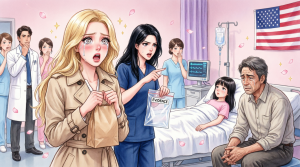
She came in slowly, holding a clear evidence bag.
Inside was Emma’s little pink water bottle from school.
My knees weakened.
I knew that bottle.
I had rinsed it in our sink the night before.
Emma had covered it with tiny stickers that peeled at the edges.
A cloud.
A cat.
A crooked yellow star.
Carla’s mouth tightened as she handed it to the detective.
The cap had been sealed separately.
A white intake sticker crossed the bag with the time written in black marker.
2:07 p.m.
The detective asked where it had been found.
Carla said it had come in with Emma’s school things.
The teacher had noticed it on the floor beside Emma’s desk after she collapsed.
Michael’s phone slipped lower in his hand.
He looked at the bottle like it might accuse him out loud.
Then the ER doors opened.
Patricia walked in with a paper bakery bag in one hand and her purse hooked over her arm.
She had dressed like she was coming to save the day.
Neat beige coat.
Soft scarf.
Hair sprayed into place.
A worried grandmother’s smile already arranged on her face.
“Oh, sweetheart,” she said, moving toward Emma’s bed. “Grandma’s here.”
Carla stepped between her and Emma.
She did not shout.
She did not touch Patricia.
She simply placed her body in the way and lifted the evidence bag higher.
The room froze.
The doctor stopped beside the monitor.
The detective closed the folder.
Michael made a sound like the breath had been punched out of him.
Patricia looked at the evidence bag.
At first, she looked confused.
Then she recognized the bottle.
The smile vanished.
It did not fade politely.
It dropped.
“Mom,” Michael whispered. “Tell me you didn’t.”
Patricia’s eyes moved from the bottle to Emma, then to me.
For one second, I saw something cold behind all that concern.
Not panic.
Calculation.
The detective asked her why her fingerprints would be on the bottle Emma drank from before she collapsed.
Patricia swallowed.
The paper bakery bag crinkled in her grip.
“I gave her water,” she said. “That’s all.”
The detective asked when.
She said Friday.
The detective looked down at the log.
“Only Friday?”
Patricia’s mouth opened.
Nothing came out.
Michael sat down hard in the visitor chair.
He looked smaller than I had ever seen him.
All those early mornings, all those late nights, all that distance between us suddenly had a shape.
It was guilt.
Not guilt because he had done this.
Guilt because some part of him had known his mother was too involved, too present, too determined to explain Emma’s symptoms before anyone had asked.
The doctor said Emma needed to remain under observation.
The detective asked Patricia to step into the hallway.
She refused at first.
Then Carla looked at her and said, “You will not come closer to that child.”
I had heard Carla use that voice only once before, when a drunk man tried to push past security into a trauma bay.
Patricia stepped back.
In the hallway, her voice changed.
Through the curtain, I heard pieces.
She said Emma was dramatic.
She said I worked too much.
She said Michael was exhausted.
She said she was only trying to help.
People who do terrible things often dress the first version of the truth as help.
The detectives kept asking.
The school log.
The water bottle.
The refill pickup.
The Friday sign-out.
The herbal drinks.
The fact that Emma’s symptoms got worse on days Patricia visited and eased when she did not.
Michael bent forward in the chair and covered his face.
I did not comfort him.
Not then.
My child was lying in a hospital bed because someone had decided her body was a problem to be managed.
My husband’s grief would have to wait its turn.
When Emma woke, she blinked slowly and looked around the room.
Her voice was small.
“Mom?”
I moved so fast the bed rail hit my hip.
“I’m here.”
Her eyes shifted toward the doorway.
“Is Grandma mad?” she whispered.
My throat closed.
I asked why Grandma would be mad.
Emma’s lower lip trembled.
“She said if I told, Dad would have to choose.”
Michael heard it.
The chair scraped back as he stood.
For a moment, he looked like he might run into the hallway.
Instead, he gripped the back of the chair until his hands shook.
That was the first right thing he did that day.
He stayed with Emma.
He did not go protect his mother.
He did not explain.
He did not soften it.
He said, “I choose you.”
Emma stared at him like she needed the words repeated in a language her fear could understand.
He said it again.
“I choose you.”
The police report came later.
The interviews came later.
The hospital discharge papers came later.
Patricia’s version changed three times before sunset.
First, it was water.
Then it was tea.
Then it was a supplement she claimed was harmless.
By the time the detectives finished comparing the visitor log, the medication access, the water bottle testing, and Emma’s own quiet answers, harmless was gone from the room.
Michael called his mother once after she was escorted out.
Not to comfort her.
Not to argue.
To tell her she was not to come near our daughter again.
I watched him say it.
His voice broke halfway through.
But he said it.
That night, Emma slept in the pediatric observation room with a stuffed animal tucked under her chin and a monitor glowing beside her.
I sat in the vinyl chair until my back ached.
Michael sat on the floor because he said he did not deserve the other chair.
I did not disagree.
At 3:12 a.m., he looked at me and said he should have listened.
I looked at our daughter instead of him.
“Yes,” I said.
It was not forgiveness.
It was not a speech.
It was the truth.
In the weeks that followed, there were forms, calls, follow-ups, and hard conversations with people who loved Patricia’s grandmother act more than they loved asking what she had done.
Some relatives said we were overreacting.
Some said she was old-fashioned.
Some said family problems should stay inside the family.
I learned then that silence is not peace.
Sometimes silence is just the room where harm gets comfortable.
Emma recovered slowly.
Her appetite came back first.
Then her color.
Then her laugh, cautious at first, like she was testing whether the world would punish her for making noise.
Michael changed the locks.
He changed his emergency contacts.
He moved every medication into a locked box.
He told the school office, in writing, that no one but us could sign Emma out.
He handed the front desk a printed copy and waited while they scanned it into her file.
It was not enough to erase what had happened.
But it was action.
And after years of hearing him say his mother meant well, action mattered more than any apology he could offer me.
One morning, months later, Emma stood in the same kitchen with a new water bottle on the counter and her math folder under one arm.
The toast popped.
My coffee went cold beside my badge.
The little American flag on our neighbor’s porch flicked in the wind outside the window.
Emma looked at the chair where Michael sat waiting for her.
This time, he was not gone early.
He had made breakfast badly, burned the first piece of toast, and packed her lunch with the wrong kind of crackers.
Emma noticed.
She smiled anyway.
Before she left for school, she asked if I would walk her in.
I said yes.
Michael stood up too.
Emma looked between us.
“Both of you?” she asked.
“Both of us,” he said.
At the school doors, she held my hand on one side and his on the other.
For a second, she was still the little girl in the hospital bed, pale and frightened, asking whether Grandma was mad.
Then she squeezed both our hands and stepped forward.
Healing did not arrive all at once.
It came in small ordinary things.
A lunch packed safely.
A school form updated.
A father who stayed.
A mother who listened to the fear in her own chest and stopped calling it worry.
And a child who finally learned that the people who love you do not ask you to keep secrets that hurt.

