After my grandfather’s funeral, my dad inherited $56M and threw me out before the mud had dried on my shoes. He said, “You’re useless now,” like he was closing a file. Twenty-four hours later, the same lawyer who had read the will walked me back into the Oak Lane house and smiled at my father in the foyer. Then he asked the question that made Thomas Stewart go pale. “Did you actually read the whole will?” The funeral had been the day before, but it already felt like something my father had stepped over. Grandpa William’s casket had lowered into wet ground under a gray sky, and the rain came down soft and cold, the kind that clings to your hair and collar and makes every handshake feel heavier than it should. People came up to me with casserole promises and damp hugs. They said he was a good man. They said he loved me like his own child. They did not know that, to me, he had been more than that. Grandpa William had raised me after my mother died, while my father built his life around work, image, and the kind of money that makes people forgive too much. The Oak Lane house was where I learned to ride a bike in the driveway. It was where Grandpa taught me how to make coffee before I was old enough to drink it. It was where he kept a jar of quarters in the laundry room and told me, “Emergency money is not about fear, Soph. It is about dignity.” When I was eight, he gave me a brass key with a small tag he had written on himself.
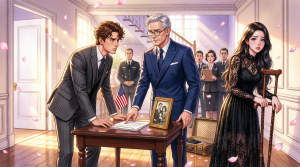
HOME. I carried it for sixteen years. After the funeral, I carried it into Harold Jenkins’s office. Harold had been Grandpa’s lawyer for as long as I could remember. His office smelled faintly of old paper, raincoats, and coffee gone bitter in a pot nobody wanted to admit needed washing. A small American flag stood beside a framed courthouse photo on the wall behind him. The traffic outside hissed over the wet street while my father sat across from him in a charcoal coat, already impatient. Thomas Stewart had cried once at the cemetery when someone important was watching. By the time we reached the conference room, his face had gone dry and sharp again. “We are here to read the last will and testament of William Arthur Stewart,” Harold said. Dad leaned back. “Skip the ceremony,” he said. “We all know why we’re here.” Harold looked over his glasses at him. It was not anger. It was something colder. He opened the file anyway. The Oak Lane house. The investment accounts. The controlling interest in Stewart and Sons Construction. The full estate value: fifty-six million dollars. All of it passed to Thomas Stewart. My father’s shoulders settled like he had been waiting years for a chair to turn into a throne.
“Excellent,” he said.
That was the word.
Not heartbreaking.
Not thank God.
Not I wish Dad were here.
Excellent.
Some people do not mourn a parent.
They inventory them.
I waited for my name.
I wish I could say I did not, but grief makes children out of grown women.
I was twenty-four years old, with a degree, a suitcase still in the trunk from staying at Grandpa’s hospital bedside, and enough pride to know better.
Still, I waited.
I did not want millions.
I wanted a sentence.
I wanted proof that the man who packed my lunch, fixed my bike, saved every report card, and sat through my mother’s memorial every year had left some small piece of me in the legal record.
Harold turned one page.
My father stood before he could read the next.
“Send the transfer documents to my office by noon,” Dad said. “I want the house empty today. Stagers are coming Monday.”
Harold did not rise.
“Thomas,” he said, “Sophia has lived in that house most of her life.”
“Sophia is twenty-four,” Dad said. “She has a degree. She can find an apartment.”
His tone barely changed.
“My father was sentimental. I am not.”
“Dad,” I said.
My voice sounded small in that glass-walled room.
I hated it immediately.
“I just buried the man who raised me.”
His eyes moved to me like I had interrupted a meeting.
“You buried my father,” he said. “Do not confuse affection with ownership.”
There are sentences that do not shout, but still leave marks.
That was one of them.
Harold’s folder was still open on the table.
I could see the notary date.
I could see the county clerk stamp.
I could see the clean black ink that had turned my childhood into something transferable.
Dad walked around the table until he stood over me.
He looked down at the brass key in my hand.
“You have two hours,” he said.
“For what?”
“To remove your personal effects.”
My mother’s framed photo was in that house.
Grandpa’s sweaters were in that house.
The little ceramic bowl I made in fifth grade art class was still on the bookshelf because Grandpa said ugly things made by loved ones were still treasures.
“My whole life is there,” I said.
“Then pack quickly.”
For one hot second, I pictured throwing the brass key across the table.
I pictured it hitting the glass hard enough to crack something polished.
I did not do it.
Grandpa had taught me that anger feels clean only while it is still in your hand.
After that, it becomes evidence against you.
“Please,” I said. “Give me a week.”
Dad checked his watch.
“You are useless to me now, Sophia.”
No one spoke.
That was the part that stayed with me later.
Not the cruelty.
The silence around it.
Harold closed his eyes for half a second.
“At noon,” Dad said, “anything left in the house becomes mine. If you take anything of value, I will treat it as theft.”
By 11:07 a.m., I was back at Oak Lane.
A locksmith’s van was already in the driveway.
Two security men stood near the front steps.
A real estate agent’s SUV was parked behind my father’s car.
Someone had set a clipboard on the porch rail like grief had been converted into a work order.
“Exterior locks first,” Dad told the locksmith. “Then the gate code.”
I ran past him.
In my room, I packed like the house was on fire.
Jeans.
A hoodie.
My laptop charger.
The stuffed bear Grandpa won at a county fair when I was ten.
My mother’s photograph in the silver frame.
Every drawer felt like an accusation.
Every shelf asked what counted as mine when love had never come with receipts.
At 11:31 a.m., I tried to step into Grandpa’s room.
Dad blocked the doorway.
“Nothing from here,” he said.
“I just want his watch.”
“It’s worth ten grand.”
“He was my grandfather.”
“And now he is an asset.”
That sentence did what shouting had not done.
It made me calm.
A family can train you to beg for warmth from a closed door.
The day you stop knocking, they call it disrespect.
I turned away from Grandpa’s room and did exactly what he had once told me to do whenever someone powerful tried to rush me.
I documented.
At 11:46 a.m., I recorded the locksmith’s van in the driveway.
I recorded the security guards by the steps.
I recorded the real estate agent measuring the foyer windows.
I photographed every room before I left.
I packed only what belonged to me.
I touched nothing from Grandpa’s desk.
I took no jewelry.
I took no documents.
I took no framed awards from Stewart and Sons Construction, even though one of them had Grandpa’s fingerprints in the tarnished brass.
Then I walked to the front door with my suitcase in one hand and my old key in the other.
Dad stood beside the guard.
He held out his palm.
I placed the brass key in it.
He smiled.
“Good girl.”
That night, I slept in my car under the white lights of a grocery store parking lot.
My suitcase was wedged behind the driver’s seat.
My mother’s photo was wrapped in a sweater beside me.
Every time someone pushed a cart across the pavement, the metal wheels rattled me awake.
At 2:14 a.m., I almost called my father.
Not to apologize.
Not to beg.
Just to hear someone in my family answer.
Then I looked at my mother’s photo and put the phone facedown.
By morning, the windshield was fogged from my breathing.
The grocery store doors slid open and shut in front of me, bright and automatic, like the world had no idea a person could become homeless between breakfast and lunch.
At exactly 9:00 a.m., my phone rang.
Harold Jenkins.
“Sophia,” he said carefully, “where are you?”
I looked at the shopping carts lined up in metal rows.
“In my car.”
The pause that followed told me he had guessed worse and hoped better.
“Come back to Oak Lane,” he said.
“Why?”
“Do not call your father. Do not warn him. Bring nothing except yourself.”
My fingers tightened around the phone.
“Harold, what happened?”
“You trusted your grandfather,” he said. “Now let him finish.”
One hour later, Harold and I walked through the front door together.
The new lock was not fully installed yet.
The old one hung crooked, half removed, screws lined up on a folded rag near the threshold.
Dad was in the foyer with the real estate agent, pointing toward Grandpa’s library.
“We’ll tear out the built-ins,” he said. “Too old-fashioned. Buyers want clean lines.”
The agent held her tape measure in midair when she saw me.
The locksmith stopped at the staircase.
One security guard looked down at his shoes.
Dad turned red before he even spoke.
“I told you to get lost.”
Harold stepped between us and set his briefcase on Grandpa’s entry table.
For the first time since the funeral, the lawyer smiled.
“Thomas,” he said, opening the latches, “did you actually read the whole will?”
Dad’s mouth tightened.
“I read enough.”
“No,” Harold said. “You read the part you liked.”
He pulled out a second sealed section still clipped behind the probate filing.
The sound of paper sliding free made the whole foyer go quiet.
The real estate agent lowered her clipboard.
The locksmith froze with one hand on the new lock.
My father stared at the document like it had grown teeth.
Then Harold looked at me, looked back at my father, and said, “Then you missed the only paragraph that mattered.”
Dad reached for the paper.
Harold covered it with his palm.
“No,” he said. “You do not get to handle this after what you did yesterday.”
Dad laughed once.
It came out thin.
“This is ridiculous. My father left the estate to me.”
“Provisionally,” Harold said.
That word changed the air.
The real estate agent’s tape measure slipped from her hand and snapped against the hardwood.
The locksmith took one step back from the door.
I stood beside Harold with my suitcase still in my hand because I had not known where else to put it.
Then Harold reached into his briefcase and removed one more envelope.
My name was written across the front in Grandpa’s crooked block letters.
SOPHIA — IF THOMAS DOES WHAT I THINK HE WILL DO.
My knees nearly folded.
Dad saw the handwriting and went pale.
For the first time, he stopped looking at the house.
He stopped looking at the agent.
He stopped looking at the locksmith.
He looked at my grandfather’s handwriting like it had reached out of the grave and put a hand around his wrist.
Harold slid the will toward me.
Not toward him.
“The estate did pass to Thomas,” he said quietly. “But only if he honored one condition within the first twenty-four hours.”
Dad’s lips barely moved.
“What condition?”
Harold looked at my suitcase.
Then he looked at the half-installed lock.
Then he looked at my father.
He read the first line aloud.
“If my son, Thomas Stewart, removes Sophia Stewart from the Oak Lane residence, denies her access to her personal property, threatens her with legal action, or attempts to liquidate the home within twenty-four hours of my funeral, he forfeits all residential rights, all voting control in Stewart and Sons Construction, and any direct claim to the trust assets named herein.”
No one moved.
The grandfather clock in the hall ticked once.
Then again.
My father’s face changed in slow pieces.
Confusion first.
Then refusal.
Then calculation.
Then fear.
“That is not enforceable,” he said.
Harold looked almost tired.
“Thomas, your father expected you to say that.”
He opened the next page.
“The condition was drafted as a conduct clause attached to a conditional trust transfer. It was notarized, witnessed, and filed with the probate packet three weeks before his final hospitalization.”
Dad looked at the real estate agent.
She looked away.
Harold continued.
“The Oak Lane house was not yours to sell yesterday. It was never yours to empty. The voting interest in Stewart and Sons was held pending your compliance.”
My father swallowed.
“And if I did not comply?”
Harold glanced at me.
I felt the entire room pull toward that answer.
“Then Sophia becomes primary beneficiary of the Oak Lane residence, controlling trustee of the Stewart family trust, and temporary voting trustee over the company shares until probate review is complete.”
The security guard by the stairs whispered something under his breath.
The real estate agent pressed her fingers to her mouth.
The locksmith set the new lock down on the floor like it had become evidence.
Dad stared at me.
“You planned this.”
I almost laughed.
The sound would have been too sharp.
“I slept in a grocery store parking lot,” I said. “I did not plan anything.”
Harold opened my envelope.
Inside was a single handwritten letter.
He handed it to me without reading it first.
My hands shook so badly the paper trembled.
Soph,
If you are reading this, your father did what I prayed he would not do.
I am sorry I had to protect you this way instead of trusting him to love you correctly.
That line blurred.
I had to blink hard before I could keep going.
I have watched Thomas mistake control for strength for too long.
I have watched you mistake endurance for peace.
The house is yours because it was always your home.
The company vote is yours because he will need to learn that money without character is just a loaded gun in a careless hand.
Do not let him rush you.
Do not let him shame you.
And for God’s sake, keep records.
I covered my mouth.
For sixteen years, Grandpa had been teaching me how to survive a day he hoped would never come.
The quarters in the laundry room.
The key.
The warnings.
The quiet advice about documenting every room.
None of it had been paranoia.
It had been love with paperwork.
Dad’s voice cut through the silence.
“You are going to let her take this?”
Harold turned to him.
“I am going to follow your father’s will.”
“She is a child.”
“I am twenty-four,” I said.
“You know nothing about running a company.”
“I know not to order new locks before my father is cold in the ground.”
His hand twitched.
Not toward me.
Toward the will.
Harold saw it.
“Do not,” he said.
It was quiet, but it stopped my father cold.
The real estate agent finally found her voice.
“Mr. Stewart,” she said carefully, “I think I need to leave.”
Dad turned on her.
“You will stay where you are.”
“No,” Harold said. “She will not.”
The agent picked up her clipboard with shaking hands.
The locksmith gathered his tools.
The security guard stepped away from the staircase.
In less than thirty seconds, the little audience my father had hired to watch my humiliation became witnesses to his.
That was the thing about cruelty performed in public.
Sometimes the room remembers who brought the crowd.
Harold told the locksmith to reinstall the original lock.
The man nodded so fast he nearly dropped his screwdriver.
Dad looked at me with a hatred so polished it almost passed for calm.
“This is not over,” he said.
“No,” Harold replied. “It is not. Probate review is at 2:00 p.m., and I will be submitting Sophia’s photographs, her timestamped videos, your lock change invoice, and the agent’s entry log.”
Dad’s mouth opened.
Nothing came out.
Harold closed the folder.
“And Thomas?”
My father looked at him.
“Your father also included a no-contest penalty. If you attempt to challenge the conduct clause without good-faith legal grounds, your remaining distribution goes to the scholarship fund Sophia’s mother started.”
That was the final blow.
Not because of the money.
Because of the name.
My mother’s scholarship fund had been the one thing my father never mentioned unless there were donors nearby.
Now Grandpa had placed it at the center of the trap.
Dad looked at me then, really looked at me.
Not as a daughter.
Not even as an enemy.
As the person standing between him and everything he had already spent in his mind.
I thought I would feel victorious.
I did not.
I felt tired.
I felt cold.
I felt like a little girl standing in a house full of adults, waiting for someone to say that love should have protected her before paperwork had to.
Harold touched my shoulder gently.
“Do you want him removed from the property?”
Dad’s eyes narrowed.
The old me would have looked down.
The old me would have apologized for being difficult.
The old me would have searched his face for one last sign that maybe he was only hurt, only grieving, only saying things he did not mean.
But I had heard him.
You are useless to me now.
I had slept in my car with my mother’s photograph wrapped in a sweater.
I had handed over the HOME key while he smiled.
I looked at Harold.
“Yes,” I said.
Dad laughed under his breath.
It sounded broken.
“You would throw your own father out?”
I looked at the half-installed lock.
Then at my suitcase.
Then at the brass key sitting in Harold’s open palm.
“No,” I said. “You taught me how.”
Harold called the security men by name and instructed them that Thomas was to leave the Oak Lane property until the probate hearing.
My father did not shout.
That surprised me.
He adjusted his coat, smoothed his sleeves, and walked toward the door like dignity could be assembled from fabric.
At the threshold, he turned back.
“You will regret this.”
I held Grandpa’s letter against my chest.
“I already regret a lot,” I said. “Just not this.”
The door closed behind him.
For a moment, nobody spoke.
The foyer looked the same and not the same.
The wet driveway was still outside.
The porch rail still held the mark where the clipboard had been.
The old lock was still crooked.
But the house had exhaled.
Harold handed me the brass key.
I took it with both hands.
The tag still said HOME.
By 2:00 p.m., we were at the courthouse.
I wore the same black dress because I had nothing else unpacked.
Harold submitted the timestamped video from 11:46 a.m., the photographs of each room, the lock change receipt, and the written statement from the real estate agent confirming Dad had ordered staging before probate transfer was complete.
My father arrived with his own attorney.
He would not look at me.
The probate officer reviewed the will, the conduct clause, and the sealed letter.
I answered every question Harold had prepared me for.
Yes, I had been told to leave.
Yes, I had slept in my car.
Yes, I had been warned that anything left behind would be treated as theft.
Yes, the locksmith was present before noon.
Yes, Dad had blocked me from Grandpa’s room.
My father’s attorney asked whether I had taken anything of value.
I said, “My mother’s photograph.”
The room went quiet.
The officer looked down at the file for a long moment.
Then she said the Oak Lane residence would remain under protected trust control, with me as beneficiary occupant pending final probate review.
The company shares would be frozen from Thomas’s voting control until the clause was reviewed in full.
Dad’s attorney objected.
The officer let him talk for exactly forty seconds.
Then she said, “Your client appears to have created the very condition his father anticipated.”
That was all.
No shouting.
No dramatic gavel.
Just a sentence and a stack of paper.
Sometimes justice does not arrive like thunder.
Sometimes it arrives as a clerk stamping the page your abuser did not bother to read.
That evening, I went back to Oak Lane.
Harold walked me inside and left only after checking the lock himself.
The house was quiet.
Too quiet at first.
I stood in the mudroom and pressed my face into Grandpa’s Christmas sweater still hanging on the hook.
Cedar.
Coffee.
A little dust.
I cried then.
Not pretty crying.
Not movie crying.
The kind that bends you forward until your ribs hurt.
I cried for Grandpa.
I cried for my mother.
I cried for the little girl who had thought being useful was the same as being loved.
Then I went to the laundry room.
The jar of quarters was still there.
Taped beneath it was a small folded note.
I almost did not touch it.
My hands were already shaking.
But Grandpa’s handwriting was on the outside.
For emergencies.
Inside, there was only one sentence.
You were never useless, Soph.
I sat on the laundry room floor for a long time after that.
The washer hummed softly beside me though it was not running.
The house made its old night sounds around me.
Pipes settling.
Wind at the porch.
A branch tapping the upstairs window.
The next week was not simple.
My father called twelve times.
I did not answer.
His attorney sent letters.
Harold answered them.
Stewart and Sons called an emergency board meeting.
I attended with Harold beside me and Grandpa’s old leather notebook in my bag.
Men who had known me since I was thirteen suddenly stood when I entered the conference room.
Some did it out of respect.
Some did it out of fear.
I accepted both.
I did not pretend I knew everything.
I asked for financial summaries.
I requested operating reports.
I hired an independent accountant to review the trust-linked accounts.
I kept records.
Three months later, the final probate order confirmed what Grandpa had written.
The Oak Lane house was mine.
The trust remained under my control with Harold as legal advisor until I completed trustee training and appointed an independent co-trustee.
My father received a reduced distribution, minus penalties tied to the failed challenge.
A large portion went to my mother’s scholarship fund.
When Harold told me that, I cried again, but softer.
This time, it felt less like breaking and more like something being set down.
I still live at Oak Lane.
I did not tear out the built-ins.
I kept Grandpa’s library exactly as it was for six months before I moved a single book.
Then I made one change.
I put my mother’s photograph on his desk.
Beside it, I placed the brass key with the HOME tag, the grocery store receipt from the morning Harold called me, and Grandpa’s note from the quarter jar.
Not as a shrine.
As evidence.
Because love, real love, leaves proof too.
It leaves keys.
It leaves quarters.
It leaves warnings.
It leaves a house standing open after everyone else has tried to lock you out.
My father told me I was useless when he thought he had inherited everything.
He was wrong about the will.
He was wrong about the house.
Most of all, he was wrong about me.
THE END.