My four-year-old son called me at work, crying, “Dad, Mom’s boyfriend hit me with a baseball bat.” I was 20 minutes away. So I called the only person who could get there faster. My phone buzzed against the conference-room table in the middle of a budget meeting, hard enough to make the water in my plastic cup tremble. The room smelled like stale coffee, dry marker ink, and the lemon cleaner the janitor used on the glass walls every afternoon. Outside those walls, downtown traffic crawled past in slow silver lines. Inside, twelve adults sat around a table pretending the whole world could be reduced to percentages, quarterly targets, and little colored bars on a screen. At first, I tried to ignore the vibration. Not because I did not care. Because I had learned how people looked at divorced fathers who needed to leave early, answer calls, pick up sick kids, or move meetings because daycare had rules no spreadsheet cared about. Men in pressed shirts do not love interruptions. They especially do not love them from the guy who has already checked the clock three times. Then the phone buzzed again. That second vibration was different. It hit somewhere below my ribs before I even looked down. The screen showed Noah’s name. My son was four years old, and his name on my phone was still saved with a tiny dinosaur emoji he had picked himself. He did not call me at work. Lena and I had taught him carefully, almost like a game, that “emergency” meant something serious. There were picture cards on the fridge. A fire. A stranger.
A bad hurt. Not spilled juice. Not a nightmare. Not the tablet dying during cartoons. He knew the difference better than some adults I knew. But that day, my four-year-old called twice. I answered before the second buzz finished. “Hey, buddy,” I said, trying to sound normal. “You okay?” For a moment, I heard nothing but breathing. Small, shaky breathing. Then came a sob that sounded like he was trying to swallow it before someone else could hear. “Dad…” Every muscle in my body tightened. “I’m here,” I said. “Talk to me.” “Please come home.” My chair scraped backward so hard it struck the wall behind me. Every face in the conference room turned. My manager blinked at me over the top of his laptop. A woman from accounting lowered her pen but did not speak. “Noah,” I said, already standing. “What happened? Where’s Mom?” “She’s not here,” he whispered. I could hear him crying into his hand. Then he said the sentence that split my life into before and after. “Mom’s boyfriend… Travis… hit me with a baseball bat.”
The room disappeared.
The screen disappeared.
The budget slide, the plastic cup, the clicking pens, all of it dropped away like somebody had cut the floor from under me.
“My arm hurts really bad,” Noah whispered. “He said if I cry, he’ll hit me again.”
Before I could answer, a man’s voice exploded in the background.
“Who are you talking to? Give me the phone!”
Then the line went dead.
For one full second, I did not move.
The conference room stayed frozen around me.
Pens hovered over yellow legal pads.
My manager stared at the blank slide like the numbers might tell him what a human being was supposed to do next.
Someone’s cuff link tapped once against the table.
The air conditioner clicked on.
Nobody asked if my son was alive.
Nobody asked if I needed help.
Nobody moved.
Rage is not always hot.
Sometimes it goes cold so fast it feels surgical.
I wanted to throw my phone through the glass wall.
I wanted to run until my lungs tore.
I wanted to scream Travis’s name in a way that would make every person in that building remember it.
Instead, I pressed my palm against the table and forced myself to breathe.
My hand shook anyway.
“My son has been attacked,” I said.
My voice sounded strange to me.
Too clear.
Too calm.
“I’m leaving.”
No one stopped me.
That might have been worse.
The hallway outside the conference room was cold and polished, with the same lemon-cleaner smell and framed company awards nobody ever looked at.
I walked fast at first.
Then I ran.
By the time I reached the elevator, my hands were shaking so badly I nearly dropped my keys.
I looked at the call log again because part of me needed proof that I had heard what I heard.
2:14 PM.
Tuesday.
First missed vibration.
Second call.
Thirty-one seconds connected.
Thirty-one seconds that would later become the first thing the Riverbend Police Department asked me to forward.
But at that moment, I did not care about evidence.
I cared about distance.
I was 20 minutes away from my child.
Twenty minutes in normal traffic.
Longer if the lights turned bad.
Longer if downtown stayed clogged with delivery trucks and office workers and people whose worst problem that afternoon was cold coffee.
My four-year-old son was alone with a grown man who had just hurt him.
A parent learns the true shape of helplessness in seconds.
It is not fear.
It is not even anger.
It is distance.
A red light can become a wall.
An elevator can become a cage.
A line of cars can become the cruelest thing you have ever seen.
The only person closer than me was my older brother, Derek.
Derek had been in Noah’s life since the day Lena and I brought him home from the hospital wrapped in a blue blanket.
He was the first person outside the two of us who held him and looked terrified by how small he was.
He taught Noah to fist-bump.
He fixed the little bike when the training wheel bent in my driveway.
He kept a spare dinosaur cup at his apartment because Noah refused to drink apple juice out of anything else.
Once, when Noah had a fever that made his eyes glassy and his body too limp to fight the medicine, Derek sat on the floor beside his bed half the night, reading the same picture book over and over until my son finally slept.
Derek did not make big speeches about family.
He showed up.
That was why I called him while the elevator numbers blinked too slowly above the doors.
He answered on the second ring.
“Hey,” he said. “What’s up?”
“I just got a call from Noah,” I said.
My voice cracked on my son’s name.
“Lena’s boyfriend hit him with a baseball bat. I’m 20 minutes away. Where are you?”
There was a pause.
Not long.
Just enough for the old Derek to disappear and the other one to step in.
My brother had fought in regional mixed martial arts years earlier, before a shoulder injury ended that part of his life.
But fighting was never what made him frightening.
Control did.
I had seen him stop a parking-lot fight once without throwing a punch.
He just stepped between two men and spoke so quietly that both of them backed up.
That was the voice I heard now.
“I’m about fifteen minutes from your house,” he said. “Do you want me to go by?”
“Go now,” I said. “I’m calling 911.”
“I’m already moving.”
The elevator doors opened, and I ran.
My shoes cracked against the concrete in the parking garage.
The place smelled like exhaust, damp cement, and somebody’s spilled fast food.
I fumbled the keys once, cursed under my breath, then got into my car and hit the 911 button before I even had the engine fully started.
The dispatcher answered with the practiced calm of someone trained to stand in the middle of other people’s worst moments.
I gave her everything.
My name.
Noah’s name.
Lena’s name.
Travis’s first name.
The address.
The words my son had used.
The threat in the background.
The baseball bat.
My voice kept trying to run ahead of itself, and I had to drag it back one fact at a time.
“Is your child injured?” she asked.
“Yes.”
“Is the adult male still inside the residence?”
“I believe so.”
“Are you at the location now?”
“No. I’m twenty minutes out. My brother is closer. He’s going there now.”
Keys clicked through the speaker.
“An incident call is being created now,” she said. “Units are being sent.”
“My brother can get there first,” I said.
“Tell him not to engage if he can avoid it.”
That sentence almost broke me.
Avoid it.
As if language could stay tidy after a four-year-old begged for help.
As if a person could stand outside a door, hear a child cry, and still choose neatness.
I knew why she said it.
I knew she was doing her job.
But knowing that did not make the words easier to hear.
I pulled out of the parking garage too fast and hit a wall of traffic two blocks later.
Brake lights stretched ahead of me in a red line.
A delivery truck blocked half the lane.
A man in a suit stepped off the curb holding a sandwich like the world was still normal.
I leaned on the horn.
The dispatcher stayed on the line.
“Sir, I need you to drive safely.”
“My son is four,” I said.
“I understand.”
No, I thought.
No one understands unless they have heard their child whisper because he is afraid crying will make it worse.
My other line flashed with Derek’s name.
I put the dispatcher on speaker and answered.
“Derek?”
“I’m two blocks out,” he said.
His breathing sounded low and controlled.
Not rushed.
Not panicked.
That scared me more than if he had been yelling.
“Stay on the line,” I said.
“I am.”
Traffic inched forward.
My hands were locked around the steering wheel so tightly my fingers hurt.
The dispatcher asked for Derek’s full name and description.
I gave it while watching a red light refuse to change.
Then Derek said, “I see the house.”
Something in me stopped.
I pictured the front porch.
The little mailbox at the curb with a dent in one side.
The narrow driveway where Noah liked to draw chalk dinosaurs in the summer.
The porch light Lena always forgot to turn off.
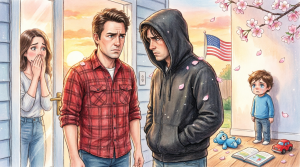
The small American flag the previous owner had left mounted beside the door, faded at the edge from too much sun.
I pictured my son somewhere inside, trying not to cry.
“Derek,” I said.
“I’m here.”
I heard his engine cut.
Then a truck door slammed through the line.
The sound was ordinary.
That was what made it unbearable.
Just a door closing on a Tuesday afternoon.
Just boots hitting gravel.
Just my brother walking toward the house where my child had called me for help.
“What do you see?” I asked.
“Front door’s closed,” Derek said. “Blinds are partly down. Lena’s car isn’t here.”
The dispatcher’s voice came through my other speaker.
“Sir, tell your brother officers are en route. He should wait outside if it’s safe.”
I repeated it.
Derek did not answer right away.
I heard his footsteps slow.
Then he knocked.
Once.
Twice.
The knocks were heavy but controlled.
“Travis,” Derek called. “Open the door.”
Nothing.
I could hear birds somewhere near the porch.
I could hear wind moving across the phone microphone.
I could hear my own pulse so loudly it felt like another person in the car.
Derek knocked again.
“Travis. Open the door.”
A muffled voice answered from inside.
I could not make out the words.
Then came a sound I will hear until the day I die.
Noah cried out.
Not a scream.
Not even a full word.
Just one small, broken sound from somewhere inside the house.
Derek’s voice changed.
It did not get louder.
It got quieter.
“Noah, buddy,” he said. “I’m right here.”
I was three miles away and completely useless.
A car ahead of me moved six feet.
I wanted to drive over the median.
I wanted to abandon the car and run.
Instead, I gripped the wheel and listened to my brother breathe.
A lock scraped.
The front door opened a crack.
Just a few inches.
A man’s voice said something sharp and low.
Travis.
Derek did not push inside.
He did not swing.
He did not become the version of him I knew he was fighting to keep buried.
He planted one hand flat against the doorframe.
“Move,” he said.
The word landed like a weight.
Travis answered, but his voice had changed too.
The anger was still there, but underneath it was something thin and nervous.
Fear makes a different sound when it realizes someone bigger than its victim has arrived.
“Where’s Noah?” Derek asked.
No answer.
“Where is he?”
The dispatcher said something in my speaker, but I barely heard her.
I was listening for my son.
For breathing.
For crying.
For anything.
Then Derek said, “I can see him.”
My lungs stopped working.
“How is he?” I asked.
Derek did not answer me directly.
That told me enough.
He said, “Noah, look at me. Don’t look at him. Look at me.”
I heard a tiny sob.
Derek’s voice softened, but the steel stayed under it.
“That’s it, buddy. I’m right here.”
A horn blared behind me.
The light had turned green.
I moved because my foot knew what to do, not because my mind was there.
The dispatcher said, “Officers are close.”
“How close?” I demanded.
“They’re en route.”
That did not mean close.
It meant not here yet.
Through Derek’s phone, I heard another car pull in fast.
Tires over gravel.
A door opening.
A woman’s voice.
Lena.
“What happened?” she called.
Her voice was breathless, confused, and already afraid.
“Where’s Noah?”
Nobody answered fast enough.
That silence did something to her.
I heard her shoes hit the porch steps.
Then she saw enough to understand that the world she had left was not the world she had come back to.
“Oh my God,” she whispered.
Derek said, “Stay back.”
“What happened to my son?” Lena cried.
The porch boards creaked.
Something dropped.
Maybe her purse.
Maybe her keys.
Maybe her knees against the wood.
I could hear her breathing turn ragged through the phone.
Travis muttered something about an accident.
An accident.
The word made my vision blur.
Noah had not called me whispering because of an accident.
He had not said Travis threatened to hit him again because of an accident.
Some men do not lie because they believe the lie.
They lie because they expect the room to help them carry it.
This time, the room was a porch, a doorway, my brother, my ex-wife, my son, and a phone line carrying every sound straight into my car.
Derek said, “Tell her what you did.”
Travis snapped something back.
Derek did not raise his voice.
“Tell her,” he repeated.
Lena made a sound I had never heard from her before.
It was not crying exactly.
It was the sound of a person realizing she had trusted the wrong adult near her child.
I wanted to hate her in that moment.
Some part of me did.
But beneath the rage, there was the older truth.
She was Noah’s mother, and she had just come home to the thing every parent fears most.
“Move away from the door,” Derek said.
“I said it was an accident,” Travis barked.
“No,” Derek said. “You said you’d do it again if he cried.”
The line went so quiet I thought it had dropped.
Then Noah sobbed once.
That one sound proved everything.
I was less than ten minutes away now.
I could hear sirens somewhere, but I could not tell if they were near me, near the house, or only in my head.
The dispatcher asked me to confirm I was still driving safely.
I said yes.
I do not know if that was true.
Derek shifted, and his voice turned toward me for the first time in several seconds.
“Brother,” he said.
Something in that one word froze me.
“What?”
“He’s holding the bat behind the door.”
I stopped hearing traffic.
I stopped hearing the dispatcher.
For a second, all I could see was my son’s little hand on a tablet, pressing my name because he had remembered what emergency meant.
Then Derek spoke again, not to me this time.
He spoke through the crack in the door, low and clear.
“Travis, put it down.”
Lena started crying harder.
Noah whimpered.
The porch boards creaked under Derek’s boots.
And somewhere behind that half-open door, the man who had threatened my child had to decide whether he was going to let go of the bat before everyone saw what he really was.
THE END.

