“No,” Caleb snapped. “It’s not complicated. He destroyed everything.” The apartment seemed smaller suddenly. Caleb looked directly at me then. “You know what’s weird?” he asked. “After you left, the house got quieter… but worse.” Nobody answered. Because we understood exactly what he meant. Caleb continued before anyone could stop him. “Dad started trying too hard after that. Family movie nights. Dinners together. Therapy talk.” He rolled his eyes harshly. “But everything already felt fake.” Owen rubbed his forehead tiredly. “Caleb—” “No, seriously,” Caleb interrupted. “It was like he suddenly realized we were actual people after Grandma left.” The words landed heavily inside my chest. Clare stared silently at her younger brother now. For the first time since arriving, Caleb’s anger cracked slightly around the edges. “He cries sometimes,” he muttered. Nobody moved. “Dad,” he clarified quietly. That hurt more than shouting would have.
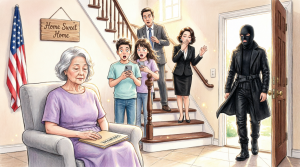
Because pain becomes real when even angry children notice it. Owen swallowed hard. “He talks about you a lot now,” he told me softly. I looked down at the recipe book in my lap. The worn corners. The handwritten notes. Tiny stains from meals cooked decades ago. A whole life pressed between paper pages. “What does he say?” I asked carefully. Owen hesitated. Then: “That you were the only person who ever loved him before he became useful.” The room went silent again. Completely silent. And somewhere deep inside me… something dangerous began softening. # PART 3 — THE FIRST DINNER After the boys left that night, the apartment felt strangely hollow. As if their presence had reopened rooms inside me I had spent years carefully locking shut. Clare washed dishes silently while I sat at the kitchen table turning pages of my old recipe book. Tiny handwritten notes filled the margins. Less salt for Michael. Caleb allergic to walnuts. Owen hates mushrooms. Entire years of love reduced to little reminders in fading ink. “They shouldn’t have come alone,” Clare finally muttered from the sink. “I know.” “But I’m glad they did.” I looked toward her. “So am I.” Rain still touched the windows softly. Neither of us mentioned the real thing lingering between us: Michael.
Because now he no longer felt distant again.
Now he felt close.
Dangerously close.
Two days later, another letter arrived.
Shorter this time.
Mom—
No.
Again the word had been crossed out.
Eleanor,
Owen told me he visited you.
I’m sorry he involved you unexpectedly, but selfishly… I’m grateful he went.
I know I have no right to ask for anything.
But if you are willing, I would like to see you once.
Public place.
No pressure.
No expectations.
If you say no, I will respect it.
Michael
At the bottom was a restaurant address.
Small Italian place.
Tuesday.
Six o’clock.
Clare read the letter twice before setting it down.
“I don’t trust him.”
“I know.”
“I mean it, Grandma.”
“I know.”
She folded her arms tightly.
“But are you going?”
That was the terrifying question.
Because the answer had already started forming inside me before she even asked.
“Yes,” I admitted quietly.
Clare closed her eyes briefly like someone losing an argument with fate.
Then:
“Okay.”
No yelling.
No dramatic protest.
Which somehow hurt more.
“You think this is a mistake,” I said softly.
“I think people can regret hurting you and still hurt you again.”
The honesty in that sentence stayed with me all night.
Tuesday arrived cold and gray.
I changed clothes three times before leaving the apartment.
Not because I wanted to impress Michael.
Because I suddenly cared what I looked like to him again.
That realization angered me more than anything.
In the mirror, I saw a woman trying not to appear nervous about seeing the son who betrayed her.
I hated that vulnerability still existed inside me.
Before I left, Clare touched my arm gently.
“If anything feels wrong,” she said quietly, “you leave immediately.”
I nodded.
The restaurant sat on a quiet corner beneath warm amber lights.
Small tables.
Soft music.
The smell of garlic and wine drifting through the air.
For one horrible second after entering, I considered turning around.
Then I saw him.
Michael stood immediately when he noticed me.
And for a moment…
I barely recognized my own son.
He looked older.
Much older.
Not physically alone.
Emotionally.
The sharp polished confidence that once filled every room around him had disappeared completely.
No expensive suit.
No perfect watch.
No performance.
Just a dark sweater, tired eyes, and hands that looked strangely uncertain resting against the table.
He smiled carefully.
“Hi.”
My chest tightened painfully.
Because his voice sounded smaller now.
“Hello, Michael.”
For a second neither of us moved.
Then he awkwardly pulled out my chair like he remembered old manners suddenly mattered again.
“Thank you,” I said softly.
The waitress arrived quickly.
Menus.
Water glasses.
Temporary escape.
Michael barely looked at his menu.
“You look healthier,” he said quietly.
There it was again.
That devastating sentence.
Not:
You look pretty.
You look younger.
Healthier.
As if he too could now see how badly I had faded while living under his roof.
“I am healthier,” I answered honestly.
He nodded slowly.
“I’m glad.”
Silence settled between us.
Not hostile.
Just fragile.
Michael rubbed his hands together once before speaking again.
“I almost didn’t come.”
“Why?”
“Because I wasn’t sure if seeing me would only reopen things for you.”
I studied him carefully.
For years Michael had mastered performance:
* charm
* control
* emotional persuasion
But tonight something felt different.
Not pure.
Not trustworthy yet.
But stripped down somehow.
Like life had finally removed all the polished layers he used to hide behind.
“You lost weight,” I observed quietly.
A faint humorless smile crossed his face.
“Turns out anxiety burns calories.”
I almost laughed despite myself.
Almost.
That frightened me too.
The waitress returned.
Orders placed.
Another delay.
Michael stared down at the table for several seconds before finally speaking again.
“I read your court statement sometimes.”
I blinked.
“What?”
“The one describing how you felt living with us.”
My stomach tightened instantly.
Arthur had helped me write that statement during the financial case.
I never imagined Michael actually read it carefully.
Michael swallowed hard.
“There was one line I can’t stop thinking about.”
His voice lowered.
‘There was no room for my rocking chair. No room for my photographs. No room for my life.’
I looked away immediately.
Because hearing my own words spoken back to me hurt differently somehow.
Michael continued quietly.
“I didn’t realize how small we made your world.”
The food arrived then.
Steam rising between us.
Temporary interruption again.
Neither of us touched our plates immediately.
Finally Michael spoke softly.
“I used to think providing money made me a good man.”
I remained silent.
“And when I started losing control financially…” he continued, “I became terrified. Everything in my life depended on appearances. Success. Stability. Image.” He laughed bitterly under his breath. “I think somewhere along the way I stopped seeing people emotionally. I only saw what they could solve for me.”
Including me.
He nodded immediately.
“Yes.”
No defensiveness.
No excuses.
That made it worse somehow.
Because honest guilt feels heavier than manipulation.
Michael finally picked up his fork.
Then paused again.
“Do you know what Caleb said to me last month?”
I shook my head.
“He said: ‘Grandma loved people when they were weak. You only love people when they’re useful.’”
The sentence sat heavily between us.
Michael stared at the untouched food in front of him.
“And the horrible thing,” he whispered, “is that I didn’t know how to tell him he was wrong.”
Something inside me shifted painfully then.
Not forgiveness.
Not trust.
Something more dangerous.
Understanding.
And understanding can reopen doors you fought very hard to close.
# PART 4 — CLARE DOESN’T TRUST HIM
After the dinner, Michael walked me to my car without asking if he could.
The night air smelled like rain and cigarette smoke drifting from somewhere down the block. Streetlights reflected softly against wet pavement.
For several seconds we simply stood there awkwardly beside my old car.
Neither of us seemed to know how to end the evening.
Finally Michael spoke.
“Thank you for coming.”
His voice sounded careful.
Almost fragile.
I nodded once.
“You were honest tonight.”
A shadow crossed his face.
“I’m trying to be.”
Trying.
Not succeeding.
Just trying.
That distinction mattered more than he probably realized.
Before I could answer, he reached into his coat pocket.
Immediately my body tensed.
The reaction happened automatically.
Michael noticed instantly.
Pain flickered across his expression.
Slowly, deliberately, he removed only a small folded paper.
“A recipe,” he explained quietly. “Owen wanted me to ask if you still make the cinnamon bread from Christmas mornings.”
I stared at him for a moment before taking the paper.
Our fingers brushed briefly.
Both of us pretended not to notice.
“I still make it,” I said softly.
Michael nodded.
Then, after a long silence:
“I miss who we used to be.”
The sentence hit me harder than any apology.
Because it carried something unbearable beneath it:
So did I.
I drove home in silence.
The windshield wipers moved steadily back and forth while the city blurred around me in wet lights and shadows.
At a red light, I realized my hands were trembling slightly on the steering wheel.
Not from fear.
Hope.
And hope terrified me more than anger ever had.
—
Clare was waiting awake when I returned.
She sat curled on the couch beneath a blanket with one of her sketchbooks balanced across her knees.
“You were gone three hours,” she said without looking up.
“It was dinner, not a hostage negotiation.”
“That long?”
I sighed softly and set down my purse.
“He talked.”
“Manipulated?”
“No.”
“Cried?”
“A little.”
Clare finally looked up then.
“And did it work?”
I hesitated too long.
Her expression darkened immediately.
“Oh no.”
“It’s not that simple.”
“It actually is.”
I sat carefully in the chair across from her.
“No, sweetheart. It isn’t.”
Clare closed the sketchbook sharply.
“You know what scares me?” she asked quietly.
“That I’ll forgive him?”
“That you already started to.”
The apartment fell silent.
Outside, distant sirens drifted through the night somewhere downtown.
I rubbed tiredly at my forehead.
“He sounded different.”
“People sound different when they lose everything.”
“That’s unfair.”
“No,” Clare replied softly. “What he did to you was unfair.”
That landed hard because it was true.
Clare stood and walked toward the kitchen before speaking again.
“You know the worst part?”
“What?”
“I think he really does regret it now.”
I looked up at her.
She leaned against the counter with tired eyes.
“And somehow that almost makes me angrier.”
Because if he regretted it…
then he understood it.
And if he understood it…
then somewhere deep down, he had known all along.
Neither of us said that aloud.
We didn’t need to.
—
Over the next month, Michael became a careful presence at the edge of our lives.
Not pushing.
Not demanding.
Just… appearing gently.
A phone call from Owen asking for cooking advice.
A text from Michael thanking me for seeing him.
A photograph Caleb sent accidentally-on-purpose of burned pancakes labeled:
“Dad tried making breakfast. We survived.”
Tiny things.
Human things.
And that was the dangerous part.
Because monsters are easier to hate than wounded people trying to improve.
One Saturday afternoon, Michael visited the flower shop unexpectedly.
I nearly dropped an entire tray of tulips when I saw him near the front counter.
Megan raised one eyebrow dramatically from across the room.
“You know him?”
“Unfortunately.”
Michael smiled faintly at that.
But he looked nervous.
Actually nervous.
My son had once spoken confidently in corporate boardrooms filled with investors.
Now he seemed uncomfortable standing beside buckets of roses.
“I didn’t know you worked weekends,” he admitted.
“I do sometimes.”
He nodded awkwardly.
Then held up a small potted herb plant.
Mint.
Of course.
My chest tightened immediately.
“I saw it outside and…” He stopped himself halfway through the sentence. “I don’t know. It reminded me of you.”
Megan quietly disappeared into the back room with the survival instincts of a wise woman.
I crossed my arms lightly.
“You don’t need to bring me things.”
“I know.”
“Then why do it?”
Michael looked down at the mint plant in his hands.
“Because for the first time in my life,” he said quietly, “I’m trying to give something without expecting a return.”
That sentence lingered painfully between us.
Because once upon a time, I would have believed it instantly.
Now I examined every word carefully for hidden hooks.
Michael noticed.
Of course he noticed.
And for a second genuine sadness crossed his face.
Not anger at being mistrusted.
Sadness that he had earned the mistrust honestly.
“I deserved that look,” he admitted softly.
I said nothing.
He placed the mint plant gently on the counter.
“Anyway,” he said, stepping backward slightly, “I just wanted to say hi.”
Then he left.
No pressure.
No manipulation.
No dramatic speech.
Just left.
And somehow…
that disturbed me more than if he had begged.
—
That evening, Clare saw the mint plant immediately.
“Oh absolutely not.”
“It’s just a plant.”
“It’s emotional warfare disguised as gardening.”
Despite myself, I laughed.
Clare stared suspiciously at me.
“You’re smiling.”
“He brought me mint, not a marriage proposal.”
“That’s how it starts,” she muttered darkly.
But later that night, after she went to bed, I found myself standing alone on the balcony beside the new plant.
The city glowed softly beneath the spring rain.
I touched one small leaf between my fingers.
Fresh scent filled the air instantly.
Memory is dangerous.
Especially when tied to tenderness.
Then I noticed something tucked beneath the plastic pot.
A folded receipt.
My stomach tightened immediately.
For one terrible second, every old instinct returned:
the lies
the hidden paperwork
the manipulation
Slowly, I unfolded it.
The plant had cost $4.99.
Cash payment.
Nothing else.
No hidden account.
No strange document.
Just a receipt.
But my hands still shook afterward.
Because Clare was right about one thing.
I no longer trusted my own hope completely.
# PART 5 — THE GARDEN HOUSE
Three weeks later, Michael asked if I would take a drive with him.
Nothing more.
No explanation.
Just:
> “There’s something I want to show you.”
I almost said no immediately.
Old instincts still lived inside me now.
Careful instincts.
Survival instincts.
But something in his voice felt strangely uncertain.
Not manipulative.
Hopeful.
Which was somehow more dangerous.
—
Clare hated the idea instantly.
“Absolutely not.”
“It’s the middle of the afternoon.”
“Serial killers also work afternoons.”
I sighed.
“He’s your father, not a documentary villain.”
“That remains under investigation.”
But beneath the sarcasm, real worry lived in her eyes.
She sat across from me at the kitchen table twisting her fingers together.
“Grandma… promise me something.”
“What?”
“If anything feels wrong, you leave. Immediately. No guilt. No trying to protect his feelings.”
I reached across the table and squeezed her hand gently.
“I promise.”
Still, when I left the apartment that Saturday, I noticed Clare standing at the balcony watching until my car disappeared down the street.
—
Michael was waiting outside a small coffee shop downtown.
For a moment, seeing him leaning against the curb startled me.
Because he looked… ordinary now.
No luxury car.
No expensive coat.
No corporate confidence.
Just jeans, tired eyes, and coffee in his hand.
He smiled carefully when I parked.
“Hi.”
“Hello.”
He opened the passenger door for me before getting into the driver’s seat himself.
The inside of the car smelled faintly like coffee and rain.
For several minutes, we drove mostly in silence through the edge of the city.
Then suburbs slowly gave way to quieter roads.
Open fields.
Telephone wires.
Patches of forest.
My chest tightened slightly.
“This is a long drive for a surprise.”
“I know.”
Another silence.
Finally Michael spoke softly.
“I sold the old house.”
That surprised me.
Not emotionally.
Physically.
As if the sentence actually shifted the air inside the car.
“The boys took it hard at first,” he admitted. “But honestly… keeping it felt wrong after everything.”
I looked out the window.
The old house.
The storage room.
The dining table.
The packed suitcase.
Ghosts still lived there for me.
Maybe always would.
“What did you buy instead?” I asked quietly.
Michael hesitated.
“Something smaller.”
That word again.
Smaller.
My stomach tightened briefly before I could stop it.
Michael noticed immediately.
Pain crossed his face.
“I’m sorry,” he said quietly. “I didn’t think before saying that.”
But I knew the truth.
He had thought.
We both had.
Some wounds never stop echoing.
—
Twenty minutes later, he turned onto a narrow gravel road lined with trees.
At the end sat a tiny white cottage beneath enormous maple trees.
My breath caught immediately.
Not because it was luxurious.
Because it wasn’t.
Small porch.
Green shutters.
Tiny garden beds.
An old wooden swing hanging from one tree.
Simple.
Peaceful.
And beside the porch steps…
mint.
Growing in thick green clusters along the walkway.
I stared silently through the windshield.
Michael shut off the engine but didn’t move immediately.
“I know it’s not your old house,” he said softly. “Nothing could be.”
The wind moved gently through the trees outside.
“I used part of my settlement money,” he continued carefully. “And sold a lot of things.” A faint humorless smile crossed his face. “Turns out nobody actually needs three televisions.”
I still said nothing.
Because emotion had lodged somewhere painfully inside my throat.
Michael finally looked at me fully.
“I bought this place for you.”
The world seemed to stop for one long second.
“What?”
“You and Clare.”
I turned toward him slowly.
Michael swallowed hard.
“I know I can’t undo what I did. I know that.” His voice shook faintly now. “But I wanted to give something back that wasn’t tied to guilt or obligation or manipulation.”
The last word sounded difficult for him to say aloud.
“I remembered how much you loved your garden near Hudson,” he whispered. “And Clare said once you missed having quiet.”
I stared toward the little cottage again.
A breeze moved softly through the mint leaves.
Memory hit me all at once:
Morning coffee on my old porch.
Basil in clay pots.
Peace before betrayal entered my life.
My eyes burned suddenly.
Dangerously.
“No,” I whispered immediately.
Michael blinked.
“No?”
“I can’t accept this.”
His expression fell carefully.
Not angry.
Just wounded.
“You don’t even want to see inside?”
“That’s not fair.”
“I’m not trying to pressure you.”
“Then why does this feel like pressure?”
Silence filled the car instantly.
Because both of us understood the deeper truth beneath my words.
Every gift from Michael now carried history attached to it.
He looked down at his hands.
“I spent sixteen months trying to figure out whether I ever did anything for people without secretly needing something back.”
The honesty in that sentence hurt.
Because it did not sound rehearsed.
It sounded exhausted.
Michael looked back toward the cottage.
“I think this is the first thing I’ve done where I genuinely wanted someone else to feel safe more than I wanted to feel forgiven.”
That nearly broke me.
Not because it erased the past.
Because part of me believed him.
And belief felt terrifying now.
Slowly, before I could stop myself, I opened the car door.
The gravel crunched softly beneath my shoes.
The air smelled like rain and earth and growing things.
Michael stayed several steps behind while I walked slowly toward the porch.
No pressure.
No speech.
Just distance.
I touched the wooden railing gently.
Real wood.
Real peeling paint.
Real imperfection.
Not polished.
Not performative.
Human.
The mint brushed softly against my ankles in the wind.
And for one dangerous moment…
I imagined living here……….