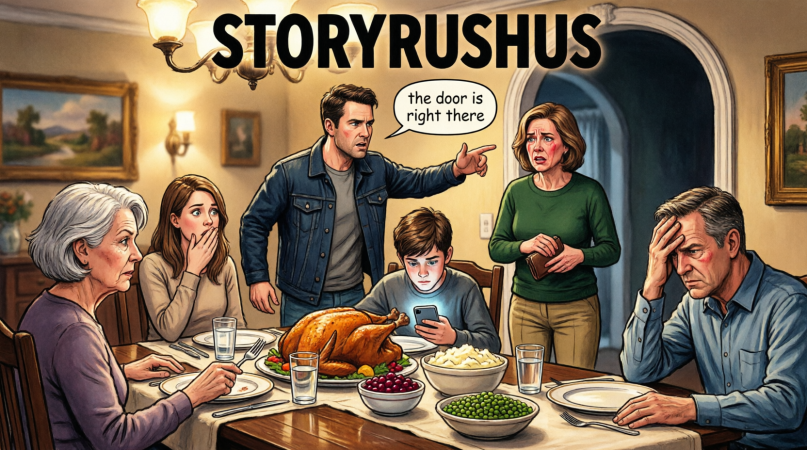
At Sunday dinner, my son said if I had a problem watching his kids for free, “the door is right there.” I stood up, folded my napkin, and said, “Perfect. I’m leaving.” Then I walked back to the storage room they called my bedroom, where my suitcase had already been packed. By the next morning, he finally understood I wasn’t the only one leaving that house. At the family dinner table, my son Michael said, “Your job is to watch my kids while I enjoy my life with my wife. It’s that simple. If you have a problem with it, the door is right there.” I looked at him, then at his wife, Jessica, then at the three children sitting frozen around the table. “Perfect,” I said. “I’m leaving. And you two can start paying your own bills. It’s that simple.” The words left my mouth before I could soften them. They came out cold and clear, like ice cracking in a glass. Michael stopped chewing. Jessica dropped her fork. The sound of metal striking porcelain rang through the dining room and vanished into a silence so thick even the twins stopped moving.

Only Clare, my sixteen-year-old granddaughter, looked directly at me. She had those dark, all-seeing eyes she inherited from my mother, and in her gaze I found something I had not expected.
Pride.
I should have seen it coming.
I should have noticed the signs during those three months. The glances Michael and Jessica exchanged when they thought I wasn’t looking. The conversations that ended abruptly whenever I walked into the living room. The packed suitcases by the front door, always waiting, as if the house were a hotel and I were the permanent staff.
But a mother never wants to believe her own son is using her.
A mother makes excuses. A mother explains things away. A mother forgives before anyone has even apologized.
I stood up slowly, with the kind of dignity my own mother had taught me when I was a girl growing up in a small farming town in upstate New York. I did not tremble. I did not cry.
I simply folded the cloth napkin from my lap, placed it beside my untouched plate, and walked toward the hallway without looking back.
Behind me, Michael’s chair scraped against the hardwood floor.
“Mom, wait,” he called. “It wasn’t a big deal.”
But it was a big deal.
It was a much bigger deal than he could possibly imagine.
That Sunday dinner, the one I had spent four hours preparing, was the moment everything finally exploded. But the story began three months earlier, on a Tuesday afternoon, when Michael called me while I was watering basil in the small garden behind my house near Hudson, New York.
It was a little cream-colored house with a front porch, old windows, and a wooden rocking chair that creaked whenever I sat in it with my morning coffee. My late husband and I had dreamed of a place like that for years, and after he died, I bought it with part of his pension and my savings.
It was not grand, but it was mine.
Every corner held a memory. The kitchen smelled of coffee and mint. The porch faced open fields where birds sang before sunrise. I had lived alone there for years, but I had never felt lonely.
Then the phone rang.
“Mom, I need you,” Michael said.
Those four words were enough.
He explained that Jessica was exhausted, that three children were too much for her alone, that his executive job kept him traveling all over the country, sometimes for weeks at a time. He said they only needed temporary help, just a few months until things settled down, until they found a suitable nanny, until Jessica recovered from what he called burnout.
His voice sounded so tired, so desperate, that I did not hesitate.
Within a month, I sold my house for $45,000. It was less than it was worth, but I needed the money quickly, and Michael told me it would help all of us get organized. He said I could stay with them as long as I needed. He said there was a room for me. He said we would be a united family again, the way we had been when he was little.
I wanted to believe him.
So I arrived on a Friday afternoon with two suitcases, three boxes, and the few pieces of my life I had not sold, donated, or left behind.
Michael and Jessica greeted me with hugs and bright smiles. The children ran to me shouting, “Grandma! Grandma!” Owen and Caleb, the eight-year-old twins, jumped around me like puppies. Clare, the oldest, kissed my cheek quietly, but even then her eyes looked sad in a way I did not understand.
They showed me my room.
It was the small room at the end of the hall, the one they had used for Christmas decorations, old electronics, and boxes of things they no longer wanted. There was a twin bed, a narrow closet, and a window facing the alley behind the house.
The walls were white and bare. There was no space for my rocking chair. No space for my framed photos. No space for almost anything that had once belonged to me.
Michael put his hand on my shoulder.
“It’s temporary, Mom,” he said. “Just until we get organized.”
I smiled and told him it was perfect.
The first week was lovely.
I cooked for everyone, prepared the children’s school lunches, washed clothes, folded towels, ironed Michael’s shirts, and helped the twins with their homework. Jessica hugged me and said, “I don’t know what we’d do without you, Eleanor.”
Michael came home to a clean house, bathed children, completed homework, and dinner waiting on the stove.
I felt useful.
I felt needed.
I felt like I belonged somewhere again.
The second week, Michael and Jessica announced that they had to travel for work. Three days in Albany for an important conference, they said. I would stay with the children.
“Of course,” I told them. “That’s what I’m here for.”
They left on a Wednesday morning with elegant suitcases. Jessica wore a salmon-colored dress that made her look polished and rested before the trip had even begun. Michael wore a gray suit that made him look successful and confident.
They kissed me on the cheek and left a list of instructions taped to the refrigerator.
They returned Sunday night tanned, relaxed, and smelling faintly of expensive perfume and wine.
They brought me a box of chocolates as a thank-you.
The third week they traveled again.
Then the fourth.
Soon it became a routine.
I woke at five in the morning before the sun came up. I prepared coffee in Jessica’s silver coffee maker, the one that made a sighing sound when it finished brewing. The smell filled the silent kitchen while I packed three lunch boxes with sandwiches cut into triangles, washed fruit, and homemade cookies.
At six-thirty, I woke the children. I dressed the twins, combed their hair, found missing socks, tied shoes, and reminded Clare to take breakfast even when she said she was not hungry.
Then I walked the children four blocks to school, Owen holding my right hand, Caleb holding my left, Clare moving ahead with her backpack slung over one shoulder and her earbuds in.
I returned to the empty house and cleaned.
Every day, I cleaned a house that never stayed clean.
I mopped hardwood floors, dusted furniture, washed dishes, folded laundry, cleaned bathrooms, and picked up toys left in every room. At noon, I often ate standing by the kitchen sink, staring out at the neglected backyard.
In the afternoons, I picked the children up from school, gave them snacks, supervised homework, and took them to the park when the weather was good. At night, I cooked dinners that Michael and Jessica rarely ate because they came home late or did not come home at all.
The suitcases by the front door became part of the landscape.
One black. One wine-colored.
Always ready.
Michael said it was for work. Important meetings. Clients to impress. Contracts to close.
But slowly, I started noticing details that did not fit.
Hotel tags on their luggage from beach resorts. Receipts from restaurants nowhere near Albany. Spa brochures tucked into Jessica’s purse. A tan line on Michael’s wrist where his watch had been.
One afternoon, while the twins played on the living room floor, Jessica left her phone on the sofa. It was unlocked.
I did not want to look.
I truly didn’t.
But the screen lit up with an Instagram notification.
A new photo posted.
Jessica stood in an elegant restaurant with a glass of wine in her hand, smiling at the camera. The location tag said Cancun. The caption read, “A well-deserved rest.”
It had been posted two days earlier, while they were supposedly at a work conference in Albany.
I sat there holding that unfamiliar phone, my hands trembling, while the twins built towers with colorful blocks at my feet.
Owen shouted that his tower was taller.
Caleb said his was stronger.
Across the room, Clare lay on the other sofa with a book open in her lap, but her eyes were not moving across the page.
She was watching me.
I swiped once.
There were more photos.
Jessica on a white-sand beach in a coral-colored bathing suit and enormous sunglasses. Michael beside her, tanned and relaxed, holding a beer. The two of them in a restaurant overlooking the ocean. The two of them toasting with champagne.
The dates matched every supposed work trip.
Every single one.
I closed the app and placed the phone exactly where I had found it.
My hands were no longer trembling. Something else had entered me, not anger, not grief, but a cold clarity, like muddy water settling until the bottom becomes visible.
Clare closed her book slowly.
“Grandma,” she said in a low voice, “I have to show you something.”
We went upstairs to her room while the twins kept playing downstairs. Clare’s room was the only place in the house that seemed to have a soul. Band posters on the walls. Clothes draped over the back of a chair. Books stacked on her desk. Sketches tucked into the mirror frame.
She locked the door and took out her phone.
“I’m sorry,” she said. “I should have told you weeks ago, but I didn’t know how.”
Her voice sounded guilty and frightened.
She opened a folder of screenshots and showed me messages from a private chat between Michael and Jessica. Clare had seen them one night while using her mother’s phone to send herself school photos. She had taken screenshots because, even at sixteen, she knew evidence mattered.
The chat was named The Mom Plan.
The messages began four months earlier, before I had even sold my house.
Michael had written: I talked to my mom. She’s in.
Jessica had replied: Perfect. With her watching the kids, we save the $1,200 a month for a nanny.
Michael: And she’ll give us the money from her house sale. We can use it to pay down the credit cards.
Jessica: Great. We’ll tell her we’re keeping it safe for her, but we’ll use it for the debts. She doesn’t know how to check online banking anyway.
Michael: She’s my mom. She won’t ask questions.
I kept reading.
There were dozens of messages.
Jessica complaining that I cooked with too much oil. Michael laughing because I did not understand the new television remote. The two of them planning trips while I stayed behind with the children. Jessica suggesting they put me in the storage room because I did not need much space. Michael agreeing that the small back room was enough for someone my age.
Then came a message from two weeks earlier.
Jessica: Your mom is starting to ask questions about the money.
Michael: I’ll tell her it’s invested. She doesn’t understand that stuff.
Jessica: We should have her sign power of attorney. That way we can manage everything.
Michael: Good idea. I’ll tell her it’s for emergencies.
Clare lowered the phone.
My hands were clenched in my lap so tightly my nails dug into my palms.
“There’s more,” she whispered. “They sold the furniture you left in the garage. The pieces you said you wanted to keep until you found a bigger place. Mom posted them on Facebook Marketplace. They got eight hundred dollars and went to a fancy restaurant. I know because they made me go. Dad made a toast and said, ‘Thanks, Mom, for your generosity.’”
I stood and walked to the window.
From Clare’s room, I could see the quiet street, the trees moving in the wind, the trimmed lawns, the American flag on the porch across the road lifting gently in the afternoon breeze. Everything looked normal. Clean. Ordered.
But inside me, the world had turned inside out.
For three months, I had believed I was helping my son.
For three months, I had risen at five in the morning, cooked, cleaned, ironed, comforted, and cared.
For three months, I had slept in a narrow little room and told myself I was useful, needed, loved.
And all of it had been planned before I even arrived.
“Grandma, I’m so sorry,” Clare said.
When I turned, tears were running down her cheeks.
“I wanted to tell you sooner, but I was scared. I was afraid you would leave and I’d be alone with them. You’re the only one in this house who treats me like I matter. The only one who asks how my day was and waits for the answer.”
I pulled her into my arms.
Her thin body trembled against mine.
She was only sixteen, trapped in a family that used her as decoration. I realized then that I was not the only invisible person in that house.
Clare was invisible too.
Just another responsibility delegated to Grandma while Michael and Jessica built a perfect life for Instagram.
“I’m not leaving without you,” I whispered. “I promise.”
That afternoon, after I picked up the twins from school and gave them snacks, I waited until they were watching television. Then I went to my small room, closed the door, and took out an old notebook from my suitcase.
It was the notebook where I used to write recipes and grocery lists.
On a clean page, I began writing everything down.
The date Michael had called me. The promise that I could stay as long as I needed. The pressure to sell my house quickly. The money. The furniture. The trips. The lies. The power of attorney. Every conversation I could remember.
Then I searched the bottom of my suitcase for a business card I had saved years ago.
Arthur Vance.
Attorney at Law.
He was an older lawyer from my old town, the man who had helped my husband prepare his will years before he died. I did not know if Arthur still practiced law. I did not know if the number still worked. But he was the only person I could think of who might help me.
I went downstairs and used the house landline.
The phone rang three times. Four. Five.
I was about to hang up when a familiar voice answered.
“Arthur Vance’s office.”
“This is Eleanor Ramirez,” I said. “I don’t know if you remember me. You helped my husband with his will years ago.”
There was a pause, then warmth entered his voice.
“Of course I remember you, Mrs. Ramirez. Tell me how I can help.”
So I told him everything.
I kept my voice low so the children would not hear me from the living room. I told him about the house money, the furniture, the fake work trips, the messages Clare had shown me, and the plan to have me sign power of attorney.
He listened without interrupting.
When I finished, there was a long silence.
Then he said, “Mrs. Ramirez, what you are describing may qualify as financial elder exploitation, fraud, and theft, depending on the documents and the account structure. You have rights. You have options.”
He explained that the screenshots were important but not enough by themselves. We needed account records, proof of withdrawals, proof of the furniture sale, copies of messages, and any documents showing that Michael had used my money for his own benefit rather than mine.
He warned me that the process would be painful. Public, perhaps. There could be civil consequences, and if prosecutors accepted the case, there could be criminal consequences too.
Then he asked, “Are you sure you want to move forward?”
I looked around the kitchen I cleaned every day. The dishes drying in the rack. The shining floor. The grocery list on the refrigerator in my handwriting. Evidence of invisible labor everywhere.
I thought about my sold house, my lost garden, my stolen peace.
I thought about Clare crying in my arms.
“I’m sure,” I said. “Tell me what I need to do.”
Arthur gave me precise instructions.
First, gather evidence.
Second, do not confront them yet.
Third, do not sign anything.
Fourth, make a safe plan for leaving.
Then he said the words that became my rule for the following weeks.
“Mrs. Ramirez, you cannot let them know you know. Act normal. If they suspect anything, they may hide records, delete messages, move money, or pressure you harder. You need to keep being the helpful grandmother until you are ready to leave.”
Act normal.
Those two words became my private command.
Act normal while I made breakfast for the people who had betrayed me.
Act normal while I ironed the shirts of a son who saw me as free labor.
Act normal while Jessica complained about dinner and left dishes in the sink.
That same night, Michael and Jessica arrived late again. They came through the front door laughing, shopping bags hanging from their arms.
Jessica wore a lavender dress that probably cost more than I spent on groceries for the week. Michael smelled like beer and expensive cologne.
They found me in the kitchen washing dishes from the dinner they had not come home in time to eat.
“Hi, Mom,” Michael said, kissing my forehead. “The kids asleep?”
I nodded. “They’re in bed. Clare is in her room.”
Jessica passed me without a glance, her heels clicking against the hardwood floor. Michael opened the refrigerator, took out a beer, and leaned against the counter.
“Mom, I need to talk to you about something important.”
My heart sped up, but I kept washing the plate in my hands.
“Tell me, son.”
“It’s about your finances,” he said. “I’ve been thinking you should sign a power of attorney. It’s a legal document that lets me manage your money if there’s a medical emergency or something. It’s for your own security.”
There it was.
Exactly as the messages had said.
I placed the plate in the drying rack and dried my hands slowly.
“A power of attorney,” I repeated.
“Yeah. It’s common. A lot of older folks do it. That way I can help you with bank paperwork and all that complicated stuff. You know you’re not great with technology. I’m just trying to make your life easier.”
I looked into his face.
Those brown eyes were identical to mine. The same eyes that had once looked up at me when he was a baby crying in the night. The same eyes that had widened with fear during thunderstorms. The same eyes I had comforted through school troubles, heartbreak, and failures.
Now those eyes looked at me with impatience hidden under a thin layer of false concern.
“Let me think about it,” I said softly. “It’s important. I want to understand it completely.”
A flash of irritation crossed his face before he smiled again.
“Sure, Mom. Take your time. But it’s no big deal. It’s just a piece of paper.”
He finished his beer, left the empty bottle on the counter for me to throw away, and went upstairs.
I stood alone in the kitchen with damp hands.
For a moment, I waited for the familiar ache in my chest.
It did not come.
What I felt instead was determination.
The next morning, after I took the children to school, I returned to the house and went upstairs to Michael and Jessica’s bedroom. It was the first time I had entered it since moving in. Michael and Jessica were out for what they called a midday investor meeting. I no longer cared whether that was true.
I opened Michael’s closet.
It was full of expensive suits, shirts arranged by color, and shoes lined up like soldiers. On the top shelf were several shoe boxes. I took them down one by one.
Most held shoes.
The fifth held papers.
Bank statements.
I carried them to the bed and reviewed them in the light coming through the window.
There it was.
My account. My name. My $45,000 from the sale of my house.
Michael had been added as a convenience signer after he convinced me that online transfers would be easier if he helped me. I had thought it was a harmless arrangement between mother and son. I had not understood that he was giving himself access to my money.
The withdrawals began two weeks after I arrived.
$3,000.
$5,000.
$2,500.
$4,000.
Each withdrawal carried a vague note: family expenses, home repair, medical support, investment transfer.
There had been no medical bills.
There had been no repairs.
There had been no investment.
The current balance was $16,200.
Almost $30,000 was gone.
I took out my cell phone, the one Clare had been teaching me to use better, and photographed every page. Every statement. Every withdrawal. Every lie on bank letterhead.
My hands were steady.
I put everything back exactly where I had found it, closed the closet, went downstairs, made tea, and sat at the kitchen table until they returned.
When Michael and Jessica came home two hours later carrying more shopping bags, they found me peeling potatoes for dinner.
“Hi, Mom,” Michael said.
“Hi, Eleanor,” Jessica added without really looking at me.
I smiled the smile I had perfected over seventy-two years, the one that hid everything I needed to hide.
That night, after everyone was asleep, I went downstairs and sat on the living room sofa in the dark. I sent the photos to Arthur.
He replied within minutes.
This is strong evidence. We can move forward when you are ready. But once we begin, there may be no quiet way back.
I looked around the dark living room. The twins’ toys were tidied in a basket. Family photos covered the wall, all perfect smiles and perfect lies. The suitcases waited by the door.
I thought about my house, my garden, my furniture, my dignity.
Then I thought about Clare upstairs, probably awake too, wondering if I would really do something or if, in the end, I would give in like everyone expected.
I typed back.
I’m ready. Tell me what’s next.
Arthur responded quickly.
First, you need somewhere safe to go. You cannot remain in that house once they know what you are doing. Do you have family or a trusted friend nearby?

