For four weeks, that card had felt like proof that I existed. Now it looked like a receipt for a lie. “Fine,” I said. Mom blinked. “Fine?” “Cancel it.” Relief moved across her face so fast she did not even have time to hide it. “Thank you, sweetheart,” she said. “I knew you’d understand.” That sentence finished something in me. Not because she canceled the party. Not because Dad agreed. Not even because Amber smiled. Because my mother heard me surrender and mistook it for love. I set the invitation on the table between her untouched coffee and the phone she had probably already used to start calling guests. “You’re right,” I said. “This did teach me something about family.”
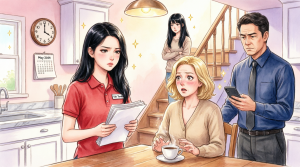
Dad frowned. Amber stopped pretending to cry. “It taught me exactly where I stand.” Then I reached for my keys. My hands were not shaking anymore. That is the part I remember most. The stillness. The strange calm that comes after years of trying to be chosen and finally understanding the vote was never open. I went upstairs. Behind my Stanford acceptance letter was a folder I had made for myself. Inside were the scholarship notice, the housing confirmation, the financial aid email, my pay stubs from the grocery store, and the notes from my guidance counselor about a local education segment she had submitted my name for. The email was dated March 18 at 9:42 p.m. The subject line read: Stanford-Bound Graduate Feature — Claire Reynolds. I had printed it because I was proud. Then I had hidden it because pride felt dangerous in that house.
My guidance counselor, Mrs. Patel, had written that the segment might include a short interview after graduation.
She had also written, in a line I had read more times than I wanted to admit, “You deserve to be celebrated for what you built.”
I stood there with the folder in my hand while my mother called from downstairs.
“Claire, don’t be dramatic.”
For once, I did not answer.
I packed only what belonged to me.
Two duffel bags.
My laptop.
The folder.
The cap and gown.
The Stanford letter came off the wall last.
The tape tore a small patch of paint from above my desk, and I remember thinking that even leaving would leave evidence.
When I came downstairs, Dad was in the hallway.
He looked at the bags and frowned like the situation had suddenly become inconvenient in a new way.
“Where do you think you’re going?” he asked.
“Aunt Linda’s,” I said.
That was the first time my mother looked scared.
Not heartbroken.
Not remorseful.
Scared.
Because Aunt Linda was the one relative who asked follow-up questions.
She was the one who sent me twenty dollars on exam weeks and called it coffee money.
She was the one who had driven four hours for a party my parents had just canceled because my sister felt invisible.
Mom stood in the kitchen doorway.
“Claire, this is ridiculous.”
“No,” I said. “This is documented.”
I lifted the folder.
Dad’s eyes dropped to it.
Amber had come halfway down the stairs.
Her face was no longer arranged into anything.
It was just young and angry and frightened by consequences she had never expected to touch her.
I did not scream.
I did not throw the invitation.
I did not make a speech long enough for them to interrupt.
I simply walked out.
Aunt Linda answered on the second ring.
When I told her what happened, she went quiet for a few seconds.
Then she said, “Drive to me. Do not stop to argue with anyone.”
So I drove.
Four hours through dark roads, with my cap and gown in the back seat and my scholarship folder on the passenger side like a witness.
By the time I reached Aunt Linda’s porch, it was after midnight.
She opened the door in slippers and a robe, took one look at my face, and pulled me inside without asking me to explain twice.
The next morning, she called my parents.
I did not hear the whole conversation.
I only heard her say, “You canceled your daughter’s graduation party because your other daughter felt left out, and you thought nobody would notice what that meant?”
There was a pause.
Then Aunt Linda laughed once, sharp and humorless.
“No, I am not bringing her back so you can make her apologize for being hurt.”
Graduation came ten days later.
My parents attended the ceremony.
So did Amber.
They sat several rows behind Aunt Linda.
I knew because I saw them when I walked across the stage.
Mom cried.
Dad clapped.
Amber looked at her lap.
I do not know what they expected after that.
Maybe they thought I would come home because the big moment was over.
Maybe they thought leaving was a performance.
People who benefit from your silence often mistake your first boundary for a mood.
They learn too late that quiet people keep records.
The local news segment aired two months later.
By then, I was preparing to leave for Stanford.
Mrs. Patel had helped coordinate the interview.
Aunt Linda sat beside the camera crew in her living room, crying into a tissue and pretending she was not.
They filmed my grocery store uniform hanging on a chair.
They filmed my scholarship folder.
They filmed the cap and gown.
They asked what had kept me going.
I almost gave a safe answer.
Hard work.
Teachers.
Dreams.
Then I thought about the kitchen.
The untouched coffee.
The invitations.
The way nobody moved.
So I said, carefully, “I learned that sometimes the first place you have to leave is the place that taught you to disappear.”
They used that line.
Of course they did.
The segment called me a Stanford-bound graduate who worked her way through school and earned a full scholarship after years of balancing classes, shifts, and family pressure.
They showed my name on the screen.
Claire Reynolds.
They showed my acceptance letter.
They showed Mrs. Patel saying I was one of the most disciplined students she had ever taught.
They showed Aunt Linda saying, “She deserves every good thing coming to her.”
My parents watched it on the news.
I know because Dad called six minutes after it aired.
I let it go to voicemail.
Then Mom texted.
We saw the segment. We wish you had told us it would be on.
I stared at that message for a long time.
Not congratulations.
Not we are sorry.
Not we should have celebrated you when we had the chance.
They were upset they had not been invited to be seen.
A few minutes later, Amber texted too.
You made us look horrible.
That one almost made me laugh.
I typed three different replies and deleted all of them.
Then I sent one sentence.
I didn’t make you look like anything.
I let what happened be visible.
Nobody answered after that.
Not right away.
Months later, when I was on campus, Mom tried again.
She sent a long message about misunderstanding, about stress, about how hard it had been to balance two daughters with different needs.
I read it sitting under a tree outside a lecture hall, surrounded by students carrying books and coffee and lives that did not know anything about Amber’s bedroom door or the kitchen calendar with the blue star.
For the first time, I did not feel the old pull to comfort her.
I did not feel cruel.
I felt clear.
I told her I hoped she and Dad would think carefully about why my leaving felt more embarrassing to them than my pain had felt important.
I told her I loved Amber, but I would not keep paying for her insecurity with my milestones.
I told her I was not coming home for Thanksgiving unless they could respect that.
There was no perfect ending.
Families like mine do not transform in one speech, one news segment, or one daughter finally closing the door.
Dad apologized first, awkwardly and badly.
Mom apologized later, with more tears than accountability.
Amber did not apologize for a long time.
When she finally did, it came in a text so short I almost missed the point.
I liked being the one everyone protected. I’m sorry I let them do it to you.
I believed her enough to answer.
Not enough to forget.
That is the part people do not always understand.
Forgiveness is not the same as returning to the room where they learned how easily they could erase you.
I still have one of the invitations.
Aunt Linda framed it.
Cream paper.
Gold letters.
My name in the center.
For four weeks, that card had felt like evidence that I existed.
Now it means something different.
It reminds me that the night my parents canceled my graduation party for my sister’s feelings, I did not lose my celebration.
I lost the illusion that I needed their permission to have one.
THE END.