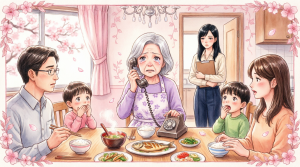
The first thing Hope Mendoza noticed that evening was the smell of rosemary clinging to the steam above the stew. The second was the way Linda looked around the dining room as though kindness had already made the house available. Hope was sixty-eight years old, widowed, and still living in the brick Chicago home she and Anthony had bought with teacher salaries. Nothing in that house had ever come easy. Every wall had a memory attached to sacrifice. They had bought it when Edward was still small enough to fall asleep against Anthony’s shoulder. They paid the mortgage through clipped coupons, postponed vacations, and one used car that rattled through four winters longer than it should have. The Cook County Recorder of Deeds still carried their names on the original file. The final mortgage payoff letter from First Midwest Bank sat in a blue folder in Hope’s desk. The Cook County Treasurer mailed the property tax bill to her.
Not Edward. Not Linda. Hope.
After Anthony died, the house became quieter, but not empty. His reading glasses stayed in the end table. His chipped mug remained in the cabinet. Some mornings, Hope could still hear his old joke in the refrigerator hum.
He used to call that sound “the house clearing its throat.” Hope had laughed every time, even when the joke became familiar. After he was gone, she kept listening for it because grief often hides inside ordinary noises.
Edward was her only son. She had packed his lunches, signed his forgotten permission slips, and sat through cold rain at soccer fields when he insisted he could play through anything. Hope had loved him with the steady exhaustion of a mother.
So when Edward called at 10:42 a.m. on a Tuesday and said he had lost his job, Hope did not ask for proof. She did not ask how long he expected to stay. She heard panic and opened her door.
She gave him the front door code. She cleared the guest room. She stocked the refrigerator with Dylan’s favorite snacks and bought fresh flowers for the dining table. That was her trust signal: a key, a code, a mother’s door.
Edward arrived looking thinner than she remembered. Worry had hollowed the area beneath his eyes. Dylan hugged Hope with both arms. Sarah stepped in with one earbud in and her phone lifted like a shield.
Linda came last. Her hair was polished, her blouse careful, her smile bright enough to look practiced. She thanked Hope for letting them stay, but her eyes were already measuring the room.
By 3:17 p.m., Linda had opinions. The guest room was too small. The upstairs bathroom had poor lighting. The closets were not practical. Hope listened, nodded, and folded a dish towel too tightly in her hands.
By 5:06 p.m., Linda said she and Edward should take the master bedroom because it “made the most sense.” Hope felt something in her jaw tighten, but she did not answer with anger.
For one quick, ugly second, she imagined bringing Anthony’s chipped mug to the table and setting it in front of Linda. She wanted Linda to see the man whose home she was casually rearranging.
She did not do it. Hope had spent decades confusing restraint with peace. She had not yet learned that some people do not recognize mercy unless it arrives with paperwork.
Still, she cooked. Beef stew, the one Edward used to ask for after soccer practice. Warm bread. A bottle she had been saving. Holiday china that Anthony always insisted made ordinary meals feel like promises.
Hope wanted the first dinner to feel like a soft landing, not a defeat. She lit two candles and placed flowers in the center of the table. The room glowed gently enough to almost fool her.
For a few minutes, it worked. Dylan helped carry bowls. Edward looked tired but grateful. Sarah slid into her chair with one earbud still in. Linda arrived last, wearing that downtown-dinner posture that judged before speaking.
Steam lifted from the plates. Silverware touched china with a small bright clink. Rosemary, bread, beef, and candle wax filled the room. Hope let herself believe the sharpness in Linda had been stress.
Then Linda set down her fork.
“I’m the one in charge of this house now,” she said.
The room froze. Dylan’s spoon stopped halfway between bowl and mouth. Sarah’s small laugh came out wrong, then disappeared. Edward stared at his plate like the blue pattern around the rim might excuse him from becoming a son.
One drop of stew slid down the serving spoon and fell back into the bowl. Linda’s glass hovered near her mouth, untouched. The candle flame bent and straightened while the people at the table remained still.
Nobody moved.
Then Linda glanced toward the back door and said, “Take your plate outside and eat with your friend.”
That was the sentence Hope would remember most clearly. Not because it was the cruelest sentence she had ever heard, but because of where it landed: inside her own dining room, under her own roof, in front of her son.
Hope did not scream. She did not cry. She did not ask Edward to remember who had raised him. She only felt the rage go cold and clean inside her, as if grief had sharpened itself into a blade.
Then she smiled.
At 6:48 p.m., Hope pushed her chair back and walked to the kitchen wall phone. Linda’s smile widened because she thought Hope was calling a neighbor to rescue her pride.
Edward finally looked up, but not enough to meet his mother’s eyes. Dylan watched silently. Sarah lowered one earbud. Hope dialed a number she had kept longer than anyone in that room realized.
Gabriella answered on the second ring.
“Gabriella,” Hope said quietly, “it’s time.”
Gabriella Santos had known Anthony and Hope for more than twenty years. She had handled the closing documents when Anthony retired and helped Hope organize estate paperwork after the funeral. She knew exactly where every signature belonged.
Months earlier, after a different uncomfortable visit from Linda, Hope had asked Gabriella to help her review the house records. Not because Hope wanted a war, but because Anthony had always believed love should be generous and documented.
The documents were simple. The house remained Hope’s. The deed, the tax bills, the mortgage satisfaction letter, and the estate file all said the same thing. Gabriella had made certified copies and kept them ready.
Eight minutes after Hope’s call, headlights washed across the dining room window. Linda’s smile faltered. The knock landed against the front door with a firm, official weight.
Hope opened it herself.
Gabriella stood on the porch with a leather folder tucked against her chest. Beside her was a man in a navy coat who introduced himself only after Hope invited them inside. He was there as a witness, not a threat.
Rain shone on the brick behind them. The porch light made the folder look almost too ordinary for what it carried. Gabriella stepped into the dining room and took in the table without changing expression.
Linda spoke first. “What is this?”
Gabriella looked at Hope, not Linda. “The file you asked me to bring.”
Edward stood halfway, then stopped. Shame moved across his face in pieces. He looked at the folder, then at his mother’s plate, then at the chair Linda had tried to empty.
Gabriella placed the first document on the table. It was a certified copy of the deed. The second was the First Midwest Bank mortgage payoff letter. The third was the most recent Cook County property tax bill addressed to Hope Mendoza.
Linda reached for the papers. Gabriella moved them just out of reach.
“These are Mrs. Mendoza’s documents,” she said. “You may look when she gives permission.”
The sentence was quiet, but it changed the temperature of the room. Linda’s face hardened, then paled. For the first time that day, she was not speaking from assumed power.
Hope looked at her son’s wife and finally answered the sentence that had been thrown at her. “This is not your house, Linda. It has never been your house.”
Edward whispered, “Mom.”
Hope turned to him then. The hurt in her chest was old and new at the same time. “I opened my door because you were my son and you said you needed help. I did not open it so your wife could erase me.”
Dylan began to cry softly. Sarah looked at her father with an expression too sharp for a teenager. Edward sat down as if the chair had pulled him there.
Linda tried to recover. She said Hope was overreacting. She said everyone was tired. She said she had only meant the household needed order. Each explanation arrived smaller than the one before it.
Hope listened until Linda stopped talking.
Then she made the decision she had been afraid to make all afternoon. She did not throw children into the night. She did not punish Dylan or Sarah for their mother’s cruelty. But the arrangement changed immediately.
Linda and Edward would not take the master bedroom. They would not rearrange rooms. They would not decide rules for a house they did not own. If they wanted to stay temporarily, they would do so as guests.
Gabriella slid another paper forward. It was not eviction paperwork. It was a written guest agreement Hope had requested after Edward’s call, prepared in case kindness needed boundaries.
The document listed quiet hours, shared spaces, privacy expectations, and one nonnegotiable rule: Hope Mendoza retained full authority over the property. No resident or guest could claim ownership, control, or exclusive rights.
Linda stared at it as if it were written in another language.
Edward read every line. When he reached the bottom, his hands began to shake. “You prepared this before tonight?” he asked.
Hope answered honestly. “I hoped I would never need it.”
That broke him more than anger would have. He covered his face with both hands. For a moment, Hope saw the little boy who used to come home from soccer with grass on his socks and hunger in his eyes.
But mothers can love their children and still refuse to be used by them. That was the lesson Hope had learned too late and exactly on time.
Linda did not sign that night. She announced that she would never live under humiliating rules. Hope said nothing. Edward looked at the children, then at the folder, then at the mother he had failed to defend.
By morning, Edward apologized. Not perfectly. Not dramatically. But he stood in the kitchen while Hope made coffee and said, “I should have stopped her.”
Hope did not rush to forgive him. Forgiveness offered too quickly can become another form of permission. She told him he could begin by teaching his children what respect looked like when nobody was performing for company.
Linda stayed two more days. She avoided the dining room, avoided Gabriella’s folder, and avoided Hope’s eyes. On the third morning, she told Edward they should leave. Edward said he needed time to rebuild properly, not pretend control belonged to whoever shouted first.
That argument was not Hope’s to solve. For the first time in years, she allowed other adults to carry the weight of their own choices.
Dylan apologized before they left for school that week, though he had done nothing wrong. Sarah washed the dinner bowls without being asked. Small things, Hope knew, but small things are how a house learns to breathe again.
The blue folder returned to Hope’s desk. Anthony’s mug stayed in the cabinet. The dining room table was wiped clean, but Hope could still see the exact place where Linda’s fork had rested when she said, “This is my house now.”
It was not.
Weeks later, Hope changed the front door code. She gave Edward the new one only after he signed the guest agreement and only because he asked with humility instead of entitlement. That mattered.
The house did not become louder after that night. It became clearer. Hope still cooked. She still loved her family. She still kept flowers on the table when she could afford them.
But she no longer mistook silence for strength. She no longer believed peace required disappearing from her own chair. And she no longer let anyone turn kindness into a deed transfer.
In the end, the lesson was not about a house. It was about the moment a woman who had spent years swallowing her dignity finally set down the spoon, picked up the phone, and remembered her own name.
That was the night Hope Mendoza learned that love can open a door, but boundaries decide who gets to remain inside.
THE END.