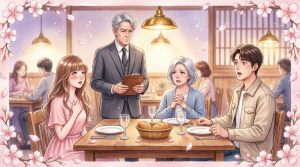
“Six hundred dollars,” I said. “That was our rent money for May. We are already two months behind. Our landlord has started eviction proceedings.”
I looked at Jason. He had stopped scrolling his phone. His hand was still, the screen dark, his face carrying the expression of a man who is beginning to understand that the ground he is standing on is not as solid as he believed.
“I took our rent money and paid for this dinner in advance because I knew,” I said. “I knew you would do exactly what you just did. I knew Amber would say what she said. I knew you would nod. I have known for longer than I wanted to admit.”
I opened the folder. The first page was a bank statement from March 2008. Transfer to Jason Michael Sullivan. Amount: two million dollars.
“Do you remember this?” I asked.
He looked at the statement and his face changed the way a landscape changes when a cloud moves across the sun, the light retreating all at once, everything that was bright a moment ago suddenly shadowed.
I laid out what was behind it. Hospital bills. Pharmacy receipts. Insurance denial letters. Three years of paper showing what Kathy and I had been paying since we gave him everything. The invoices for her insulin. The co pays for her kidney specialist. The cost of the bandages for her foot. The mortgage payments we had missed because the money that should have been our safety net was in his investment account, growing, compounding, turning into Porsches and renovations and Japanese maples and resort vacations in Greece.
Then I held up a single page on medical letterhead. My name at the top. My diagnosis in clinical language beneath it.
“Stage two prostate cancer,” I said. “Diagnosed March third. Estimated treatment cost: seventy eight thousand dollars. I have not treated it. I have not told anyone. Because we did not have seventy eight thousand dollars. We barely had seventy eight.”
Kathy grabbed my arm. Her grip was stronger than I expected, the grip of a woman whose body was failing but whose will had not received the message. “Hank,” she said. “You didn’t tell me.”
“I couldn’t,” I said. “We couldn’t afford your insulin. How was I supposed to tell you we needed another eighty thousand for me?”
The table was very still. Around us the restaurant continued its ordinary rhythms, the clink and murmur and movement of people who were eating dinner and celebrating Mother’s Day and living inside their own evenings without any awareness that at our table, near the window, a family was coming apart.
Jason was staring at the medical letter. His face had lost the smooth, managed quality it had carried all evening, the face of a man in a tailored suit who controls rooms and manages people and moves through the world with the confidence of someone whose account balance is a form of armor. What remained was something rawer. Something that looked, from where I stood, like the beginning of a reckoning.
“Dad,” he said. “You have to get treatment.”
“I chose your mother over my own life,” I said. “That is what you do when you love someone. You do not sit in a hospital hallway and discuss how long she has left. You do not calculate what you will inherit when she dies. You do not bring her to a restaurant on Mother’s Day and refuse to pay for her soup.”
Jason flinched. He opened his mouth and closed it. Then his eyes went to Kathy. His mother, sitting in her fifteen year old dress with tears drying on her face and her foot bleeding under the table and her insulin cut in half because the money that should have protected her was parked in his portfolio.
“I heard you,” I said. “In the hospital. Eight weeks ago. I heard you and Amber in the hallway. I heard you ask how long she had. I heard you agree to wait.”
The color left his face entirely. Amber reached for her wine glass and then seemed to forget why she had reached for it and set her hand back on the table.
“I’m sorry,” Jason said. The words came out hoarse and unsteady, the voice of a man who is not accustomed to the sound of his own honesty. “Dad, I’m sorry.”
Kathy stood. She was unsteady on her feet and I put my arm around her waist. “We’re leaving,” she said.
We walked out of the restaurant, slowly, Kathy leaning into me the way she leaned when her foot was bad and the pain made balance difficult. Miguel held the door. He did not say anything. He did not need to. The night air was warm and dry and smelled like jasmine and parking lot asphalt, and the sky above Scottsdale was clear and dark and full of the particular emptiness that desert skies carry after the sun has gone, the vast open nothing that makes you feel both very small and very present at the same time.
The Honda started with the grinding sound it had been making for weeks. I pulled out of the parking lot and onto the boulevard, and Kathy sat beside me with her hand on my arm and her face turned toward the window, and we drove home in silence because there was nothing to say that would fit the size of what had just happened. Some evenings are like that. They exceed the capacity of language and all you can do is sit inside them and breathe and let the silence hold what the words cannot.
When we got home, Kathy went to the bathroom and changed her bandage. I heard the water running and the small sounds of her tending to herself, the careful, practiced movements of a woman who has been managing her own wounds for so long that the management has become a kind of expertise. She came out in her nightgown and sat beside me on the couch and we looked at each other for a long time.
“How long have you known?” she asked. “About the cancer.”
“Since March.”
“Two months.”
“Yes.”
She was quiet. Then she said, “I’ve been cutting my insulin since January.”
“I know. I found the notebook.”
Her eyes filled again. “We’ve been keeping secrets to protect each other.”
“Yes.”
“We have to stop.”
“Yes.”
She put her head on my shoulder and I put my arm around her and we sat on the couch in our small rented house with the eviction notice on the counter and the ceramic rooster on the shelf and the sound of the air conditioner clicking on and off in the rhythm that had become, over the years, the heartbeat of our domestic life. I did not know what was going to happen. I did not know if Jason would call or if Amber would fight or if the money would come or if my cancer would wait for us to afford its treatment. I did not know anything except that Kathy was beside me and that I loved her and that the evening had cost us six hundred dollars we did not have and had given us, in return, something I could not yet name but that felt, in the silence of the living room, like the first clear breath after years of holding.
Jason called three days later. His voice was different. Stripped of its polish, its managerial smoothness, the practiced warmth he had used on the phone for years that I now understood had been a performance maintained so long it had become indistinguishable from who he was. What remained was uncertain, ragged, the voice of a man who had spent three days sitting with something he could not manage or delegate or optimize away.
“Can we talk?” he said. “Please. I know I don’t deserve it.”
He came to the house. He parked the Porsche on the street and walked up the front path in jeans and a wrinkled shirt and stood on the porch looking at the door as if he were not sure he was allowed to knock. I opened it before he had to decide. He came inside and stood in the kitchen where he had once sat as a thirty year old man and cried when I told him we were giving him everything, and he looked around at the room he had grown up in, at the counter where Kathy had packed his lunches and the window where the light came in during the afternoons and the refrigerator with the photograph of him at eight years old holding a fishing pole beside his father, and something in his face collapsed.
He sat at the kitchen table and put his head in his hands. “What have I done,” he said, and it was not a question. It was a statement, the kind a person makes when the answer is already inside them and there is no version of it that allows them to remain the person they believed themselves to be.
I sat across from him. I did not touch him. I did not reassure him. There are moments when a parent’s job is not to comfort but to witness, to sit on the other side of the table and let the truth do its work without softening its edges, because the edges are the point. They are what cut through the layers of self deception that a person has built over years of choosing convenience over conscience, and if you blunt them too soon the cut does not reach deep enough to change anything.
“Your mother cuts her insulin in half,” I said. “She has been doing it since January. She writes about it in a notebook she hides in the kitchen drawer. She asks God to forgive her for it. She does not tell me because she does not want me to worry. And I do not tell her about my cancer because I do not want her to suffer more than she already is. We have been protecting each other from the things we cannot afford, and meanwhile you have been planning a vacation to Greece.”
He cried. Not the polished, manageable tears of a man who has learned to use emotion strategically. He cried the way children cry, open and ugly and without any attempt to control the shape of it, and I sat across from him and watched and felt, beneath the anger and the grief and the exhaustion, the faintest stirring of something I was not yet ready to call hope.
What happened next was not dramatic. It was administrative. Jason paid off Kathy’s medical debt, which had accumulated to a hundred and forty six thousand dollars across three hospitals and four specialists and a pharmacy that had been sending collection notices for eighteen months. He paid for my cancer treatment. He bought Kathy an insulin pump that cost eighteen thousand dollars and that changed her daily life so immediately and so completely that she sat at the kitchen table the first morning she used it and cried, not from sadness but from the disorienting relief of a woman who has been rationing her own survival for so long that the arrival of adequate care felt almost violent in its generosity.
He came to the house twice a week after that. He brought groceries. He drove Kathy to appointments. He bought a notebook and started tracking her glucose readings, morning and night, with the same methodical attention he had once applied to his investment portfolio, and there was something in the discipline of it, in the way he wrote the numbers down in his careful handwriting and set alarms on his phone so he would not forget, that suggested the change was not performance but penance, the daily labor of a man who has understood, finally, that love is not a number on a bank statement but a series of small, unglamorous actions performed without expectation of return.
Amber left. That is the short version. The longer version involves conversations and lawyers and a process that was ugly in the way that the dissolution of a marriage built on shared ambition rather than shared values is always ugly, but the details do not belong in this story because this story is not about Amber. She was a woman who saw people as instruments and who mistook the absence of resistance for the presence of agreement, and when the instrument she had married began to resist, she moved on to another arrangement. I do not think about her often. When I do, I feel nothing in particular, which is its own kind of resolution.
On a morning in late June, more than a year after that Mother’s Day dinner, Kathy and I sat in the oncologist’s office and heard the words I had not allowed myself to imagine. Complete remission. My PSA had dropped to a number that meant the cancer was gone, not permanently, not with certainty, but gone for now, and in medicine gone for now is the best version of good news there is. The doctor turned to Kathy and told her that her A1C had dropped from ten point two to seven point two, that her kidneys were stabilizing, that the insulin pump was working. Kathy looked down at her hands, the same hands that had trembled through dinner at the restaurant, and said, “Jason did that. He checks my glucose every morning and every night. He sets alarms so he doesn’t forget.”
I do not know whether I have forgiven my son. Forgiveness is a word people use as if it describes a single event, a door you walk through and then you are on the other side, but in my experience it is not a door. It is a landscape. You walk through it slowly. Some days you are closer to the far edge and some days you are back near the beginning and some days you are standing in the middle of it looking in both directions and unable to tell which way you are facing. What I know is that Jason came back. He came back not with words or money or the grand gestures that people use to compress redemption into something that fits inside a single afternoon, but with notebooks and alarms and grocery bags and the slow, patient labor of a man rebuilding a relationship he nearly destroyed, brick by brick, morning by morning, glucose reading by glucose reading. Whether that constitutes forgiveness or something short of forgiveness or something adjacent to forgiveness that does not yet have a name, I cannot say. I know only that it is happening, and that it is real, and that reality, after years of pretense, is enough to build on.
Kathy and I still live in the same house. Jason paid the back rent and settled the eviction and offered to move us somewhere larger, somewhere with a yard, somewhere that matched the scale of what he could now afford to give us. We declined. The house is small and the siding is pale yellow and the screened porch needs repair again and the kitchen window still looks out toward the strip of grass where the lizards sun themselves in the afternoons, and all of that is ours in a way that has nothing to do with money and everything to do with the fact that we chose it, and choosing is a form of love that no inheritance can replace.
On a recent evening, after Jason had gone home and the house was quiet, Kathy and I sat by the window in the living room. The sun had gone down. The neighborhood was dark and still. Somewhere outside, a sprinkler was running, the rhythmic sound of water landing on grass, and the air coming through the screen smelled like warm earth and the jasmine that grew along the fence between our yard and the neighbors’.
“Do you forgive him?” Kathy asked.
“I don’t know,” I said. “Not all the way.”
She nodded slowly. “Me neither.”
Then she reached for my hand. Her fingers were thin and warm and they closed around mine with a pressure that was gentle and specific, the grip of a woman who has been holding my hand for forty seven years and who knows exactly how much force to use, not so much that it hurts, not so little that it disappears, just enough to say I am here and I am not leaving and whatever this is we will carry it together.
“But he came back,” she said.
“Yes,” I said. “He came back.”
The sprinkler ran. The jasmine bloomed. The house held us the way it always had, quietly, without commentary, in the ordinary light of an evening that asked nothing of us except that we sit inside it and breathe. And for that night, that was enough.
THE END.

