My Wife Told Me This Would Be Our ‘Best Christmas Ever’ As She Put The Turkey On The Table. Ten Minutes Later, She Was Dying In My Arms, Foam Pouring From Her Mouth, While Our Kids Twitched On The Floor, Faces Turning Blue. Doctors Said One Word: Poison. The Police Looked At Me. My In-Laws Cried On Camera. But When I Pulled My Home Security Footage And Saw Who Spiked The Gravy, I Realized The Killer Was Sitting Right There Smiling At Us.” “Some Family Come To Eat – Some Come To Kill!”
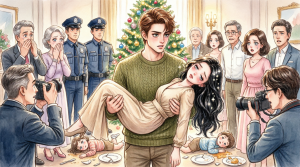
I watched my wife die with Christmas lights blinking behind her like nothing in the world had changed.
The turkey was still warm. The gravy boat sat in the center of the table, steam curling off it in lazy ribbons. Cinnamon candles burned on the sideboard. Bing Crosby sang softly from the speaker by the window, his voice so calm it made the screams sound unreal.
Harper collapsed first.
One second she was laughing at something our seven-year-old son Mason had said about Santa needing a bigger belt. The next, her fork slipped from her fingers and struck the plate with a sharp little clink that cut through the dinner noise.
I looked over.
Her eyes were wrong.
“Harper?”
She tried to answer, but only a wet choking sound came out. Her hand went to her throat. Her face drained of color so fast it looked like somebody had pulled a plug inside her. Then she pitched forward, face-first into her mashed potatoes.
For half a second nobody moved.
Then Laya screamed.
My five-year-old daughter had cranberry sauce on her chin and terror in her eyes. She reached toward me, her little fingers clawing at the air.
“Daddy, it burns.”
Mason gagged beside her. His lips were turning blue. Foam bubbled at the corner of his mouth.
After fifteen years in Delta Force, I’d seen men die in ways that still woke me at night. I’d watched blood soak into desert sand. I’d heard last breaths under helicopter blades. I’d trained for nerve agents, chemical attacks, poisoned water, ambushes hidden behind smiles.
But nothing prepares you for your family dying at your own Christmas table.
I shoved my chair back so hard it crashed into the wall. Plates shattered. Someone screamed my name, maybe Kendra, maybe Harper’s mother, maybe my own voice coming from outside my body.
I rolled Harper onto the floor. Her skin was gray. Her mouth was red with blood and vomit. I started compressions, counting under my breath because counting was the only thing keeping my mind from cracking.
“One, two, three, come on, baby, breathe.”
Mason fell from his chair.
Laya convulsed so violently her tiny shoes drummed against the hardwood.
“Call 911!” I roared.
People moved then. Chairs scraped. Glass broke. My brother-in-law Grant stood frozen with his hands half-raised, like he’d forgotten what hands were for. His wife Kendra was sobbing into her phone. Their teenage son Tristan backed into the corner, pale and useless. Harper’s old college friend Evan ran toward the sink and vomited.
My mother-in-law, Violet, stood near the doorway in her cream cardigan and pearls, one hand pressed neatly over her mouth.
Too neat.
That thought flashed through my mind and vanished under panic.
I tasted metal.
It spread across my tongue like pennies and blood. My stomach cramped. Sweat broke cold across my neck.
Poison.
The word didn’t arrive like a guess. It arrived like a fact.
I grabbed Mason with one arm while still pressing on Harper’s chest with the other. My son’s body was limp, his lashes fluttering. Laya’s cries had faded into a thin wheeze that scared me worse than the screaming.
“Stay with me,” I said, though I didn’t know which one of them I was saying it to. “All of you. Stay with me.”
Sirens came like wolves in the distance.
By the time paramedics burst through the front door, Christmas dinner had become a battlefield. Food smeared the tablecloth. Red wine crawled down the wall. The tree blinked blue, gold, blue, gold over Harper’s body as they shoved tubes into her throat.
A young paramedic tried to pull me back.
“Sir, we need space.”
“I’m not leaving her.”
“Sir—”
“I said I’m not leaving her.”
He saw something in my face and stopped arguing.
They loaded Harper first. Then Mason. Then Laya.
I climbed into the ambulance with my wife. Her hand hung off the stretcher, wedding ring dull under the harsh lights. I held it between both of mine, feeling for warmth, for pressure, for anything.
The monitor screamed.
A medic pushed something into her IV. Another started compressions. The ambulance rocked hard as we tore through the snow-slick streets.
“Harper,” I whispered. “You promised me one normal Christmas.”
Her eyes stared past me.
At the hospital, they ripped me away from her.
Two security guards had to do it.
I fought them until I saw Laya’s stretcher flash past the hallway, my daughter swallowed by white sheets and tubes. Mason came behind her, his face so still I thought he was already gone.
That stopped me.
The ER smelled like bleach, blood, and burnt coffee. Nurses shouted. Doctors moved in bright blue scrubs. Doors swung open and closed, stealing pieces of my family from me.
Then a doctor with tired eyes came toward me.
I knew before he spoke.
“Mr. Reed,” he said softly. “I’m sorry. Your wife didn’t make it.”
The world narrowed to the blood under my fingernails.
“What about my kids?”
His pause was small.
It was enough to kill me twice.
“They’re alive,” he said. “But critical.”
I slid down the wall because my legs forgot they belonged to me. My wife was dead. My children were fighting machines. And somewhere behind me, in that dining room full of broken dishes and Christmas music, one of our guests had put death into our meal.
By dawn, grief hardened into something colder.
I didn’t know who had done it yet.
But I knew one thing with absolute certainty: someone at that table had smiled at my children while waiting for them to die.
### Part 2
The hospital waiting room had the kind of fluorescent lighting that made everyone look guilty.
Grant paced near the vending machines, rubbing both hands over his bald spot. Kendra sat with her knees pressed together, tissue shredded in her lap. Tristan kept his hood up and his eyes down. Evan leaned against the wall by the water fountain, still pale, still wiping his mouth with the back of his hand.
Violet sat apart from everyone.
My mother-in-law had always looked expensive, even when she was doing ordinary things. That night she wore pressed slacks, pearl earrings, and a soft cream sweater that hadn’t picked up a single stain from the chaos. Her lipstick was smudged at one corner, but even that looked deliberate, like grief was something she’d chosen from a wardrobe.
She saw me staring.
“Logan,” she said, voice thin. “I’m so sorry.”
I didn’t answer.
My body was failing in small ways. Muscles shaking. Mouth dry. Stomach twisted from whatever amount of poison I’d taken in. Doctors had pumped me, run fluids, drawn blood, asked questions I couldn’t fully hear.
Did you eat the gravy?
Did you drink wine?
Did the children eat the same food?
Who prepared what?
Every question was a door. Behind each door stood someone I knew.
Harper had cooked the turkey and rolls. I made the mashed potatoes because she said mine were smoother. Violet brought green bean casserole. Grant and Kendra brought sweet potatoes. Evan brought wine, though I’d told Harper we had enough. Kendra made the cranberry sauce. Somebody had filled the gravy boat while I was carving.
That detail stayed blurry.
It bothered me.
Detective Maria Calder arrived around four in the morning with snow melting on her coat shoulders and a notebook already open. She was compact, sharp-eyed, and too tired to waste words.
“Mr. Reed,” she said. “I know this is not the time you want questions, but it’s the time I need answers.”
“Ask.”
She studied me for half a second. “Military?”
“Retired. Delta.”
That changed the way she held the pen.
“Then you understand what I’m asking. Was this random?”
“No.”
“You’re sure?”
I looked through the ICU glass.
Mason lay under a heated blanket, tubes taped to his face, his small chest rising because a machine told it to. Laya was in the next room. Her curls were still sticky from vomit where no one had cleaned them yet, because saving her life mattered more than dignity.
“I’m sure,” I said.
Calder followed my gaze and softened for only a moment.
“Could this be connected to your service?”
“It could be,” I said. “But it doesn’t feel like that.”
“Why not?”
Because enemies from overseas don’t usually know your wife’s favorite gravy boat.
Because revenge men don’t usually poison children with food passed by family hands.
Because the timing was too intimate.
I didn’t say all that. I just said, “It happened at our table.”
Calder nodded like that was enough.
She asked me to walk her through the dinner. I did it three times, each time noticing more. Evan and Harper whispering in the kitchen. Grant insisting everyone try the sweet potatoes. Violet watching Harper take the first bite of casserole. Kendra fussing over Laya’s napkin. Tristan barely eating at all. The gravy boat being passed from hand to hand, heavy white ceramic, a chip near the spout.
“Who ate gravy?” Calder asked.
The question hit hard.
“The kids,” I said. “A lot. Harper had some. I had maybe a little on the potatoes. Not much.”
“Who didn’t?”
I replayed the table.
Violet had touched almost nothing except turkey and salad. Grant drowned his plate in everything, but he was fine. Kendra ate gravy. Evan didn’t. Tristan mostly pushed food around.
“That doesn’t make sense,” I muttered.
“What?”
“Grant and Kendra should be sick too.”
“Unless the poison wasn’t evenly distributed,” Calder said. “Or unless the delivery wasn’t only the gravy.”
The doors to ICU opened before I could answer. A nurse came out with a face so carefully neutral it made my blood stop.
“Mr. Reed, your son’s blood pressure dropped, but we stabilized him. Your daughter is responding to treatment. The next forty-eight hours are critical.”
I nodded because if I spoke, I might break apart in front of everyone.
Violet stood.
“Can I see them?”
The nurse hesitated and looked at me.
“No,” I said.
Violet blinked.
“Logan, I’m their grandmother.”
“My wife is dead,” I said. “My kids are in there because someone poisoned them. Until I know who, nobody sees them but me.”
Grant turned. “Come on, man. You don’t think one of us—”
“I don’t think anything yet.”
But that was a lie.
I was thinking too much.
Evan pushed off the wall. “This is insane. It had to be food poisoning. Bad meat. Something from the store.”
I looked at him.
His eyes flicked away.
There it was again, that tiny crack. The same hollow note I’d heard when he’d said Harper was “everything” in the ER hallway. Too familiar. Too personal.
“You brought the wine,” I said.
His face tightened. “Yeah. And I drank it too.”
“Did you?”
Silence spread.
Calder wrote something down.
Evan’s jaw worked. “I’m not doing this. Harper was my friend.”
“Was she?”
Violet made a small offended sound. “Logan, grief is making you cruel.”
I turned to her.
“No,” I said. “Grief is making me awake.”
At six in the morning, Calder got the first toxicology hint. Not final, but enough to change the room. Heavy metal poisoning. Rare. Deliberate. Not bad turkey. Not spoiled cream. Not an accident.
She told me quietly near the elevator, but voices carry in hospitals when people are pretending not to listen.
Violet heard.
Her hand went to her pearls.
Grant cursed under his breath.
Evan sat down hard.
I walked back to the ICU glass. Mason’s fingers twitched against the sheet. Laya slept with tape across her cheek and purple bruises blooming where IVs had gone in.
I pressed my palm to the glass.
Behind me, my family whispered, cried, denied.
But one person didn’t make a sound.
I turned just in time to see Violet slip her phone into her purse, her face calm again.
And for the first time that morning, I wondered who she had been texting while my children fought to breathe.
### Part 3
I went back to the house before noon because grief was useless unless it could be pointed at something.
The police had sealed the dining room with yellow tape, but Detective Calder walked me through after I told her about the cameras.
“You have security footage?” she asked.
“Front door, back door, kitchen, living room. Cloud backup.”
Her eyes sharpened. “Why didn’t you mention that earlier?”
“Because earlier my wife died.”
She didn’t flinch. “Fair.”
The house still smelled like Christmas dinner and vomit. That was the worst part. Not death, exactly. Death has its own metallic weight, but this was worse because it was mixed with butter, rosemary, cinnamon, and roast turkey. A good smell ruined forever.
The tree lights blinked over the empty living room. Mason’s toy drone sat half-unwrapped under the tree. Laya’s dollhouse had a bow still stuck to the roof.
I kept my eyes away from the floor where Harper had fallen.
Calder followed me to the office.
My hands knew what to do even while my chest wanted to cave in. Laptop open. Security app. Login. Password. Christmas Eve timeline.
At 3:12 p.m., Violet arrived.
The front camera caught her stepping carefully over the icy porch with two casserole dishes stacked in quilted carriers. Felix wasn’t with her this year. Flu, she’d said. Too bad, Harper had said, though I’d heard relief in her voice.
Violet paused before ringing the bell and looked straight into the camera.
Not a glance.
A look.
“Rewind,” Calder said.
I did.
Violet stood on my porch in the blue winter light, face composed, eyes lifted toward the camera lens as if she knew exactly where it was.
“Could mean nothing,” Calder said.
“Could.”
Inside the kitchen, Harper hugged her mother with the tense smile she used when she didn’t want a fight. Violet didn’t hug back fully. She patted Harper’s shoulder twice, then carried the food to the counter like she owned the room.
For thirteen minutes, she was alone in the kitchen.
That didn’t mean anything either, not by itself. She unpacked casserole. Adjusted serving dishes. Opened drawers she shouldn’t have known so well. Checked the oven. Wiped the counter.
A woman being controlling.
A woman being a mother-in-law.
A woman having opportunity.
At 4:05, Grant, Kendra, and Tristan arrived. Grant brought bourbon. Kendra carried cranberry sauce. Tristan looked bored and cold, earbuds in. Normal family misery.
At 4:37, Evan showed up with two bottles of red wine and a small wrapped gift for Harper. He hugged her too long.
I felt Calder glance at me.
“History there?” she asked.
“College friend.”
“That’s not an answer.”
“It’s the only one I have.”
On the screen, Evan said something that made Harper step back. Not angry. Not scared. Just careful. She took the gift and set it unopened on the side counter. He watched her do it.
A red herring, maybe.
Or a clue dressed like one.
We watched dinner prep in silence.
I saw myself carving turkey, sleeves rolled up. Mason running through the kitchen with a paper crown from a Christmas cracker. Laya spinning in her red dress. Harper laughing as she tried to catch her.
For a moment I forgot to breathe.
Calder didn’t rush me.
Then the gravy boat appeared.
Kendra lifted it from the cabinet. Empty.
Grant poured drippings into a saucepan. I remembered that. He liked pretending he knew how to cook at holidays. Harper teased him for burning water. He stirred while Evan opened wine. Violet stood near the sink, watching all of us.
At 5:46, Grant carried the saucepan toward the dining room. Kendra stopped him and said something. He laughed, handed her the spoon, and walked away to answer his phone.
Kendra stirred.
Then Harper came in and took over, adding flour, salt, pepper. She tasted it. Smiled. Poured it into the gravy boat.
Clean so far.
Too clean.
At 5:51, Harper left the kitchen to help Mason with something in the hallway.
Violet entered.
She walked to the counter, opened her purse, and took out a small silver compact. She checked her reflection. Powdered her nose.
Calder exhaled.
Violet set the compact beside the gravy boat.
Then Evan appeared in the doorway.
Violet snapped the compact shut and slid it back into her purse.
They spoke. No audio. Evan’s posture was tight, angry. Violet’s was still. Then he pointed toward the dining room. She leaned closer and said something that made his face go blank.
“What was that?” I whispered.
Calder leaned toward the screen. “Keep going.”
Evan left first.
Violet stayed. Her hand hovered near the gravy boat, but Laya ran in before she touched anything. Violet smiled down at my daughter, reached into her pocket, and gave her a peppermint.
My stomach turned.
“What kind of peppermint?” Calder asked.
“Those old-fashioned chalky ones. Violet always had them.”
“Did Laya eat it?”
On screen, Laya popped it into her mouth.
I stood so fast the chair tipped backward.
Calder touched my arm. “Logan.”
“The gravy wasn’t the only delivery.”
She was already calling it in.
We watched the rest with a different kind of horror.
Violet gave Mason a peppermint too when he ran through. Harper entered moments later, saw the candy, and said something with a frown. Violet waved her off. Harper looked annoyed, but not alarmed.
Mothers and daughters have whole wars in single expressions.
At 6:04, everyone moved to the dining room.
Dinner began.
The kitchen camera caught one final thing.
Evan returned alone while the rest of us were seated. He picked up the wrapped gift he’d brought for Harper from the counter, seemed to think better of it, then slipped something small from beside the wine bottles into his jacket pocket.
Calder froze the frame.
“What is that?”
I zoomed in until the image blurred.
A glass vial.
Maybe.
Or a corkscrew.
Or nothing.
My phone rang before we could decide.
Hospital.
I answered with my whole body clenched.
“Mr. Reed,” the nurse said. “Mason is asking for you.”
My knees nearly went.
“He’s awake?”
“Briefly. Very weak. But yes.”
“And Laya?”
“Still sedated, but stable.”
For the first time since Harper’s last breath, air entered my lungs without hurting.
I looked at the screen, at Violet’s hand near the gravy boat, at Evan pocketing something, at my children taking candy from their grandmother.
Calder closed the laptop slowly.
“We have more than one suspect,” she said.
I thought that should have made me feel better.
Instead it made the room colder.
Because if more than one person had touched death that night, then my family had not been attacked by a stranger.
We had been surrounded.
### Part 4
Mason looked too small for the hospital bed.
He had always been all knees and questions, a boy who turned cereal boxes into forts and believed every flashlight could become a laser cannon. Now he lay under white blankets with tubes in his arms and cracked lips, his freckles standing out against skin the color of old paper.
When I walked in, his eyelids fluttered.
“Daddy?”
That one word nearly finished what the poison started.
I sat beside him and took his hand, careful of the wires taped to his fingers. His palm was warm. Weak, but warm.
“Hey, buddy.”
“Where’s Mommy?”
The question was soft.
The room wasn’t.
The monitor beeped. A pump clicked. Somewhere down the hall, a man coughed like he was breaking apart.
I had planned this moment in the elevator. I had rehearsed words that were gentle and honest. But plans belong to people who still believe they control anything.
“Mason,” I said, and my voice cracked. “Mommy got too sick. The doctors tried everything.”
His eyes filled before I finished.
“She died?”
I nodded.
He turned his face into the pillow and made a sound I had never heard from him before. Not crying. Not exactly. More like something tearing.
I laid my forehead against his blanket and stayed there while he shook.
A nurse came in, saw us, and left without speaking.
When he calmed, he whispered, “Did I do something bad?”
“No.” My answer came too sharp. I softened it and held his face between my hands. “No, Mason. You didn’t do anything. Somebody hurt us.”
His eyes changed then. A child’s grief became fear.
“Who?”
“I’m finding out.”
“Was it Santa?”
That broke me in a place I didn’t know I still had.
“No, buddy. Not Santa.”
He nodded like he was embarrassed for asking.
“Laya?”
“She’s sleeping. The doctors are helping her.”
“Can I see her?”
“Soon.”
He closed his eyes, exhausted from five minutes of living.
Before sleep took him, he said, “Grandma gave me candy.”
“I know.”
“It tasted funny.”
My hand tightened around his.
“How funny?”
“Like metal.” He swallowed painfully. “I didn’t want it, but she said big boys don’t waste presents.”
The room tilted.
I kissed his forehead and stood before rage could show on my face.
In the hallway, Detective Calder was waiting. She had that look investigators get when facts start forming a shape they don’t like.
“Toxicology confirmed thallium sulfate,” she said. “High concentration in the gravy sample. Trace amounts on two peppermint wrappers recovered from your trash.”
I stared at her.
“Violet.”
“We’re not there yet.”
“I am.”
“We need evidence clean enough to survive court.”
I almost laughed. Court. Rules. Procedures. My wife was in a morgue drawer and my children had metal in their blood because their grandmother handed them candy. Still, she was right. I knew the difference between justice and revenge. I also knew how easy it was for one to wear the other’s face.
“What about Evan?” I asked.
“We found residue in the pocket of his jacket.”
My head snapped up.
“Thallium?”
“No. A sedative. Mild. Liquid form.”
“Why would he have that?”
“That’s what I asked him.”
“And?”
“He lawyered up.”
Of course he did.
Calder walked me toward a quiet alcove near the ICU vending machines.
“Logan, I need to ask about Harper and Evan.”
“No.”
“You don’t know what I’m asking.”
“Yes, I do.”
Her voice stayed level. “Was there an affair?”
I looked through the glass at Laya’s room. My daughter slept with a ventilator tube down her throat, her stuffed rabbit tucked under one arm by a nurse who didn’t know her but was kind enough to guess.
“I don’t know,” I said.
The words tasted worse than poison.
Harper and I had survived deployments, missed anniversaries, bad phone connections, nightmares, my silence, her loneliness. Love doesn’t die in one dramatic moment. Sometimes it gets bruised in little places you don’t notice until somebody presses there.
“Evan came around more after I deployed last time,” I said. “She said he was helping with the kids. Fixing things. Being a friend.”
“You didn’t like him.”
“I didn’t have to like him. I had to trust her.”
“And did you?”
I didn’t answer.
Calder’s phone buzzed. She checked it and frowned.
“What?”
“Your mother-in-law is downstairs asking to speak with you.”
My laugh came out flat. “She’s bold.”
“She also brought a lawyer.”
That stopped me.
Violet came up ten minutes later escorted by hospital security and a man in an expensive gray coat. She looked smaller in daylight but not weaker. Her hair was pinned perfectly. Her eyes were dry.
“Logan,” she said. “I heard Mason woke up.”
“You don’t say his name.”
Pain flickered across her face. It looked rehearsed.
“I know you’re angry.”
“My wife is dead.”
“My daughter is dead,” she snapped, and for one second the mask cracked. “Do not pretend you own all the grief in this room.”
There she was. The real Violet. Not the weeping grandmother. Not the socialite with pearls. A woman who believed loss was a competition and she had been cheated if she didn’t win.
Her lawyer touched her elbow. “Mrs. Morrison—”
She ignored him.
“I want to see the children.”
“No.”
“They need family.”
“They need safety.”
Her eyes hardened.
“Harper always did fill your head with ugly ideas about me.”
I stepped closer. Security shifted.
“Did you give my kids poisoned candy?”
The lawyer cut in. “My client will not answer accusations.”
But Violet smiled.
Just barely.
“Children often think medicine tastes metallic,” she said. “Perhaps Mason is confused.”
Something inside me went quiet.
Not calm.
Quiet.
I’d felt it before on missions, right before a door blew open and the world narrowed to targets and angles.
Calder appeared beside me.
“Mrs. Morrison,” she said, “we’d like you to come downtown and answer some questions.”
Violet looked at her lawyer, then back at me.
“Of course,” she said. “I have nothing to hide.”
As they led her toward the elevator, my phone buzzed.
Unknown number.
A text.
Ask yourself why Harper never told you about the money.
Below it was a photo of my wife outside a law office, holding a folder against her chest, looking over her shoulder like she knew someone was watching.
The message vanished ten seconds later.
### Part 5
Harper had secrets.
That was the thought I hated most, because it made grief complicated. Pure grief is clean in its own terrible way. You miss the person. You ache for them. You would trade anything to hear them say your name.
But secrets put shadows around the dead.
They make you search memories like crime scenes.
I sat in my truck in the hospital parking garage, staring at the empty space where the text had been. The photo remained burned into my head. Harper outside Alden & Briggs, a law firm downtown. Gray coat. Hair tucked behind one ear. Folder clutched tight. Snow on the sidewalk.
She had looked scared.
Not guilty. Scared.
I called Victor Dane.
Victor had been CIA before he became the sort of private investigator wealthy men hired when they didn’t want their problems wearing uniforms. He owed me his life from a bad night in Syria, and I owed him enough nightmares that we never kept score.
He answered on the second ring.
“Logan. I heard. I’m sorry.”
“I need you working.”
A pause. Then, “Name it.”
“Alden & Briggs. Find out why my wife went there. Also trace a disappearing text if you can.”
“Send me what you’ve got.”
“I don’t have the text. It vanished.”
“Then send me the number.”
I did.
He was quiet for a moment. “You sure you want all of it?”
“No.”
Another pause.
“But I need it,” I said.
“Understood.”